Mystery of the church

Dancing in the Kingdom- Table of Contents

Dancing In the Kingdom – Part 2 – The Kingdom Revealed – Chapter 13 – Distinctives within the body of Christ

Mystery of the church

[Bible references: Acts 2:42-47; 1 Corinthians 12:17, 27; 2 Corinthians 5:20; 1 Peter 2:9]

What is the church?

As commonly used in current times, the “church” is a building to go to. In biblical terms it referred to an assembly of believers (called out ones).[1] How we understand this idea can influence our behavior. There are a few biblical metaphors that describe the church.

  • The body of Christ – This metaphor brings the ideas: that Christ is the head of the church, and we are His presence in the world, that each of us has a unique role in bringing Christ’s presence in the world. Our unique roles are distinguished by the spiritual gifts imparted to each of us to enable us to build each other in our faith.
  • A holy priesthood – This metaphor brings the idea that we have a relationship with God and can act as intermediaries.
  • A temple – This metaphor describes each individual as a stone in the temple and that it is all of us together who make up the temple, that is, the place where God resides on earth.
  • Ambassadors – This metaphor highlights our role in representing God’s to those not reconciled to God.

In the beginning, the organization of the church was not given in detail but seemed to be a cohesive group that “devoted themselves to the apostles’ teaching and to fellowship, to the breaking of bread and to prayer … had everything in common … broke bread in their homes and ate together with glad and sincere hearts.”

Is the church more than a Jewish sect?

[Bible references: Romans 11:17; Ephesians 3:6]

At first the church was mainly a Jewish sect. Jesus focused his ministry within the borders of Israel and his disciples were mainly Jewish. After Jesus died, that situation did not change much until Jesus took definitive steps with Peter and Paul to reach the non-Jews (Gentiles). Until that happened, the church mainly consisted of Jews who happened to also be believers, and as Jews, kept up many Jewish practices. But when Gentiles started to be included, there was the question of whether they needed to become Jewish to belong. It took a council of the church to determine that Gentiles were not bound by the Jewish practices. But even after that council, the debate persisted.[2]

In the Old Testament, we are told that Israel will be a blessing to the rest of the world, but it was not revealed just how that would happen. In Ephesians 3, the apostle Paul explains that “through the gospel the Gentiles are heirs together with Israel, members together of one body, and sharers together in the promise in Christ Jesus.” And then in Romans 11, Paul explains that the Gentiles were “grafted” into the family of believing Jews, of whom Abraham is the root, so that the Gentiles may receive all the same blessings.

What is the visible and invisible church?

The invisible church consists of all those, past, present, and future, who have put their trust in Christ. Only God knows who they all are. The visible church is the groups of people gathered together as communities. Both believers and unbelievers may be in the visible church.

Some congregations/ denominations are very strict about how to interpret scripture and/or have a limited view of forgiveness, and so would put limits on who they would consider to be in the church.[3] Other congregations/denominations have an extreme view that all of society should be under Christian rule[4] and then misused Luke 14:23, “Go out into the highways and hedges and compel them to come in,” that they would even resort to torture in order to persuade a people to make a “confession of faith.” Then there are those who think that everyone will ultimately be saved.[5]

Who has authority in the church?

As the church grew and spread throughout the Roman Empire, the natural development was to “institutionalize” the church, trying to make the church more effective with more formal organization. While the apostles were still alive, it was possible to unify the church around the apostles, but of course that was temporary.

Over time, different governance models emerged within the church as there was no model within the church except for the synagogue. In the episcopal model, there is a single leader, or bishop, who oversees a group of congregations and selects the pastors for each congregation. In the presbyterian model, there is a “plurality” of elders, who oversee a congregation or a group of congregations – the congregation may elect their pastor, but the Presbytery has to approve whoever is selected. In the congregational model, the congregation itself is its ultimate overseer and selects its pastor.

Some congregations are independent from one another, and some are affiliated with other congregations. The affiliation may be a denomination where there is strong oversight by the denomination over the individual congregations, but some affiliations are mainly an association for the purpose of sharing resources, but the association has no oversight function.

Some congregations emphasize the importance of maintaining apostolic authority by maintaining the transfer of authority of the apostles and trace the leadership of the church from one generation to the next beginning with the apostles.[6] The Roman Catholic denomination further emphasizes their authority is transferred from the apostle Peter, whom they think was given the most authority from Jesus. Other denominations will maintain that they are apostolic because of their faithfulness to scripture and therefore to the apostolic teachings.

One issue related to authority within the church is related to gender roles. Due to apparent conflicts in some Bible passages, two main views have emerged regarding the role of women in the church On one side, there is no restriction of ministry roles because of gender, but on the other side, women are restricted from any role in which they have spiritual authority over men.

What is the role of elder, bishop, deacon, priest?

The New Testament doesn’t clearly specify how to organize a congregation and that has resulted in congregations organizing themselves in a variety of ways. The New Testament does show examples of elders (aka bishops) serving as spiritual leaders of a congregation and deacons serving the physical needs of the congregation. Priests, in the Old Testament performed duties for God on behalf of the other people. The New Testament talks about Christ being the high priest for all of us but then talks about all Christians as being priests since we all have direct access to God and our role as Christians is to present ourselves as a living sacrifice to God.

The first denominations that emerged did keep the title of a priest, no longer offering the Old Testament sacrifices but rather now sharing the sacrament of the Last Supper. The Orthodox and Catholic traditions consider the bishops who oversee the priests to be the elders of the denomination. The priests are chosen to serve the sacraments, although they also serve in other ways with deacons helping the priests in carrying out the liturgy in the worship service or serving in other ways as well. In this context, the spiritual leadership of bishops or priests is recognized by the use of honorific titles such as Reverend or Father.

Protestant traditions vary. Anglican and Episcopal congregations retain the title of priest, while in other Protestant traditions congregations are led by pastors or elders.[7]

In some congregations, the pastor is considered to be the elder and the lay leaders are considered to be deacons. In other congregations the pastor is considered to be a teaching elder (if that title is used) while the lay leaders are considered to be ruling elders, or just elders. Some congregations are governed primarily by the pastor, some by a group (plurality) of elders, and some by the congregation itself.

What is the function of a creed?

As explained at the beginning of this chapter, there is much of God that is beyond comprehension. So, when God revealed himself through the prophets, the revelations were more in the form of stories and the interactions of God with the world than a spelled-out theology. That type of revelation requires us to do some of amount of interpretation as we try to better understand God, and that process of interpretation has been the function of the church at large. However, some individuals in the church came up with teachings that seemed to be more than minor differences and actually opposed the more accepted teachings of the church. Those ideas were considered to be heretical. Over time, to combat the heresies that arose, the church developed abbreviated teachings of the church called creeds.

As conflicts within the church developed, different sets of creeds started to emerge. The Protestant section of the church caused even more divergence with the creation of more detailed creedal statements called “confessions of faith,” while other congregations claimed to be non-creedal, stating that the Bible as a whole was their creed because creedal statements are limited and could never present a comprehensive theology of the church.

How can broken people within broken congregations can be instruments of God?

[Bible references: Romans 7:7-25; 1 Timothy 5:10; 2 Timothy 2:21; 3:17; Ephesians 2:10; Colossians 1:10; Hebrews 13:21]

In this time between the Kingdom has come and is yet to come in full, even those of us who trust in Christ have wills that are internally divided between the desire to do good and the desire to do evil. Despite our brokenness, God still desires to use us to accomplish His will on earth. He did not remove the mandates given to us back in Genesis. We may be broken instruments, but God knows how to use broken instruments.

Is the church an Organism or an Organization?

[Bible references: Matthew 28:16-20; 1 Timothy 3:1-6; Titus 1:6-9; 1 Peter 5:1-3]

When Jesus gave the command to “go into all the world” he didn’t specify how to do it, particularly how they should organize themselves to do it. They were to be his body, that is, his hands, feet, legs, eyes, ears, etc. on the earth to continue to do what he had begun. He left no instructions that we know of on how to organize themselves to complete the mission.

The apostles did have the model of synagogue that they could refer to.[8] The first people they reached out to were already in synagogues. But the Bible makes no specific mention of them using that model to organize themselves. In the apostles’ letters to churches and individuals that we have preserved in the Bible, there are some details from which various organizational models have been proposed, ranging from congregation choosing their own leaders to leaders over the congregations choosing leaders for each congregation.

What the Bible is clear on, is the qualifications for those who would lead the church. Some of those qualifications are to be blameless, even tempered, hospitable, to love what is good, to be disciplined, and to encourage others with sound doctrine. The biblical focus seems not to be on how leaders organize their congregations but on the qualifications that those leaders should have.


[1] Biblehub. “1577. Ekklesia” Bible Hub biblehub.com/Greek/1577.htm

[2] Marcos, Juan. Gutierrez, Bejarano. “The Judaisms of Jesus’ Followers” (Chapter 10, The Church Fathers and Jesus Oriented Judaisms) Yaron Publishing, 2017. Nazarenes held orthodox beliefs except in their adherence to Jewish law. Not deemed heretical until the fourth century. Ebionites, possibly a splinter group from the Nazarenes held that circumcision is necessary for salvation.

[3] This “rigorist” viewpoint was held by various people such as the “Novationists” (third century) and “Donatists” (fourth century).

[4] This idea is known as Christendom. Mere Orthodoxy mereorthodoxy.com/christendom-1200-words-give-take/

[5] Encyclopedia Britannica, “Universalism” Encyclopedia Britannia www.britannica.com/place/Universalism

[6] Encyclopedia Britannia “Apostolic succession” Encyclopedia Britannia www.britannica.com/topic/apostolic-succession

[7] Whitaker, Alexander. “The Protestant Problem with Priesthood” The North American Anglican 8 June 2020 northamanglican.com/the-protestant-problem-with-priesthood; Patheos “Leadership”

[8] Burtchaell, James Tunstead. “From Synagogue to Church: Public Services and Offices in the Earliest Christian Communities” Cambridge University Press 1992 (pp.349-352)

Reflect

The quality of church governance is more dependent on the quality of the leaders than the type of governance structure. What qualities do you think church leaders should have?

Observe

Read 1 Corinthians 12:17, 27; 2 Corinthians 5:20; 1 Peter 2:9. How does the different metaphors for the church help you to understand the church?

The challenge of the church

Dancing in the Kingdom- Table of Contents

Dancing In the Kingdom – Part 2 – The Kingdom Revealed – Chapter 13 – Distinctives within the body of Christ

The Challenge of the church

[Bible references: 2 Corinthians 11:1-15; Galatians 2:7; Colossians 2:8; 2 Thessalonians 2:4-15; 1 Timothy 2:14-26; 6:11-21; 2 Timothy 1:12-14; 2:16; 3:14-16]

Mysteries and distinctives

There is an impossible task set before the believers through the world who comprise what some call the invisible, universal church: Differences have arisen which have caused different local congregations to have some disagreements about what the correct theology is. We will call these differences, distinctives. It is from these distinctives that local congregations divide from one another with some finding themselves aligned into different groups that we call denominations or associations, and some not formally aligning themselves with any other congregation at all.

Although while trying to understand God, we may find that although some things are incomprehensible, other things are knowable. The knowable things make it possible to construct a limited theological framework, despite the tensions cited in Chapter 2 that require us to hold some things in tension.

When distinctives become heresies

Trying to understand a complex, incomprehensible and paradoxical God leads naturally to some diversity of thought. The problem is trying to detect when diversity leads to heresies, ideas that are identifiably contrary to the Biblical message and ought to be rejected by all the major bodies in the church. Heresies typically develop when biblical verses are taken out of context, or when attempts are made to mesh non-Christian ideas with biblical ideas.

The following is a list of some of the most prevalent heresies. For a more comprehensive list of some of the heresies and the terms used for them, read “Appendix F – Partial Listing of Heresies”.:

  • Matter is inherently evil and only the spiritual is good,
  • being saved by grace allows us to ignore any laws or norms,
  • rejection of the Old Testament,
  • rejection of the Trinity,
  • only the Father is God,
  • Gentiles need to be circumcised and follow the Jewish laws,
  • the validity of sacraments depends on the moral character of the person administering the sacraments,
  • those guilty of grave sin are permanently excluded from the church,
  • we can choose to be good apart from God’s grace,
  • Christ is not fully human and fully divine,
  • prophets who claim that they supersede the apostles,
  • all truth and knowledge of God is accessible by the human mind.,
  • all people will be saved.

Even within our limited framework, it is possible to find that sometimes someone’s theology seems so wrong that it must be corrected and dealt with more strongly. In those cases, the church must determine when some of our distinctives have crossed over from being a ‘distinctive’ to being a ‘heresy,’ teachings that are not just different but cause fundamental theological problems in the teachings of the church. The task of identifying and correcting heresies is a job that must be done but these days is complicated by the divisions within the church. This is one area where we need to recognize Dynamic Tension at work: balancing the need to deal with doctrine and practices that are deemed to be heretical with the need to, as much as possible, retain whatever unity is possible in the church.

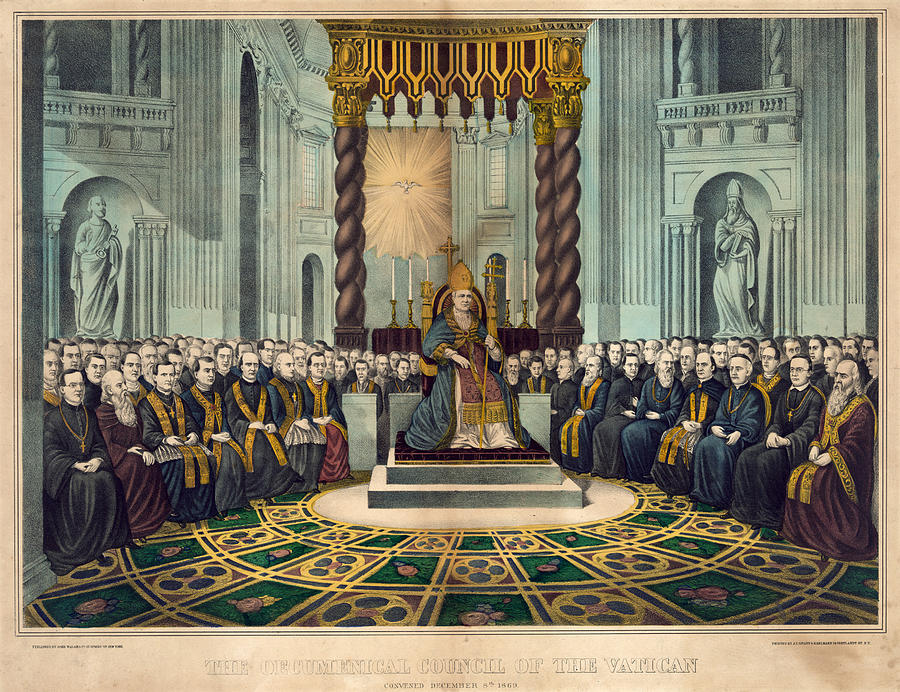
There was a time that it was more possible to call together representatives from all parts of the church to discuss difficult issues and come to a common agreement, but that is no longer possible. Between AD325 and AD757 there were seven ecumenical councils[1], councils that were called by the Roman emperor which tried to resolve various questions, at least within the empire, which were dividing the church.

“all the doctrinal definitions of the Seven Ecumenical Councils (councils which have always, and still do, receive the unqualified acceptance of both East and West) … An Ecumenical Synod may be defined as a synod the decrees of which have found acceptance by the Church in the whole world”[2]

One of the most essential products of the councils were increasingly detailed creeds[3] for the church, statements written in response to perceived heresies that were being taught, clarifying what the orthodox teaching of the church ought to be.

Because of the complexities of the different viewpoints, the increasingly detailed creeds were never able to entirely resolve the differences between the Latin speaking and the Greek speaking parts of the church leaving the church with very intense divisions in the aftermath of each of the councils. After the seven Ecumenical Councils, the divisions in the church had become irreconcilable and it is no longer possible to call a council in which all sections of the church would be able to have an agreement on critical theological issues. There have been various ecumenical efforts through the years, including the creation of the World Council of Churches, but such efforts have not been able to overcome those disagreements on critical issues.

This division has complicated the issue of when theological differences become heresies. The inability of the visible church to resolve such issues forces us acknowledge our dependence on Christ; that the Gospel is the good news about our salvation to be found in the grace of Christ – and not in His still fractured church. In the meanwhile, despite the visible fracturing of the visible church, we need to humbly acknowledge the mystery of the unity of the church in Christ.


[1] Orthodox Church of America. “The Councils” Volume I – Doctrine and Scripture, Sources of Christian Doctrine, The Councils www.oca.org/orthodoxy/the-orthodox-faith/doctrine-scripture/sources-of-christian-doctrine/the-councils; Keating, Karl. “The 21 Ecumenical Councils” Catholic Answers www.catholic.com/magazine/print-edition/the-21-ecumenical-councils. Protestants and Eastern Orthodox regard only 7 ecumenical council, while the Roman Catholic regards 21 ecumenical councils because the Roman Catholic Church regards Eastern Orthodox and Protestant Churches as “separated brethren”.

[2] Schaff, Philip (1819-1893) (Editor) Publisher: Grand Rapids, MI: Christian Classics Ethereal Library, “A select library of the Nicene and Post-Nicene Fathers of the Christian Church. Second Series. Volume XIV. The Seven Ecumenical Councils. For a summary of the seven ecumenical Councils, See Appendix H

[3] See Appendix I – Creeds of the Church

Observe

Read 2 Corinthians 11:1-15; 1 Timothy 4:1-4; 6:1-10; 2 Timothy 2: 14-26. What are the warning signs of “false teachers?”

Limits of theology

Dancing in the Kingdom- Table of Contents

Dancing In the Kingdom – Part 2 – The Kingdom Revealed – Chapter 13 – Distinctives within the body of Christ

The limits of theology

[Bible references: Isaiah 55:1-13; John 8:43;21-30; 41-48; Acts 1:1-11]

The church is the body of the incomprehensible Christ, and this incomprehensibility creates tension because many of us who are in this body think we understand different aspects of God. Somehow, we end up disagreeing on issues that each of us thinks should be clear to everyone else, resulting in us taking sides and dividing because: not only can’t we understand everything about God, but we are also subject to our personal human frailties (e.g., sins, particular inclinations and weaknesses), the cultures we live in and the languages we speak (which inform the way we interpret scripture) and the events around us (e.g., wars, revolutions, politics, etc.). Those frailties have led to a rather mixed history of how the church has lived into what it knows about the gospel. Sometimes we seem like the Indian fable about six blind men and the elephant,[1] we end up seeing God from such different places that we seem to be describing a different God.

Language may not determine thought, but it focuses perception and attention on particular aspects of reality, structures and thereby enhances cognitive processes, and even to some extent regulates social relationships. Our language reflects and at the same time shapes our thoughts and, ultimately, our culture, which in turn shapes our thoughts and language.[2]

Our culture and our language are inseparably bound together, they affect how we think and how we perceive the world and, particularly, they tend to cause misunderstandings when people from two or more different language/cultural groups communicate with each other.[3] In the case of the church, there were four major languages involved at the beginning: Aramaic, the local language of the Jews in Israel and the region to its east; Greek, the international language of the Roman Empire; Latin, the legal language of the Roman Empire; and Hebrew, the language in which the Old Testament was written.

The majority of the church first developed in the Roman Empire. While the legal language of the empire was Latin, the international language of the empire was Greek, and it was Greek culture that had been strongly adopted within the empire. Even the cultural influences of Plato, Zeno, Aristotle, and Epicurus persisted affecting the development of the church and its values.

Aramaic was the language of the “Church of the East” which developed primarily outside the Roman Empire. In addition to some isolation because of the language differences, it was further isolated by being outside the Roman Empire.

Even within the same people group, misunderstandings occur when people from one time period are interpreting information from an earlier time period. All these factors were in play at the time the church was forming. For example

  • The scripture from the Old Testament was written over a 1400-year time period with different authors using different literary styles.
  • As the church grew across the world, different cultural issues arose.
  • and the New Testament documents written about them were high-context documents but were being interpreted with low-context.[4]

There are also other issues creating internal tensions within the church. We also have a natural propensity to segregate ourselves into different groups. All our communities also experience cultural changes.

The game plan for spreading the gospel throughout the world didn’t follow any typical conventions. The people Jesus selected to be apostles did not receive any training in building organizations, neither did he tell them to plan for the long-term survival of the church that they were charged to begin building. The key instruction that they did receive was “wait,” that is, wait for the Holy Spirit. Jesus may have a master plan, but he only let them know (just as he lets us know) one step at a time. Naturally then, we respond to his revealed plan only one broken step after another and, as we do, we discover our need to lean on him as we work through our frailties and sin. The plan is and was for us to follow the Great Commandment and the Great Commission and the Holy Spirit. Not much detail, no written instructions, sometimes confusing, but that was the plan. Some would characterize the apparent plan as “Love people and tell them about Jesus.”


[1] All About Philosophy “Blind Men and the Elephant” www.allaboutphilosophy.org/blind-men-and-the-elephant.htm ; Saxe, John Godfrey. “The Blind Men and the Elephant” Poetry.com www.poetry.com/poem/101535/the-blind-men-and-the-elephant

[2] Burton, Neel. “How the Language You Speak Influences the Way You Think” Psychology Today www.psychologytoday.com/us/blog/hide-and-seek/201808/how-the-language-you-speak-influences-the-way-you-think

[3] White, James Emery, “the Greek, the Latin and the Hebrew” Crosswalk.com 2 Sept 2008 www.crosswalk.com/blogs/dr-james-emery-white/the-greek-the-latin-and-the-hebrew-11581208.html; Leveridge, Aubrey Neil, “The Relationship between Language and Culture and the implications for language teaching” TEFL.net Sept 2008 www.tefl.net/elt/articles/teacher-technique/language-culture

[4] High context communication occurs when people are in a shared environment with common values, history, etc. where many things are not said because it is assumed that the other person already knows and assumes those things as well. In low context communication, there is much less assumed about what the other person knows and so many more details are included in the communication.

Observe

Read Acts 1:1-11. When it comes to leading the church, what are the strengths and weaknesses of relying on the Spirit?

The context of theology

Dancing in the Kingdom- Table of Contents

Dancing In the Kingdom – Part 2 – The Kingdom Revealed – Chapter 13 – Distinctives within the body of Christ

The Context of Theology

[Bible references: Matthew 22:37-39; John 13:34-35; 15:1-17; Romans 12:3-8; 1 Corinthians 12; 13; Ephesians 4:11-16]

More than doctrine

Everybody has an opinion of some sort when it comes to ideas about God. That is, everybody practices theology. According to one classical definition, theology is “faith seeking understanding.”[1] The only question is. whether our theology is good or bad. That said, there are some who may question whether or not to make a big deal of theology because it seems to create such divisiveness and others think that we should just keep everything as simple as possible.

We were created by God with mind, body, and soul – and it is through all those means that we can come to know God. The formal field of study that we call “theology” has often been restricted to academia, focusing on the intellectual – the mind; but as beings created in the image of God it would be a mistake to restrict our theology to just our mind. It is through our whole being that we can come to know and be transformed by God. Jesus once said that this transformed people would be recognized not by their knowledge, but by their love. Although it is beneficial if our love is informed by our knowledge, love is expressed in its action. In fact, Jesus identified the greatest commandments as loving God and loving our neighbors. Therefore, the practice of following Jesus (aka discipleship) is something we practice in community.

Once we understand all this, that our understanding of God requires the effort of our whole being, then we can see that while theology may have an academic component, it is more than an intellectual exercise. In fact, our soul, or spirit, is the first place in our being to examine our theology. Our theology is lacking if our God’s love is not overflowing through us into the rest of our lives.

To evaluate what our overflowing love might look like, we can consider the descriptions we find for the “fruit of the spirit” as shown in Galatians 5 and in 1 Corinthians 13: love, joy, peace, patience, kindness, goodness, faithfulness, gentleness, and self-control, does not envy or boast, is not proud, rude or self-seeking, is not easily angered, takes no account of wrongs, takes no pleasure in evil, rejoices in truth, bears all things, believes all things, hopes all things, endures all things. We can also consider how we express our love through the various gifts of God that He provides each one of us for the purpose of building each other up in the faith: wisdom, knowledge, faith, healing, miracles, prophets, discernments, tongues and their interpretation, leadership, serving, exhortation, giving, mercy, helps apostle, prophet, pastor, teacher.

It is interesting that many non-Christians, even those with limited knowledge of the Bible or of the church, are able to critique Christians by contrasting Christians with Christ. They may possibly misunderstand Christ, but because they have been designed as image-bearers of God, even they have some basis to compare the behavior of others to Christ.

The whole of faith

Meanwhile, in this in-between time, even disciples of Jesus are affected by sin and our theology is subject to corruption. We misuse theology in various ways: sometimes using it as a tool to achieve something else such as gaining power or justifying bad attitudes (e.g., arrogance or hatred), sometimes by focusing on just the academic side while neglecting the spiritual or practical aspects; or sometimes neglecting the academic side and try to avoid the truth or complexities of theology and simply stop asking questions, preferring instead to yield to fideism, which can be described as the “exclusive or basic reliance of faith alone” [2]

A robust faith is not a blind faith, but rather a thinking faith, a faith with eyes wide open to the realities of life’s circumstances and the reality of God’s providence,[3] a faith that seeks God with our whole self: body, mind, and spirit. So, we should not ignore the academic side of our faith or our theology. The process of taking all the knowledge we have gathered about God and then using that to “build up into an organic and consistent whole all our knowledge of God and of the relations between God and the universe” is called systematic theology.[4]

The all-encompassing nature of systematic theology requires care. Scientific models are helpful in understanding natural phenomena but are limited in predicting future behavior because the models are only approximations of the phenomena they describe. Similarly, our systematic theologies are helpful in understanding the infinite God and his works, but we need to be aware of its limitations. One of those limitations is how our perceptions are influenced by our particular personality, our particular environment/culture, our particular language, and our particular historical context.[5]

The problem of the other

Ever since the creation of humanity, we have continually chosen to idolize ourselves and to not love God, which also meant we have chosen to not love others. This mindset then causes us to blame whatever problems we have on others or even to blame God. It is this sort of mindset that would cause the New Testament church to disconnect itself from its Judaic heritage, setting the church up for continued divisiveness in the future. So it is worth exploring what led to the church to the severing its Judaic roots.

We know that Jesus spoke of how scriptures – and he could only be referring to what we call the Old Testament scriptures – pointed to him and his ministry, and how he was the fulfillment of those scriptures. That would mean that Jesus’ ministry was a continuation of God’s love and grace as set out in the Old Testament. Later on, as the ministry of the church strongly expanded to Gentiles, the apostle Paul spelled out that the Gentiles in the church were like the branch of a wild olive tree being grafted into nurtured tree; the tree being the Jews that were in the church and whose roots went back to the Old Testament people of faith. Paul then warned the Gentiles not to become arrogant about any of the other branches that were broken off because God is capable of grafting the original branches back onto the tree.

As the ministry to the Gentiles proceeded and expanded, Christian Jews still met in the temple and the synagogues with the non-Christian Jews, increasing their ministry there even as many of the non-Christian Jews strongly resisted. But there were two events that would change the trajectory of the church.

In AD 66 the zealots started to revolt against the Roman government. The Christians in Jerusalem want to avoid getting caught up in the rebellions and moved to Pella, causing tension between the zealots and the Christians. After the rebellion was defeated by the Romans in AD 70, the temple was destroyed and the Jews were scattered, but now there was increased tension between the Christian and non-Christian Jews.

Later on, in AD 132, a zealot nicknamed Bar Kokhba (meaning “son of the star”) arose to start another rebellion. He, with the support of a prominent rabbi, declared himself a messiah. Now, the Christian Jews not only did not want to participate in a rebellion, but they had to refuse to acknowledge a messiah other than Jesus. And the zealots, who supported Bar Kokhba, declared Bar Kokhba as messiah, thus rejecting Jesus as messiah, which quickly led to a hardening of those non-Christian Jews against the church, making them more resistant than before to the gospel. When the Romans defeated the zealots, Jews were now banned on penalty of death, from entering Jerusalem.

After this point, when leaders in the church tried to reach the Jews with the gospel, they encountered hardened hearts. However, instead of the recognizing that it had been foretold that Jews hearts would be hardened until the time of the Gentiles was over, the leaders in the church now arrogantly hardened their own hearts and became increasingly anti-Semitic. This resulted in the church increasingly turning away from their own roots and thus becoming susceptible to increasing influence of Greek philosophy. This would create dramatic effects in the development of theology in such areas as the rejection of the human body and sexuality as evil and sinful, and the conversion of asceticism from a form of spiritual discipline to a rejection of the pleasures God created as good things.[6]

The limits of language

Early on, in church history, there was an attempt to overcome the problem of the language barrier in the church. It was thought that the church could be united if theologians across the church world could use a common theological language. This attempt in the 5th century, when the languages included Aramaic, Greek, and Latin as well as all the local languages, did make it easier to find solutions to theological problems, but the negative consequence was that differences in theological views became heightened, leading to what may be the inevitable schisms in the church.

Theologians believed that one faith has to be expressed in one language … Distortion of language, they believed, inevitably leads to distortion of the common faith … ‘Byzantine scholasticism’ emerged in the post-Cyrillian era. This shift had both positive and negative consequences. The positive ones were that theologians started speaking one language. This helped them to easier find solutions to theological problems … The negative consequences of language-centrism were that when theologians disagreed on terms or categories, the regarded their disagreements about theological formulas as essential theological difference. This became one of the most important reasons of the church schism in the post-Cyrillian era.[7]

We cannot approach any field of study as a blank slate. All of our particular factors contribute to which particular theological method people may choose to use. Charles Hodge identified three general classes of methods used within the field of systematic theology: Speculative, Mystical, and Inductive.[8] Given all of that, we can see that there can be many approaches to even framing the questions we might ask about God, never mind the types of answers towards which we may lean. Engaging in the quest of trying to understand the current multi-faceted state of the current church can be overwhelming and most people don’t have the time to study a typical church history book of 800-1000 pages. To make this task more bearable, the approach here will not be to present a comprehensive study but to develop an overview of the church by focusing on 1) the internal and external issues that affected the development of the church, and 2) the main questions that the church has asked and briefly sharing the different answers formulated by different congregations.


[1] Migliore, Daniel L. “Faith Seeking Understanding”  William B. Eerdmans Publishing, third edition. 1991

[2] Amesbury, Richard. “Fideism” Stanford Encyclopedia of Philosophy ©2016 plato.stanford.edu/entries/fideism

[3] Migliore, Daniel L. “Faith Seeking Understanding” William B. Eerdmans Publishing, third edition. 1991 (pp. 3-5)

[4] Bible Study Tools “Chapter III – Method of Theology” Bible Study Tools www.biblestudytools.com/classics/strong-systematic-theology/part-i-prolegomena/chapter-iii-method-of-theology.html

[5] Migliore, Daniel L. “Faith Seeking Understanding” William B. Eerdmans Publishing, third edition. 1991 (p.205) Confession of Jesus Christ takes place in particular historical and cultural contexts … our response to questions of who we say Jesus Christ is and how he helps us will be s shaped in important ways by the particular contexts in which these questions arise … all theology is contextual

[6] Dualism rejects the physical world as evil or not desirable. “Mystery of Wisdom.” (p. 166)

[7] Hovorun, Cyril. Studia Patristica Vol. LVIII, Volume 6: Neoplatonism and Patristics, Peters 2013.  Importance of Neoplatonism on Formation of Theological Language” (p. 17-28)

[8] Hodge, Charles, “Systematic Theology” (Chapter I: On Method) Eerdmans Publishing Company, (Chapter I: On Method) 1940

Reflect

How can love affect your ability to know someone?

Observe

Read John 15:1-17; Ephesians 4:11-16. How do these passages relate to each other?

Generous and overflowing shalom

Dancing in the Kingdom- Table of Contents

Dancing In the Kingdom – Part 1 – Shadows of the Kingdom – Chapter 3 – The image-bearers

Generous and overflowing shalom

[Bible references: Deuteronomy 30:9; Psalm 37; 65; 72; 92; Isaiah 9:6; John 10:10; 14:25-31; 20:19-23; Philippians 4:4-9]

The church has a stake in human flourishing. The challenge for the church is to define and promote human flourishing (which we might otherwise describe as human well-being, human happiness) in accordance with biblical teaching, to present and commend its alternative approach to human flourishing in the face of competing cultural visions, and to embody human flourishing in the presence of God amid a culture of death and destruction. Christian theology has a role to play in assisting the church to meet this challenge.[1]

“God made us: invented us as a man invents an engine. A car is made to run on petrol, and it would not run properly on anything else. Now God designed the human machine to run on Himself. He Himself is the fuel our spirits were designed to burn, or the food our spirits were designed to feed on. There is no other. That is why it is just no good asking God to make us happy in our own way without bothering about religion. God cannot give us a happiness and peace apart from Himself because it is not there.”[2]

Goodness, generosity and shalom all fit together. We begin with the premise that we are representatives of the Prince of Peace. Scripture is full of encouragement for us to live in peace because it is through shalom that much else flows, including goodness and generosity. Goodness flows out of the shalom which is concerned with the overall well-being of others and is necessarily linked to justice, mercy, and humility – and we are not to be content with helping God to usher in only the minimal amounts of justice, mercy into the world but the fullness of justice and mercy that stems from the overflowing goodness of God.

Our Creator and Temple-maker intended for us to enjoy his overflowing love and goodness. He provided us with a place of abundance where all our needs could be met, where He had a purpose for us as His stewards and His co-creators and where we could enjoy him and enjoy each other. This overflowing can actually be overwhelming when we consider the breadth, the beauty, the abundance, and the complexity of this temple he has provided. And we can marvel at the breadth, the beauty, the abundance and the complexity of the skills and abilities He has provided for us as his stewards and co-creators. Just look at what He has done and what we have done with what He has given us!


[1] Swain, Scott. “Psalm 19 and human flourishing” Reformation21 www.reformation21.org/blogs/psalm-19-and-human-flourishing.php

[2] Lewis, C.S. “Mere Christianity” Samizdat 2014 (p. 31)

Reflect

In what ways can the shalom of God flow over from our lives to the lives of others?

Observe

Read Psalm 37. How do we experience shalom when we see injustice?

The Temple Maker

Dancing in the Kingdom- Table of Contents

Dancing In the Kingdom – Part 1 – Shadows of the Kingdom – Chapter 2 – The God who created

The Temple Maker

[Bible references: Genesis 1-2; Exodus 26; 1 Kings 6; Job; Psalm 8; 95; 100; 104 and others; Proverbs 8:22-31; Isaiah 44:21-28; 45:5-12; 51:4-12; 55:6-13; Matthew 26:61; I Corinthians 6:19-20; Revelation 21-22]

There has been much debate about how to interpret the creation account. There have been various attempts to understand creation as physical processes that had occurred (over shorter or longer periods, depending on your analysis) because in our current cultural context we default to thinking of creation in physical, scientific terms. But what if (surprise! surprise!) we consider the biblical text to be a theological text instead of a scientific one, about functional origins and not about material origins.[1]

The cosmos can only function as sacred space once God has inhabited it and people in his image are there. God is declaring purpose for the cosmos as an ordered space for people and as sacred space where he will dwell. This is what defines the divine activity …Adopting and promoting a vision and mission statement will not change how the institution operates. But it articulates a purpose and identity that may not have been realized or present before and proclaims that as its purpose. Genesis 1 is doing something similar. It is articulating a purpose through a mission statement (people living out their designated role as the image of God) and a vision statement (seeing the world around us as sacred space where God is living among his people and being in relationship with them). .[2]

In the last few decades, research has uncovered much more about the culture in the Ancient Near East than ever before. It has been discovered that in Ancient Near East cultures, the Genesis account would not have interpreted the creation account in terms of physical processes but rather in terms of assigning meaning and purpose. So, as we read the Creation account in Genesis 1, on the first three days the spaces of light and dark, waters above and below, and the land are being assigned a purpose. The next three days the populations of those spaces are assigned a purpose: the sun and the moon and stars, the birds and fish, the land animals.

In this perspective, the story of creation is seen more as a story about the dedication of a temple, where the universe and the world were dedicated as a sacred space, a space where God would dwell with his people. Therefore, the seventh day is when God rested from the act of dedicating the earth, which would now be the place where He would now live with his image-bearers. If you read Genesis 1-2, you will see that, unlike the other days, there is no “there was evening and there was morning.” That is because we are living in the seventh day.

The completion of God’s temple would be later remembered by the seventh day celebration of the Sabbath. Although God’s temple was completed by the seventh day, it was not a time where God ceased to do everything. The still continuing seventh day is the time when the “temple” which is our “home” is completed so that God and we, as his co-regents, can settle in and do the things that our home was designed for. Jesus in John 5:1-7 clarified this idea where he explained, “My Father is always at his work to this very day, and I too am working.” Living into this sacred space would entail us taking part with God in his continual acts of creating and sustaining the universe. That is the perspective of Eve, when she gave birth to Cain, she recognized that “I’ve created a man with Yahweh.”[3]

In Genesis 2, the focus moves to the humans God created and how they were to function in that sacred space where the Garden of Eden is the center. Genesis 2 is also where God’s name, “Yahweh,” begins to be used. Genesis 1 introduces the God as the Creator of the universe whereas Genesis 2 introduces the God who in establishing a personal relationship with the people he created uses a personal name.[4]

The cosmos that God created was intended to be a temple, the place where He would meet with his people. The temple/creation imagery permeates and unites all of scripture from the first book, Genesis, to the last book, Revelation. The temple/creation theme shows up in places like in the stories of Noah, Moses, and Abraham, in the construction of the Tabernacle and the Temple, in Job’s dialog with Yahweh, in the poetry of Psalms[5], in prophecies of Isaiah, in the body Jesus and in us as his Body and finally in the depiction of reuniting of heaven and earth. Each instance shows its own unique aspect of the temple, so that when combined with each other, they show a more complete picture of how God meets with us and provides for us and what he has intended for us. We see a complex picture of the temple as a physical place in Creation and at the same time the temple is within us, inside the bodies of all of those who call on his name. In both those cases we can see the provision of God who 1) abundantly fills all of Creation in ways that exceed our imagination and exceed the capacity of any book to tell and, 2) abundantly fills us with His strength and His Spirit so that we can fulfill the desire He has for us to “cultivate and keep” the abundant place He has provided for us.

One of the benefits of considering only the theological aspects of the Creation accounts, or the why of creation, is that we don’t have to be as highly concerned about the how of creation, or the scientific/physical accounts of creation. When scientific creation accounts are proposed and are not perceived to be correct because they don’t seem to theologically fit, we don’t need to despair. It may be that the various proposed scientific explanations simply don’t theologically fit because they just don’t or because we just don’t understand just how they could theologically fit. We know that the sciences are limited and that theories will change as more discoveries are made. Sometimes those theories may seem to move closer or further from our limited theological understandings, but our theology is not constrained by whatever the current science may indicate. In the meanwhile, we are free to explore the science and wonder in awe and marvel at just how God managed to do it all while humbly admitting that we don’t have the mind of God and how much higher his ways are than our ways.


[1] Walton, John. “The Lost World of Adam and Eve,” Proposition 3, InterVarsity Press. 2015 Kindle Edition. pp. 35-45; Driver, Cory. “Commentary on Genesis 1:1-5” Working Preacher 10 Jan 2021 www.workingpreacher.org/commentaries/revised-common-lectionary/baptism-of-our-lord-2/commentary-on-genesis-11-5-5; Carlson, Reed. “Commentary on Genesis 1:1-2:4a 12” Working Preacher Sept 2011 www.workingpreacher.org/commentaries/narrative-lectionary/creation-by-the-word/commentary-on-genesis-11-24a-5; Throntveit, Mark. “Commentary on Genesis 1:1-2:4a; or 1:1-5,26-2:4a 1 Working Preacher 1 Sept 2011 www.workingpreacher.org/commentaries/narrative-lectionary/creation/commentary-on-genesis-11-31-21-4

[2] Walton, John. “Material or Function in Genesis 1? John Walton Responds” Biologos 3 Apr 2015 biologos.org/series/reflections-on-the-lost-world-of-genesis-1-by-john-walton/articles/material-or-function-in-genesis-1-john-walton-responds

[3] Friedman, Richard Elliot, Commentary on the Torah, Harper Collins, 2003 Location 6942 of 37412

[4] There will be more discussion on that name in “Hope in the Brokenness,” Chapter 4

[5] Muran, Alexej. “The Creation Theme in Selected Psalms” Geoscience Research Institute 1 May 2015 www.grisda.org/the-creation-theme-in-selected-psalms

Reflect

Does viewing the universe as a temple affect the way we look at it?

Observe

Read Proverbs 8. This proverb personifies God’s wisdom. Read how God is describing how His wisdom is built into the very framework and fabric of this temple we call Creation. How can we sense God’s presence with us because of how His wisdom should be speaking to us?

Playful and orderly

Dancing in the Kingdom- Table of Contents

Dancing In the Kingdom – Part 1 – Shadows of the Kingdom – Chapter 2 – The God who created

[Bible references: Genesis 1; 3:6; Job 26:7-14; Psalm 102:25-28; 104:26; Proverbs 8:30-31; Jeremiah 9:24; Zechariah 8:4; Romans 1:18-32; 5:12-20]

It would be more conventional to title this section, “Creative and Orderly,” but creativity is just a part of broader category of play. Although many experts disagree on how to define play[1], we may think of play as activity which is typically not productive and is done only because one wants to do it and is usually a fun activity involving other people and will typically help people bond together.

When it comes to the Creation, God did not have to create anything. God did not need the universe or anything in it – not the planets, nor the stars, nor the creatures. God created the heavens and the earth for the delight of it, and He did it because He wanted to share heaven and earth with his image-bearers. This spirit of playfulness is reflected in many of God’s creatures[2] including Leviathan and humans. God’s playfulness also shows up in other interesting places in the Bible.

When Job complains about the difficulties he is going through, God seems to admonish him by “putting Job in his place” and citing all the ways in which God’s ways are higher than Job’s ways. But God does not follow through with any discipline of Job but rather begins the process of restoring Job’s fortunes. In response, Job confesses, “I spoke of things I did not understand … I retract my words and I repent in dust and ashes.” … And yet, Job changes an interesting behavior – he no longer rose early in the morning to offer burnt offerings for all of his children, worrying that “perhaps they have sinned.” Job seems to have understood what Shams-ud-din Muhammed wrote later on:

the difference between our life and a saint’s is that the saint knows that the spiritual path is like a chess game with God and that God has made such a fantastic move that the saint trips over joy in surrender whereas we think we have a thousand serious moves.[3]

Another instance of playing occurs in Mark 6, when Jesus takes a late-night walk on a very windy lake, walking as if to go by his disciples. Of course, they were initially terrified, thinking they were seeing a ghost. But he got in the boat and the waters calmed down. He could have calmed the waters down before the disciples started to go on the lake. He could have chosen another way to make his point … but he decided to do it that way.

God’s creativity can be seen within the created world in the extremely diverse types of plants and animals: differences in colors and shapes; different ways of digesting food; different ways of moving and observing the environment to name a few. The creativity we see is awesome. From out of nothingness, from no previous model, God created a whole system of particles and energy fields that interact with each other to form the building blocks of subatomic particles which are used to form atoms, which are used to form molecules of all sorts of complexity, which are then used to form planets and stars (actually, the fusion reaction in stars is used to create larger molecules from smaller ones). And at least one planet was used to create living things like plants and animals in all their complexity and then those living things were used to create communities (ecosystems) that allowed living things to thrive and flourish.

Yet, within the overwhelming creativity displayed within all the diversity of living things there is an order that is imposed by natural processes, sometimes called scientific laws. Christians, like Francis Bacon, pursued these laws as an extension of God’s moral laws in the universe, which then led to the development of modern science.[4] It is within science that we examine orderly processes at work that we call the natural laws which describe how all physical things behave: like the forces of gravity, electrical forces, etc.

There is no disobeying these natural laws. If you think that you can try to violate them, you’d be wrong. For instance, if you are on earth and stand on the top of a table and then jump off with the assumption that you will not be subject to gravity but rather float around without falling to the floor, you’d be wrong. You can’t violate gravity. You can try to set up circumstances that will cause other forces to come into play – such as airplanes do when they use aerodynamic forces that counteract gravity – but you simply can’t violate gravity, and there will be consequences if you try.

By observing the laws of the created order, we can ascertain some aspects of the character of God. The natural laws that govern how things are supposed to behave reveals a God who expects things to behave, and that violations are not tolerated. But when image-bearers were brought into the world there was a new level of complexity added to this physical model constrained by natural, physical laws. Because image-bearers were created to reflect God’s transcendence, those image bearers were given moral freedom, the ability to accept or reject God’s rule, the ability to choose to be good or not good. And just like attempts to violate physical laws have consequences, so do attempts to violate moral laws. However, the framework that provides order is also the scaffolding for creativity and play. The order that allows us to study God’s ordered creation also allows us to observe the activity of the living God when He does the unexpected.


[1] Edgar, Brian. “The God Who Plays: A Playful Approach to Theology and Spirituality” Chapter 5: Theology: Ludic(rous) Thinking, Theories of Play Cascade Books 2017 (e-book)

[2] Yu, Alan. “Which animals play, and why?” WHYY 15 Aug 2019 whyy.org/segments/which-animals-play-and-why/

[3] Hafiz (or Shams-ud-din Muhammad Tripping over Joy (translated by Daniel Ladinsky) (c. 1320-1389) wrote about God as his Friend, the Beloved, the Beautiful One. from reference by Edgar, Brian “The God Who Plays: A Playful Approach to Theology and Spirituality” Chapter 4: Spirituality: Playing with friends, Competing with God

[4] Harrison, Peter, “Christianity and the rise of western science” ABC Religion and Ethics, 8 May 2012, www.abc.net.au/religion/articles/2012/05/08/3498202.htm; Armstrong, David, “Christianity Crucial to the origin of science,” Patheos, 18 Oct 2015, www.patheos.com/blogs/davearmstrong/2015/10/christianity-crucial-to-the-origin-of-science.html; Hannam, James. “How Christianity Led to the Rise of Modern Science” Christian Research Institute www.equip.org/articles/christianity-led-rise-modern-science/

Observe

Read Romans 1:18-32.  Reflect on how natural laws reflect the character of God. Based just on natural laws, what kind of character does that reveal about God?

Timeless and in time

Dancing in the Kingdom- Table of Contents

Dancing In the Kingdom – Part 1 – Shadows of the Kingdom – Chapter 2 – The God who created

Timeless and in time

[Bible references: Psalm 102:25-29]

Closely related to the paradox of how God is both transcendent and immanent is how God is both timeless and in time. Many scholars in philosophy and science have trouble trying to resolve questions such as: How can God even have both attributes? Did God create time or is God himself confined by time? Is time static such that the past, present and future all exist simultaneously, and God sees them all at once, or is time dynamic such that the future does not yet exist – and therefore God does not yet know it?[1]  

It is not practical to try to summarize all the arguments with all their nuances here. For our purposes, we will not try to resolve the many difficult theological/philosophical issues[2] but, as Psalm 102 does, accept the finite mortality of our life on earth and the fact that God is both with us in the midst of our distress yet also exists outside of that.


[1] Closer to Truth “Is God Temporal or Timeless” This is a series of interviews showing different views on the subject of God’s timelessness. Closter to Truth www.closertotruth.com/series/god-temporal-or-timeless

[2] McKnight, Scott. “Is God Timeless” Patheos, Jesus Creed, 23 Feb 2013,  www.patheos.com/blogs/jesuscreed/2015/02/23/is-god-timeless/; Craig, William Lane. “God, Time and Eternity” Reasonable Faith, www.reasonablefaith.org/writings/scholarly-writings/divine-eternity/god-time-and-eternity/; Ganssle, Gregory E. Review of “The End of the Timeless God by RT Mullins The Gospel Coalition,  themelios.thegospelcoalition.org/review/the-end-of-the-timeless-god; All About God “God is Infinite Bible Verses” All About God www.allaboutgod.com/god-is-infinite-bible-verses-faq.htm

Observe

Read Psalm 102.  Reflect on how both anguish and hope are expressed. What speaks to you from that Psalm? How does God’s unchangeability provide hope in the midst of difficult circumstances?

Transcendent and Immanent

Dancing in the Kingdom- Table of Contents

Dancing In the Kingdom – Part 1 – Shadows of the Kingdom – Chapter 2 – The God who created

Transcendent and Immanent

[Bible references: Genesis 1; Psalm 139:2-3; Isaiah 6:1-5; 40:21-31; Jeremiah 23:23-24; Matthew 10:29-31; Acts 17:27; Romans 8:29; Philippians 2:5-11; Colossians 1:17; Hebrews 1:3]

Genesis tells us there was a time when the universe, the heavens, and the earth, began to exist. Before that moment of time, they did not exist – but before that beginning there was God and then God created the universe. From that starting point, we can see the transcendent nature of God. He was not part of the universe but apart from the universe. Fortunately, we are not simply left with a God who is unreachably “out there” leaving us to fend for ourselves. In some incomprehensible fashion, while God is “out there” existing outside of Creation, He is simultaneously inside Creation … everywhere at once.[1]

This paradox of God’s transcendence (existing outside of Creation) and immanence (existing everywhere within Creation) has sometimes bewildered many who try to examine it through sheer logic.

God is other and set apart from everything else, that he is in a class by himself. God is not just quantitatively greater than us, but qualitatively different in his greatness. He is transcendent, infinitely above or beyond us. The true God is distinct, set apart, from all that he has made as the only truly self-sufficient Being. All his creatures depend on him; he alone exists from within himself. “And the true God is distinct, set apart, from all that is evil. His moral perfection is absolute. His character as expressed in his will forms the absolute standard of moral excellence. God is holy, the absolute point of reference for all that exists and is good. Across the board he is to be contrasted with his creatures. At heart he is a glowing-white center of absolute purity … But thankfully for us, God is not just transcendent; he is also immanent. Simply put, God is near. God is wholly present with and active in the created order. God is near us, present with us, active on earth and involved in our world. He is present and active in nature, in history, in our lives. He acts in this world and dwells with his people … Both truths must be affirmed. The two ideas must be kept together in biblical balance. Only Christianity has the right mix. Pantheism denies God’s transcendence. Deism denies God’s immanence. Only Christianity affirms both, especially as seen in the incarnation. [2]

As we unwrap the significance of this paradox, we discover many interesting attributes of God. Here are a few:

Regarding God’s Transcendence

  • God’s existence apart from creation, and apart from the brokenness of the world is described as his holiness. This holiness is so profound that mortal, sinful people (as we all are) could not stand to be his presence.
    • God’s omnipotence is seen in his ability to not only create the universe, but in his ability to sustain it.

    • God’s omniscience is seen in his knowledge about the hairs on our head, our everyday actions and even in our destiny.
  • God is omnipresent, present everywhere all at once.

Regarding God’s Immanence

  • Although God is apart from the universe, He is the one who holds the universe together.
  • God is present throughout the earth and available to all who call for him and even to those who are not calling for him.

In the chapters ahead, we will examine many of the ways God has inserted himself into the middle of creation and even address how God is involved in ways we can’t even imagine.


[1] Compelling Truth. “What is the meaning of ‘perichoresis’?” Compelling Truth www.compellingtruth.org/perichoresis.html

[2] Meuhlenberg, Bill. “On God’s Immanence and Transcendence, Culture Watch, 5 Aug 2013 billmuehlenberg.com/2013/08/05/on-gods-immanence-and-transcendence . The first portion is a quote from Thomas Trevethan

Reflect

If you’ve had a chance to look at the stars at night or at large landscape scene that’s miles long, what goes through your mind? (e.g., Getty Images, “Stars in the sky”; Fine Art America, Landscape photographs fineartamerica.com/art/photographs/landscape )


Observe

Read Isaiah 40:21-31. How does knowing s knowing Yahweh give us hope?

Interlude

Dancing in the Kingdom- Table of Contents

Dancing In the Kingdom – Part 1 – Shadows of the Kingdom – Chapter 1 – Prelude

Interlude

[Bible references: Psalm 19]

As I was working one warm summer night at a convenience store with the door open, it was not unexpected to see a moth fly in through the door. Normally, moths are attracted to light sources, but this time the moth was attracted to the white top of a garbage container. The moth was distracted by the light reflected off the garbage container. That describes a lot of human behavior; we get distracted by the pretty garbage.

Since the time of Adam and Eve we’ve had the temptation to place ourselves at the center of the universe, dismissing the idea that we did not create the natural beauty of the world around us but that we can possess and control it ourselves, that we are the masters of all we see. We are tempted to dismiss the reality that we are part of a universe we did not create with the idea that we can define the universe which we think revolves around us.

In the meantime, there is a story that began long ago when God brought into being creatures made in his image, a story about his plans for those creatures, plans for them to fill the earth and making the whole earth a place of love and goodness, but a place where that love and goodness would be disrupted by our rebellion. Fortunately, that disruption did not deter God from continuing his plans for his image-bearing creatures and that story is still in the making. That story is now our story.

What can get confused is that this story is contained in the Bible which is often presented as a disconnected story. The Old and New Testaments of the Bible can seem disconnected because of the cultural barriers between us and the testaments. Some people even think the God described in the Old Testament is different from the God in the New Testament.

That disconnect is exasperated by the long and messy history of the church. The church seems very divided on how to interpret those writings and how to live into them, leaving us with a confusion of various interpretations and practices that seem to contradict one another. How is one supposed to make sense of it all?

However, it is possible to obtain a clearer understanding of how both Testaments make one cohesive story, a story into which we can fit. When we see how the unified story than runs from Creation to Revelation, we can then see how we, as part of God’s church, are intended to participate in that story. God did not need to create us or the universe, He did it out of a desire to share his love and delight. God’s creation was more an act of play than of work and He desires that we actively play with him, if you will, to dance with him in His Kingdom.

The Kingdom Dance is not meant to be a solo effort, we are to dance with God and with his people. To that end, while this book can simply be read as a solo exercise, there are additional ways to engage with the material.

  • Biblical references are provided extensively through the book. They are there to support the text. If you read them, particularly the shorter passages, take the time to slow down and let God the Spirit speak to you. The Bible has been described as ancient Jewish Meditation Literature.[1] It is best read when you give yourself time to absorb it.
  • There are extensive footnotes throughout the book. Whenever possible, I have provided hyperlinks to online materials to make the additional materials easily available to you. If you spend time investigating the footnotes, you will notice that I am not drawing from only one Christian tradition, but from a variety of them, allowing the richness of the different traditions to form a more complete story. To form a more complete story I also, particularly in the beginning, will use materials from the “Second Book of God” that is, book of Creation.[2]

“God has, in fact, written two books, not just one. Of course, we are all familiar with the first book he wrote, namely Scripture. But he has written a second book called creation.”[3]

  • For those who are not practiced in studying the Bible, Appendix A gives a summary of techniques that could be used to help understand scripture. This may prove useful for understanding when you study the Biblical references given throughout this book.
  • Reading the material with a group can make the most impact. There are questions at the end of each chapter that ask you to reflect on the material and then read related biblical passages to think more deeply about various issues. These exercises and questions will help you engage with the material by first asking you to think about how each section applies to your life and secondly to share your thoughts with others in the group so that together you can more thoughtfully “Enter the Dance” with God, with all the others that have come before, with those that are coming now and with that will continue to come until Heaven and Earth are reunited.
  • Finally, the best participation will be not to just read and reflect, but to dance the Kingdom dance with God. Part 3 of this book will suggest ways to take part in his activity in bringing healing to the world he loves, broken now but to be finally and fully restored when He rejoins heaven and earth.

The Bible is a complex collection of literature, using many literary styles and techniques and it can be difficult to understand some parts, particularly when one part seems to contradict another. I have found a useful principal in studying the Bible which I call “Conflicts are Clues” which says that any apparent conflict or confusion in Scripture should be handled as clues to look further instead of thinking that the conflicts create contradictions which reduce the integrity of the Bible.

In our age, many regard science and theology to be in conflict. In years past, however, the issue was not about conflict but about which discipline rules over or undergirds all the other disciplines. These ideas were expressed in ways such as “theology is the queen of all sciences,” “math is the queen of all sciences,” “philosophy is the queen of all sciences,” “philosophy is the handmaid of all sciences.”

The biblical perspective is that God speaks to us both through two books, the book of Creation and the Bible. Theology’s main goal is to understand spiritual reality and science’s main goal is to understand physical reality, but both fields can inform the other about the nature of God.

This principle of “Conflicts are Clues” applies not just to the “First Book of God” (that is, Scripture) but also to the “Second Book of God” (that is, Creation) which is practiced by the testing and revisions of theories, but also between the Two Books. During the course of history, the study of the Two Books got separated and some of those in science rejected Scripture and some of those who were Christian rejected science, leaving conflicts unresolved as contradictions. But moving forward, this does not prevent us from considering apparent conflicts between the books as clues to be investigated further.


[1] Bible Project “Ancient Jewish Meditation Literature” Bible Project bibleproject.com/explore/video/bible-jewish-meditation-literature-h2r/

[2] Rusbult, Craig. “How should we interpret the Two Books of God, in Scripture & Nature” American Scientific Affiliation www.asa3.org/ASA/education/origins/two-books.htm

[3] Bacon, Francis. “The Two Books of Francis Bacon of the Proficience and Advancement of Learning, Divine and Human.” The First Book. Section.VI.Paragraph.16 1605

Observe

Read Psalm 19. This Psalm captures a response to what Francis Bacon called the two books of God:  the Book of Creation and the Book of Scripture. How do you respond to the “two books”?

The paradox of authority

Dancing in the Kingdom- Table of Contents

Dancing In the Kingdom – Part 1 – Shadows of the Kingdom – Chapter 1 – Prelude

The paradox of authority

[Bible references: Jeremiah 29:7; Matthew 18:16-20, 21:22-24; 28:16-20; Romans 13:1-3; 1 Corinthians 2:6-13; 13:9-11; 1 Timothy 3:1-12; 1 Peter 2:12-14]

On the one hand, we consider scripture to be inspired by God and therefore to be authoritative and a means by which God can speak to each of us. On the other hand, scripture was determined by the operation and traditions of the church because the church, as the Body of Christ was given the authority to preserve, teach and preach God’s Word.[1] This process creates a tension concerning authority when there is an apparent conflict between the authority of scripture and the traditions of the church. One of those conflicts resulted in the Protestant Reformation when the Reformers, seeing the corruption inside the Roman Catholic Church, wanted to place the Bible’s authority over the traditions of the Church.[2]


[1] Terry, Tom. “The Power and the Authority of the Church” Preachitteachit, preachitteachit.org/archives/12186; Uttinger, Greg “The Power and Authority of the Church” Chalcedon Foundation, chalcedon.edu/resources/articles/the-power-and-authority-of-the-church

[2] History.com “The Reformation” History.com, www.history.com/topics/religion/reformation

Reflect

When you assemble a gathering of imperfect Christians, they will make an imperfect congregation. And yet, as a part of the Body of Christ, they have the authority to preserve, teach and preach God’s Word. In our current day, many people are dissatisfied with the organized church. Why do you think this is?

Observe

Read Matthew 28:16-20; Romans 13:1-3. What do we do if there is a conflict between the authority of the government with our authority as Jesus’ disciples to make disciples?

Patterns of love

The young women will dance for joy, and the men—old and young—will join in the celebration. I will turn their mourning into joy. I will comfort them and exchange their sorrow for rejoicing. (Jeremiah 31:13, New Living Translation)

Dancing in the Kingdom- Table of Contents

Dancing In the Kingdom – Preface

Patterns of love

[Bible references: Exodus 34:6; Numbers 14:19; Deuteronomy 4:37; 5:10; 6:5; 7:8-9; 10:12, 15; 13:1-4; 30:6,16-20; 1Kings 8:23; Nehemiah 9:17, 32; Psalm 17:7; 23:6; 33:18; 36:5; 103:1-17; Lamentations 3:22, 32]

The theme is love

The hardest thing to understand is the one thing we need to understand for the world to be understandable, to make us understandable, and it provides the themes for what we write the most poetry and songs and fiction about. And it’s even the hidden feature behind many non-fiction books.

We have this desire to express love and be loved but most of the time we are confused about what love actually is. We sometimes get analytical about it but only to wind up with a mix of

  • it’s an emotion that happens to us,
  • it’s something we choose to do,
  • we just fall in it,
  • we have to grow into it

We can’t pin it down, but it’s so much of who we are that we end up writing stories about it. The interesting thing about those stories is that we are creatures who desire to love and be loved but we all seem to be broken when we try to give and receive that love.

That brings us to another thing that seems so hard. Most of us are aware of this thing called “the Bible” or “the Holy Bible” but there seem to be confusing things about that Bible that seem to lead to many ways of trying to interpret it—and if “experts” can’t agree about it what chance do most of us have?

The Bible is about love as well, but it doesn’t get analytical about it, it basically just tells stories:

  • stories about God and the creatures he designed for love,
  • the Kingdom he desired to build with them,
  • how that love got broken,
  • and how God put a plan in place to restore that love and restore His Kingdom.

From the beginning, the Bible lays out patterns of all the practical ways to live out the Christian faith today. These patterns can be followed through the Bible itself as well as through church history. At one level, those patterns make it possible for the average reader to discover the Bible’s basic meanings while, at another level, scholars can discover the Bible’s richly intricately woven literary text and its patterns of clues and links that can lead to deeper understandings of God, of His Creation and of us.

The goal is of this book is to allow a more average reader to begin to uncover some of the literary richness of the Bible and see how the patterns laid out in Genesis trace not just through the rest of the Bible but also through church history and even provide guidance for us to live today.

Once we begin the process of finding pattern and discovering their meanings, we can discover that God of Creation has provided abundant patterns that could fill an encyclopedia, more than enough to fill our lifetimes. The full complexity of who God is, of His Creation and who we are is beyond our grasp, but He created us to be His Friends and the Stewards of His Creation. We can look forward to a joyous eternity of discovering and living out all He has laid out before us.

For people who want to love

Many of us look at the Bible and we can love some things … but other things are not so easy. Most of the time we find it easy to love Jesus … most of the time. But some things that the apostle Paul writes about? And the Old Testament can be tough; some things are so violent and there are those religious practices that we can’t relate to.  Are they even relevant?

How are we to understand how the apparent conflicts in the Bible: the stories of an angry God in the Old Testament and the merciful Jesus in the New Testament, the violence in the Old Testament and the message of peace in the New Testament; a story of creation that doesn’t seem to match the findings of science; the meaning of the laws in the Old Testament when the New Testament tells us we are not under the law; why Christianity of the New Testament seems so disconnected from our Jewish roots in the Old Testament.

And then, if we can get by all that and learn how to love the Bible, how do we move beyond that and love the church when so many people over so many years seemed to do so many wrong things. And even if we manage to love some of our people in the church, all those other people in the church are hard to love. It doesn’t help that over the years it has seemed that the church has divided up into so many denominations that we can’t even count them never mind trying to get to the point where we could love them.

On top of all this, who has the time to do all the reading to put all this together enough so that we can understand how the processes God’ started with image-bearing creatures in Genesis follow through to Revelation and then through church history to the processes and problems we can follow today.

From a writer who loves

More than 45 years ago, I was, in one moment, in such a bitter spirit that my brother warned his Christian friends to stay away from me, then in another moment I found myself sneaking into his room to start reading some of my brother’s books like Basic Christianity, Mere Christianity, Knowing God, and Evidence that Demands a Verdict. Somewhere in that reading my heart softened until I acknowledged Jesus as my Lord. Somewhere in that reading I also seemed to grasp that the story of Jesus began in Genesis and that the Old and New Testaments made a complete set.

In my first year as a Christian, I found myself in a small group that took an entire year to work their way through the four-page book of Philippians because Philippians seemed to be a portal to many other parts of Scripture and also to their lives. Also, in that first year (in fact, the first semester of that year), I had a Sunday School teacher who assigned a five-page writing assignment on one of the attributes of God. I didn’t know any better about how unusual all of that was. I just soaked it all in.

Since then, I’ve had the opportunity for more than 45 years to serve the church in different ways including church governance and teaching different levels of Sunday School and Bible studies. I was ever curious to learn and to read about the Bible and the church because to me it always seemed that there must be a whole story to connect from Genesis to today even if I didn’t know all the pieces.

It seemed like such a large task. I also had a large problem which I will share later in the book. As we all know, the ones you love the most can hurt you the most. And so, in the reality of church family, as in all families, there is ample opportunity to get hurt. It is in the processing of that hurt that gave me a chance to learn how to truly love the church.

The impetus for this book started in 2017, when I participated in a 9-month (12 if you include the pre-class summer reading) journey in theology. The course was designed to provide, through group discussions, readings and practice of the spiritual disciplines an

“understanding of the scope of the Good News of Jesus Christ: By his death and resurrection, his renewing his people and the world. We want participants to see how their individual faith stories are part of the larger story of God’s redemption so that they find new freedom and boldness to serve the church and to engage every aspect of culture.”[1]

The intensive course required 4000 pages of reading, but I even read more. I also had the desire to bring this kind of knowledge to others who did not have the time for such expansive reading. It is therefore, the intention of this book to provide a manageable way for the average person to explore breadth and continuity of the biblical story, how that story has been expressed by the church through the years and how our individual stories can fits into that original story, so that we can look forward to participating with God in bringing His kingdom into the world.

This book can be read at different levels. To make this book more accessible, most theological terminology is minimized while at the same time terms that are commonly used (e.g., church, bible, etc.) are explained. People who have less background or have less time can get all the essential information by simply reading through the text without using footnotes or appendices. Those who have more background or have more time can explore the Bible references, appendices and more than 500 footnotes. Again, to make the book accessible, the footnotes point to online resources whenever possible.

For deeper exploration, discussion points are available at the end the chapters which have thought provoking questions designed for group study, challenging readers to engage scripture and their own thoughts and to share thoughtful responses within a group. This approach recognizes the value we have as interdependent parts of the Body of Christ and the value we each have as creative and capable image-bearers of God.

There is also a journal available, Dance Steps, for a day-by-day closer reading of the book and how it may apply to your life.

I bring no special academic credentials to this project. I do bring a love of the church, of teaching, and of reading widely. The research needed to create even this short book is shown by the extensive footnotes referring to experts from many different fields such as biblical studies, ancient near east languages and cultures, linguistics, church history, anthropology, psychology, science, Judaism, philosophy, etc.

I love the Bible, the church and the One who gave us both. I love reading, and teaching and the One who gave me both abilities.


[1] The class, called Brooklyn Fellows, was offered by a church network, Resurrection Brooklyn in Brooklyn NY. Special thanks to Marc Choi who led the class and my fellow students who gave their time and attention to all the necessary reading and gave their input and questions. The journey of the church network that gave rise to Brooklyn Fellows has ended, but God continues his work through those people.

The Impossible Story

The Impossible Dance – Table of Contents

The Impossible Dance – Chapter 1 – Mystery and Confusion

A few thousand years ago, someone began writing a story, a different story than the others in circulation at the time. Those other stories were about gods who, except for being immortal, acted just like the humans with all their faults and shortcomings. And those stories headed nowhere. Nothing got better. But this new story was not about many gods but one God. This new story explained that even though things were originally good, there is a mess now, but there is a plan to make it better.

Intriguingly, although this story was begun by one human author, the story would continue to be written by many other human authors, different authors who spoke different languages and who lived at different times over the course of 1500 years. What held it all together was the divine author whose Spirit was breathed into each human author. What began as a set of writings by one human author, eventually became a book, a literary masterpiece with common themes, but also with complex literary devices, inter-textual references, poetry and songs, and different kinds of narratives about events before the writers lived, or about events witnessed by the different writers, or prophetic narratives about God’s judgments and His plans in either the immediate or far-off future.

This long, complex story told in these many texts revealed a God who has remained faithful despite our distracted and discontented ways.  These texts were compiled into the book we now call the Bible, divided into sections we call the Old Testament and New Testament. Sadly, for many people, the Old and New Testaments of the Bible can seem disconnected. Some have even proposed that the God described in the Old Testament portion is different from the God in the New Testament. The apparent disconnection is partly due to the issue of the cultural barriers between us and the Bible, particularly, the Old Testament.

Unfortunately, there is a further disconnect we also need to address.  Between us and the biblical writings is the long and messy history of the Church. The Church seems very divided on how to interpret those writings and how to live into them. It is downright confusing to sort out all the various interpretations and practices that seem to contradict one another.

Another area of tension for many is what is perceived to be a conflict between science and theology. In years past, however, the issue was not about conflict but about which discipline rules over or undergirds all the other disciplines. These ideas were expressed in ways such as “theology is the queen of all sciences,” “math is the queen of all sciences,” “philosophy is the queen of all sciences,” “philosophy is the handmaid of all sciences.” Regardless of whether we seek truth through science and/or theology, God is the author of both Creation and the Bible, God speaks to us both through both books. Theology’s main goal is to understand spiritual reality and science’s main goal is to understand physical reality, but both fields can inform the other about the nature of God.

Prelaunching Two books

An Invitation

This blog introduces a pair of books which are now in the last stages of progress and is an invitation to offer constructive criticism during the stages of the draft’s editing.

The book, Dancing in the Kingdom is the academic version with appendices and footnotes and with an accompanying workbook with questions. The book, The Impossible Dance, is the easier-to-read version without appendices or footnotes and with questions at the end of each chapter and is also somewhat condensed.

Let me know what’s confusing, enlightening, misspelled, needs explanation, what you like or don’t like etc. This blog will roll out the books one section at a time – sometimes 2-3 blog postings in a day – 3 days a week. I expect the whole process may take approximately a year, leaving plenty of time for thoughtful comments and review and seeing other people interact with the material.

The easiest way to see the books may be to go the Contents page for each book where there will be links to each of the posted sections. For more information about the book please see “About the Book”

I welcome your thoughtful comments!