Our relationships

Dancing in the Kingdom- Table of Contents

Dancing In the Kingdom – Part 3 – Dancing in the Kingdom– Chapter 14 – Remembering our creation

Our Relationships

[Bible references: 1 Peter 4:7-11]

All of these activities are done in context of our relation to God, to each other, and to our land. God has created us in His image, in the image of a triune God in which Father, Son and Holy Spirit exist as three persons united into one. Within that framework, God created us as male and female, each created as creatures made in God’s image yet different from and interdependent upon each other. When God made a woman for Adam, He specified that the woman would be an ‘ezer kegnedo,’[1] a strength corresponding to him. God created us from the dust of the earth, so although we are stewards of the earth, we are also dependent on the earth. In the earth, God has provided for us the resources we need to do our tasks. In all these relationships, God has intended that we are to live in unity with Him, with one another and with our environment.

Over time, our unity in all these areas got more complicated as our numbers grew. We needed to create organizations which necessarily became more complex as our societies grew and as our collective impact on the earth became more substantial. We needed extra discipline to maintain our relationship with God. We also needed to develop more skills in diplomacy, administration, and hospitality as we deal with more and different people. We needed to pay closer attention to the effects of our culture on the earth and its creatures to minimize the damage from so many people using our physical resources.

All of our work, our stewardship, is intended to have a direction, to bring maturity, fruitfulness, and growth to God’s work. The work we were charged to begin in the Garden of Eden was designed to end in the filling and subduing of the earth, in the cultivation of the whole earth where heaven and earth overlap so that work and worship are the same thing.[2]


[1] God’s Word to Women. “Ezer Kenegdo” God’s Word to Women godswordtowomen.org/ezerkenegdo.htm; Francois, Mark Steven. “(Ezer Kenegdo) in Genesis 2:18” Between the Perfect and the Doomed markfrancois.wordpress.com/2013/07/22/%D7%A2%D6%B5%D7%96%D6%B6%D7%A8-%D7%9B%D6%B0%D6%BC%D7%A0%D6%B6%D7%92%D6%B0%D7%93%D6%B4%D6%BC%D7%95%D6%B9-ezer-kenegdo-in-genesis-218/

[2] Huber, Dave. “Avodah Word Study” EFCA Today Summer 2012 www.efcatoday.org/story/avodah-word-study

Observe

Read 1 Peter 4:7-11. What are we charged to do?

Mystery of the sacraments

Dancing in the Kingdom- Table of Contents

Dancing In the Kingdom – Part 2 – The Kingdom Revealed – Chapter 13 – Distinctives within the body of Christ

Mystery of the sacraments

[Bible references: Matthew 26:17-35; Exodus 30:17-20; Mark 1:1-11; Acts 2:38, 41-42; Romans 6:1-23; 1 Corinthians 11:17-34]

Defining Sacraments

Sacraments, the rituals of belonging

“The language surrounding ‘sacraments’ did not develop in the church for some time. We hear of a ritual of baptism in the Christian community of the Acts of the Apostles, and of the ‘breaking of bread’ (Acts 2:38, 41- 42). These celebrations were called by their name, there was no generic term that grouped these experiences together. It was not until the third century that the word mysteries (Greek: ‘mysterion’), a word that the pagans used to describe rites of initiation, also began to be used to describe Christian rites. The Eastern Orthodox church still uses the term ‘mysterion’ to describe these practices.

However, in the Latin wing of the church, in order to avoid any confusion with pagan thinking the church began to use the Latin word, ‘sacramentum’ for ‘mysterion’ to describe baptism. Sacramentum was also used to describe a sacred oath of allegiance that a Roman soldier would make to the emperor. It was suggested that just as the soldier’s oath was a sign of the beginning of a new life, so too was initiation into the Christian community through baptism and eucharist.[1]

“St Augustine of Hippo in the 5th century developed the notion that a sacramentum is a sign that sanctifies – makes holy – because it is efficacious – produces the intended effect. For instance, Christ and the Holy Spirit make effective, through grace, the cleansing that water signifies in baptism. It was Augustine who called a sacrament ‘a visible sign of invisible grace.’ He also, in his letters referred to a sacramentum as a sacrum signum ‘sign of a sacred thing’ It is worth mentioning that Augustine did not consider only rituals but also acts or deeds or things that point to Christian mysteries to be sacraments – and listed over 300 such signs.[2] The Church gradually reduced this by differentiating between rituals and signs and symbols that assist people in prayer and devotion such as holy water, palms, ashes etc. These latter are sometimes called “sacramentals.”[3]

Some congregations hold that sacraments administered by the church convey, by means of the Holy Spirit, grace to the recipients while some hold that the sacraments are only outward signs of an inward grace. Other differences are whether the sacraments are an objective reality that are effective in and of themselves or whether the effectiveness of the sacraments depends on the faith response of the recipients. Either way, the purpose of the sacraments is to make people holy, to build up the body of Christ, to teach, and to give worship to God.

Since the 16th century, the Orthodox and Roman Catholics recognize seven sacraments (The Orthodox church stipulates that there are even more but does not formally name them). Protestants only recognize baptism and the Lord’s Supper as sacraments. Some Anabaptist and Brethren groups consider foot-washing to be a sacrament. “Some Protestant groups, notably the Quakers and the Salvation Army, do not use sacraments.”[4]

Baptism and the mikva’ot

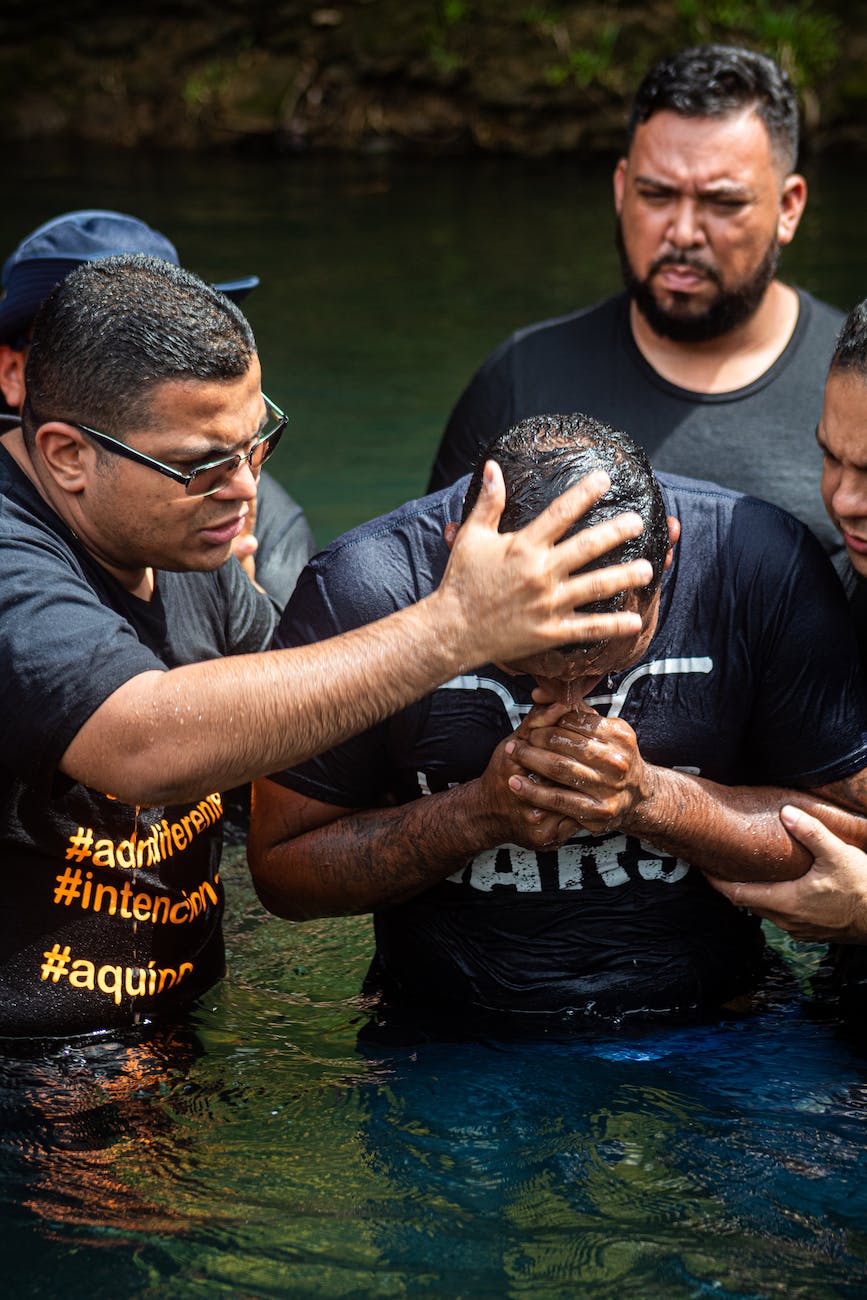
The word ‘baptism’ is a transliteration of a Greek word that meant to immerse. The Old Testament introduces us to the idea that we need to be cleansed before entering the presence of God (Exodus 30:17-20). By Jesus’ time, the city of Jerusalem had many buildings with a ritual bath (mikveh) in them where people could ritually cleanse themselves by dipping themselves in the mikveh. The mikveh can signify: a collection of water, something waited for, abiding, gathering together.[5]

In the New Testament, we are introduced to John the Baptist preaching about the coming of the Lord – and it was a time when many people were expecting the coming of the Messiah. John was baptizing people as they confessed their sins and as these people were being baptized, they would have understood that they were being cleansed and being gathered together for the coming Messiah.

When Jesus was ready to begin his time of ministry, he told John to baptize him. This obviously confused John who knew that Jesus did not need to be cleansed from sin, but Jesus had come to identify himself with us in baptism.

We see the practice of adults confessing their sins and then being baptized continue throughout the New Testament. After the New Testament we now enter an era of confessing adults bringing up their children. In the Jewish tradition, baby boys would be circumcised when they were 8 days old as a way of bringing them into the Jewish community. It is not long after the New Testament times that we see parts of the church using infant baptism as a way of bringing their children into the Christian community. The infants are obviously not confessing believers but believing parents can raise them up with the hope that they will later confirm their baptism. This issue of child baptism would later become an issue that the church would divide over.

Communion and the Passover Feast

The Communion celebration, sometimes called the Eucharist (from the Greek word for grateful or thanksgiving) is tied back to the Jewish Passover Feast. The Passover Feast was a commemoration of God’s work that convinced the Egyptian Pharaoh to let the Israelite slaves to leave. God’s work was to send an angel to kill all the firstborn children of the Egyptians but to “pass over” those Israelite homes that had the blood of a perfect lamb sprinkled on the doorposts of their homes. Every year after that, the Israelites were to commemorate that event with a Passover Feast that would include eating, among other items, bread with no yeast to remember the time they had to leave in haste from Egypt. The Passover meal would be one of many celebrations in the Old Testament that pointed to their fulfillment in the New Testament times.

At the end of Jesus’ earthly ministry, he gathered with his disciples to celebrate the Passover Feast; it would be his “last supper” with them before his crucifixion. He shared with them the bread and wine, but now adding their intended significance: the bread would represent his body that would be sacrificed for the world and the wine would represent his blood shed for the world.

There are differences about whether, during the Communion service, that the bread and wine actually become transformed into Jesus body and blood, or whether his body and blood are present with the bread and wine or whether the bread and wine only metaphorically represent Jesus’ body and blood.

What are the sacraments and how do we practice them?

Sacrament is Latin translation (sacramentum) of the Greek “Mysterion,” which means mystery.  The sacraments are used to refer to different rituals/activities conducted by the church.

There is agreement about the sacraments being a sign of grace imparted to those receiving sacraments, but there is disagreement (naturally, since we’re talking about mysteries) about how that grace works. Some consider the sacraments to be an objective reality that are effective for imparting grace in and of themselves,[6] others think that the effectiveness of the sacraments to impart grace depends on the faith response of the recipients, while others think that the sacraments are more simply a sign of grace.

Since the 16th century, the Orthodox and Roman Catholic recognize seven sacraments (The Orthodox church stipulates that there are even more but does not formally name them). Protestants only recognize baptism and the Lord’s Supper as sacraments. Some Anabaptist and Brethren groups consider foot-washing to be a sacrament. “Some Protestant groups, notably the Quakers and the Salvation Army, do not use sacraments.” [7]

  • Baptism – The first step in a lifelong journey of commitment and discipleship. Immersion identifies us with the death and resurrection of Christ.
  • Eucharist (or Communion) – In a re-enactment of the Last Supper, we share elements that remind us of Jesus’ sacrifice for us. 
  • Reconciliation (or Penance) – Has three elements: conversion, confession, and celebration.
  • Confirmation – An initiation into the church. It is most often associated with the gifts of the Holy Spirit.
  • Marriage – A public sign that one gives oneself totally to this other person. It is also a public statement about God: the loving union of husband and wife speaks of family values and also God’s values.
  • Holy Orders – The priest being ordained vows to lead other Catholics by bringing them the sacraments (especially the Eucharist), by proclaiming the Gospel, and by providing other means to holiness.
  • Anointing of the Sick (Last Rites) – A ritual of healing appropriate not only for physical but also for mental and spiritual sickness.

What are the different views on communion?

There are different views on what happens to the communion elements: bread and wine become literal flesh and blood, bread and wine become spiritual flesh and blood, or the elements are simply to remind us Jesus’ sacrifice for us.[8]

There are also different views on who can take communion: whether any Christians present may participate, or only members of local congregation or denomination may participate.[9]

Do we represent Jesus’ body with leavened or unleavened bread. Do we represent Jesus’ blood with wine or grape juice? Are both elements shared or is just the bread shared? Are only designated representatives of the church allowed to administer the elements?

What are different views on baptism?

There are different views on who may be baptized:  Adults only (Believer baptism, only people old enough to confess their faith may be baptized) Infants (infants of believers are baptized as acknowledgement of the infant as a new member in the church community and in hope that they will make a commitment in the future).

There are different views of what happens during baptism: baptism overcomes original sin, frees the baptized from powers of darkness, Baptism in the Holy Spirit – When someone is saved, the Holy Spirit overcomes the person and causes that person to speak “in tongues.”

There are different views of how many times the recipient is immersed: Once (there are differences in whether the words to use are “in the name of Jesus” or “in the name of the Father, and the Son, and the Holy Spirit), Three times (once for each of the Godhead: Father, Son, Holy Spirit).

There are different views on how the baptism is performed: Immersion (recipient is completely immersed in water), Pouring (water is poured on the head of the recipient), Sprinkling (water is sprinkled on the head of the recipient).


[1] Szczesny, Mike. “[Greek] μυστήριον (mystērion), [Latin] sacramentum” Resounding the faith resoundingthefaith.com/2016/10/27/greek-%CE%BC%CF%85%CF%83%CF%84%CE%AE%CF%81%CE%B9%CE%BF%CE%BD-mysterion-latin-sacramentum/

[2] Tennent, Timothy. “The Body and The Sacraments as a Means of Grace” Seedbed seedbed.com/the-body-and-the-sacraments-as-a-means-of-grace/

[3] Catholic Answers“Sacramentals” Catholic Answers www.catholic.com/encyclopedia/sacramentals

[4] Theopedia “Sacraments” Theopedia www.theopedia.com/sacraments

[5] One for Israel. “The Jewish Roots of Baptism” One for Israel www.oneforisrael.org/bible-based-teaching-from-israel/was-baptism-originally-jewish/

[6] Theopedia “Sacramentalism”  Theopedia theopedia.com/sacramentalism; Phillips, Matthew. “Augustine, Luther, and the Sacraments” Gospel Notes steadfastlutherans.org/2013/06/augustine-luther-and-the-sacraments

[7] Theopedia “Sacraments” Theopedia www.theopedia.com/sacraments

[8] Zondervan Academic Blog “Transubstantiation, Consubstantiation, or Something Else? Roman Catholic vs. Protestant View of the Lord’s Supper” Zondervan Academic 20 Oct 2017 zondervanacademic.com/blog/transubstantiation-consubstantiation-catholic-protestant

[9] Truediscipleship “Communion – Is it Open or Closed? True Discipleship truediscipleship.com/communion-is-it-open-or-closed

Mystery of God

Dancing in the Kingdom- Table of Contents

Dancing In the Kingdom – Part 2 – The Kingdom Revealed – Chapter 13 – Distinctives within the body of Christ

Mystery of God

[Bible references: Deuteronomy 6:4; Isaiah 55:8; Luke 3:21-22; John 10:30; 1 Corinthians 2:11-14; Philippians 2:5-11; 1 Timothy 3:15-16; 1 Peter 4:14; 1 John 1:6-8; 2:18-22]

How is it that there is only one God and yet Jesus is God, and the Holy Spirit is God, and the Father is God?

The Bible reveals but doesn’t explain this paradox. From the beginning of the Old Testament there is an explicit teaching that “The Lord our God, the Lord is one,” a teaching that contrasted with all the other cultures around at the time. And yet, from the beginning of the Old Testament we have hints that this One God is complicated. The New Testament gets more explicit about the situation but still does not explain it. This paradox, that there was a person, God, and that there are three persons (Father, Son, Holy Spirit) who are equally God, was given a name, Trinity.[1] The Greek side of the church uses a term, “perichoresis” to describe the interpenetration, etc. of the persons of the Trinity.

But just because a name was given to this paradox did not make it easy to accept. Various explanations were given to explain how this worked and how the three persons related to each other. Discussions involved how to define terms like person, substance and nature.

The following list shows a few of some different explanations that have been espoused but are considered to be heretical:

  • The three persons are three different modes of God expressing himself,[2]
  • The belief that God is only one person,[3]
  • Jesus was created and was less than the Father,[4]
  • God the Son and God the Holy Spirit are subordinate to God the Father not merely relationally, but also in nature and being.[5] This eventually led to the belief that neither Jesus nor the Holy Spirit are truly God.[6]

How can Jesus both be God and human?

There are two views held: 1) the one person Jesus has two natures, human and divine, combined in one person, or 2) the one person Jesus has one nature in which his divinity and humanity are combined, [7] In either case Jesus is made of the same substance as God[8].

There were controversies over whether that God could have suffered,[9] that Jesus only seemed to suffer,[10] or whether a human like Mary could have given birth to God.[11] 

So exactly what is the relation of the Holy Spirit to God the Father and God the Son?

There is a question about whether the Spirit proceeds from just the Father or the Father and the Son. This question was captured in a statement in the Nicene-Constantinople Creed which originally stated, “And we believe in the Holy Spirit, the Lord, and Giver of Life, Who proceeds from the Father ….” In disagreement with the Eastern Orthodox side of the church, the Roman Catholics felt the need to add the words “and the Son.” [12]

How does one develop knowledge of God?[13]

We need to distinguish that we are not trying to know about God as much as to know God, the person. We get to know a person by more than studying about a person, but rather spending time and doing things with that person. We are not a just a student, but a disciple.

When to comes to knowing about God, we find that He has revealed himself to all people through his creation and through our ability to reason.[14] That type of knowledge is not the same as knowing God as a person. To know God as a person, we need to be in his presence and allow him to reveal himself to us. We can do this through prayer, meditation, or scripture. Sometimes God will spiritually reveal himself to us or sometimes he will act through miracles. Other times we interact with God as we do things in His name.[15]

Whether we are learning through general or special revelation,[16] in either case, we are finite creatures trying to understand the infinite God, which is a task we can only do in part. But either way, the knowledge we seek is not an end itself but is for the sake of our relationship with God.

The following examples are some of the particular ways different parts of the church have practiced the pursuit of knowing God:

  • Eastern Orthodox traditions recognize our utter limits in knowing God through negative theology – that is, God’s infinite qualities are so far from our comprehension that it makes more sense to define what we know God is not, instead of trying to define what God is.[17]
  • Many traditions, including the Eastern Orthodox, posit the impossibility of our finite minds to be able to know God by intellectual means and we need to extend our knowledge of God through various spiritual practices such as fasting, prayer and meditation.
    • In the early church, an innovation introduced by Montanus[18] promoted revelations from the Holy Spirit. This caused the church to back away from any other innovations in theology.
    • Quakers have emphasized quieting oneself and waiting for God to reveal himself through the “inner light” that is available to all people.
  • The Eastern Orthodox tradition emphasizes the necessity of becoming transformed by God to become more like him to know God.[19]
  • In a reaction to an overemphasis on knowing God through intellectual means, a movement developed which emphasized spiritual disciplines such as Bible study and prayer.[20]
  • Some in the church over-emphasized knowing God by faith, leading to an anti-intellectual strain in the church. This despite the Christian heritage which did much to support the life of the mind. Christians founded universities, were some of the first to use science to investigate the natural world and have invested much towards loving God with “all our minds.”
  • Some in the church stressed the mysteries of God and the need to develop the more mystical disciplines of prayer, meditation, and contemplation.

[1] In AD 185, Irenaeus claimed that this concept was the teaching of the apostles, but it wasn’t until AD200 that Tertullian created the term, Trinity. Tertullian was responding to the teaching of modalism.

[2] Theopedia “Modalism” Theopedia theopedia.com/modalism

[3] Theopedia “Monarchianism” Theopedia theopedia.com/monarchism

[4] Arian (AD 256–336) was a presbyter in Alexandria. He did have some success in persuading people of his view and for a while it became quite a controversy in the church, but it was eventually denounced.

[5] Theopedia “Subordinationism” Theopedia theopedia.com/subordinationism”

[6] Theopedia “Unitarianism” Theopedia theopedia.com/Unitarianism

[7] Plante, Evan. “What is the difference between Dyophysitism and Miaphysitism?” Mainsail Ministries mainsailministries.org/index.php/q-a-a-god-bible-theology-culture/105-what-is-the-difference-between-dyophysitism-and-miaphysitism.html Dyophysitism (Christ has two natures, fully human and fully God) is the view of the Protestant, Roman Catholic and Eastern Orthodox. denominations. Miaphysitism (Christ has one nature that is both human and divine) is the view of the Oriental Orthodox denomination.

[8] Homoousios – In Greek, the argument looked even more subtle. Was Jesus made of the same substance (homoousios) as God or a similar substance (homoiousios).

[9] OrthodoxWiki “Nestorianism” OrthodoxWiki orthodoxwiki.org/Nestorianism

[10] OrthodoxWiki “Docetism” OrthodoxWiki orthodoxwiki.org/Docetism

[11] Theotokos means “God-bearer”

[12] This additional phrase, referred to as the “filioque” is held by the Roman Catholics and the Protestants but the original wording is held by the Eastern Orthodox.

[13] Epistemology is the study of how we can know things.

[14] This is sometimes called “general revelation.” Trying to understand God this way can be called “natural theology.”

[15] These different ways of knowing God by being with him in these activities is sometimes called “special” or ”divine revelation.”

[16] Got Questions “What is general revelation and special revelation?” Got Questions www.gotquestions.org/general-special-revelation.html

[17] OrthodoxWiki “Apophatic theology” OrthodoxWiki orthodoxwiki.org/Apophatictheology

[18] Early Christian History “Montanus” Early Christian History www.earlychristianhistory.info/montanus.html

[19] Theopedia “Theosis” Theopedia www.theopedia.com/theosis

[20] Theopedia “Pietism” Theopedia www.theopedia.com/pietism

Reflect

We truly have reached the limitations of our knowledge of God when we consider both the concept of the Trinity and the concept of Jesus being both fully God and fully human. How do you handle that limitation?

Observe

Read Philippians 2:5-11; 1 Timothy 3:15-16; 1 John 1:6-8; 2:18-22. What does it  mean to us that God came to us in human form as Jesus?

Paradox of responsibility

Dancing in the Kingdom- Table of Contents

Dancing In the Kingdom – Part 2 – The Kingdom Revealed – Chapter 12 – Launching the church

Paradox of responsibility

[Bible references: Jeremiah 3:1-9; 31:1-4; Zechariah 8:16; Ephesians 4; Philippians 2:1-18]

This then is our paradox; we are given the responsibility of correctly handling the Truth of God even when we cannot completely understand what that Truth is. For instance, how can we understand that there is one person, God, and yet have God revealed in three personalities:  God the Father, God the Son and God the Holy Spirit? How can the God who exists outsides the confines of time and space, confine Himself to a particular space and time and come to be born and then to live and die as a normal human being? How can these things be?

As we look across the breadth of the history of the church, we see the church wrestling with these paradoxes and others. The result of that wrestling sometimes has gotten downright ugly with the church sometimes quite literally killing each other about it, not only with those outside the church but within it. In fact, if one were to look across the world at the state of Christianity, it might seem to one of the most fractious and divided groups ever.

How can it be that God would entrust this church with the task of bringing that His Truth to others and from one generation to the next, the church that has from time to time seemed to fail the apostle Paul’s challenge to be “one in the Spirit.”

Reflect

When children are not compliant as they grow up, do we just give up on them?

Observe

Read Zechariah 8:16; Ephesians 4; Philippians 2:1-18. What should the church look like as it handles its responsibility to presenting the truth of God to each other and to the world?

Brooding, moving, dancing

Dancing in the Kingdom- Table of Contents

Dancing In the Kingdom – Part 1 – Shadows of the Kingdom – Chapter 1 – Prelude

Brooding, moving, dancing

[Bible references: Genesis 1; Jeremiah 29:11; Romans 8:19-21; Galatians 3:13-14; Ephesians 3:20; 1 Peter 5:10]

In the beginning, God created the heavens and the earth … and the Spirit of God brooded[1] over the face of the waters …

Like a bird sitting on eggs keeping them warm until the eggs would hatch and bring forth new birds, the Spirit hovered, brooded, over the earth ready to bring forth life of all sorts, but particularly creatures that would be like God, creatures that would reflect the character of God: transcendent, loving, wise, fruitful, etc. This is how the story begins, full of anticipation and hope for what must be a grand and wonderful future. But even before the story begins, we may contemplate another mystery, the mystery of how there can be one God and also three persons identified as God: God the Father, God the Son, and God the Holy Spirit. The early church[2] struggled with this concept and eventually, in the second century, a Christian apologist, Tertullian, coined the term “Trinity” to describe this 3 persons in 1 God concept.

However, that tidy little term can mask over the impossible to understand idea of God being one person and three persons at the same time. There is Greek word available to us that addresses the complexity of this three-in-oneness, “perichoresis[3] which comes from two Greek words which mean “around,” and “to give way” or “to make room.” This is meant to describe the interpenetration or mutual indwelling of Father, Son, and Holy Spirit.

“In that regard the term “perichoresis” (meaning “interpenetration,” “circumincession” or “mutual indwelling”) has been used theologically at least since the time of John of Damascus to refer to the way the three divine persons live in joyful, dynamic communion without merging, loss, or distinction. It is said to be derived from the Greek term perchoreuo meaning “to dance around.” However, the evidence indicates that the term is derived from the different though similar looking perichoreo which refers to “interpenetration” but does not refer to dancing…. this does not mean that the concept itself is inappropriate, as evidenced by those who appreciate its use in that way.” [4]

While this term may be partly helpful in understanding this impossible to understand concept, there is another word that is very similar to another Greek which means “to dance around,” which gives us a word picture of our living and complex God in which the Father, Son and Holy Spirit not only interpenetrate but interact with one another, in a freewheeling but synchronized dance. This means that, as God’s image-bearers, we can reflect the image of the loving, interpenetrating, interacting, and dancing God as we participate in His work of taking care of His Creation and of one another.[5]

This dance which started before Creation, has been joined by God’s image-bearers since the beginning of humanity. It is now our turn. We just need to learn the moves and join the dance.


[1]  Biblehub “Genesis 1:2” Bible Hub biblehub.com/commentaries/genesis/1-2.htm Most translations or this phase use the terms “hovering” or “moving,” but there is also a case for using the term, “brooding,” as in a bird sitting on a nest of eggs.

[2] Van Ee, Joshua J. “The Church in the Old Testament” Westminster Seminary California 9 Nov 2017 www.wscal.edu/blog/the-church-in-the-old-testament The term “church” as used in this book will refer to what may more properly be called the “new testament church.” I wish to make that distinction because the term “church” may be properly applied to all of those who are “called out” to follow Yahweh.

[3] Compelling Truth. “What is the meaning of ‘perichoresis’?” Compelling Truth www.compellingtruth.org/perichoresis.html

[4] Edgar, Brian. “The God Who Plays: A Playful Approach to Theology and Spirituality,” Cascade Books 2017 (e-book) Chapter 9: Kingdom: Playing with God, The Dance of Life

[5] Miller, Darrow. “Perichoresis: Great Dance of God and Creation” Darrow Miller and Friends 16 July 2018 darrowmillerandfriends.com/2018/07/16/perichoresis-great-dance-god-creation/

Observe

Read Genesis 1.  Think of the Spirit of God hovering, moving and brooding over the earth. In your imagination, think about a spiritual being “giving birth” to physical living things, what would you expect to happen?

Body, Soul and Spirit

Dancing in the Kingdom – Table of Contents

Part 1 – Shadows of the Kingdom, Chapter 3 – The Image-bearers

[Bible references: Genesis 2; Matthew 3:16-17; 19:6; Acs 2:42-47; Romans 5:5; 1 Corinthians 3:16-17; 6:19-20; 12:4-30; 2 Corinthians 9:6-8; Colossians 1:18; Revelation 21-22]

The mystery of perichoresis which tries to describe the one person God consisting of the relation of the Father, Son and Holy Spirit may very well be the best approach to the mystery of God’s image-bearers. There are conflicting views on whether a person consists of a body and soul or body and spirit or body and soul and spirit. Are we two parts or three parts then which parts? A similar issue arises in the attempts to figure out the relation between the brain and consciousness.[1] Although some researchers reductionistically think that consciousness is all biology and that we will be able to eventually build a computer with a conscious, it is likely that the mystery of perichoresis will prevail.

As image-bearers, being created as community of male and female points one way to the community of God as Father, Son and Holy Spirit, but also points in another way to their unity as represented by becoming “one flesh.” There is an element of equality with a difference between male and female as represented by the woman being created from, what has been commonly translated, a “rib” from Adam’s side. The equality becomes more apparent however, when we understand the word that has been translated as “rib” is more usually translated as “side” – as if Eve were constructed from a full half Adam’s side.[2]

Yet the Hebrew word צלע (tsela) does not mean “rib,” but rather “side.” … Adam’s own words clarify that Eve comes from one of his sides when he declares of his wife, “Finally, this is bone of my bone and flesh of my flesh!” (Gen 2:23). Had Eve been created from the man’s rib alone, Adam would only have been able to say that she was “bone of his bone.” As Adam’s bone and flesh, the woman is the man’s “other half.” When man and woman cleave to one another and return to being “one flesh” (2:24), the two equal halves of humanity are brought back together.[3]

Adam’s “deep sleep” (תרדמה, tardemah) connotes a hospital patient’s sleep via anesthesia. However, the practice of anesthesiology was unknown in ancient Israel; Genesis does not have modern medicine in mind. Rather than physical sleep, tardemah denotes a visionary trance … Instead of splitting Adam physically, God provides him with a vision to show him the meaning of the relationship that he will have with his wife: a fully equal partnership with a person who constitutes his “other half.”[4]

The mystery deepens further when we consider the sexual union of husband and wife. Our male and femaleness show us our human incompleteness without each other. In the joining of the male and female bodies we manifest a completeness. Humans are unlike all other creatures in that we are made in God’s image with body, soul and spirit, and our spirit is joined to God’s Spirit. Therefore, the sexual union of husband and wife, unlike other creatures, is described as becoming “one flesh.” The combination of spiritual union and physical union creates a living metaphor of the union of Christ with the Church. The love, intensity and passion of two different but complementary bodies united both in spirit and in “one flesh” is an extension of the perichoresis of the Trinity as the bodies of the image-bearers united in spirit with Christ become the body of Christ on earth, joined in love, intensity and passion, enjoying the overflowing goodness and shalom that God has intended for us.

We are created body, soul and spirit with the intention that when heaven and earth are rejoined, we will be restored body, soul and spirit (although it will be in resurrected bodies) in the new heaven and earth. It is also through our bodies that we are restored to Christ. When he took on flesh.

God created the flesh of man, which the Son assumes in the Incarnation, all so that he might save the flesh of man. Tertullian states this idea straightforwardly: caro salutis cardo, the flesh is the hinge of salvation …Thus, our bodies are not meat-suits to be discarded or clusters of atoms that will disintegrate and disappear. They are made to last, because God’s kingdom will last, taking up from this world all that is good and preserving it. All that is made in and through Christ – including the body – will find its ultimate meaning in him. “My soul longs, yea, faints for the courts of the Lord; my heart and flesh sing for joy to the living God” (Ps. 84:2 RSV).[5]

When fellow Christ-bearers assemble together, they are together the Body of Christ, with each person bringing different gifts to support and strengthen the others in the Body.

Paul’s marital imagery in describing the relationship between Christ and the church. By wedding himself to humanity, Christ truly becomes “one flesh” with them (Ephesians 5:30–32), making them his members, “the body of Christ” (1 Corinthians 12:27), with Christ as their Head (Colossians 1:18). Head and body are joined through the “bond of charity,” the love that has been “shed abroad in our hearts” by the Holy Spirit (Romans 5:5). The union of love between Head and body is so close that “Head and body speak as one,” because they are “no longer two, but one flesh” (Matthew 19:6).[6]


[1] Tolson, Jay. “Is There Room for the Soul?” CBS News 15 Oct 2006 http://www.cbsnews.com/news/is-there-room-for-the-soul/

[2] Walton, John. “The Lost World of Adam and Eve” Genesis 2-3 and the Human Origins Debate”. InterVarsity Press. 2015 Kindle Edition. p. 78

[3] Schaser, Nicholas J. “Did Eve Come From Adam’s “Rib?” Israel Bible Weekly 8 May 2021 weekly.israelbiblecenter.com/eve-come-adams-rib/

[4] Schaser, Nicholas J. “Splitting the Adam” Israel Bible Weekly 23 July 2021 weekly.israelbiblecenter.com/splitting-the-adam/

[5] Franks, Angela. “What’s a Body For?” Plough Quarterly 6 Aug 2018 http://www.plough.com/en/topics/justice/culture-of-life/whats-a-body-for

[6] Colbrook, Niamh. “Inhabiting Our Feeling Bodies” Comment Essay 26 Aug 2021 comment.org/inhabiting-our-feeling-bodies

Reflect

If God’s love is expressed through our current bodies which were used to shape our character, do you think that it is possible that our resurrected bodies will retain aspects of our current bodies which have shaped us in the same way that Jesus’ resurrection body still bore his scars?

Observe

Read Genesis 2. Unlike other creatures who were simply created male and female, Genesis 2 gives a story of a man being specifically made from the dust and a woman being created from the side of the man. What do think was God’s purpose for describing the origin of his image-bearers?

Chapter 2 – The Impossible God, Part 1

The Impossible Dance – Table of Contents

The Impossible Dance – Chapter 2 – The Impossible God

The Impossible God

In Genesis 1:2, most translations will read that the Spirit “hovered” over the face of the waters, but that word can also mean “brooded,” as in a bird sitting on her eggs to keep the eggs warm until they hatch. So here we can read that the Spirit hovered and brooded, over the earth ready to bring forth life of all sorts, but particularly creatures that would be like God, creatures that would reflect the character of God: transcendent, loving, wise, fruitful, etc. This is how the story begins, full of anticipation and hope for what must be a grand and wonderful future.

But even before the story begins, we may contemplate another mystery, the mystery of the one person God also being the three persons: God the Father, God the Son and God the Holy Spirit. The early church struggled with this concept and eventually, in the second century, a Christian apologist, Tertullian, coined the term “Trinity” to describe this 3-persons in 1-person concept.

However, that tidy little term can mask over the impossible to understand idea of God being one person and three persons at the same time. There is Greek word available to us that addresses the complexity of this three-in-oneness, “perichoresis” which comes from two Greek words which mean “interpenetrate” or “mutually indwell.” This is meant to describe the interpenetration or mutual indwelling of Father, Son and Holy Spirit.

While this term may be partly helpful in understanding this impossible to understand concept, there is another word that is very similar to perichoresis which means “to dance around,” which gives us a word picture of our living and complex God in which the Father, Son and Holy Spirit not only interpenetrate but interact with one another, in a freewheeling, synchronized dance. There is no way for us to fully understand this one-person who is a community. So as we try to understand God, there will naturally be some paradoxes and mysteries.

Paradoxes and Mysteries

When we look at a work of art, what can we tell about the artist? What can we find from the skill in using materials, the subject matter, the emotional content, the values? We may be able to figure out a few things, but all-in-all we can discern very little. To learn much more we need the artist to reveal not just more about the artwork but also about him or herself.

So, as we begin to explore what we can know about the Creator, we also begin by looking at his artwork (that is, the creation) but then we need to hear what the Creator has revealed about himself to us (that is, through the Holy Bible).

So, let us begin by looking at the living things God created. Sometimes, we think we can look around us and figure out what is living and what is not; but when look at the spectrum of living things, especially through the eyes of the scientists who specialize in it, it becomes more difficult to try to come up with a definition for life. In fact, one organization catalogued over 100 definitions … and none of those definitions satisfy everybody. What does that say about the one who created those living things?

If we get so confused about what was created, it is likely that we will get confused about the Creator. When Job challenged God, Yahweh responded, “Where were you when I laid the foundations of the earth?” In Isaiah, God explicitly says, “My ways are higher than your ways.” There simply are things about God that are beyond our comprehension, mysteries, which should give us a spirit of humility.

Because much about God is mysterious and beyond understanding, we naturally find that the Creator is full of paradoxes: with characteristics that seem to oppose each other. When we do encounter apparently conflicting statements about God, we must hold those qualities in tension with each other. Sometimes we might not totally understand how these characteristics can all be true together, but that is what we should expect. If we cannot fully comprehend the creation, why should we think that we can fully comprehend the Creator. We should also consider that if we ever think that we totally understand the Creator of the universe then we probably are not understanding things correctly – we are probably creating a god in our own image rather than the other way around.

This inability to totally understand God forces us to make speculations as we try to find a way to reason things about God. We do have to be careful though, for we will create all sorts of arguments with each other if we insist on certain speculations as the defined truth of God. It might be that if we study those revelations of God that we can draw some conclusions, but we need to be careful about making dogma out of something that we don’t fully understand. Unfortunately, we will see in future chapters that various theologians and congregations have sometimes split up over some of those very issues which no one can fully understand.

A Person and a Community

It is sometimes said that a picture is worth a thousand words, as it would take many words to describe the colors, shapes and expressions detailed in a picture. But sometimes, it can also be said that a word is worth a thousand pictures, as it is possible that one word in one document can be linked to many other documents where that same word is used with the meaning in each instance add to the meanings in the other instances. For example, the first sentence in the Bible says, “In the beginning, God created the heavens and the earth.”

Let’s consider the word “God.” In the Hebrew language that was used in the original writing of the first part of the Bible, that word is “Elohim.” The curious thing is that “Elohim” is a plural noun which could be, and often is, translated as “gods” while the verb “created” (“bara” in Hebrew) is singular. This combination of “Elohim” with a singular verb happens throughout the Old Testament part of the Bible and in all those cases, “Elohim” is translated as the singular noun, “God”. So, what’s the story with this?

On the one hand, the Bible is very strident in insisting that there is only one God. One of the central doctrines taught to the Jews is, “The LORD our God, the LORD is one.” In the time frame that the Bible was written, this statement strongly contrasted with all the other cultures which had multiple gods. On the other hand, the Bible in both the Old and New Testaments, talks about God as Father and also God as Son and also God as Holy Spirit. This phenomenon shows up even as we look at Genesis 1, where we can see that God created and that the Spirit was hovering over the water. We continue to see this concept of one God, but three persons referred to as God develop throughout scripture, both in the Old Testament as the New Testament.

So how do we make sense out of the insistence on there being one God while also revealing that there are multiple personalities associated with “God.” This is certainly a tough question that has created problems in the church and is but one thing among many that God seems to have revealed to us without explaining it. The church has referred to this complexity as the “Trinity.” It is from the outflowing of love between the members of the Trinity that God created us, desiring us to join each other in community and together join the community of love that is present in the Trinity.

Transcendent and Immanent

Genesis tells us there was a time when the universe, the heavens and the earth, began to exist. Before that moment of time, they did not exist – but before that beginning there was God and then God created the universe. From that starting point, we can see the transcendent nature of God. He was not part of the universe but apart from the universe. No matter what happens in the universe or to the universe, those things do not affect God who is separate from all that. Fortunately, we are not simply left with a God who is unreachably “out there” leaving us to fend for ourselves. In some incomprehensible fashion, while God is “out there” existing outside of Creation, He is simultaneously inside Creation … everywhere at once.

This paradox of God’s transcendence (existing outside of Creation) and imminence (existing everywhere within Creation) has sometimes bewildered many who try to examine it through sheer logic. As we unwrap the significance of this paradox, we discover many interesting attributes of God. Here are a few:

  • Regarding God’s Transcendence
    • God’s existence apart from creation, and apart from the brokenness of the world is described as his holiness. This holiness is so profound that mortal, sinful people (as we all are) could not stand to be his presence.
    • God’s omnipotence is seen in his ability to not only create the universe, but in his ability to sustain it.
    • God’s omniscience is seen in his knowledge about the hairs on our head, our everyday actions and even in our destiny
    • God is omnipresent
  • Regarding God’s Immanence
    • Although God is apart from the universe, He is the one who holds the universe together
    • God is present throughout the earth and available to all who call for him and even to those who are not calling for him

Timeless and in Time

Closely related to the paradox of how God is both transcendent and immanent is how God is both timeless and in time. Many scholars in philosophy and science have trouble trying to resolve questions such as: How can God even have both attributes? Did God create time or is God himself confined by time? Is time static such that the past, present and future all exist simultaneously and God sees them all at once, or is time dynamic such that the future does not yet exist – and therefore God does not yet know it?  

It is not practical to try to summarize all the arguments with all their nuances here. For our purposes, we will not try to resolve the many difficult theological/philosophical issues but, as Psalm 102 does, accept the finite mortality of our life on earth and the fact that God is both with us in the midst of our distress yet also exists outside of that.

Sovereign and Servant

There is a contemporary name for this juxtaposition of attributes: servant leadership. The one who is the creator and sustainer of all things does not wield that power in a self-centered way but uses that power to serve the needs of the very beings he created – even though they defied his authority and it cost him much anguish.

When the Creator decided to make creatures in his image, creatures that had the ability to love (and therefore the ability to choose whom to love or whom to not love), he imbued these creatures with the ability to make independent decisions. Doing that required releasing some control and then providing enough space be given so that those creatures would be free to make choices.

However, those creatures violated that love and incurred an awful penalty. Fortunately, the Creator did not just mete out the penalty, but with compassion, and at great cost to himself, put in place a plan that would restore his relationship with his image-bearers. This costly plan would highlight an attribute that already had been revealed, the attribute of servanthood in which the Creator acts on behalf of his creatures.

The ability to create and sustain the universe needs tremendous knowledge and wisdom as does the ability to create creatures in his image and then to guide them amid their missteps and varied circumstances. Were God to simply control each and every action in the universe, that would be difficult enough, but although God can control things directly through his sovereign will, there are actions which he desires but he gives us the option to obey or not. We cannot even begin to understand the vast knowledge and wisdom that God needs. In fact, wisdom is so pervasive, not only in creation but as part of the many ways God interacts with us, that Wisdom is metaphorically portrayed to us in Proverbs as a person.

Gracious, Merciful and Just

There is a common misunderstanding of how God is seen in the Old Testament vs. how God is seen in the New Testament. The perceived contrast has caused reactions such as thinking that there are two different gods or ignoring the Old Testament while focusing exclusively on the New Testament. It is easy to see how these misperceptions happen while looking cursorily at the Bible, but this misperception can be resolved by looking more carefully into the text. We can see that God’s love, mercy and grace is found not just in the New but also the Old Testament. We can also see that God’s wrath and justice is found not just in the Old but also in the New Testament.

God’s love, mercy and grace can be seen in the Old Testament right near the beginning. There is grace in the placing the image of God on creatures that did nothing to earn it. There is mercy in the judgements meted onto Adam and Eve after their sin and grace in the provision of covering for their nakedness. While we could look at more other instances of mercy and grace in the Old Testament, let’s just consider the meanings of the Hebrew words that have been translated as “mercy.”  One Hebrew word could be translated as compassion and another word as steadfast loyalty. These characteristics can be seen in God’s steadfast compassion and loyalty to Israel even after repeated rejections from his image-bearers.

But even beyond mercy and grace, God’s compares his love with his chosen people with the love of a husband to a wife. This Hebrew word often used for love refers to a giving type of love, which indeed was the way God showed his love to his chosen ones; even though time after time his people rejected him, God patiently worked through it all giving us a chance to see ourselves as we really are and the chance to put our trust in his unfailing love.

Wrath and justice in the New Testament can be seen in God’s strong desire expressed as zeal or jealousy concerning the welfare of his image bearers. In both the Old and New Testaments, God is clear about his desire for justice and righteousness. God expresses his anger very clearly when we try to cover-up our lack of justice with religious exercises or pretentiousness.

God’s response to injustice is his wrath. Although God’s wrath has been long covered by his patience and his desire that all people would come to him, his wrath will eventually be revealed when he comes back to earth to fully restore his kingdom on earth. While he cautions us to allow him to carry out vengeance, that does not mean we should not be concerned by the injustice that we see. The Greek term which is usually translated as “righteousness” can also be translated as “justice.”  Jesus exemplified justice throughout his ministry, and he encourages us to practice justice as well.

That concern for justice and desire to eliminate sin is explicitly expressed in Jesus’ statements in Matthew 10:34 (“Do not suppose that I have come to bring peace to the earth. I did not come to bring peace, but a sword.”) and Luke 12:49 (“I have come to bring fire on the earth, and how I wish it were already kindled!”). Then later in Revelation 19:11-21, however real or metaphoric this passage may seem to be, the passage clearly expresses in very warlike terms, Jesus’ concern to eliminate evil.

God’s often responds to the injustice in the world with love, patience, and mercy – even passionately pleading with us to turn back to him in repentance and receive His forgiveness. But when we don’t respond with repentance, God will ultimately invoke His righteousness, justice and wrath.

Playful and Orderly

Many experts disagree on how to define play, we may think of play as activity which is typically not productive and is done only because one wants to do it and is usually a fun activity involving other people and will typically help people bond together. When it comes to the Creation, God did not have to create anything. God did not need the universe or anything in it – not the planets, nor the stars, nor the creatures. God created the heavens and the earth for the delight of it, and He did it because He wanted to share heaven and earth with his image-bearers. This spirit of playfulness is reflected in many of God’s creatures including Leviathan and humans. God’s playfulness also shows up in other interesting places in the Bible.

When Job complains about the difficulties he is going through, God seems to admonish him by “putting Job in his place” and citing all the ways in which God’s ways are higher than Job’s ways. But God does not follow through with any discipline of Job but rather begins the process of restoring Job’s fortunes. In response, Job confesses, “I spoke of things I did not understand … I retract my words and I repent in dust and ashes.” … And yet, Job changes an interesting behavior – he no longer rose early in the morning to offer burnt offerings for all of his children, worrying that “perhaps they have sinned.” Shams-ud-din Muhammed in his work “Tripping Over Joy” may have captured what Job was thinking when he wrote “the difference between our life and a saint’s is that the saint knows that the spiritual path is like a chess game with God and that God has made such a fantastic move that the saint trips over joy in surrender whereas we think we have a thousand serious moves.”

Another instance of playing occurs in Mark 6, when Jesus takes a late-night walk on a very windy lake, walking as if to go by his disciples. Of course, they were initially terrified, thinking they were seeing a ghost. But he got in the boat and the waters calmed down. He could have calmed the waters down before the disciples started to go on the lake. He could have chosen another way to make his point … but he decided to do it that way.

God’s creativity can be seen within the created world in the extremely diverse types of plants and animals: differences in colors and shapes; different ways of digesting food; different ways of moving and observing the environment to name a few. The creativity we see is awesome. From out of nothingness, from no previous model, God created a whole system of particles and energy fields that interact with each other to form the building blocks of subatomic particles which are used to form atoms, which are used to form molecules of all sorts of complexity, which are then used to form planets and stars (actually, the fusion reaction in stars is used to create larger molecules from smaller ones). And at least one planet was used to create living things like plants and animals in all their complexity and then those living things were used to create communities (ecosystems) that allowed living things to thrive and flourish.

Yet, within the overwhelming creativity displayed within all the diversity of living things there is an order that is controlled by a set of ordered processes, some of which we call scientific (natural) laws. Christians, like Francis Bacon, pursued these laws as an extension of God’s moral laws in the universe, which then led to the development of modern science. It is within science that we examine orderly processes at work that we call the natural laws which describe how all physical things behave: like the forces of gravity, electrical forces, etc.

There is no disobeying these natural laws. If you think that you can try to violate them, you’d be wrong. For instance, if you are on earth and stand on the top of a table and then jump off with the assumption that you will not be subject to gravity but rather float around without falling to the floor, you’d be wrong. You can’t violate gravity. You can try to set up circumstances that will cause other forces to come into play – such as airplanes do when they use aerodynamic forces that counteract gravity – but you simply can’t violate gravity, and there will be consequences if you try.

By observing the laws of the created order, we can ascertain some aspects of the character of God. The natural laws that govern how things are supposed to behave reveals a God who expects things to behave, and that violations are not tolerated. But when image-bearers were brought into the world there was a new level of complexity added to this physical model constrained by natural, physical laws.

On the one hand, we image-bearers are physical creatures and are therefore subject to the natural laws, but on the other hand we image-bearers were created to reflect God’s transcendence and were even given dominion over the creation into which God had placed us. Within that capacity, we image-bearers were given a moral freedom, the freedom to choose between good and evil. This freedom could not be given without some risk, because in order for image-bearers to be able to reflect God’s character of being good and choosing to do good there must be the possibility for the image-bearers to be able to choose to not be good.

And just as there are natural, physical laws that govern how physical things behave with consequences for trying to violate those laws, God has also imposed spiritual, moral laws to govern how the image-bearers ought to behave in the good universe He created with consequences for violating those moral laws. Sometimes the sin of one generation is passed down to the next. But regardless of whether a particular sin is passed to from one generation to another, the penalty for sin is physical and spiritual death.


A Person and a Community

Dancing in the Kingdom – Table of Contents

Part 1 – Shadows of the Kingdom, Chapter 2 – The God who created

[Bible references: Genesis 1:1; Deuteronomy 6:4; Isaiah 48:14-16; Matthew 3:16-17]

It is sometimes said that a picture is worth a thousand words, as it would take many words to describe the colors, shapes and expressions detailed in a picture. But sometimes, it can also be said that a word is worth a thousand pictures, as it is possible that one word in one document can be linked to many other documents where that same word is used with the meaning in each instance add to the meanings in the other instances. For example, the first sentence in the Bible says, “In the beginning, God created the heavens and the earth.”

Let’s consider the word “God.” In the Hebrew language that was used in the original writing of the first part of the Bible, that word is “Elohim.” The curious thing is that “Elohim” is a plural noun which could be, and often is, translated as “gods” while the verb “created” (“bara” in Hebrew) is singular.[1] This combination of “Elohim” with a singular verb happens throughout the Old Testament part of the Bible and in all those cases, “Elohim” is translated as the singular noun, “God”. So, what’s the story with this?

On the one hand, the Bible is very strident in insisting that there is only one God. One of the central doctrines taught to the Jews is, “The LORD our God, the LORD is one.” In the time frame that the Bible was written, this statement strongly contrasted with all the other cultures which had multiple gods. On the other hand, the Bible in both the Old and New Testaments, talks about God as Father and also God as Son and also God as Holy Spirit. This phenomenon shows up even as we look at Genesis 1, where we can see that God created and that the Spirit was hovering over the water. We continue to see this concept of one God, but three persons referred to as God develop throughout scripture, both in the Old Testament as the New Testament.[2]

So how do we make sense out of the insistence on there being one God while also revealing that there are multiple personalities associated with “God.” This is certainly a tough question that has created problems in the church (more on that later) and is but one thing among many that God seems to have revealed to us without explaining it. The church has referred to this complexity as the “Trinity.” It is from the outflowing of love between the members of the Trinity that God created us, desiring us to join each other in community and together join the community of love that is present in the Trinity.


[1] Biblehub “Elohim” Strong’s Concordance, Bible Hub biblehub.com/hebrew/430.htm

[2] Stewart, Don. “Is the Doctrine of the Trinity Found in the Old Testament?” Blue Letter Bible, ?”  Blue Letter Bible www.blueletterbible.org/faq/don_stewart/don_stewart_330.cfm

Reflect

Chapter 1 introduced perichoresis as a way of trying to picture the relationship of the persons of the Trinity. How do you think of love as an integral part of not only that relationship but the desire to expand that relationship to include us?

Observe

Read Genesis 1:1-2; Deuteronomy 6:4; Isaiah 48:14-16; Matthew 3:16-17.  This passage in Genesis uses the plural word “Elohim” to identify God. Deuteronomy is insistent that there is one God. Isaiah and Matthew indicate three persons as God. The word, “Trinity,” was invented to describe this phenomenon. The word, “perichoresis,” was used to try to describe this phenomenon. How could you use these words to explain this phenomenon to other people?

A Brief Account

Dancing in the Kingdom – Table of Contents

Dancing In the Kingdom – Part 1 – Shadows of the Kingdom Chapter 1 – Prelude

A Brief Account

The following is an Extremely Brief Account of the Very Long Story, a summary of the Bible’s story.

There was, and is, and will be, a complex person we call God, who exists as three people that we have come to know as the Father, Son and Holy Spirit. God decided that he wanted to expand the love that was shared between the Father, Son and Holy Spirit. To that end, he created an entire universe so that on one of its planets he could create an abundance of living creatures.

On that planet, he created special creatures, humans, who were made in his image such that they could love him in the way that he loved them. This universe then, would be a form of temple, a place where God can meet with his people. The garden he placed them in was where the dimensions of heaven and earth overlapped. The garden was a place where God’s good and beautiful kingdom of heaven was fully present.

Of course, these humans were not duplicate spiritual beings who were gods themselves, but physical creatures who had enough of God’s characteristics so that they could love in the way God loved. But because love is a voluntary thing that we must choose to do, we cannot love unless we have the option to not love.

God placed his first people in a garden and gave them an assignment. They were to be his representatives, priests if you will, in this garden. They were to take care of it as His representatives, His stewards in the garden. Their long-term task was to multiply and fill the earth so that the whole earth would become the place where God could meet with all his people. The entire earth was intended to be filled with God’s abundant provision for his people who would then take care of what God provided, and all the while giving and receiving and sharing the love which God would freely bestow. In this way, the kingdom of heaven would overlap with the entire kingdom of earth and God would freely mingle with his people.

The option to love or not love was provided by a test of trust. There was in the garden a tree whose fruit not only looked appealing but promised to provide the gift of all knowledge if one ate it. The humans were told to trust God and not eat the fruit of that tree. Eating that fruit would not only provide certain knowledge but would also provide death.

The results of that test are now apparent all around us. Death comes to us not only in the form of physical death, the separation of our souls from physical life, but also in the form of spiritual death, the lack of love which separates us from each other and from God. Fortunately, our current situation is not our destiny – and that is what the rest of the story is about.

God intended that death would not merely be a penalty for not trusting (or loving) but would also be the very mechanism by which he would restore us to himself. From the descendants of the first people, God separated out a family through which he would bring blessing to the entire world. Through that family that a nation would be raised and through that nation the eternal God would choose a family to accomplish the inconceivable. In that chosen family, the eternal God would cause himself to be conceived within the womb of a woman who would then give birth to a being who was both fully God and fully human. He would then be raised as a human and eventually would suffer death by execution as a human and then be resurrected as a human.

In that resurrected human body, the eternal God would return to heaven, but before doing so, he invited us to, in essence, to represent Him on earth by becoming part of his body on earth. By trusting him and accepting his Spirit, we could join with him in His death and resurrection by dying to our own self-interests and uniting with his loving interests.

He then promised to return to us again in bodily form, at which time the kingdoms of heaven and earth will again overlap. Heaven will be rejoined to earth to fulfill the intention God had from the beginning. But meanwhile, in this time between His incarnation and His eventual return, we are still called to be stewards of our currently broken world, bringing slivers of the light and hope of heaven into a world now very dark with evil and suffering and pain.

Reflections

How do you feel in comparison to the immense size of the universe? What does it mean to you, that the universe was designed with you in mind?

Observe

Read Acts 2:22-36; 7:2-50; 10:34-43; 13:16-39; 17:22-31. These passages show the various ways the gospel was presented to various audiences. As you read through the different accounts of the gospel, what stands out to you?