Our limits

Dancing in the Kingdom- Table of Contents

Dancing In the Kingdom – Part 3 – Dancing in the Kingdom– Chapter 14 – Remembering our creation

Our Limits

[Bible References: Genesis 1-2; Deuteronomy 15:11; Psalm 40:17; 1 Corinthians 12]

As we seek to fulfill our cultural mandate, there are various constraints which control how we exercise our call.[1] First and foremost, as God’s image-bearers, we are to act in accordance with God’s character: holding to the balance and tension of acting with sovereignty and servitude, mercy and justice, playfulness, and orderliness, along with his attributes of overflowing goodness, generosity and peace, trustworthiness, faithfulness, self-sacrifice and forgiveness. Although we are not transcendent in the same way God is, as his image-bearers his character of transcendence can be reflected in the ways we manifest His other qualities: Our ability to creatively imagine the ways in which we establish dominion, live into our relationships, display fruitfulness, and fulfill our responsibilities as God’s image-bearers.

We also need to remember that there are limits with which we should exercise our responsibilities. God has given us finite resources of materials or time to work with along with the reminder of Sabbath to help us refocus, to remember that although we are designed to work that we are not designed solely for work. It is not work that gives us value, rather it is God who gives us value and our work only has value if it gives God the glory.

Part of our limits are tied to our embodiment. Our earthiness is a reminder of our dependance on the earth, each other, and God. Our earthiness should help us lean into the humility worthy of image-bearers of God. Our need to sleep is a constant reminder that we are not God who never sleeps.

The multi-faceted call God has given us, requires us as God’s stewards to weave together the call to glorify God, to bring to maturity God’s rule over the earth, to reflect God’s triunity within the community of his image-bearers. This call is not for us to fulfill individually, but rather together as the Body of Christ with whatever God provides.


[1] Theology of Work Commentary, “Genesis 1-11 and Work” Hendrickson Publishers Marketing 2015, 2016

Reflect

We have built-in limits to what we, in our bodies, can do. How do these limits remind us of our dependency on the earth where we live, on each other, and on God?

Observe

Read Deuteronomy 15:11; Ps 40:17; 1 Corinthians 12. Why do we need each other?

Limits of theology

Dancing in the Kingdom- Table of Contents

Dancing In the Kingdom – Part 2 – The Kingdom Revealed – Chapter 13 – Distinctives within the body of Christ

The limits of theology

[Bible references: Isaiah 55:1-13; John 8:43;21-30; 41-48; Acts 1:1-11]

The church is the body of the incomprehensible Christ, and this incomprehensibility creates tension because many of us who are in this body think we understand different aspects of God. Somehow, we end up disagreeing on issues that each of us thinks should be clear to everyone else, resulting in us taking sides and dividing because: not only can’t we understand everything about God, but we are also subject to our personal human frailties (e.g., sins, particular inclinations and weaknesses), the cultures we live in and the languages we speak (which inform the way we interpret scripture) and the events around us (e.g., wars, revolutions, politics, etc.). Those frailties have led to a rather mixed history of how the church has lived into what it knows about the gospel. Sometimes we seem like the Indian fable about six blind men and the elephant,[1] we end up seeing God from such different places that we seem to be describing a different God.

Language may not determine thought, but it focuses perception and attention on particular aspects of reality, structures and thereby enhances cognitive processes, and even to some extent regulates social relationships. Our language reflects and at the same time shapes our thoughts and, ultimately, our culture, which in turn shapes our thoughts and language.[2]

Our culture and our language are inseparably bound together, they affect how we think and how we perceive the world and, particularly, they tend to cause misunderstandings when people from two or more different language/cultural groups communicate with each other.[3] In the case of the church, there were four major languages involved at the beginning: Aramaic, the local language of the Jews in Israel and the region to its east; Greek, the international language of the Roman Empire; Latin, the legal language of the Roman Empire; and Hebrew, the language in which the Old Testament was written.

The majority of the church first developed in the Roman Empire. While the legal language of the empire was Latin, the international language of the empire was Greek, and it was Greek culture that had been strongly adopted within the empire. Even the cultural influences of Plato, Zeno, Aristotle, and Epicurus persisted affecting the development of the church and its values.

Aramaic was the language of the “Church of the East” which developed primarily outside the Roman Empire. In addition to some isolation because of the language differences, it was further isolated by being outside the Roman Empire.

Even within the same people group, misunderstandings occur when people from one time period are interpreting information from an earlier time period. All these factors were in play at the time the church was forming. For example

  • The scripture from the Old Testament was written over a 1400-year time period with different authors using different literary styles.
  • As the church grew across the world, different cultural issues arose.
  • and the New Testament documents written about them were high-context documents but were being interpreted with low-context.[4]

There are also other issues creating internal tensions within the church. We also have a natural propensity to segregate ourselves into different groups. All our communities also experience cultural changes.

The game plan for spreading the gospel throughout the world didn’t follow any typical conventions. The people Jesus selected to be apostles did not receive any training in building organizations, neither did he tell them to plan for the long-term survival of the church that they were charged to begin building. The key instruction that they did receive was “wait,” that is, wait for the Holy Spirit. Jesus may have a master plan, but he only let them know (just as he lets us know) one step at a time. Naturally then, we respond to his revealed plan only one broken step after another and, as we do, we discover our need to lean on him as we work through our frailties and sin. The plan is and was for us to follow the Great Commandment and the Great Commission and the Holy Spirit. Not much detail, no written instructions, sometimes confusing, but that was the plan. Some would characterize the apparent plan as “Love people and tell them about Jesus.”


[1] All About Philosophy “Blind Men and the Elephant” www.allaboutphilosophy.org/blind-men-and-the-elephant.htm ; Saxe, John Godfrey. “The Blind Men and the Elephant” Poetry.com www.poetry.com/poem/101535/the-blind-men-and-the-elephant

[2] Burton, Neel. “How the Language You Speak Influences the Way You Think” Psychology Today www.psychologytoday.com/us/blog/hide-and-seek/201808/how-the-language-you-speak-influences-the-way-you-think

[3] White, James Emery, “the Greek, the Latin and the Hebrew” Crosswalk.com 2 Sept 2008 www.crosswalk.com/blogs/dr-james-emery-white/the-greek-the-latin-and-the-hebrew-11581208.html; Leveridge, Aubrey Neil, “The Relationship between Language and Culture and the implications for language teaching” TEFL.net Sept 2008 www.tefl.net/elt/articles/teacher-technique/language-culture

[4] High context communication occurs when people are in a shared environment with common values, history, etc. where many things are not said because it is assumed that the other person already knows and assumes those things as well. In low context communication, there is much less assumed about what the other person knows and so many more details are included in the communication.

Observe

Read Acts 1:1-11. When it comes to leading the church, what are the strengths and weaknesses of relying on the Spirit?

Guardians of the truth

Dancing in the Kingdom- Table of Contents

Dancing In the Kingdom – Part 2 – The Kingdom Revealed – Chapter 12 – Launching the church

Guardians of truth

[Bible references: Psalm 25:2; 45:4; 145:18; Proverbs 12:19; 22:21; Isaiah 45:19; 59:15; Jeremiah 5:1; Zechariah 8:16-19; John 1:14-17; 4:23-24; 8:44-45; 14:6; 16:13; Acts 20:30; Romans 1:18-25; 2:1-20; I Corinthians 11:18-19; 1 Timothy 4:6; 2 timothy 2:14-29; 1 John 2:20-21; 3 John 1:1-12]

God is always in part incomprehensible, mysterious, and paradoxical, which leads to an inevitable diversity of ideas about Him. And yet He has left us with a challenge, He has declared Himself to be the Truth and He has charged the church to be His instrument in making disciples, therefore making us the guardians of that truth. This means that when the church goes about its business of growing in the knowledge of God and developing doctrines about the One who always mysterious, there will be an inevitable tension of trying to discern when the developing diversity of ideas about the Truth will lead to ideas that oppose the gospel or lead to the revealed knowledge of God.

Observe

Read 2 Timothy 2:14-19. What lies are Timothy told to be concerned about?

Clash of cultures

Dancing in the Kingdom- Table of Contents

Dancing In the Kingdom – Part 2 – The Kingdom Revealed– Chapter 10 – The Class of Apparitions

Clash of cultures

As we can see in the previous section, the Jewish culture in Israel had no less diversity than we do today.[1] Various cultural groups within Israel had their diversity of viewpoints, but as is common today, there were many people who likely could identify with more than one group. In this next section we will look at some of the cultural issues that were present then and are still present today and we will pursue some of these ideas in later chapters.


[1] Gutierrez, Juan Marcos Bejarano. “The Judaisms of Jesus’ Followers: An introduction to Early Christianity in its Jewish Context” Yaron Publishing, 2017 (Locations: 187, 741, 1914, 2560)

Reflect

What are the reasons for some of the cultural tensions today and what are the different ways people handle them?

Sadducees

Dancing in the Kingdom- Table of Contents

Dancing In the Kingdom – Part 2 – The Kingdom Revealed– Chapter 10 – The Class of Apparitions

Sadducees

[Bible references: 2 Samuel 8:15-18; Ezra 7; Matthew 3:7; 16:1-11; 22:23-34; Mark 12:18; Luke 20:27; Acts 4:1; 5:17; 23:6-8]

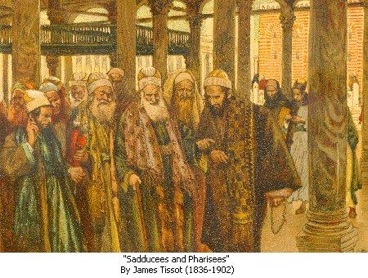
The Sadducees were priests who based their legitimacy on their descendance from Zadok, a priest who lived at the time of King David. It was the Zadokite line of priests that emigrated back to Jerusalem when Persians allowed the Israelites to return from captivity. They were intent on holding onto their power which came through the ministry of the temple. Like the Samaritans, the Sadducees regard only the writings of Moses to be scripture and they interpreted them very literally.

The corrupting influence of power caused them to cooperate with the Greeks when Israel became a client kingdom of the Greek empire. Although Pharisees were also in the Sanhedrin, the Sadducees became the prominent group controlling the Sanhedrin notably during the Greek and Roman occupation.

Because the Sadducees only included the books of Moses in the scripture, they did not develop any beliefs in the resurrection, which caused conflicts with both with Jesus and the Pharisees. The interactions that are recorded are all confrontational. There is an obvious tension between Jesus and the Sadducees. Jesus came to undergo death and resurrection and to eliminate the need for continual temple sacrifices, but the Sadducees did not believe in resurrection and their status was dependent on the continuation of the temple sacrifices. In contrast to the poor and needy ‘lost sheep of Israel,’ the Sadducees were the rich upper class. The Sadducees disappeared from history upon the destruction of the temple by the Romans in AD 70.

Observe

Read Matthew 16:5-11. What is the yeast of the Sadducees?

Dynamic tension

Dancing in the Kingdom- Table of Contents

Dancing In the Kingdom – Part 1 – Shadows of the Kingdom – Chapter 3 – The image-bearers

Dynamic tension

[Bible references: Genesis 3:11-19; 1 Corinthians 3]

Just as there are tensions within the attributes of the living God that actively interact with each other, so also God’s image-bearers have to deal with similar tensions. Those tensions can combine in some very interesting ways. For instance, how to creatively combine work and play and worship. But in addition to those good and healthy tensions, we also impose another tension due to our rebellion against God. Our rebellion has created tensions not only within us, but between us and also between us and God.

Observe

Read Genesis 3:11-19. What kind of tensions did our rebellion create between humans and between the humans and God?

Dynamic Tension

Dancing in the Kingdom- Table of Contents

Dancing In the Kingdom – Part 1 – Shadows of the Kingdom – Chapter 2 – The God who created

[Bible references: Luke 17:1-10; Ephesians 2;1-10]

Dynamic Tension

When we encounter Biblical statements that seem to conflict with each other, we need to hold to one of the principles of biblical interpretation, we need to examine any interpretation in the light of all other scripture – that is, let scripture interpret scripture. Even so, our best interpretations may still leave us with tensions between apparently conflicting statements. In those cases, we should acknowledge and accept those tensions rather than try to force those statements to a particular resolution.

The study of biology may provide good analogues in dealing with those tensions. For instance, in biological life, it seems that there are no simple formulas, no simple rules. While there are underlying precisely defined processes like the laws of chemistry and physics, there are also overlying complex and variable biological processes that are adaptable to circumstances around them.

Even more, living organisms by themselves are noted by intricately balanced but unstable processes that, if the balance between processes fails, there is a most certain death. One of the standard definitions of life is that living things must evade the decay to equilibrium while at the same time maintaining internal order and organization.[1]  One example that we live with all the time is with our skin – every day our skin is shedding cells and creating new cells such that, on average, every 27 days an entire layer of skin is being replaced. Our skin seems “stable” and seems to stay the same even though entire layers of skin are constantly being replaced.

That type of process holds true for all the processes happening in all the cells of living organisms; The internal structures seem to be stable, while matter and energy are constantly flowing through them and the materials within the internal structures are being constantly refreshed. More remarkably, if we examine all of this activity, we discover that this activity is sustained by an array of complex sets of interdependent processes where one set of processes feeds off the by-products of other processes and visa-versa. All this activity is delicate in one sense, if some processes fail at one point the result can be death. In another sense, the processes are flexible, allowing an organism to live in a wide variety of circumstances (environments). Thus, we have a paradox of systems that are simultaneously fragile and robust.

This dynamic tension can be seen on another level with the interactions of bone and muscle. In a given skeletal muscle, some fibers are attached to one bone in one direction and some fibers are attached to another bone in another direction. For instance, in your bicep muscles, some fibers attach to the shoulder and the other fibers attach to the elbow. As the fibers within a muscle pull against one another the bones they are attached to move. You can see this activity when you “make a muscle.” As you draw your forearm towards your shoulder, you see the biceps start to bulge in the middle as the opposing fibers pull into each other.

Exactly which way the bones move is determined by the creature that controls the muscles as the creature interacts with the environment, determining what direction to go or what task to do. While it seems at one level that in a given muscle the fibers are working against one another and seem to work opposite to one another, they are in fact on a larger scale working with each other to accomplish particular tasks.

All of this seems to reflect what we see in spiritual life. On one level, the attributes we see in the living God, His holiness, grace, etc. never change although they are constantly interacting with different circumstances. As circumstances change, although it may seem that God’s responses may change, it is not because God has changed, only that God’s dynamic response to different circumstances, whether globally or locally, has changed.

So, as we consider this, it may seem that some of God’s characteristics conflict with each other or seem to pull against one another. For instance, how is God’s perfect desire for justice able to be reconciled with God’s grace? Or how is it that He can be the Lord of all and able to also be the Servant of all? In fact, God is interacting with the world, determining what He wants to do and then coordinating His attributes to do what He desires. For example, although God’s authority and servanthood seem to be in tension with one another, He is coordinating them to deal with our individual circumstances. These apparent tensions are resolved, strengthened and harmonized in God himself.

I call this interaction, Dynamic Tension; a process controlled by a person or an organism in which the attributes seem to be pulling in different directions but are in fact working in concert with one another to accomplish particular goals. These tensions carry over into many areas of theology. We see that as different congregations wrestle with apparently conflicting issues, they make decisions based on their particular situations. Different congregations in different situations will come to different resolutions.

We are blessed to have both God’s creation itself and God’s revelation available to us as we try to try to learn about the living Creator. Fortunately, it is to our blessing that we don’t have to know everything about God for us to know or understand him, because we can at best only know Him in part. But meanwhile we have some paradoxes about God for us to examine and we will start exploring some of those paradoxes now.

“… many of the great theologians and leaders of the church—including Justin Martyr, Irenaeus of Lyons, Origen of Alexandria, Augustine of Hippo, Thomas Aquinas, Martin Luther, John Calvin, and John Wesley—in various ways believed that Creation bears witness to the glory and truth of its Creator and that this witness is fully compatible with the witness of Scripture.” [2]


[1] Weber, Bruce. “Life” Stanford Encyclopedia of Philosophy 7 Nov 2011, plato.stanford.edu/entries/life

[2] Mann, Mark H. “The Church Fathers and Two Books Theology” Biologos 4 Nov 2012 biologos.org/articles/the-church-fathers-and-two-books-theology

Observe

Read Luke 17:1-10; Ephesians 2:1-10. Verse 10 in both of these passages seems to say the opposite thing. How does the context of Luke 17:10 and Ephesians 2:10 help to resolve these two verses?

Dynamic Tension

Dancing in the Kingdom – Table of Contents

Part 1 – Shadows of the Kingdom, Chapter 3 – The Image-bearers

[Bible references: 1 Corinthians 3]

Just as there are tensions within the attributes of the living God that actively interact with each other, so also God’s image-bearers have to deal with similar tensions. But in addition to those good and healthy tensions, we also impose another tension due to our rebellion against God. Our rebellion has created tensions not only within us, but between us and also between us and God.

Reflect

Do you have any relationships that do not have some unhealthy tension?

Observe

Read Genesis 3:11-19. What kind of tensions did our rebellion create between humans and between the humans and God?

Dynamic Tension

The Impossible Dance – Table of Contents

The Impossible Dance – Chapter 1 – Mystery and Confusion

Throughout the Bible there are statements that seem to conflict with each other. Since one of the principles of biblical interpretation is to examine any statement in the light of all scripture, the best option for understanding the tension between apparently conflicting statements would be to simply accept the tensions between those paradoxical statements rather than to resolve every issue to an understanding to a particular point.

The study of biology may provide good analogues in dealing with those tensions. For instance, in biological life, it seems that there are no simple formulas, no simple rules. Although, on the one hand, there are underlying precisely defined processes like the laws of chemistry and physics, on the other hand, there are overlying complex and variable biological processes that are adaptable to circumstances around them.

Even more, living organisms by themselves are noted by intricately balanced but unstable processes that, if the balance between processes fails, there is a most certain death. One of the standard definitions of life is that living things must evade the decay to equilibrium while at the same time maintaining internal order and organization.  One example that we live with all the time is with our skin – every day our skin is shedding cells and creating new ones such that, on average, every 27 days an entire layer of skin is being replaced. Our skin seems “stable” and seems to stay the same even though entire layers of skin are constantly being replaced.

That type of process holds true for all the processes happening in all the cells of living organisms; The internal structures seem to be stable, while matter and energy are constantly flowing through them and the materials within the internal structures are being constantly refreshed. More remarkably, if we examine all of this activity, we discover that this activity is sustained by an array of complex sets of interdependent processes where one set of processes feeds off the by-products of other processes and visa-versa. All this activity is delicate in one sense, if some processes fail at one point the result can be death. In another sense, the processes are flexible, allowing an organism to live in a wide variety of circumstances (environments). Thus, we have a paradox of systems that are simultaneously fragile and robust.

This dynamic tension can be seen on another level with the interactions of bone and muscle. In a given skeletal muscle, some fibers are attached to one bone in one direction and some fibers are attached to another bone in another direction. For instance, in your bicep muscles, some fibers attach to the shoulder and the other fibers attach to the elbow. As the fibers within a muscle pull against one another the bones they are attached to move. You can see this activity when you “make a muscle.” As you draw your forearm towards your shoulder, you see the biceps start to bulge in the middle as the opposing fibers pull into each other.

Exactly which way the bones move is determined by the creature that controls the muscles, as the creature interacts with the environment, determining what direction to go or what task to do. While it seems at one level that in a given muscle the fibers are working against one another and seem to work opposite to one another, they are in fact on a larger scale working with each other to accomplish particular tasks.

All of this seems to reflect what we see in spiritual life. On one level, the attributes we see in the living God, His holiness, grace, etc. never change although they are constantly interacting with different circumstances. As circumstances change, although it may seem that God’s responses may change, it is not because God has changed, only that God’s dynamic response to different circumstances, whether globally or locally, has changed.

So, as we consider this, it may seem that some of God’s characteristics conflict with each other or are pulling against one another. For instance, how is God’s perfect desire for justice able to be reconciled with God’s grace? Or how is it that He can be the Lord of all and able to also be the Servant of all? In fact, God is interacting with the world, determining what He wants to do and then coordinating His attributes to do what He desires. For example, although God’s authority and servanthood seem to be in tension with one another, He is coordinating them to deal with our individual circumstances.  At some point He sees the need to demonstrate more authority and at other times, more servanthood.

I call this interaction, Dynamic Tension; a process controlled by a person or an organism in which the attributes seem to be pulling in different directions but are in fact working in concert with one another to accomplish particular goals. These tensions carry over into many areas of theology. We see that as different congregations wrestle with apparently conflicting issues they make decisions based on their particular situations. Different congregations in different situations will come to different resolutions.

We are blessed to have both God’s creation itself and God’s revelation available to us as we try to try to learn about the living Creator. Fortunately, it is to our blessing that we don’t have to know everything about God for us to know or understand him, because we can at best only know Him in part. But meanwhile we have some paradoxes about God for us to examine and we will start exploring some of those paradoxes now.

Just as there are tensions within the attributes of the living God that actively interact with each other, so also God’s image-bearers have to deal with similar tensions. But in addition to those good and healthy tensions, we also impose another tension due to our rebellion against God. Our rebellion has created tensions not only within us, but between us and also between us and God.