Flourishing community

Dancing in the Kingdom- Table of Contents

Dancing In the Kingdom – Part 3 – Dancing in the Kingdom– Chapter 17 – Finding our place

Flourishing community

[Bible references: Proverbs 17:17; 27:10; Ecclesiastes 4:9-10; Romans 12; Philippian 4:4-9; Hebrews 10:19-25; 13:2;1 Peter 1:12 22; 4:9; 2 Peter 1:3-11]

One mark of the Kingdom of God is the presence of communities that flourish. In this in-between time, these communities will not be any more perfect than the individuals within the community. But there are practices that we can engage in that will help our communities flourish. How we share our lives as individuals, congregations, or families will either draw people in or push them away. Within the culture that surrounds us, there are many practices that serve to isolate individuals, creating loneliness and emotional fragility. However, within the context of healthy congregations, there are various practices that serve not only to build us up within the church community but can also impact the communities around us. Christine Pohl has identified four characteristics that will sustain flourishing communities:[1]

  1. Gratefulness: As much as we are aware of how God has provided for us and we are secure in that knowledge, our gratitude can flourish. When we have gratitude, our lives will be enhanced by being more likely to notice what is good and beautiful around us. When our hearts are grateful, we are enabled to increase our ability to love and to offer grace to one another.

“Be thankful for the smallest blessing, and you will deserve to receive greater. Value the least gifts no less than the greatest, and simple graces as especial favors. If you remember the dignity of the Giver, no gift will seem small or mean, for nothing can be valueless that is given by the most high God.” [2]

2. Making and keeping promises: We arrange much of our lives according to our expectations of others’ behavior and the promises they make. Broken promises lead to a sense of betrayal and disappointment to the loss of integrity of the promise maker. On the other hand, promises that are kept strengthen our commitment and love with one another and provides stability for the community.[3]

“The history of the human race, as well as the story of any one life, might be told in terms of commitments. . .  At the heart of this history . . . lies a sometimes hidden narrative of promises, pledges, oaths, compacts, committed beliefs, and projected visions.” [4]

3. Truth-filled lives:[5] Without expectations of truth, there can be no trust. One need only to look at the broken social and political environment that we have today and see the consequences of a society in which trust is broken.

4. Hospitality:[6] To be truly hospitable is to recognize each other’s common humanity, to set aside the priorities of efficiency and instead, to care for and nurture one another, to prioritize our needs for rest and renewal. According to a tradition in Africa, no one individual is a host but the rather it is the community that offers hospitality.

“Welcome is one of the signs that a community is alive. To invite others to live with us is a sign that we aren’t afraid, that we have a treasure of truth and of peace to share.;” Ogletree, Thomas. Hospitality to the Stranger (Fortress Press, 1985) “to be moral is to be hospitable to the stranger.” [7]

All the characteristics mentioned above should ideally be present in the Christian community. When we notice their absence from the communities around us, we can see the destruction created by their absence. A healthy church then has the opportunity to bring a healing influence into the communities around us. As Leslie Newbigin has stated, “the presence of a new reality will be made known by the acts that originate from it.”[8]

One of the challenges/opportunities for the church is to maintain those healthy characteristics across all the boundaries of the different groups within the church so that there is healthy interaction between married and single adults, between adults and children, between different ethnic groups. Paying attention to those interactions within the church will help to navigate those interactions with those outside the church.

Linked to the gift of hospitality is the gift of friendship. Because this gift is costly in the amount of time and energy that we devote to someone else, exercising this gift outside the bounds of the church will usually require significant intentionality,


[1] Pohl, Living into Community, Cultivating Practices that Sustain us William B. Eerdmans Publishing Company 2012. eBook

[2] Kempis, Thomas à. The Imitation of Christ early 15th century (Chapter 35)

[3] Arendt, Hannah. The Human Condition University of Chicago Press, 1958, p.244

[4] Farley, Margaret A. Personal Commitments: Beginning, Keeping, Changing Harper & Row, 1986,pp. 12-13, 34, 38

[5] Aquinas, Thomas, Summa Theologica, Vol 2, Question109: “Of Truth”

[6] Vanier, Jean, Community and Growth 1979

[7] Turyomumazima, Bonaventure, “Africa Files – Christ in Africa: Stranger, Guest, Host” www.africafiles.org/printableversion.asp?id=14009 (no longer available); De Vries, Roland. Becoming a Guest: Christology and Ecclesiological Identity Erudit Volume 25, Numero 2, 2017 p. 165-184 www.erudit.org/fr/revues/theologi/2017-v25-n2-theologi04371/1056942ar (p. 165-184)

[8] Chilcote, Paul and Warner, Laceye” The Study of Evangelism: Exploring a Missional Practice of the Church. Wm B Eerdmans Publishing Co. 2008 Chapter Four, Leslie Newbigin. Evangelism in the context of secularization.

Reflect

Of the characteristics mentioned by Pohl, which are evident in your local church community? 

Observe

Read 2 Peter 1:3-11. What would a community look like if everyone was living out this passage?
Paradox of responsibility

Dancing in the Kingdom- Table of Contents

Dancing In the Kingdom – Part 2 – The Kingdom Revealed – Chapter 12 – Launching the church

Paradox of responsibility

[Bible references: Jeremiah 3:1-9; 31:1-4; Zechariah 8:16; Ephesians 4; Philippians 2:1-18]

This then is our paradox; we are given the responsibility of correctly handling the Truth of God even when we cannot completely understand what that Truth is. For instance, how can we understand that there is one person, God, and yet have God revealed in three personalities:  God the Father, God the Son and God the Holy Spirit? How can the God who exists outsides the confines of time and space, confine Himself to a particular space and time and come to be born and then to live and die as a normal human being? How can these things be?

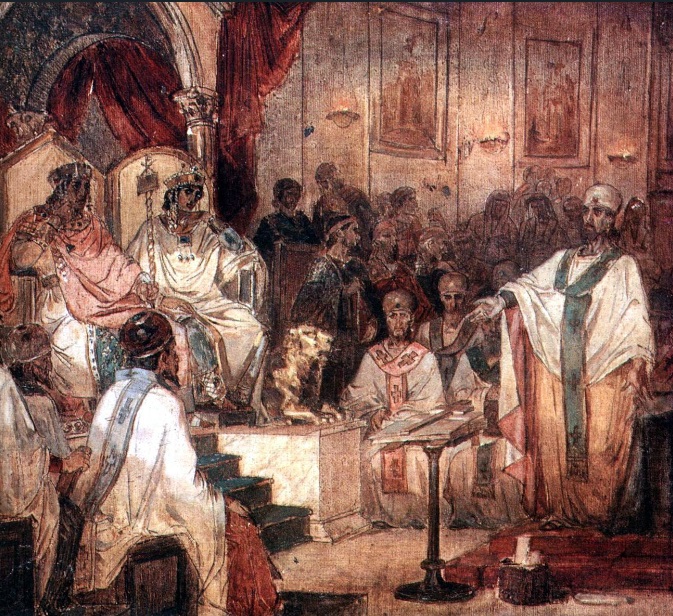
As we look across the breadth of the history of the church, we see the church wrestling with these paradoxes and others. The result of that wrestling sometimes has gotten downright ugly with the church sometimes quite literally killing each other about it, not only with those outside the church but within it. In fact, if one were to look across the world at the state of Christianity, it might seem to one of the most fractious and divided groups ever.

How can it be that God would entrust this church with the task of bringing that His Truth to others and from one generation to the next, the church that has from time to time seemed to fail the apostle Paul’s challenge to be “one in the Spirit.”

Reflect

When children are not compliant as they grow up, do we just give up on them?

Observe

Read Zechariah 8:16; Ephesians 4; Philippians 2:1-18. What should the church look like as it handles its responsibility to presenting the truth of God to each other and to the world?

Guardians of the truth

Dancing in the Kingdom- Table of Contents

Dancing In the Kingdom – Part 2 – The Kingdom Revealed – Chapter 12 – Launching the church

Guardians of truth

[Bible references: Psalm 25:2; 45:4; 145:18; Proverbs 12:19; 22:21; Isaiah 45:19; 59:15; Jeremiah 5:1; Zechariah 8:16-19; John 1:14-17; 4:23-24; 8:44-45; 14:6; 16:13; Acts 20:30; Romans 1:18-25; 2:1-20; I Corinthians 11:18-19; 1 Timothy 4:6; 2 timothy 2:14-29; 1 John 2:20-21; 3 John 1:1-12]

God is always in part incomprehensible, mysterious, and paradoxical, which leads to an inevitable diversity of ideas about Him. And yet He has left us with a challenge, He has declared Himself to be the Truth and He has charged the church to be His instrument in making disciples, therefore making us the guardians of that truth. This means that when the church goes about its business of growing in the knowledge of God and developing doctrines about the One who always mysterious, there will be an inevitable tension of trying to discern when the developing diversity of ideas about the Truth will lead to ideas that oppose the gospel or lead to the revealed knowledge of God.

Observe

Read 2 Timothy 2:14-19. What lies are Timothy told to be concerned about?

Need for doctrine

Dancing in the Kingdom- Table of Contents

Dancing In the Kingdom – Part 2 – The Kingdom Revealed – Chapter 12 – Launching the church

Need for Doctrine

[Bible references: 1 Timothy 1, 4; 2 Timothy 4:2; Titus 1:9; 2 John 1:8-9]

The growing process has not been easy, and the combination of new challenges and our ever-present sin has resulted in wide divisions in the church, leading some to think that the doctrine that ought to be holding us together seems to be tearing us apart instead. In fact, the opposite should be true. Our doctrine should be holding us together. In fact, if the church doesn’t have its own doctrine and culture, how would we stay together as a church if we are all simply doing our own things? How would we agree how to worship in common or define who is in the church or how we would worship? Under what pretext would we invite people into the church? What common truth would we hold to?

Observe

Read 1 Timothy 4. Whatwarnings are given to Timothy about those who would create problems?

Guarding the faith

Dancing in the Kingdom- Table of Contents

Dancing In the Kingdom – Part 2 – The Kingdom Revealed – Chapter 12 – Launching the church

Guarding the faith

[Bible references: Matthew 5:11-12; Romans 5:3-4; 1 Corinthians 11:29-31; 13:7; Ephesians 6:10-18; Philippians 1:10; 1 Timothy 4:16; 2 Timothy 2:10-12; 4:5; Hebrews 10: 36; James 1:2-12; 3:2-12; Revelation 2:3]

The church was launched in a world that was opposed to it. Jesus made it very clear that following him was in invitation to suffer. There would be enemies both within and outside the church, enemies that were sometimes not so apparent and therefore requiring discernment by the faithful. The opposition takes many forms but behind all the opposition are the spiritual forces in heavenly realms.

The real enemy is not so much the individual people we see but the spiritual forces of darkness acting around us manifesting as deceivers, scoffers, false apostles, divisions in the church, idolatry, or immorality – all either around us or within us. The challenge of fighting against those forces requires us to put on the full armor of God: truth, righteousness, the gospel, faith, salvation, the Spirit, and the Word. We are called to be alert, to always pray, to learn discernment, to endure and persevere.

By both his life and his death, Jesus offered reconciliation to all cultures. By his teaching Christ called Jew and Gentile together; both were offered a place in God’s kingdom, with the ethnicity of the Jews giving them no advantage whatsoever. While Jesus modeled this reconciliation in his own life and ministry, it took his followers some time to put this aspect of his message into effect. When they did, however, the results were revolutionary. The Jewish disciples of Jesus were taught to reach out with love and acceptance to the Gentiles, whom they had come to think of as beasts. The Gentiles were invited into fellowship with the Jewish disciples without having to become Jewish. … multiculturalism means fostering a genuine respect for diverse cultural expressions such as music, art, literature, and dance, and diverse cultural traditions in such matters as education, the family, and work. Such respect does not mean ignoring moral or spiritual failings reflected in these cultural expressions and traditions (since these can be found in any culture, including European). It does mean recognizing that certain constants of human life — love, growth, need, aspiration, suffering, hope — find expression in all cultures. [1]

As we engage with other cultures, we can celebrate God’s imprint on his image-bearers which has produced many creative, diverse, and multicultural ways to display God’s goodness. As we do, we should take care to recognize that all the world’s cultures are also subject to corruption. In our role as God’s ambassadors, we can recognize the good displayed in each culture and also reach out to offer God desire to reconcile all people to himself.

Since you died with Christ to the elemental spiritual forces of this world, why, as though you still belonged to the world, do you submit to its rules:  Do not handle! Do not taste! Do not touch!”? These rules, which have to do with things that are all destined to perish with use, are based on merely human commands and teachings. Such regulations indeed have an appearance of wisdom, with their self-imposed worship, their false humility, and their harsh treatment of the body, but they lack any value in restraining sensual indulgence. (Colossians 2:20-23, NIV)

In our discerning of the good and the bad in the cultures around us, we should be discerning of our own cultures and behaviors, not just the good and the bad, but the universal and cultural expressions of the gospel.


[1] Bible.org “Christ and Cultures: Multiculturalism and the Gospel of Christ” Bible.org bible.org/seriespage/12-christ-and-cultures-multiculturalism-and-gospel-christ.

Read Ephesians 6:10-18; James 3:2-12. What does it take to survive as a fruitful Christian?

Desires and truths of the faith

Dancing in the Kingdom- Table of Contents

Dancing In the Kingdom – Part 2 – The Kingdom Revealed – Chapter 12 – Launching the church

Desires and Fruits of Faith

[Bible references: Psalm 1:1-3; John 15:1-5; 1 Corinthians 13; Galatians 5:22-23; Ephesians 4:11-16; Colossians 1:10; James 2:14-26]

A part of faith is the mental assent to the truth of who Jesus is who we are, but that is just the beginning. If the assent is real, then faith should include a submission of the will which will then lead to a lifestyle that demonstrates trusting in Jesus and submitting to His Lordship. This faith should affect who we are and should show up in our behavior as Jesus starts the process of transforming our character. The fruits of the Spirit ought to be increasingly visible in our lives. Becoming a mature Christian ought to seen in the maturity of the fruits of the Spirit in our lives.

For us to grow and mature, and produce spiritual fruits, we need to think like a farmer; growing fruit requires feeding and nurturing. To this end, Jesus cautions us to remember that we are like branches on a vine, we need to stay connected to him to grow. Staying connected to God however is not an easy thing for us as we tend to be like sheep mindlessly wandering around. Thankfully, we have a God who has never stopped pursuing us.[1]

Our dance with God is a dance where He works on the process of transforming our lives to look more like Him. Our personalities will not all be the same, but there are certain characteristics that should become more evident in our lives. One concise list of those characteristics can be found in a short sentence within the letter to the Galatians, “But the fruit of the Spirit is love, joy, peace, forbearance, kindness, goodness, faithfulness, gentleness, and self-control. Against such things there is no law.” (Galatians 5:22-23). The first and most primary characteristic is that of love, a fuller expression of which can be found in 1 Corinthians 13. The epitome of love is described in John 15:13, “Greater love has no one than this, that someone lay down his life for his friends.” God created us out of the outpouring of His love, and He has created us to be in His image. Love is the characteristic that permeates all of God’s other characteristics and it should be the driving force in all we do.


[1] Compelling Truth “Does God Pursue Us?” Compelling Truth www.compellingtruth.org/does-God-pursue-us.html

Reflect

Our lives should be increasingly marked by a love that has responded to the love of God. We should not be driven by fear or hatred or legalism. In what ways do we seem to be motivated by something other than love?

Observe

Read Psalm 1; John 15:1-5; 1 Corinthians 13. What should mark a life of faith?

Basics of the faith

Dancing in the Kingdom- Table of Contents

Dancing In the Kingdom – Part 2 – The Kingdom Revealed – Chapter 12 – Launching the church

Basics of the faith

[Bible references: Acts 1:12-26; 2:42-47; 4:32-37; 6:1-6; 8:14-17; 9:26-31; 11:1-18; 13:1-3; 15;1-29, 36-41; 1 Corinthians 1:10-17; 5:1-13; 6:1-11; 10:1-22; Galatians 2:1-14; 3:10-14. James 2:1-13; 3:1-12; 4:1-16; 2 Peter 2:1-22]

There are many aspects of the gospel, but it is nothing if it is not grounded in truth, about God and about us. But the truth is not the only thing, in fact, the whole truth of the gospel must be grounded in God’s character. The gospel is not just a set of facts that need an intellectual assent but good news that calls us to make an honest assessment of ourselves and to make a change of trust and allegiance.

The gospel is good news.

  • The gospel is the good news that God created us to pour his love into us.
  • The gospel is the good news that even though we are born in rebellion against God and are unable to keep doing things that separate us from him, that he has taken upon himself the punishment we deserve so that we don’t have to.
  • The gospel is the good news that when Jesus was resurrected and ascended into heaven, He went prepare a place for us there.
  • The gospel is the good news that if confess our sins then He is faithful and just and will forgive us our sins and cleanse us from all unrighteousness.
  • The gospel is the good news that once we begin our journey of trusting Jesus, then we begin the process of becoming more like Jesus.
  • The gospel is the good news that all of that and more is true.

There are various reasons that we sometimes don’t want to accept the good news. One of the biggest reasons is that we don’t want to acknowledge how bad we are and how deeply sin affects us. When we feel that way, we can start to imagine that we can balance out the good things we do with the bad things we do, and we’ll end up all right and God will be happy with that. But the gospel message is that,

  • the bad news is that our very nature is in rebellion against God and no amount of good works can make us unrebellious.
  • the bad news is that we can’t earn our way to a right relationship with God.
  • the bad news is that if we are not made right before God then we will suffer God’s judgement and wrath.
  • the good news is that Jesus paid the penalty for all our sins, past, present, and future.
  • the good news is that we can be made righteous through faith.
  • the good news is that it is by God’s grace that we are saved through faith. It is a gift – in fact, it can’t be something we earn.
  • the good news is that we only need to repent and confess our sins and receive His forgiveness.
  • the good news is that we can allow God to transform our lives and enable us to live lives that are pleasing to him.
  • the good news is that once God imparts his righteousness to us, we become his heirs.

Once we put our trust in Him, he does not automatically make us sinless. That won’t happen until he returns; and we all are resurrected with new, transformed bodies. It is through our untransformed bodies that we inherit the sin nature.

  • The good news is that the day of resurrection will happen.
  • The good news is that, between now and then, we can offer ourselves to God and He will, over time, begin the transformation process here in this life.
  • The bad news is that until then we will continue to rebel against God.
  • The good news is that in this in-between life that God can use our current struggles to strengthen us.
  • The bad news is that unbelievers will regard us as foolish.
  • The good news is that our apparent foolishness in committing our lives to Jesus is actually wisdom.

There is a lot of good news for us, and it’s based upon the truth of Jesus. Truth is important for Jesus, and in fact, he claims that He himself is the truth. The gospel is based on the truth, so it matters that we get the facts straight. That is why, one of the concerns expressed in the New Testament is the need to hold onto sound doctrine.

Read Galatians 3:1-12. What part of the gospel were the Galatians struggling with?