Mystery of the kingdom and eschatology

Dancing in the Kingdom- Table of Contents

Dancing In the Kingdom – Part 2 – The Kingdom Revealed – Chapter 13 – Distinctives within the body of Christ

Mystery of the kingdom and eschatology

[Bible references: Isaiah 2; 60; Joel 2; Micah 4; Daniel 7; Matthew 24; Luke 17; Revelations 20]

What is the kingdom of God/Heaven?

The kingdom of Heaven refers to where Jesus reigns. Heaven has always been under his rule and when he returns and our current earth is transformed into the new earth, Jesus’ kingdom will include that as well. In the meanwhile, His kingdom includes all those who have accepted Jesus as their king. Some only apply the Kingdom of God to only the reign of God in heaven or the reign of God after earthly governments are done away with.

How and when will Jesus return?

Discussion about the end times[1] has always been problematic because of the nature of prophetic language. This has led to much contention in the church about how events will occur or have occurred. Even though Jesus has cautioned us that only the Father knows when that will happen, people have not stopped trying to “read the signs.”

The clues about the Messiah in the Old Testament were confusing to interpret. Even after the incarnation of Jesus, we know that the disciples were confused about how the events of the end times such that Jesus’ death was incomprehensible. Even after Jesus’ resurrection and ascension there was still confusion, and it took some time to sink in that Jesus’ return was not going to happen for a while.

There are a wide variety of thoughts about the Biblical prophecies concerning the end times. The questions deal with such things as: is the book of Revelation about events now past us (e.g., the destruction of Jerusalem in AD 70) or about future events or both, does the 1000 years talked about in Revelation 20:1-15 occur now or in the future and is the 1000 years literal or metaphorical, will there be a “rapture” of believers before a coming time of great tribulation, since there was no nation of Jews after the destruction of Jerusalem do the promises that applied to Israel now apply to the church – and other questions.

There are various historical factors and hermeneutical questions that led to some of the variations in the way that these questions were answered: whether the prophecies should be interpreted literally or metaphorically, whether the Old Testament laws should be kept in effect by the church, the importance of the destruction of Jerusalem in AD 70 and the consequent re-creation of the nation of Israel in AD 1948. Regardless of the way those questions are answered, the more important issue is our behavior in the present.

The role of the prophecies in the past had been to either warn people of behaviors they needed to change or to provide encouragement and hope in the times of difficulty. Wherever we stand on these prophecies, those intentions should be our focus; our behaviors in the present life and our hope to sustain us.


[1] Herrick, Greg. “9. Eschatology: End Times” Bible.org bible.org/seriespage/9-eschatology-end-times

Mystery of the church

Dancing in the Kingdom- Table of Contents

Dancing In the Kingdom – Part 2 – The Kingdom Revealed – Chapter 13 – Distinctives within the body of Christ

Mystery of the church

[Bible references: Acts 2:42-47; 1 Corinthians 12:17, 27; 2 Corinthians 5:20; 1 Peter 2:9]

What is the church?

As commonly used in current times, the “church” is a building to go to. In biblical terms it referred to an assembly of believers (called out ones).[1] How we understand this idea can influence our behavior. There are a few biblical metaphors that describe the church.

  • The body of Christ – This metaphor brings the ideas: that Christ is the head of the church, and we are His presence in the world, that each of us has a unique role in bringing Christ’s presence in the world. Our unique roles are distinguished by the spiritual gifts imparted to each of us to enable us to build each other in our faith.
  • A holy priesthood – This metaphor brings the idea that we have a relationship with God and can act as intermediaries.
  • A temple – This metaphor describes each individual as a stone in the temple and that it is all of us together who make up the temple, that is, the place where God resides on earth.
  • Ambassadors – This metaphor highlights our role in representing God’s to those not reconciled to God.

In the beginning, the organization of the church was not given in detail but seemed to be a cohesive group that “devoted themselves to the apostles’ teaching and to fellowship, to the breaking of bread and to prayer … had everything in common … broke bread in their homes and ate together with glad and sincere hearts.”

Is the church more than a Jewish sect?

[Bible references: Romans 11:17; Ephesians 3:6]

At first the church was mainly a Jewish sect. Jesus focused his ministry within the borders of Israel and his disciples were mainly Jewish. After Jesus died, that situation did not change much until Jesus took definitive steps with Peter and Paul to reach the non-Jews (Gentiles). Until that happened, the church mainly consisted of Jews who happened to also be believers, and as Jews, kept up many Jewish practices. But when Gentiles started to be included, there was the question of whether they needed to become Jewish to belong. It took a council of the church to determine that Gentiles were not bound by the Jewish practices. But even after that council, the debate persisted.[2]

In the Old Testament, we are told that Israel will be a blessing to the rest of the world, but it was not revealed just how that would happen. In Ephesians 3, the apostle Paul explains that “through the gospel the Gentiles are heirs together with Israel, members together of one body, and sharers together in the promise in Christ Jesus.” And then in Romans 11, Paul explains that the Gentiles were “grafted” into the family of believing Jews, of whom Abraham is the root, so that the Gentiles may receive all the same blessings.

What is the visible and invisible church?

The invisible church consists of all those, past, present, and future, who have put their trust in Christ. Only God knows who they all are. The visible church is the groups of people gathered together as communities. Both believers and unbelievers may be in the visible church.

Some congregations/ denominations are very strict about how to interpret scripture and/or have a limited view of forgiveness, and so would put limits on who they would consider to be in the church.[3] Other congregations/denominations have an extreme view that all of society should be under Christian rule[4] and then misused Luke 14:23, “Go out into the highways and hedges and compel them to come in,” that they would even resort to torture in order to persuade a people to make a “confession of faith.” Then there are those who think that everyone will ultimately be saved.[5]

Who has authority in the church?

As the church grew and spread throughout the Roman Empire, the natural development was to “institutionalize” the church, trying to make the church more effective with more formal organization. While the apostles were still alive, it was possible to unify the church around the apostles, but of course that was temporary.

Over time, different governance models emerged within the church as there was no model within the church except for the synagogue. In the episcopal model, there is a single leader, or bishop, who oversees a group of congregations and selects the pastors for each congregation. In the presbyterian model, there is a “plurality” of elders, who oversee a congregation or a group of congregations – the congregation may elect their pastor, but the Presbytery has to approve whoever is selected. In the congregational model, the congregation itself is its ultimate overseer and selects its pastor.

Some congregations are independent from one another, and some are affiliated with other congregations. The affiliation may be a denomination where there is strong oversight by the denomination over the individual congregations, but some affiliations are mainly an association for the purpose of sharing resources, but the association has no oversight function.

Some congregations emphasize the importance of maintaining apostolic authority by maintaining the transfer of authority of the apostles and trace the leadership of the church from one generation to the next beginning with the apostles.[6] The Roman Catholic denomination further emphasizes their authority is transferred from the apostle Peter, whom they think was given the most authority from Jesus. Other denominations will maintain that they are apostolic because of their faithfulness to scripture and therefore to the apostolic teachings.

One issue related to authority within the church is related to gender roles. Due to apparent conflicts in some Bible passages, two main views have emerged regarding the role of women in the church On one side, there is no restriction of ministry roles because of gender, but on the other side, women are restricted from any role in which they have spiritual authority over men.

What is the role of elder, bishop, deacon, priest?

The New Testament doesn’t clearly specify how to organize a congregation and that has resulted in congregations organizing themselves in a variety of ways. The New Testament does show examples of elders (aka bishops) serving as spiritual leaders of a congregation and deacons serving the physical needs of the congregation. Priests, in the Old Testament performed duties for God on behalf of the other people. The New Testament talks about Christ being the high priest for all of us but then talks about all Christians as being priests since we all have direct access to God and our role as Christians is to present ourselves as a living sacrifice to God.

The first denominations that emerged did keep the title of a priest, no longer offering the Old Testament sacrifices but rather now sharing the sacrament of the Last Supper. The Orthodox and Catholic traditions consider the bishops who oversee the priests to be the elders of the denomination. The priests are chosen to serve the sacraments, although they also serve in other ways with deacons helping the priests in carrying out the liturgy in the worship service or serving in other ways as well. In this context, the spiritual leadership of bishops or priests is recognized by the use of honorific titles such as Reverend or Father.

Protestant traditions vary. Anglican and Episcopal congregations retain the title of priest, while in other Protestant traditions congregations are led by pastors or elders.[7]

In some congregations, the pastor is considered to be the elder and the lay leaders are considered to be deacons. In other congregations the pastor is considered to be a teaching elder (if that title is used) while the lay leaders are considered to be ruling elders, or just elders. Some congregations are governed primarily by the pastor, some by a group (plurality) of elders, and some by the congregation itself.

What is the function of a creed?

As explained at the beginning of this chapter, there is much of God that is beyond comprehension. So, when God revealed himself through the prophets, the revelations were more in the form of stories and the interactions of God with the world than a spelled-out theology. That type of revelation requires us to do some of amount of interpretation as we try to better understand God, and that process of interpretation has been the function of the church at large. However, some individuals in the church came up with teachings that seemed to be more than minor differences and actually opposed the more accepted teachings of the church. Those ideas were considered to be heretical. Over time, to combat the heresies that arose, the church developed abbreviated teachings of the church called creeds.

As conflicts within the church developed, different sets of creeds started to emerge. The Protestant section of the church caused even more divergence with the creation of more detailed creedal statements called “confessions of faith,” while other congregations claimed to be non-creedal, stating that the Bible as a whole was their creed because creedal statements are limited and could never present a comprehensive theology of the church.

How can broken people within broken congregations can be instruments of God?

[Bible references: Romans 7:7-25; 1 Timothy 5:10; 2 Timothy 2:21; 3:17; Ephesians 2:10; Colossians 1:10; Hebrews 13:21]

In this time between the Kingdom has come and is yet to come in full, even those of us who trust in Christ have wills that are internally divided between the desire to do good and the desire to do evil. Despite our brokenness, God still desires to use us to accomplish His will on earth. He did not remove the mandates given to us back in Genesis. We may be broken instruments, but God knows how to use broken instruments.

Is the church an Organism or an Organization?

[Bible references: Matthew 28:16-20; 1 Timothy 3:1-6; Titus 1:6-9; 1 Peter 5:1-3]

When Jesus gave the command to “go into all the world” he didn’t specify how to do it, particularly how they should organize themselves to do it. They were to be his body, that is, his hands, feet, legs, eyes, ears, etc. on the earth to continue to do what he had begun. He left no instructions that we know of on how to organize themselves to complete the mission.

The apostles did have the model of synagogue that they could refer to.[8] The first people they reached out to were already in synagogues. But the Bible makes no specific mention of them using that model to organize themselves. In the apostles’ letters to churches and individuals that we have preserved in the Bible, there are some details from which various organizational models have been proposed, ranging from congregation choosing their own leaders to leaders over the congregations choosing leaders for each congregation.

What the Bible is clear on, is the qualifications for those who would lead the church. Some of those qualifications are to be blameless, even tempered, hospitable, to love what is good, to be disciplined, and to encourage others with sound doctrine. The biblical focus seems not to be on how leaders organize their congregations but on the qualifications that those leaders should have.


[1] Biblehub. “1577. Ekklesia” Bible Hub biblehub.com/Greek/1577.htm

[2] Marcos, Juan. Gutierrez, Bejarano. “The Judaisms of Jesus’ Followers” (Chapter 10, The Church Fathers and Jesus Oriented Judaisms) Yaron Publishing, 2017. Nazarenes held orthodox beliefs except in their adherence to Jewish law. Not deemed heretical until the fourth century. Ebionites, possibly a splinter group from the Nazarenes held that circumcision is necessary for salvation.

[3] This “rigorist” viewpoint was held by various people such as the “Novationists” (third century) and “Donatists” (fourth century).

[4] This idea is known as Christendom. Mere Orthodoxy mereorthodoxy.com/christendom-1200-words-give-take/

[5] Encyclopedia Britannica, “Universalism” Encyclopedia Britannia www.britannica.com/place/Universalism

[6] Encyclopedia Britannia “Apostolic succession” Encyclopedia Britannia www.britannica.com/topic/apostolic-succession

[7] Whitaker, Alexander. “The Protestant Problem with Priesthood” The North American Anglican 8 June 2020 northamanglican.com/the-protestant-problem-with-priesthood; Patheos “Leadership”

[8] Burtchaell, James Tunstead. “From Synagogue to Church: Public Services and Offices in the Earliest Christian Communities” Cambridge University Press 1992 (pp.349-352)

Reflect

The quality of church governance is more dependent on the quality of the leaders than the type of governance structure. What qualities do you think church leaders should have?

Observe

Read 1 Corinthians 12:17, 27; 2 Corinthians 5:20; 1 Peter 2:9. How does the different metaphors for the church help you to understand the church?


Mystery of God

Dancing in the Kingdom- Table of Contents

Dancing In the Kingdom – Part 2 – The Kingdom Revealed – Chapter 13 – Distinctives within the body of Christ

Mystery of God

[Bible references: Deuteronomy 6:4; Isaiah 55:8; Luke 3:21-22; John 10:30; 1 Corinthians 2:11-14; Philippians 2:5-11; 1 Timothy 3:15-16; 1 Peter 4:14; 1 John 1:6-8; 2:18-22]

How is it that there is only one God and yet Jesus is God, and the Holy Spirit is God, and the Father is God?

The Bible reveals but doesn’t explain this paradox. From the beginning of the Old Testament there is an explicit teaching that “The Lord our God, the Lord is one,” a teaching that contrasted with all the other cultures around at the time. And yet, from the beginning of the Old Testament we have hints that this One God is complicated. The New Testament gets more explicit about the situation but still does not explain it. This paradox, that there was a person, God, and that there are three persons (Father, Son, Holy Spirit) who are equally God, was given a name, Trinity.[1] The Greek side of the church uses a term, “perichoresis” to describe the interpenetration, etc. of the persons of the Trinity.

But just because a name was given to this paradox did not make it easy to accept. Various explanations were given to explain how this worked and how the three persons related to each other. Discussions involved how to define terms like person, substance and nature.

The following list shows a few of some different explanations that have been espoused but are considered to be heretical:

  • The three persons are three different modes of God expressing himself,[2]
  • The belief that God is only one person,[3]
  • Jesus was created and was less than the Father,[4]
  • God the Son and God the Holy Spirit are subordinate to God the Father not merely relationally, but also in nature and being.[5] This eventually led to the belief that neither Jesus nor the Holy Spirit are truly God.[6]

How can Jesus both be God and human?

There are two views held: 1) the one person Jesus has two natures, human and divine, combined in one person, or 2) the one person Jesus has one nature in which his divinity and humanity are combined, [7] In either case Jesus is made of the same substance as God[8].

There were controversies over whether that God could have suffered,[9] that Jesus only seemed to suffer,[10] or whether a human like Mary could have given birth to God.[11] 

So exactly what is the relation of the Holy Spirit to God the Father and God the Son?

There is a question about whether the Spirit proceeds from just the Father or the Father and the Son. This question was captured in a statement in the Nicene-Constantinople Creed which originally stated, “And we believe in the Holy Spirit, the Lord, and Giver of Life, Who proceeds from the Father ….” In disagreement with the Eastern Orthodox side of the church, the Roman Catholics felt the need to add the words “and the Son.” [12]

How does one develop knowledge of God?[13]

We need to distinguish that we are not trying to know about God as much as to know God, the person. We get to know a person by more than studying about a person, but rather spending time and doing things with that person. We are not a just a student, but a disciple.

When to comes to knowing about God, we find that He has revealed himself to all people through his creation and through our ability to reason.[14] That type of knowledge is not the same as knowing God as a person. To know God as a person, we need to be in his presence and allow him to reveal himself to us. We can do this through prayer, meditation, or scripture. Sometimes God will spiritually reveal himself to us or sometimes he will act through miracles. Other times we interact with God as we do things in His name.[15]

Whether we are learning through general or special revelation,[16] in either case, we are finite creatures trying to understand the infinite God, which is a task we can only do in part. But either way, the knowledge we seek is not an end itself but is for the sake of our relationship with God.

The following examples are some of the particular ways different parts of the church have practiced the pursuit of knowing God:

  • Eastern Orthodox traditions recognize our utter limits in knowing God through negative theology – that is, God’s infinite qualities are so far from our comprehension that it makes more sense to define what we know God is not, instead of trying to define what God is.[17]
  • Many traditions, including the Eastern Orthodox, posit the impossibility of our finite minds to be able to know God by intellectual means and we need to extend our knowledge of God through various spiritual practices such as fasting, prayer and meditation.
    • In the early church, an innovation introduced by Montanus[18] promoted revelations from the Holy Spirit. This caused the church to back away from any other innovations in theology.
    • Quakers have emphasized quieting oneself and waiting for God to reveal himself through the “inner light” that is available to all people.
  • The Eastern Orthodox tradition emphasizes the necessity of becoming transformed by God to become more like him to know God.[19]
  • In a reaction to an overemphasis on knowing God through intellectual means, a movement developed which emphasized spiritual disciplines such as Bible study and prayer.[20]
  • Some in the church over-emphasized knowing God by faith, leading to an anti-intellectual strain in the church. This despite the Christian heritage which did much to support the life of the mind. Christians founded universities, were some of the first to use science to investigate the natural world and have invested much towards loving God with “all our minds.”
  • Some in the church stressed the mysteries of God and the need to develop the more mystical disciplines of prayer, meditation, and contemplation.

[1] In AD 185, Irenaeus claimed that this concept was the teaching of the apostles, but it wasn’t until AD200 that Tertullian created the term, Trinity. Tertullian was responding to the teaching of modalism.

[2] Theopedia “Modalism” Theopedia theopedia.com/modalism

[3] Theopedia “Monarchianism” Theopedia theopedia.com/monarchism

[4] Arian (AD 256–336) was a presbyter in Alexandria. He did have some success in persuading people of his view and for a while it became quite a controversy in the church, but it was eventually denounced.

[5] Theopedia “Subordinationism” Theopedia theopedia.com/subordinationism”

[6] Theopedia “Unitarianism” Theopedia theopedia.com/Unitarianism

[7] Plante, Evan. “What is the difference between Dyophysitism and Miaphysitism?” Mainsail Ministries mainsailministries.org/index.php/q-a-a-god-bible-theology-culture/105-what-is-the-difference-between-dyophysitism-and-miaphysitism.html Dyophysitism (Christ has two natures, fully human and fully God) is the view of the Protestant, Roman Catholic and Eastern Orthodox. denominations. Miaphysitism (Christ has one nature that is both human and divine) is the view of the Oriental Orthodox denomination.

[8] Homoousios – In Greek, the argument looked even more subtle. Was Jesus made of the same substance (homoousios) as God or a similar substance (homoiousios).

[9] OrthodoxWiki “Nestorianism” OrthodoxWiki orthodoxwiki.org/Nestorianism

[10] OrthodoxWiki “Docetism” OrthodoxWiki orthodoxwiki.org/Docetism

[11] Theotokos means “God-bearer”

[12] This additional phrase, referred to as the “filioque” is held by the Roman Catholics and the Protestants but the original wording is held by the Eastern Orthodox.

[13] Epistemology is the study of how we can know things.

[14] This is sometimes called “general revelation.” Trying to understand God this way can be called “natural theology.”

[15] These different ways of knowing God by being with him in these activities is sometimes called “special” or ”divine revelation.”

[16] Got Questions “What is general revelation and special revelation?” Got Questions www.gotquestions.org/general-special-revelation.html

[17] OrthodoxWiki “Apophatic theology” OrthodoxWiki orthodoxwiki.org/Apophatictheology

[18] Early Christian History “Montanus” Early Christian History www.earlychristianhistory.info/montanus.html

[19] Theopedia “Theosis” Theopedia www.theopedia.com/theosis

[20] Theopedia “Pietism” Theopedia www.theopedia.com/pietism

Reflect

We truly have reached the limitations of our knowledge of God when we consider both the concept of the Trinity and the concept of Jesus being both fully God and fully human. How do you handle that limitation?

Observe

Read Philippians 2:5-11; 1 Timothy 3:15-16; 1 John 1:6-8; 2:18-22. What does it  mean to us that God came to us in human form as Jesus?

Apocalyptism

Dancing in the Kingdom- Table of Contents

Dancing In the Kingdom – Part 2 – The Kingdom Revealed– Chapter 10 – The Class of Apparitions

Apocalypticism

[Bible references: Matthew 24:1-51; John 14; 2 Peter 3]

In our current age, there have been many groups who have forecast the end of time, and that the end times will be quite dystopian. There are also many who have claimed to be the Messiah.[1] The Essenes[2] were waiting for the Messiah to come and wipe out secular governments. The Zealots, and some Pharisees, were trying to physically push out the Romans and put a new government in place. There were over a dozen apocalyptic texts produced in the Intertestament period[3] and texts continued to be produced in the early centuries. There is widespread disagreement about the various aspects of apocalyptic prophecies, but like all prophecy there are some widely accepted principles.

Predictive prophecies can serve a number of important functions. They can glorify God by testifying to His wisdom and sovereignty over the future. Then can also assure and comfort oppressed believers and motivate people to stronger faith and deeper holiness.[4]


[1] Wikipedia “List of Messiah claimants” Wikipedia en.wikipedia.org/wiki/List_of_messiah_claimants

[2] Johnson, Paul. “History of the Jews” Harper Perennial 1987 (p.123)

[3] NIV Cultural Background Study Bible “Apocalyptic Literature” Zondervan 2016

[4] Virkler, Henry A. “Hermeneutics: Principles and Process of Biblical Interpretation” Baker Books 1981 p. 191

Observe

Read Matthew 24. According to the end of the chapter, why are we to “keep watch” regarding the day our Lord will come?

The Temple Maker

Dancing in the Kingdom- Table of Contents

Dancing In the Kingdom – Part 1 – Shadows of the Kingdom – Chapter 2 – The God who created

The Temple Maker

[Bible references: Genesis 1-2; Exodus 26; 1 Kings 6; Job; Psalm 8; 95; 100; 104 and others; Proverbs 8:22-31; Isaiah 44:21-28; 45:5-12; 51:4-12; 55:6-13; Matthew 26:61; I Corinthians 6:19-20; Revelation 21-22]

There has been much debate about how to interpret the creation account. There have been various attempts to understand creation as physical processes that had occurred (over shorter or longer periods, depending on your analysis) because in our current cultural context we default to thinking of creation in physical, scientific terms. But what if (surprise! surprise!) we consider the biblical text to be a theological text instead of a scientific one, about functional origins and not about material origins.[1]

The cosmos can only function as sacred space once God has inhabited it and people in his image are there. God is declaring purpose for the cosmos as an ordered space for people and as sacred space where he will dwell. This is what defines the divine activity …Adopting and promoting a vision and mission statement will not change how the institution operates. But it articulates a purpose and identity that may not have been realized or present before and proclaims that as its purpose. Genesis 1 is doing something similar. It is articulating a purpose through a mission statement (people living out their designated role as the image of God) and a vision statement (seeing the world around us as sacred space where God is living among his people and being in relationship with them). .[2]

In the last few decades, research has uncovered much more about the culture in the Ancient Near East than ever before. It has been discovered that in Ancient Near East cultures, the Genesis account would not have interpreted the creation account in terms of physical processes but rather in terms of assigning meaning and purpose. So, as we read the Creation account in Genesis 1, on the first three days the spaces of light and dark, waters above and below, and the land are being assigned a purpose. The next three days the populations of those spaces are assigned a purpose: the sun and the moon and stars, the birds and fish, the land animals.

In this perspective, the story of creation is seen more as a story about the dedication of a temple, where the universe and the world were dedicated as a sacred space, a space where God would dwell with his people. Therefore, the seventh day is when God rested from the act of dedicating the earth, which would now be the place where He would now live with his image-bearers. If you read Genesis 1-2, you will see that, unlike the other days, there is no “there was evening and there was morning.” That is because we are living in the seventh day.

The completion of God’s temple would be later remembered by the seventh day celebration of the Sabbath. Although God’s temple was completed by the seventh day, it was not a time where God ceased to do everything. The still continuing seventh day is the time when the “temple” which is our “home” is completed so that God and we, as his co-regents, can settle in and do the things that our home was designed for. Jesus in John 5:1-7 clarified this idea where he explained, “My Father is always at his work to this very day, and I too am working.” Living into this sacred space would entail us taking part with God in his continual acts of creating and sustaining the universe. That is the perspective of Eve, when she gave birth to Cain, she recognized that “I’ve created a man with Yahweh.”[3]

In Genesis 2, the focus moves to the humans God created and how they were to function in that sacred space where the Garden of Eden is the center. Genesis 2 is also where God’s name, “Yahweh,” begins to be used. Genesis 1 introduces the God as the Creator of the universe whereas Genesis 2 introduces the God who in establishing a personal relationship with the people he created uses a personal name.[4]

The cosmos that God created was intended to be a temple, the place where He would meet with his people. The temple/creation imagery permeates and unites all of scripture from the first book, Genesis, to the last book, Revelation. The temple/creation theme shows up in places like in the stories of Noah, Moses, and Abraham, in the construction of the Tabernacle and the Temple, in Job’s dialog with Yahweh, in the poetry of Psalms[5], in prophecies of Isaiah, in the body Jesus and in us as his Body and finally in the depiction of reuniting of heaven and earth. Each instance shows its own unique aspect of the temple, so that when combined with each other, they show a more complete picture of how God meets with us and provides for us and what he has intended for us. We see a complex picture of the temple as a physical place in Creation and at the same time the temple is within us, inside the bodies of all of those who call on his name. In both those cases we can see the provision of God who 1) abundantly fills all of Creation in ways that exceed our imagination and exceed the capacity of any book to tell and, 2) abundantly fills us with His strength and His Spirit so that we can fulfill the desire He has for us to “cultivate and keep” the abundant place He has provided for us.

One of the benefits of considering only the theological aspects of the Creation accounts, or the why of creation, is that we don’t have to be as highly concerned about the how of creation, or the scientific/physical accounts of creation. When scientific creation accounts are proposed and are not perceived to be correct because they don’t seem to theologically fit, we don’t need to despair. It may be that the various proposed scientific explanations simply don’t theologically fit because they just don’t or because we just don’t understand just how they could theologically fit. We know that the sciences are limited and that theories will change as more discoveries are made. Sometimes those theories may seem to move closer or further from our limited theological understandings, but our theology is not constrained by whatever the current science may indicate. In the meanwhile, we are free to explore the science and wonder in awe and marvel at just how God managed to do it all while humbly admitting that we don’t have the mind of God and how much higher his ways are than our ways.


[1] Walton, John. “The Lost World of Adam and Eve,” Proposition 3, InterVarsity Press. 2015 Kindle Edition. pp. 35-45; Driver, Cory. “Commentary on Genesis 1:1-5” Working Preacher 10 Jan 2021 www.workingpreacher.org/commentaries/revised-common-lectionary/baptism-of-our-lord-2/commentary-on-genesis-11-5-5; Carlson, Reed. “Commentary on Genesis 1:1-2:4a 12” Working Preacher Sept 2011 www.workingpreacher.org/commentaries/narrative-lectionary/creation-by-the-word/commentary-on-genesis-11-24a-5; Throntveit, Mark. “Commentary on Genesis 1:1-2:4a; or 1:1-5,26-2:4a 1 Working Preacher 1 Sept 2011 www.workingpreacher.org/commentaries/narrative-lectionary/creation/commentary-on-genesis-11-31-21-4

[2] Walton, John. “Material or Function in Genesis 1? John Walton Responds” Biologos 3 Apr 2015 biologos.org/series/reflections-on-the-lost-world-of-genesis-1-by-john-walton/articles/material-or-function-in-genesis-1-john-walton-responds

[3] Friedman, Richard Elliot, Commentary on the Torah, Harper Collins, 2003 Location 6942 of 37412

[4] There will be more discussion on that name in “Hope in the Brokenness,” Chapter 4

[5] Muran, Alexej. “The Creation Theme in Selected Psalms” Geoscience Research Institute 1 May 2015 www.grisda.org/the-creation-theme-in-selected-psalms

Reflect

Does viewing the universe as a temple affect the way we look at it?

Observe

Read Proverbs 8. This proverb personifies God’s wisdom. Read how God is describing how His wisdom is built into the very framework and fabric of this temple we call Creation. How can we sense God’s presence with us because of how His wisdom should be speaking to us?

Interlude

Dancing in the Kingdom- Table of Contents

Dancing In the Kingdom – Part 1 – Shadows of the Kingdom – Chapter 1 – Prelude

Interlude

[Bible references: Psalm 19]

As I was working one warm summer night at a convenience store with the door open, it was not unexpected to see a moth fly in through the door. Normally, moths are attracted to light sources, but this time the moth was attracted to the white top of a garbage container. The moth was distracted by the light reflected off the garbage container. That describes a lot of human behavior; we get distracted by the pretty garbage.

Since the time of Adam and Eve we’ve had the temptation to place ourselves at the center of the universe, dismissing the idea that we did not create the natural beauty of the world around us but that we can possess and control it ourselves, that we are the masters of all we see. We are tempted to dismiss the reality that we are part of a universe we did not create with the idea that we can define the universe which we think revolves around us.

In the meantime, there is a story that began long ago when God brought into being creatures made in his image, a story about his plans for those creatures, plans for them to fill the earth and making the whole earth a place of love and goodness, but a place where that love and goodness would be disrupted by our rebellion. Fortunately, that disruption did not deter God from continuing his plans for his image-bearing creatures and that story is still in the making. That story is now our story.

What can get confused is that this story is contained in the Bible which is often presented as a disconnected story. The Old and New Testaments of the Bible can seem disconnected because of the cultural barriers between us and the testaments. Some people even think the God described in the Old Testament is different from the God in the New Testament.

That disconnect is exasperated by the long and messy history of the church. The church seems very divided on how to interpret those writings and how to live into them, leaving us with a confusion of various interpretations and practices that seem to contradict one another. How is one supposed to make sense of it all?

However, it is possible to obtain a clearer understanding of how both Testaments make one cohesive story, a story into which we can fit. When we see how the unified story than runs from Creation to Revelation, we can then see how we, as part of God’s church, are intended to participate in that story. God did not need to create us or the universe, He did it out of a desire to share his love and delight. God’s creation was more an act of play than of work and He desires that we actively play with him, if you will, to dance with him in His Kingdom.

The Kingdom Dance is not meant to be a solo effort, we are to dance with God and with his people. To that end, while this book can simply be read as a solo exercise, there are additional ways to engage with the material.

  • Biblical references are provided extensively through the book. They are there to support the text. If you read them, particularly the shorter passages, take the time to slow down and let God the Spirit speak to you. The Bible has been described as ancient Jewish Meditation Literature.[1] It is best read when you give yourself time to absorb it.
  • There are extensive footnotes throughout the book. Whenever possible, I have provided hyperlinks to online materials to make the additional materials easily available to you. If you spend time investigating the footnotes, you will notice that I am not drawing from only one Christian tradition, but from a variety of them, allowing the richness of the different traditions to form a more complete story. To form a more complete story I also, particularly in the beginning, will use materials from the “Second Book of God” that is, book of Creation.[2]

“God has, in fact, written two books, not just one. Of course, we are all familiar with the first book he wrote, namely Scripture. But he has written a second book called creation.”[3]

  • For those who are not practiced in studying the Bible, Appendix A gives a summary of techniques that could be used to help understand scripture. This may prove useful for understanding when you study the Biblical references given throughout this book.
  • Reading the material with a group can make the most impact. There are questions at the end of each chapter that ask you to reflect on the material and then read related biblical passages to think more deeply about various issues. These exercises and questions will help you engage with the material by first asking you to think about how each section applies to your life and secondly to share your thoughts with others in the group so that together you can more thoughtfully “Enter the Dance” with God, with all the others that have come before, with those that are coming now and with that will continue to come until Heaven and Earth are reunited.
  • Finally, the best participation will be not to just read and reflect, but to dance the Kingdom dance with God. Part 3 of this book will suggest ways to take part in his activity in bringing healing to the world he loves, broken now but to be finally and fully restored when He rejoins heaven and earth.

The Bible is a complex collection of literature, using many literary styles and techniques and it can be difficult to understand some parts, particularly when one part seems to contradict another. I have found a useful principal in studying the Bible which I call “Conflicts are Clues” which says that any apparent conflict or confusion in Scripture should be handled as clues to look further instead of thinking that the conflicts create contradictions which reduce the integrity of the Bible.

In our age, many regard science and theology to be in conflict. In years past, however, the issue was not about conflict but about which discipline rules over or undergirds all the other disciplines. These ideas were expressed in ways such as “theology is the queen of all sciences,” “math is the queen of all sciences,” “philosophy is the queen of all sciences,” “philosophy is the handmaid of all sciences.”

The biblical perspective is that God speaks to us both through two books, the book of Creation and the Bible. Theology’s main goal is to understand spiritual reality and science’s main goal is to understand physical reality, but both fields can inform the other about the nature of God.

This principle of “Conflicts are Clues” applies not just to the “First Book of God” (that is, Scripture) but also to the “Second Book of God” (that is, Creation) which is practiced by the testing and revisions of theories, but also between the Two Books. During the course of history, the study of the Two Books got separated and some of those in science rejected Scripture and some of those who were Christian rejected science, leaving conflicts unresolved as contradictions. But moving forward, this does not prevent us from considering apparent conflicts between the books as clues to be investigated further.


[1] Bible Project “Ancient Jewish Meditation Literature” Bible Project bibleproject.com/explore/video/bible-jewish-meditation-literature-h2r/

[2] Rusbult, Craig. “How should we interpret the Two Books of God, in Scripture & Nature” American Scientific Affiliation www.asa3.org/ASA/education/origins/two-books.htm

[3] Bacon, Francis. “The Two Books of Francis Bacon of the Proficience and Advancement of Learning, Divine and Human.” The First Book. Section.VI.Paragraph.16 1605

Observe

Read Psalm 19. This Psalm captures a response to what Francis Bacon called the two books of God:  the Book of Creation and the Book of Scripture. How do you respond to the “two books”?

Overview of the Gospels

Dancing in the Kingdom- Table of Contents

Dancing In the Kingdom – Part 1 – Shadows of the Kingdom – Chapter 1 – Prelude

Overview of the Gospels

[Bible references: Matthew, Mark, Luke, John]

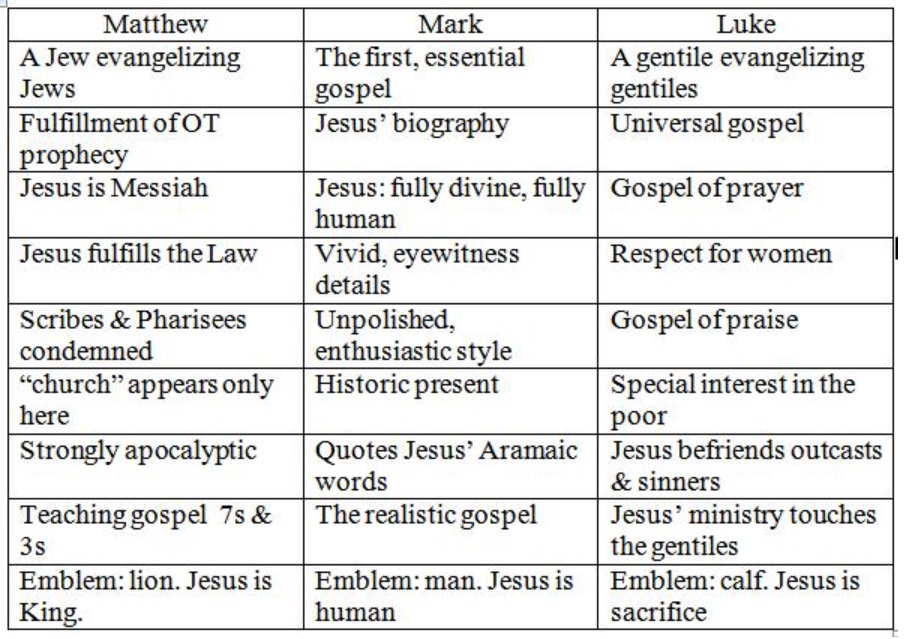
The New Testament begins with a set of four biographies about Jesus. They are referred to as the Gospels of Matthew, Mark, Luke and John. It is possible to think about the Old Testament as the inspired introduction to the New Testament, foretelling of the Person, work and kingdom of Christ. Old Testament quotes, allusions, and types are woven into the Gospels.

Christ is presented as king (who rules over all things), prophet (who represents God to the church) and priest (who intercedes for the church).  All the gospels record: the unique revelation of Christ, the ministry of John the Baptist, the feeding of the 5,000, Christ’s offer of Himself as King, the betrayal by Judas; the denial by Peter, the trial and crucifixion and bodily resurrection of Christ, events during the forty days of the post-resurrection ministry of Christ, the hope of His second coming.

The following table shows how the Gospels tell the story of Jesus from different perspectives, each focusing on different perspectives of Jesus’ life, and each trying to give a different message about the life of Jesus.

Comparison of Gospels
 MatthewMarkLukeJohn
Portrait of JesusKingServantTeacherSon of God
Original readersJewsRomansGreekschurch
Key phrasesKingdom of heaven, fulfilledKingdom of God, Immediately, nowKingdom of God, Son of manBelieve, Word of God, only begotten Son, eternal life
FocusJesus is the Messianic King of the promised Davidic kingdom which fulfills the Old Testament prophecies and claimsJesus is the authoritative Son of God. He is God’s triumphant envoy come to suffer and die in order to claim victory over sin and deathJesus is the perfect Son of Man, the Messiah prophesied by the prophets who came to save and to minister of people of all nations through the power of God the Holy SpiritJesus Christ is the fully divine Son of God who existed before creation. He is the true Lamb of sacrifice through whom we receive the gift of eternal life
Prominent sectionssermonsmiraclesparablesteachings
Genealogytraced to Abrahamnonetraced to Adamnone
Geographic emphasisGalileeGalileeGalileeJudea
Comparison of the Gospels

Observe

Read the chart above. Which gospel is centered in Judea?

Breath to breath

Dancing in the Kingdom- Table of Contents

Dancing In the Kingdom – Part 1 – Shadows of the Kingdom – Chapter 1 – Prelude

Breath to breath

[Bible ref: 2 Timothy 3:16; Romans 15:4; Hebrews 4:12; Psalm 19:7-11]

We say that the Bible is inspired, God-breathed. That is, God breathed His words to the human writers of the Bible, who then wrote down what “God breathed” into them. But how is that revelation, that communication, of God which was written by human authors, breathed into us so that we can respond to the hearing of God’s inspired word and live it out, breath it out if you will, out into the world around us as we participate with God in bringing His Kingdom into the world?

Old Testament authors used scrolls made of papyrus reeds to record his inspirations from God. But making copies of manuscripts was labor intensive and would take a long time, so most people did not have written copies of what Moses wrote. Most people only heard as others read it out loud. Reading out loud in community was the normal way to read until the invention of the printing press.

The people hearing the inspired word then learned to memorize and meditate on what they heard. The Hebrew word for “hear” is “shema.” Shema implies not just passively hearing or listening but also implies obedience. So, to “shema” the inspired Word is not just to hear it but to obey it.

When the New Testament manuscripts began to be produced, the copies could now be put into a codex, which is similar to modern-day books. The codex manuscripts were then more easily stored and carried. But again, few people had written copies and most people still relied on hearing the word and memorizing and meditating on it. The codex technology did allow for the integration of such things as parallel columns and reference notes for the few people who had access to the written Bibles.

The invention of the printing press in the 1400s now allowed copies to be easily and cheaply mass produced so that more people could now have access to the written Bible. It was at this time that the Biblical writings were now divided into chapters and verses. This allowed the average person to more easily refer to specific passages. Before the chapter and verse notations were added to the Bible, people could only refer to particular passages by quoting them – which was manageable if people were in the habit of memorizing those writings. Printed Bibles with chapters and verses now allowed people to use the Bible without as much need for memorizing Bible passages.

The Protestant Reformation’s rebellion against the authority of the (Roman Catholic) church was enabled by the availability of the Bible to the common person. In addition to Bibles, Bible reference books such as concordances and Bible dictionaries were produced, allowing the average person to study the Bible on their own.

When home computers became available in the 1980’s, electronic version of the Bible and Bible references were produced, making those resources more available to the average user. Access to the World Wide Web began in the 1990’s which made even more resources easily available. Mobile devices even added more convenient access beginning in the 2000’s. All these new technologies make it possible to learn and use the Bible in different ways.

In this digital era, I would encourage you to mix old and new, memorize not just search, meditate not just share, listen not just read, do not just hear. As you use different forms of media to encounter Scripture, reflect on them with others in your faith community and work together to make choices out of conviction rather than convenience alone.[1]

We now have many options available for connecting with the Biblical text. But knowing the Bible is not the same as engaging is spiritual disciplines to open oneself to being transformed and to better  know God and it’s not the same as participating with a community of believers building up one another.


[1] Dyer, John. “Bible Apps are the new Printing Press” Christianity Today www.christianitytoday.com/ct/2022/december/dyer-bible-apps-software-screen-printing-press.html

Observe

Read 2 Timothy 3:16. How does the definition of the Hebrew word, “shema,” fit with the statement in 2 Timothy 3:16?

Patterns of community

Dancing in the Kingdom- Table of Contents

Dancing In the Kingdom – Preface

Patterns of community

[Bible ref: Hebrews 10:23-25]

After decades of learning the Bible and church history, I could see the pattern of how the everything connected all the way from Genesis to Revelation and to all of church history, past and present. In preparing this project, all those patterns were reinforced in ways I never expected. One of the patterns that we see from the beginning is the use of stories. God is complicated and we are complicated, and we find that stories are sometimes the best way to explain everything from who God is to who we are.

To best understand the complications of who God is and who we are, this book is best processed in a small group setting so that we can work our own ideas with the ideas from other people. Furthermore, in our Western culture which prioritizes individuality, we sometimes find it hard to see the significance of the Biblical texts being addressed to the church rather to individuals within the church. We can better understand the texts if we can grasp that aspect.
Lastly, as we study the Bible, we need to remember that the goal of any Bible study is not to love the Bible but rather the One who gave it to us. That means, though, that we should love the church, which is Christ’s Body, Christ’s assembly of believers whom He loves.

And that love is not just an emotion or an idea, but a lifestyle of joy and self-sacrifice, receiving and giving, caring in word and deed, engaging with an interdependent community and with God in a dance, the Kingdom Dance, participating with God in restoring the Kingdom, turning the mourning of a broken world into the joy of a reunited heaven and earth.

Reflections – The Life Map exercise

The first step to see how our life’s story fits into God’s story, is to take the time to see how God may have already been working in your life. Plan on at least a half hour for this exercise.

Brainstorming:

Use only single words, short phrases or quick sketches to make these lists. Jot these items down as they come to you.

  • Make a list of significant things (events, people, places, etc.) in your life. People may include family members, influential people, teachers, authors, or influencers. Places may include where you’ve lived, places you’ve visited, places you want to go. Events may include family life and traditions, marriages, divorces, education, church, social organizations, jobs, or hobbies.
  • Make a list of successes or failures. These can include things that delighted you or disappointed you, relationships, things that you’ve done or things that have happened to you.

Rearrange the items in these lists in chronological order. Take some time to think of how God may have directed you in the midst of your story and talk to him about it. Think of how you would tell this story to other people.

There are other resources on the internet about make Life Maps:

Revisit in the future: As you work your way through Dancing in the Kingdom, you may want to further reflect on or revise your Life Map.

The plan to restore creation

Dancing in the Kingdom – Table of Contents

Part 1 – Shadows of the Kingdom, Chapter 4 – Deforming the intended direction for creation

[Bible references: Genesis 3:13-15; 50:20; Isaiah 53; Micah 6:8; Zechariah 7:9; Matthew 10:28-31; Luke 19:11-27; 1 Corinthians 12; Galatians 3:13-14,23-29; Ephesians 1:11-12; Hebrews 1:1-3]

The apparent penalty for sin, physical death, was actually a blessing. Unlike the angels who rebelled against God, death provided the rebellious image-bearers a means of avoiding an eternity separated from the source of goodness and grace. But for the image-bearers, death would provide a means where not only they but all of creation could be rescued from decay and death.

The plan of restoration would start to slowly unfold in ways that would sometimes be baffling and confusing and on a timetable that is beyond our comprehension. Over time though, God would gradually reveal how he intended to restore our relation to him, to end our pain and suffering, and to overcome the evil that seems to pervade everything.

The process of God’s revelation of hints of restoring creation started right at the beginning. God gave the initial clue in the curse given to the serpent, but the hint must have been a cryptic comment to His newly broken image-bearers. But since we have the privilege of looking back, we can see that God’s then cryptic reference was to the death and suffering of the character revealed in the Old Testament as the Messiah. As time went on, the Creator gradually revealed more and more clues about the plans He had to restore His creation. This gradual revelation was, and still is, a painfully slow time of waiting as we suffer the consequences of broken relations and a broken creation.

Fortunately, as we have waited in our broken universe, God’s grace has continued to intervene throughout history so that things are not as bad as they could possibly be. Our rebellion has not deterred God from providing for our everyday needs nor has he ceased to work on his plan to rejoin heaven and earth.

Meanwhile, God invites us to take part with him in the continued creation of the universe, bringing healing, health and hope directly into the midst of our now broken world, a task that he and we will continue until God fully restores his kingdom. Towards that end, he has provided spiritual gifts, gifts that we can share with one another, to build up one another and to bless the world as his ambassadors.

There are many things about the plans of God that we do not understand. God’s plans for us seem to be drawn out over a long time in which there is much suffering and pain. But even the suffering and pain we endure can be redeemed to help us become more like the Desire of our Hearts, the One who gave all Himself so that we all may become more like Him.

Reflect

What would the world look like if there was no goodness?

Observe

Read Genesis 50:20. This sentence was spoken by Joseph to his brothers in regard to their selling him into slavery. What can we learn from this?

Interlude

Dancing in the Kingdom – Table of Contents

Dancing In the Kingdom – Part 1 – Shadows of the Kingdom Chapter 1 – Prelude

Interlude

As I was working one warm summer night at a convenience store with the door open, it was not unexpected to see a moth fly in through the door. Normally, moths are attracted to light sources, but this time the moth was attracted to the white top of a garbage container. The moth was distracted by the light reflected off the garbage container. I think that describes a lot of human behavior; we get distracted by the pretty garbage.

In the meantime, there is a story that began long ago when God brought into being creatures made in his image, a story about his plans for those creatures, plans for them to fill the earth and making the whole earth a place of love and goodness, but a place where that love and goodness would be disrupted by our rebellion. Fortunately, that disruption did not deter God from continuing his plans for his image-bearing creatures and that story is still in the making. That story is now our story.

For too many people, even Christians, the Old and New Testaments of the Bible can seem disconnected. Some people have even proposed that the God described in the Old Testament is different from the God in the New Testament. This is partly due to the issue of the cultural barriers between us and the Old Testament. One purpose of this book is to show the unity of both Testaments, how they help make sense of each other and how together they make one cohesive story, a story into which we can fit.

There is a further disconnect. Between us and the biblical writings is the long and messy history of the Church. The Church seems very divided on how to interpret those writings and how to live into them. It is downright confusing to sort out all the various interpretations and practices that seem to contradict one another. How is one supposed to make sense of it all?

This book’s purpose then, is to not just overview the Biblical story from Creation to Revelation, but to show how we, as part of God’s Church, are intended to participate. God did not need to create us or the universe, He did it out of a desire to share his love and delight. God’s creation was more an act of play than of work and He desires that we actively play with him, if you will, to dance with him in His Kingdom.

The Kingdom Dance is not meant to be a solo effort, we are to dance with God and with his people. To that end, while this book can simply be read as a solo exercise, there are additional ways to engage with the material.

  • Biblical references are provided extensively through the book. They are there to support the text. If you read them, take the time to slow down and let God the Spirit speak to you. The Bible has been described as ancient Jewish Meditation Literature.[1] It is best read when you give yourself time to absorb it.
  • There are extensive footnotes throughout the book. Whenever possible, I have provided hyperlinks to make the additional materials easily available to you. If you spend time investigating the footnotes, you will notice that I am not drawing from only one Christian tradition, but from a variety of them, allowing the richness of the different traditions to form a more complete story. To form a more complete story I also, particularly in the beginning, will use materials from the “Second Book of God” that is, book of Creation.[2]

“God has, in fact, written two books, not just one. Of course, we are all familiar with the first book he wrote, namely Scripture. But he has written a second book called creation.”[3]

  • For those who are not practiced in studying the Bible, Appendix A gives a summary of techniques that could be used to help understand scripture. This may prove useful for understanding when you study the Biblical references given throughout this book.
  • Reading the material with a group can make the most impact. The Dancing in the Kingdom Workbook provides exercises and questions to help process the material as a group. These exercises and questions will help you engage with the material by first asking you to think about how each section applies to your life and secondly to share your thoughts with others in the group so that together you can more thoughtfully “Enter the Dance” with God, with all the others that have come before, with those that are coming now and with that will continue to come until Heaven and Earth are reunited.
  • Finally, the best participation will be not to just read and reflect, but to dance the Kingdom dance with God. The last chapters of this book will suggest ways to take part in his activity in bringing healing to the world he loves, broken now but to be finally fully restored when He rejoins heaven and earth.

The Bible is a complex collection of literature, using many literary styles and techniques and it can be difficult to understand some parts, particularly when one part seems to contradict another part. I have found a useful principal in studying the Bible which I call “Conflicts are clues” which says that any apparent conflict or confusion in Scripture should be handled as clues to look further instead of thinking that the conflicts create contradictions which reduce the integrity of the Bible.

In our age, many regard science and theology to be in conflict. In years past, however, the issue was not about conflict but about which discipline rules over or undergirds all the other disciplines. These ideas were expressed in ways such as “theology is the queen of all sciences,” “math is the queen of all sciences,” “philosophy is the queen of all sciences,” “philosophy is the handmaid of all sciences.”

The biblical perspective is that God speaks to us both through two books, the book of Creation and the Bible. Theology’s main goal is to understand spiritual reality and science’s main goal is to understand physical reality, but both fields can inform the other about the nature of God.

This principle of “Conflicts are Clues” applies not just to the “First Book of God” (that is, Scripture) but also to the “Second Book of God” (that is, Creation) which is practiced by the testing and revisions of theories, but also between the Two Books. During the course of history, the study of the Two Books got separated and some of those in science rejected Scripture and some of those who were Christian rejected science, leaving conflicts unresolved as contradictions. But moving forward, this does not prevent us from considering apparent conflicts between the books as clues to be investigated further.


[1] Bible Project “Ancient Jewish Meditation Literature” Bible Project bibleproject.com/explore/video/bible-jewish-meditation-literature-h2r/

[2] Rusbult, Craig. “How should we interpret the Two Books of God, in Scripture & Nature” American Scientific Affiliation http://www.asa3.org/ASA/education/origins/two-books.htm

[3] Bacon, Francis. “The Two Books of Francis Bacon of the Proficience and Advancement of Learning, Divine and Human.” The First Book. Section.VI.Paragraph.16 1605

Reflections

Look at the four videos you can find at bibleproject.com/explore/category/how-to-read-bible-introduction/ for an overview of the Bible. How do these videos help you understand the larger context of the Bible?

Observe

Read 2 Timothy 3:14-16; Hebrews 4:12-13; Romans 15:1-6; 2 Peter 1:19-21. What is the purpose of the Bible?