Occupy Till I Come

Dancing in the Kingdom- Table of Contents

Dancing In the Kingdom – Part 3 – Dancing in the Kingdom– Chapter 18 – Entering the Dance

Occupy Till I Come

[Bible references: Jeremiah 29; Luke 19:11-27]

On His way to Jerusalem the last time before His triumphal entry, Jesus knew the kind of expectations the people had about how the Kingdom of God would appear. To prepare them for the long wait between His resurrection and His return to fully restore the Kingdom of God, He told them a parable about a nobleman who would, before going into a far country, give his servants some money with instructions to engage in business while he was gone. The parable ended with rewards given to those who made profits and penalties for those who did not.

This then is our instruction, to make use of what God has given each of us to ‘engage in business,’ (KJV “Occupy Till I Come”) that is, we are called to help advance the kingdom until He returns.

When Jesus came two thousand years ago, he announced the beginning of a new age, “The Kingdom is here … The Kingdom of heaven is near … The Kingdom of God has come.” As disciples of Jesus we can say, “The Kingdom of God is within us.” Then, with our hearts changed by Jesus, we are charged to go and make disciples, to do justly, love mercy and to walk humbly with our God.

As we then join Jesus in bringing His kingdom into the world, we need to remember our humble estate …We cannot even change our own hearts, never mind the hearts of others. Certainly, we cannot change our culture. It is up to our Savior to change our hearts, and even more so to change the culture around us.

Jesus and his disciples lived more as servants or slaves within the Roman Empire. They had no political influence. But as the disciples lived transformed lives, living as well as preaching the Gospel, and showed the power of sacrificial love, their Spirit empowered lives opened the way for the Spirit of God to change the hearts of many throughout the Roman Empire, eventually moving the heart of a Roman Emperor, Constantine.

History has shown the mixed results of combining the power of state and church, but the teachings of Jesus have penetrated even our secular postmodern culture in ways that are not widely recognized as such. Despite the church’s own history of abusing and misusing power, Jesus’ concepts of using power to serve others, even one’s enemies still managed to occasionally penetrate the halls of power – in imperfect form to be sure, just as the ideas expressed in the Enlightenment imperfectly expressed ideas from Christianity.

“Reparations let’s say for slavery or in New Zealand reparations to the Māori or in Australia reparations to the Aboriginal even for native indigenous American Indians. And this language is actually not a historic language. This is a language since Jesus. See, because Genghis Khan never worried about reparations. He never felt he had any moral responsibility to somehow make it right for all the women he raped and all the men he killed and all the families destroyed and all the villages he burned down. We have Caesar or Alexander, they never really had remorse for anything they conquered or anything they destroyed or any people whose lives they overthrew. This concept of justice of using power well is a concept that only emerges because Jesus lived 2,000 years ago. He revolutionized the entire understanding of power. The idea that a government should actually care about its citizens is really, it’s not a historic human concept. This concept is infused by the ethics that Jesus brought to the understanding of power that it says when Jesus had all power and all authority, he ties a towel around his waist and he washes his disciples’ feet. This is a reinvention of power. … if you go back to World War II … when you look at the American response to conquering Germany and conquering Japan, and how within a decade or two, both of them became two of the greatest economies in the world … You get to see what happens when you’re conquered from a Christian mindset world with West Germany. You realize that Japan becomes one of our greatest allies. That doesn’t happen historically. You do not conquer a nation and then rebuild it to feel a moral obligation to re-establish that country better than it was before. Even what we’ve done historically has been informed by a Christian worldview. I’m not saying that England or United States or any Western nation is a Christian nation. What I’m saying is the conversations we’re having are informed by Jesus’s revolutionary, brilliant genius thoughts about power.” [1]

There are debates on the ideas expressed above, often fraught with ideas of self-interest[2] and ideology, about how to provide for populations that have experienced oppression or how to manage the after-effects of war. But these ideas and other expressions of compassion and justice – like hospitals, orphanages, the concept of “war crimes,” or the many ways to carry out “social justice” (that is, God’s expression of compassion and justice) – are ideas not found in history until God introduced them first to his chosen people, Israel, and then through the person of Jesus to His Body. As God’s image-bearers

Unfortunately. the church often abused its privilege, often succumbing to the worldly temptations of power and ignoring its mandate to steward God’s world with compassion and justice. But even though the church has stumbled, it has still managed to live out, admittedly imperfectly, its mandate of compassion and justice. And the world has noticed. Bu interestingly, many have adopted those same values even though they choose to ignore the source of our mandate.


[1] Mcmanus, Erwin. Interview with Carey Nieuwhof, CNLP 452: Erwin McManus on the Future of the Church, How to do Evangelism More Effectively, Authenticity and Reflections on Being Labeled a Heretic Carey Nieuwhof careynieuwhof.com/episode452

[2] Niebuhr, Reinhold.  “Editorial Notes” republished as Christianity and Crisis Magazine providencemag.com/2022/06/christian-realism-enlightened-self-interest-marshall-plan-emerges-reinhold-niebuhr/ 17 Jun 2022

Reflect

In what ways have you lived out a sacrificial love?

Observe

Read Jeremiah 29; Luke 19:11-27. What do we need to do to live transformed lives, living and preaching the Gospel, and show the power of sacrificial love with Spirit empowered lives?


Created as parts of a body

Dancing in the Kingdom- Table of Contents

Dancing In the Kingdom – Part 3 – Dancing in the Kingdom– Chapter 17 – Finding our place

Created as parts of a body

[Bible references: Romans 12:3-8; 1 Corinthians 12; Ephesians 4:1-16]

We were created to be connected. We have individual identities and desires, but we were created for love by the God of love. As God’s image-bearers, we are intended to love one another just as love is shared between Father, Son, and Holy Spirit. The greatest commandments are to love God and to love our neighbor. We are told that the world will know us by our love.

Through a process we cannot understand, the Son of God, Jesus, the Christ, appeared in the flesh two thousand years ago. After His resurrection and He “returned to heaven,” He then sent the Holy Spirit who entered into His disciples. His disciples then, as Christ’s ambassadors, became His body, creatures filled with His very Spirit who were then His feet and hands, even His voice, on the earth. And it is through His body that we and others may come to know about Christ. Sometimes we come to know Christ directly through a member of His body or indirectly by what someone recorded for us. And when we respond to His call through the body of Christ, we also become part of that same great body.

We come to Christ in response to His Spirit connecting with our spirit. But the means of that connection is through the Body of Christ. As we understand how even the set of writings, we call the Bible, was written and compiled by that great body, we can grasp the dependence that we have on His body to even to come to Him. That dependence does not end after we respond to Him but enters us into an interdependence with each other: We are dependent on each other to more fully learn how to love God and love neighbor, we are dependent on each other to build each other up.

Reflect

How can you foster the need that the church has for us to be interdependent with each other?

Observe

Read 1 Corinthians 12. If someone tries to be a “part time” church member, how does that affect everyone else?

Mystery of the kingdom and eschatology

Dancing in the Kingdom- Table of Contents

Dancing In the Kingdom – Part 2 – The Kingdom Revealed – Chapter 13 – Distinctives within the body of Christ

Mystery of the kingdom and eschatology

[Bible references: Isaiah 2; 60; Joel 2; Micah 4; Daniel 7; Matthew 24; Luke 17; Revelations 20]

What is the kingdom of God/Heaven?

The kingdom of Heaven refers to where Jesus reigns. Heaven has always been under his rule and when he returns and our current earth is transformed into the new earth, Jesus’ kingdom will include that as well. In the meanwhile, His kingdom includes all those who have accepted Jesus as their king. Some only apply the Kingdom of God to only the reign of God in heaven or the reign of God after earthly governments are done away with.

How and when will Jesus return?

Discussion about the end times[1] has always been problematic because of the nature of prophetic language. This has led to much contention in the church about how events will occur or have occurred. Even though Jesus has cautioned us that only the Father knows when that will happen, people have not stopped trying to “read the signs.”

The clues about the Messiah in the Old Testament were confusing to interpret. Even after the incarnation of Jesus, we know that the disciples were confused about how the events of the end times such that Jesus’ death was incomprehensible. Even after Jesus’ resurrection and ascension there was still confusion, and it took some time to sink in that Jesus’ return was not going to happen for a while.

There are a wide variety of thoughts about the Biblical prophecies concerning the end times. The questions deal with such things as: is the book of Revelation about events now past us (e.g., the destruction of Jerusalem in AD 70) or about future events or both, does the 1000 years talked about in Revelation 20:1-15 occur now or in the future and is the 1000 years literal or metaphorical, will there be a “rapture” of believers before a coming time of great tribulation, since there was no nation of Jews after the destruction of Jerusalem do the promises that applied to Israel now apply to the church – and other questions.

There are various historical factors and hermeneutical questions that led to some of the variations in the way that these questions were answered: whether the prophecies should be interpreted literally or metaphorically, whether the Old Testament laws should be kept in effect by the church, the importance of the destruction of Jerusalem in AD 70 and the consequent re-creation of the nation of Israel in AD 1948. Regardless of the way those questions are answered, the more important issue is our behavior in the present.

The role of the prophecies in the past had been to either warn people of behaviors they needed to change or to provide encouragement and hope in the times of difficulty. Wherever we stand on these prophecies, those intentions should be our focus; our behaviors in the present life and our hope to sustain us.


[1] Herrick, Greg. “9. Eschatology: End Times” Bible.org bible.org/seriespage/9-eschatology-end-times

Mystery of sin, salvation, and sanctification

Dancing in the Kingdom- Table of Contents

Dancing In the Kingdom – Part 2 – The Kingdom Revealed – Chapter 13 – Distinctives within the body of Christ

Mystery of Sin, Salvation, and Sanctification

[Bible references: Ps 38:39; Is 12:2; 25:9; Zephaniah 3:17; Matthew 26:28; Luke 24:47; John 3:16; 10:9; Acts 2:38; 4:12; Romans 5; 6:23; 1 Corinthians 1:21; 15:2; Ephesians 2:8; 2 Tim 3:15]

How do we inherit sin?

There are two main views of how we inherit sin:

  • According to ancestral sin, Adam and Eve alone bear the full responsibility and guilt for the sin in the Garden, but we inherit mortality, the tendency to sin, and alienation from God and other people. Expulsion from the Garden was to prevent the humans from being eternally separated from God.
  • According to original sin, as Adam’s ancestors we inherit not only Adams’ sinful nature but his guilt as well. Expulsion from the garden was a punishment.

What did Jesus do to allow our relationship with him to be restored?[1]

By taking on human flesh the way that Jesus did and becoming fully human, he experienced all the temptations to sin that we face, but without succumbing to them. When he died on the cross as a perfect God-Man, he was able to overcome death and offer to restore our relationship with him. Different congregations have different ideas on how this transaction was able to actually work.

  • God paid a ransom to free us. Once the ransom was paid, justice was satisfied, and God was able to free us. There is a dispute about whether the ransom was paid to God or to the Devil.[2]
  • Christ is seen as the second Adam who is victorious where Adam failed and undoes what Adam did. The atonement of Christ has reversed the course of mankind from disobedience to obedience. Christ’s life recapitulated all the stages of human life and in doing so reversed the course of disobedience initiated by Adam.[3]
  • Just as Adam’s sins were imputed to us (original sin), when Jesus died on the cross, his righteousness was imputed to us.[4]
  • Christ suffered for everyone so that the Father could forgive the ones who repent and believe. Pardon and forgiveness cannot be brought to pass unless God’s righteous obligations as Moral Governor can be satisfied. Nor can it happen unless man is willing to repent and embrace the conditions of mercy. Man must identify himself in a committal of faith to the sufferings of Christ for his sins, as the only hope of his forgiveness and spiritual restoration from a state of ruin.[5]

What is the effect of sin on our bodies and on our world?

Despite the effects of sin, that we are image-bearers of God. This view creates a positive view of our bodies and is supportive of taking healthy care of our bodies and also the environment. However, there is a viewpoint originally developed by Greek philosophy that has continued to affect the church in many ways from the beginning is the idea that only spiritual things are good and physical things are bad.[6]

In regard to the body, this dualism leads to the view that sex is sinful and a general discomfort in talking about the body, preventing the church from counteracting the influence of the culture both within and outside the congregation. This dualism has led to many other errors as well, such as focusing on heaven as our final destination instead of a new creation, the need to deny oneself physical pleasure[7] in order to pursue the spiritual, and the neglect of our roles as stewards of our physical environment.

How are we saved from the consequences of our sins?

When the first people rebelled against God, they brought the penalty of death and eternal separation from God upon themselves. As descendants of those people, we inherited the corrupt nature that causes us to sin and therefore also brings the penalty of death and separation from God upon ourselves. Our salvation is only possible because of the death and resurrection of Jesus. The gift of salvation can be received when we confess our sins, acknowledge Jesus’ death on our behalf and accept God’s forgiveness for our own sins.

That said, there are two explanations about how we are saved that depend on how we think we inherited sin.

  • According to the doctrine of ancestral sin, salvation is a process of avoiding sin and becoming more like God,[8] a process which, for those who are baptized into Christ, will continue after our death and resurrection. God did not expel Adam and Eve out of the Garden of Eden and away from the Tree of Life as a punishment, but out of compassion, so that we would not be like the fallen angels and become immortal in sin.
  • According to the doctrine of original sin, Jesus’ death is considered to have paid the penalty for our sins. By receiving his forgiveness, we are legally justified before God, and he gives us his spirit so that we can begin the process of becoming more like him.

What is the role of grace in salvation?

In Reformed theology, God gives irresistible grace to those he chose before time began and gave them the will to respond to his call to repent so that they can be forgiven, and once forgiven, God will ensure that they will persevere in the faith.

In provisional theology all men are given a grace[9] that allows them free will to respond to God’s call to repent and be saved and also have God’s assurance that he will not let us go.[10]

In Arminian and Orthodox theology, it is by our free will that we accept God’s forgiveness and then also have the free will to abandon that faith later.

What does it mean to be saved by grace and yet have expectations to live righteously?

Some Christians think that once they are converted, that is they have received Christ’s gift of salvation, then they have done all they need to do. After that, some will either forget or neglect the entire process of being a disciple of Christ leaving the question of whether they were actually converted.

Some congregations believe that more than faith is required in order to receive salvation[11] and insist that salvation has not happened unless some specific things are done. The Orthodox tradition states that salvation is a process that begins with conversion but then continues with the process of becoming more like God. The Roman Catholic and Protestant traditions state that once we have been justified, then God can set us apart to be the type of people that he has intended us to be from the beginning.[12] In this condition, we can begin the process of growing in Christ, that is, becoming more like God.

We are living in the time between the first coming of Christ, where he conquered death and sin, and His second coming, when he will transform creation with a new heaven and earth, and we will have new resurrection bodies. In this in-between time, we still are living in corrupt bodies and in an earth corrupted by sin although we may have begun the process of being transformed more into the image of Christ. This does create some confusion.

Until the final resurrection we still sin and need to regularly be in an attitude of repentance, confessing our sin and turning back to God and acknowledging our need for God’s grace so that we can also be ready to give grace to others.

The Roman Catholics emphasize our need to not only confess our sins, but to do something tangible to express our repentance[13] and need to be purified more completely before we can appear before God. This requires a temporary stay in purgatory before we are allowed into heaven.

Viewing things in a more positive light, some congregations emphasize that while we may not actually free from sinning, that our hearts have been cleansed from sin by the grace of God.[14]

Since we are under grace, do the commandments still apply to us?

We are told that those who are born “of the Spirit” are not “under the law” because Jesus fulfilled the law. However, that does not mean that the law can be ignored. In fact, not only does the law provide guidance for us, but the expectations for our behavior are even more comprehensive. The New Testament explicitly tells us that:

  • hating our brother is equivalent to murdering our brother. 
  • we should not hate our enemy but love them.
  • looking at someone with lust is like committing adultery.
  • if we are forced to go one mile, then we should go two miles.

Our motivation should not come from trying to obey the external law “written in stone” but rather from the internal desires “written in our hearts” to love – love God and to love one another. To give a few examples: we should be.

  • Not driven to obey the Commandment to keep the Sabbath, but rather encouraged to live every day to God.
  • Not driven to obey the command to tithe, but rather encouraged to be generous.
  • Not driven to obey the command to not covet, but rather encouraged to promote the welfare of others.
  • Not driven to obey commandments, but rather encouraged to express the fruits of the Spirit.
  • Not driven to obey externally given commands, but rather encouraged to grow in our internal desire to love,
  • Not driven to avoid doing wrong, but rather encouraged to delight in finding the best way to do what is right

However, the relationship of the church to the law has been a point of contention in many congregations causing many congregations to adopt a legalistic framework. There is a tendency to consider the laws we call the Ten Commandments to be unlike the other laws in the Old Testament – to be “moral laws” that still apply. The New Testament, however, has not separated out the “moral law” from the rest of the laws (sometimes called civil and ceremonial laws) in the Old Testament. Some consider the Law to be good as it guides us away from idolatry, but others view the law to be bad as we should rather be relying on grace instead of the law which is considered to be oppressive.

The Ten Commandments, as we call them, are not numbered in the original texts (Exodus 20, Deuteronomy 5) but in the Biblical text are referred to as the Decalogue, which means “ten words.”[15] This has resulted in a couple of different numbering schemes for the “ten words.” One of the variations is influenced by iconoclasm, which makes “You shall not make any graven images …” the second commandment.


[1] Soteriology is the study of how we are saved

[2] Theopedia “Ransom”  Theopedia theopedia.com/ransom

[3] Theopedia “Recapitulation theory of atonement”  Theopedia theopedia.com/recapitulation-theory-of-atonement

[4] Theopedia “Penal substitutionary atonement”  Theopedia theopedia.com/penal-substitutionary-atonement

[5] Theopedia “Governmental theory of atonement” Theopedia theopedia.com/governmental-theory-of-atonement

[6] In Persia during the third century, Mani tried to synthesize all the known religions, including Gnosticism and Christianity into a religion known as Manichaeism. Gnostics think that there is a good spiritual world, and a bad physical world (aka Dualism).

[7] New Advent “Asceticism” New Advent newadvent.org/cathen/01767c.htm

[8] Theopedia “Theosis” Theopedia www.theopedia.com/theosis

[9] Prevenient grace means the grace of God that surrounds all, and is at work in all, even before we know or care about it.

[10] Spurgeon, C.H. “The Security of Believers – or, sheep who shall never perish”  Spurgeon Gems spurgeongems.org given 5 Sept 1889 www.spurgeongems.org/sermon/chs2120.pdf

[11] Theopedia “Legalism” Theopedia theopedia.com/legalism

[12] Sanctification is the process of being set apart for God’s use.

[13] Catholic Encyclopedia “Penance” Catholic Encyclopedia catholic.com/encyclopedia/Penance

[14] Theopedia. “Wesleyan perfectionism”  Theopedia www.theopedia.com/wesleyan-perfectionism. Wesleyan perfectionism, sometimes called entire sanctification, is a view held by John Wesley that taught that Christians could to some degree attain perfection in this life.

[15] Hale, Philip. “Numbering the Decalogue, Images, and Iconoclasm: A Historical and Theological Survey”  Nebraska Lutherans for Confessional Study, July 25, 2013

Observe

Read John 3:16; 10:9; Acts 2:38. How can we be reconciled to God?

Future of the faith

Dancing in the Kingdom- Table of Contents

Dancing In the Kingdom – Part 2 – The Kingdom Revealed – Chapter 12 – Launching the church

Future of the faith

[Bible references: Isaiah 65:17-25; 66:22-24; Luke 20:34-362 Corinthians 5:1-10; 2 Peter 3:10-15; Revelation 21:1-8]

As mentioned in the previous section, the war against evil has been won. Christ has won the battle over sin and death. We need to keep our minds fixed on that when the battles rage around us. We need to remember that we are the side of the victor and not get defensive – our God is not small! We need to remember that the forces of evil have reigned since the fall and so, when Jesus came in the flesh, it was the forces of good that have intruded on the forces of evil, not the other way around.

With the life, death and resurrection of Jesus, the Kingdom of God has entered onto the earth and Jesus continues to bring the Kingdom of God on earth through his church. Unfortunately, we need to wait until Jesus returns before he completely restores the Kingdom of God. But He will restore it!

One of the in-between time confusions centers around what happens in the day that Christ returns. In this time, when Christians die, we are not automatically resurrected, instead we leave earth to go to heaven to be with the Lord. But that is not our last destination! When Christ returns, He will unite heaven with earth, and it is then that we will then receive our resurrected bodies so that we can live on that new earth.

One of the other confusions around what happens what is the relation between the old earth and the new earth. The language in 2 Peter 3:10 can make it seem that the old earth will simply be annihilated and replaced with the new earth. However, that would seem to conflict with Acts 3:21 where God is said to “restore all things.”

“The times of the restitution of all things – The noun rendered restitution … does not elsewhere occur in the New Testament. The verb from which it is derived occurs eight times. It means properly “to restore a thing to its former situation,” as restoring a “strained” or “dislocated” limb to its former soundness. Hence, it is used to restore, or to heal, in the New Testament …”[1]

It so happens that “all but one of the oldest and most reliable Greek manuscripts do not have the final words “will be burned up” but instead have “will be found, …”[2] and that would be more in line with Acts 3:21.[3] What has been the more common rendering of “burning up the earth” has caused some to not care about our current earth, but if the earth is to be transformed rather than destroyed then we might, as the stewards of the earth, pay more attention to taking care of the earth.


[1] Biblehub “Acts 3:21” Biblehub biblehub.com/acts/3-21.htm

[2] Wolters, Albert M. “Creation Regained: Biblical Bases for a Reformational Worldview” William B. Eerdmans Publishing 1985, 2005. (Location 568 of 1582)

[3] Bible.org “A Brief Note on a Textual Problem in 2 Peter 3:10” the meaning of the term is virtually the equivalent of “will be disclosed,” “will be manifested.” Thus, the force of the clause would be that “the earth and the works [done by men] in it will be stripped bare [before God].” BAGD suggests a slight modification of this: be found as a “result of judicial investigation” (s.v. εὑρίσκω, p. 325. 2), citing Acts 13:28; 23:9; John 18:38; 19:4, 6; and Barnabas 21:6 as approximate parallels. Danker2 suggested a parallel between 2 Pet 3:10 and Ps Sol 17:10 (“Faithful is the Lord in all his judgments which he executes on the earth”; the link here is conceptual, though in v. 8 εὑρίσκω is used of the exposure of men’s sins before God). We might add that the unusualness of the expression is certainly in keeping with Peter’s style throughout this little book. Hence, what looks to be suspect because of its abnormalities, upon closer inspection is actually in keeping with the author’s stylistic idiosyncrasies. The meaning of the text then, is apparently that all but the earth and men’s works will be destroyed. Everything will be removed so that humanity will stand naked before God.

Observe

Read 1 Peter 3:10-15. What should our attitude be because we know that the new heavens and earth will be happening?

The Spirit and the story

Dancing in the Kingdom- Table of Contents

Dancing In the Kingdom – Part 2 – The Kingdom Revealed – Chapter 12 – Launching the church

The Spirit and the Story

[Bible references: Exodus 18:13-26; Joel 2:28-32; Psalm 16; Luke 16:19-31; John 16:13; Acts 2:1-4; 6:1-7]

During Jesus’ three years of ministry, His teaching about the Kingdom of God coming to earth was accompanied by signs: miracles of healing, cleansing, and raising the dead, and by forgiveness of sins. The miracles affirmed the message. With the introduction of the church as the vehicle by which the gospel would be spread, more signs and miracles were called for.

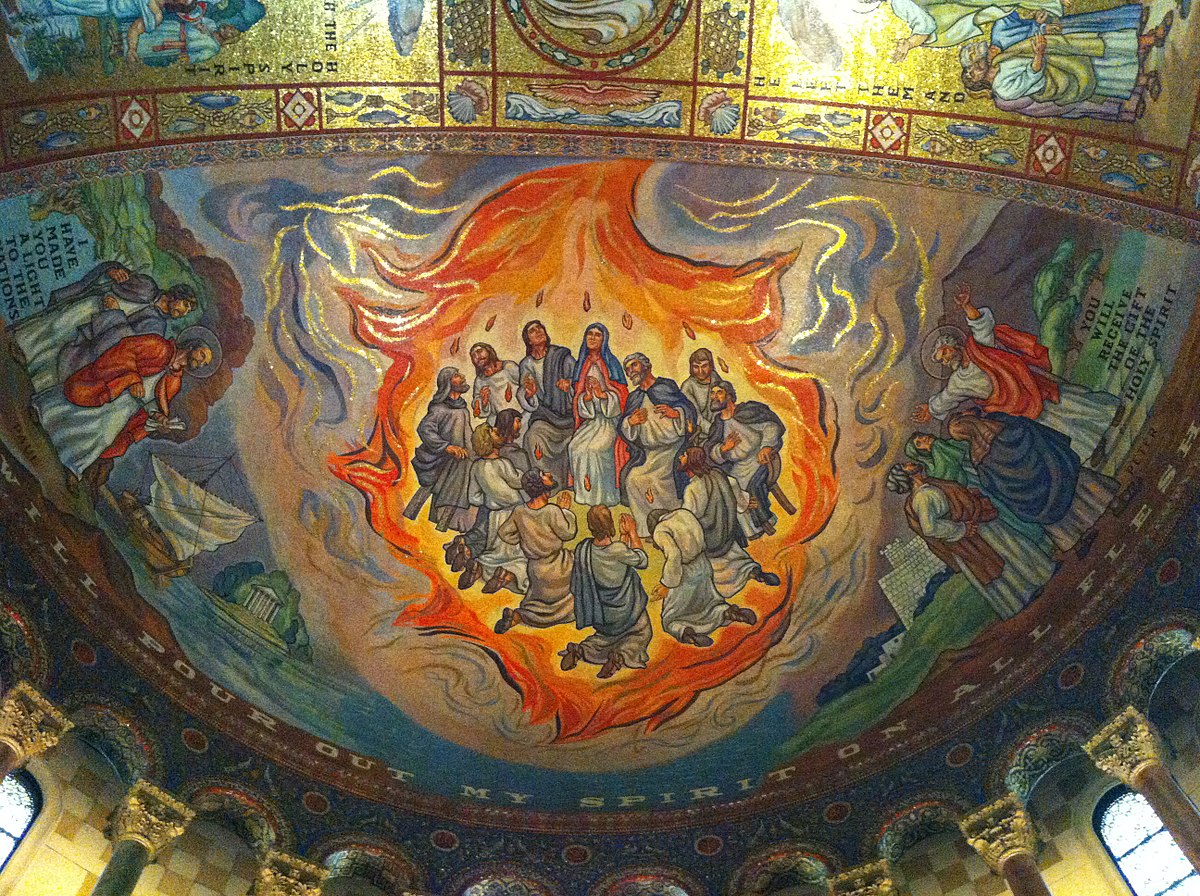
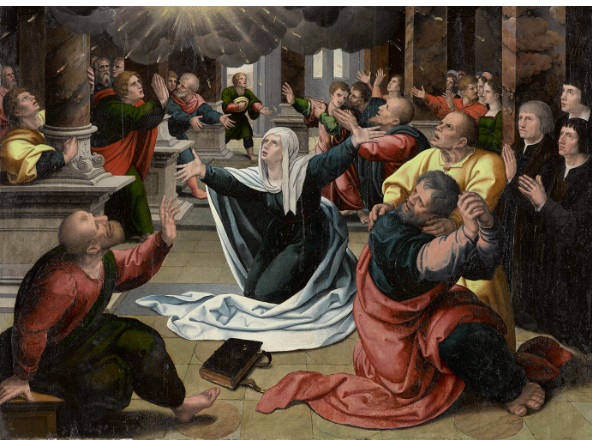
On Pentecost, Jews from all over the Roman Empire gathered in Jerusalem. Many were in the upper room with the apostles, when the Holy Spirit visibly empowered the apostles with tongues of fire, a violent wind, and the reversal of the tower of Babel as people of many different language groups were able to hear the apostles speak in their native tongues. These signs caused much excitement and wonder as the people responded to the work of God. As was true during the time of Jesus’ ministry, there were some who were ready to hear the gospel and others who were not. Those who were ready to hear the apostles’ message were able to understand the apostles’ message while those who were not ready did not understand the signs and resorted to mocking the apostles as if they were drunkards. This was no different than the time of Jesus’ ministry, the signs of the kingdom caused some to respond with increased faith while others responded with unbelief and hardened hearts.

As Jesus had promised, the Holy Spirit gave the apostles the words to explain what was happening. Peter quoted from the book of Joel about how the Spirit would be poured out causing all kinds of people to prophecy: sons and daughters, old men, and young men. Then Peter also quoted from David’s Psalms as he wove together the story of how all these things fit into the story of Jesus’ life, death, and resurrection. Those who were ready to hear the gospel asked what their response should be. Peter told them to repent, be baptized and then they too could receive the gift of the Holy Spirit. Since many of these people were from the Jewish diaspora, they, now filled with the Holy Spirit, would have been able to return to their homes to continue to spread the gospel, although it seems that some people from the diaspora stayed in Jerusalem.

We have sparse details of the life of the church, but there are a few things we know which are described quite succinctly in Acts 2:42-47:

And they devoted themselves to the apostles’ teaching and the fellowship, to the breaking of bread and the prayers. And awe came upon every soul, and many wonders and signs were being done through the apostles. And all who believed were together and had all things in common. And they were selling their possessions and belongings and distributing the proceeds to all, as any had need. And day by day, attending the temple together and breaking bread in their homes, they received their food with glad and generous hearts, praising God and having favor with all the people. And the Lord added to their number day by day those who were being saved.

With the rapid increase in disciples came some logistical problems as well. The miracles of the Spirit did not end the day-to-day problems of communicating between different cultural groups within the church. In the normal practice of sharing goods within the church and within that the need to take care of widows and orphans, there came a point where the Greek-speaking widows from outside Israel were not getting the same care as the Hebrew speaking widows. Because the apostles wanted to focus on teaching and prayer, they gathered the church to address the issue. The church resolved the issue by selecting seven men to oversee the distribution of goods. However, this would not be the last time that language and culture barriers would affect life of the church.

Observe

Read Exodus 18:13-26; Acts 6:1-7. What do these passages say about effective leadership?

The Spirit and the power

Dancing in the Kingdom- Table of Contents

Dancing In the Kingdom – Part 2 – The Kingdom Revealed – Chapter 12 – Launching the church

The Spirit and the power

[Bible references: Genesis 25-19-21; 1 Samuel 1;1-20; 2 Samuel 7; Proverbs 2:1-5; Matthew 7:7-8; Mark 11:12-26; Luke 11:113; 12-26; John 20:21-23; 3:14-16; Acts 1:1-14; 2:1-41; 1 Peter 5:6-7]

There are remarkable parallels between Genesis 2:7 and John 20:22. We see from Chapter 2 that in Genesis 2, God breathed life into Adam who was then commissioned to take care of the sacred space that God had created. That sacred space was initially identified as the Garden of Eden, but we know from Genesis 1 that God had dedicated the entire universe as his temple. We also know that since God’s image-bearers were given the commission to “be fruitful and fill the earth” that the sacred space allotted to the care of the image-bearers was intended to be the entire earth.

After the resurrection, when Jesus met with the apostles in a locked room, He breathed on (or into) them.[1] This is the same word used in the Septuagint version of the Old Testament describing God breathing life into Adam and thereby giving him life. Immediately after this gesture, Jesus instructed the apostles to “Receive the Holy Spirit” who were then commissioned to continue the task that Jesus had begun.[2]

“The very same Greek verb (here only in N.T.) is used by the LXX. in Genesis 2:7 (Wis 15:11) of breathing life into Adam. This Gospel of the new Creation looks back at its close, as at its beginning (John 1:1), to the first Creation. We are probably to regard the breath here not merely as the emblem of the Spirit (John 3:8), but as the means by which the Spirit was imparted to them. ‘Receive ye,’ combined with the action of breathing, implies this. This is all the more clear in the Greek, because pneuma means both ‘breath’ and ‘spirit,’ a point which cannot be preserved in English; but at least ‘Spirit’ is better than ‘Ghost’ We have here, therefore, an anticipation and earnest of Pentecost; just as Christ’s bodily return from the grave and temporary manifestation to them was an anticipation of His spiritual return and abiding Presence with them ‘even unto the end of the world.’” [3]

Previously, in John’s gospel, we saw that “the Son of Man must be lifted up, that everyone who believes may have eternal life in him.” Now that Jesus was crucified and was soon ascend to heaven, the apostles were given the task of sharing the gospel so that people may believe unto eternal life. It is at this moment, in the locked room, that the apostles were given the commission to share the news of forgiveness.

Ten days after Jesus ascended, fifty days after Passover, the disciples were gathered in Jerusalem, waiting for “what the Father had promised.” It was the time of Shavuot, which was known in Greek as the Pentecost. Shavuot is one of three pilgrimage festivals where Jews are supposed to travel to Jerusalem so Jews from all over the Roman Empire were in Jerusalem.

It was at this gathering that Spirit came upon the disciples in great power, revealing the fulfillment of Shavuot. While the disciples were gathered in a room, the Holy Spirit manifested himself with a great wind and tongues of fire that touched the apostles. The apostles then proceeded to prophecy and the people who were there from around the world were able to hear them speaking in their own languages. On that day 3000 people accepted Jesus as their Lord.

The full meaning of Passover and Shavuot was now revealed.

  • Jesus was executed on Passover, a holiday commemorating the celebration of freedom from slavery in Egypt which was observed by the slaying of the Passover lamb whose blood protected all the Israelites from the angel of death who had killed all the firstborn children in Egypt.
  • The miraculous outpouring of the Holy Spirit on the apostles which enabled them to speak in many different languages occurred on Shavuot, which had many different meanings for the Jews. Shavuot was associate with:

  • the giving of the commandments 50 days after the liberation from Egypt. Now the commandments were written on hearts instead of stone.
    • the first harvest of crops in the year, with those first portions being given to God, the provider of harvest. There were now 3000 souls harvested for God.
    • marriage, where Passover was considered the betrothal and Shavuot the marriage where the bride and groom commit themselves to each other. The period in-between the betrothal and marriage can be considered as a time of testing and waiting as the bride and groom prepare for life together. With His sacrifice, Jesus, the Bridegroom committed himself to the Church, His Bride.

Waiting. The virtue we want to bypass. Yet even though God has set seasons and times before us and insists on letting his ordained processes complete, from the beginning, we have wanted things immediately and we have been paying the price ever since. But there was a process God wanted to complete. After His resurrection, Jesus waited for the apostles to gather before He came to them, Jesus waited for many days to go by while He interacted with various groups of his disciples, then after His ascension, Jesus waited for his disciples to stay in Jerusalem, while they waited for the “gift His Father promised … to be baptized with the Holy Spirit.” And so, the apostles waited and prayed.


[1] Biblehub ἐνεφύσησεν Bible Hub biblehub.com/greek/enephyse_sen_1720.htm

[2] Scrivener, Glen. “What does John 20:21-23 mean” Christ the Truth christthetruth.net/2013/03/26/what-does-john-2021-23-mean; Skinner, Matt. “Commentary on John 20:19-23” Working Preacher www.workingpreacher.org/preaching.aspx?commentary_id=887; Lewis, Karoline. “Commentary on John 20:19-23” Working Preacher www.workingpreacher.org/preaching.aspx?commentary_id=76; Flattery, George. “John 20:19-23 Receive the Holy Spirit” Global Christian globalchristiancenter.com/sermons/dr-g-flattery-sermons-on-gospel-of-john/26192-john-2019-23-receive-the-holy-spirit

[3] Biblehub “John 20:22”Cambridge Bible for Schools and Colleges biblehub.com/commentaries/john/20-22.htm

Reflect

There are times when we need to take action and times when we need to wait for maturity or for “the fullness of time.” How can we discern the difference?

Observe

Read Mark 11:12-26; Luke 11:1-13. What should we expect when we pray?

No detailed strategic plan, but promises and presence

Dancing in the Kingdom- Table of Contents

Dancing In the Kingdom – Part 2 – The Kingdom Revealed – Chapter 12 – Launching the church

No detailed strategic plan, but promises and presence

[Bible references: Genesis 12:1-4; Matthew 13:15; 26:56; 26:69-74; 28:16-20; Mark 16:1-3; John 20:19; 12:31-36; Acts 1:4-9]

When Jesus had ascended to heaven, he had left a group of bewildered disciples who had no idea about the kind of enterprise they were going to launch. They were all missing pieces of the puzzle. Although Jesus had been explicit about his suffering and dying and resurrecting, the disciples did not fully grasp what had happened until they witnessed his appearance after the resurrection. A few days before his crucifixion, when he told about the death he would die, i.e., “when I am lifted up” which people knew meant crucifixion, the people protested saying they knew that the Law said the Christ remains forever, so how could that be?

Even the chosen apostles were unprepared. Upon Jesus being arrested, they fled and hid and, in the case of Peter, even denied knowing Jesus. They fearfully gathered behind locked doors, not knowing their next steps. Even those women who were close to Jesus thought they needed to anoint his deceased body. The words of the prophet Isaiah, “He has blinded their eyes and hardened their heart, lest they see with their eyes and understand with their heart,” seemed to apply just as fully to Jesus’ closest disciples.

What the evidence displays is that the program and order of Christian communities originate in direct continuity with the synagogue communities of Israel … These communities had assemblies, elders, presiding elders, deacons and a full program of worship, common policy-making, social welfare and interurban alliances. They lacked the authorization to govern themselves on behalf of the empire. But in other respects they developed patterns of community organization that were traditional to their Jewish origins and members.[1]

Even after his resurrection, when Jesus appeared again, he apparently did not give any instructions about how to organize the church, particularly for the next 2000+ years. The evidence we do have shows that early church organizational structure was based on the organizational structure of the synagogue. In fact, the first explicitly Christian assemblies were split offs from the Jewish assemblies. What they did have, and what they and their successors did build on, was the liturgical and governmental structure of the synagogue.

Jesus instigated no characteristic new organization or anarchy among those who shared faith in him. They proceeded from where they found themselves. And they found themselves in the synagogue. The synagogue became the church, not by dint of a new social format, but in virtue of new convictions within its members. It developed and adapted and consolidated and searched for its own authenticity. We claim here only that to study the energetic development we must know that it proceeded form the organization of the synagogue. [2]

In fact, there seemed to be some hints that the final consummation of the kingdom would occur in their earthly lifetimes. The main preparation of his disciples seems to have been spending time with Jesus, listening to Jesus’ descriptions of the kingdom of God and seeing (and sometimes participating with) Jesus in the inbreaking of the Kingdom through teaching, healing, compassion, and casting out demons.

After the resurrection Jesus spent times with various groups of his disciples during the next forty days. Then just before he was to “ascend to heaven,” he gave his apostles one last charge. “But you will receive power when the Holy Spirit has come upon you, and you will be my witnesses in Jerusalem and in all Judea and Samaria and to the end of the earth. Make disciples of all nations, baptizing them in the name of the Father, Son, and Holy Spirit, teaching them to observe all that I have commanded you. And behold, I am with you always, to the end of the age.”

Before he was to visibly leave the earth, he had given the promise to be with them … always. The living God was not going to be present in a physical body nor would the living God leave any instructions in a written document, instead the living God would be present by means of the Holy Spirit.


[1] Burtchaell, James Tunstead. “From Synagogue to Church: Public Services and Offices in the Earliest Christian Communities” Cambridge University Press 1992 (pp. 334-336)

[2] Burtchaell, James Tunstead. “From Synagogue to Church: Public Services and Offices in the Earliest Christian Communities” Cambridge University Press 1992 (pp.349-352)

Paradise and resurrection

Dancing in the Kingdom- Table of Contents

Dancing In the Kingdom – Part 2 – The Kingdom Revealed – Chapter 11 – The Kingdom Enters

Paradise and Resurrection

[Bible references: Matthew 27:45-53; Luke 23:42-44; John 20; 1 Corinthians 15; 2 Corinthians 12:3-5; Revelation 2:6-8; 21:1-27; 22:1-5]

His final words were, “It is finished.” Later that day, the other criminals also died, and the confessed criminal joined Jesus in paradise (heaven), the place where God resided.[1] But that is not the end of the journey.

We have to confess that we don’t understand how this happens, but in heaven, God’s creatures, the angels, etc. do not have physical bodies. This however is the place where God’s image-bearing creatures initially go when they die.

There is much we can’t understand about heaven, which is probably less a place “up there” but more like an alternate dimension where God dwells. It seems to overlap with the physical universe such as it did at the Garden Eden or the Tabernacle or the Temple or the body of Jesus or in all who are “in Christ.”  It seems also to the place where those who are “in Christ” initially go after death, to be separated from the physical world until the final resurrection when the earth is transformed into a new earth and when we receive transformed bodies. It is in heaven where God’s creatures can be in unbroken communion with God. For those who have chosen to stay in rebellion against God, there desire will be their destiny, permanently separated from the source of goodness. [2]

The final step will occur sometime later, when not only will Jesus return to earth but heaven itself will be rejoined to earth. At that time, the resurrection of the dead will occur and then, in their new resurrected bodies, all the elect of God will dwell with God in the new earth while the rest will suffer eternal separation from the God who created them. We will discuss what that will look like in the last chapter.


[1] Got Questions “Where was Jesus for the three days between His death and resurrection” Got Questions www.gotquestions.org/where-was-Jesus.html; Compelling Truth “Is Paradise the same thing as heaven? What is paradise” Compelling Truth www.compellingtruth.org/paradise.html; Welllman, Jack. “Is Paradise and Heaven the same thing?” What Christians want to know www.whatchristianswanttoknow.com/is-paradise-and-heaven-the-same-thing/

[2] Migliore, Daniel Le. “Faith Seeking Understanding” William B. Eerdmans Publishing, third edition. 1991 (p. 8)

Observe

Read Matthew 27:45-53; John 20; 1 Corinthians 15; Revelation 21-22. What will our resurrected bodies be like?

Hope in the brokenness

Dancing in the Kingdom- Table of Contents

Dancing In the Kingdom – Part 1 – Shadows of the Kingdom – Chapter 4– Retreating to chaos

Hope in the brokenness

[Bible references: Genesis 2:16-17; 3:14-15, 23; Psalm 4; 102; Isaiah 1:26; Jeremiah 29:11; Acts:318-26; Galatians 3:13-14; Ephesians 1:11-12; Romans 5:12; 8:18-3; Hebrews 1:1-4]

Grief is the normal response to loss or separation. We may grieve when we lose dreams, jobs, health, family members or friends and many other things. Death is separation. Physical death is the separation of the soul from the body. Spiritual death is the separation of the soul from God.

The first humans voluntarily separated themselves from God so that they could grab what they wanted. This was spiritual death. When the non-physical angels rebelled against God, they too suffered spiritual death. For the angels, the separation was permanent with no hope of reconciliation with their Creator. But the first humans were given the possibility of hope.

Humans were also physical creatures, with mortal bodies, physical bodies that could die. Indeed, the humans needed access to the Tree of Life in order to keep on living. When the humans rebelled, they immediately suffered spiritual death. When the humans were also denied access to the Tree of Life, then their physical death was ensured. Spiritual death followed by physical death. A double grief. But the double grief contained the possibility of hope.

The consequences of rebellions created a great tragedy that could not be undone, not by the image bearers. But even so, as we look around us, we can see that despite the tragedy around us, things aren’t totally bad. Even though evil is very evident around us, goodness is also evident. It is in that observation that we can glimpse the possibility of hope. Amidst the consequences of rebellion, there are hints of hope.

When God confronted the first humans with the consequences for their rebellion, He also gave them a hint of the undoing of death, a solution to the problem created by sin. This hint would only be the first of many other hints to come that we can see revealed in the Biblical text.

We can also see evidence for hope in the continued creation by God, as he continues to sustain the universe he created, continuing to create new living things, plants, and animals alike. There is also hope hidden in the mandate given to the image-bearers. Their mandate of stewardship of God’s creation was still in force, although there would now be suffering involved in the fulfillment of the mandate. There was hope hidden in the name of God’s Son.[1] There was also a strange hope in the banishment from the Tree of Life; the consequence of physical death would provide a way to free us from an eternity of being separated from God and open a way for our redemption.

The sacrifice of Jesus followed a life in which Jesus successfully waited to receive those things that His Father intended to give, resisting the temptation to grab those things for himself. In his life and death, Jesus successfully accomplished what Adam and all those who came after Adam had not.

In the beginning, we were eager to grasp for ourselves wisdom and the knowledge of good and evil on our own terms. What we didn’t plan on was the consequences that would follow. Sometimes God gives us what we think we want even though it would bring us the suffering that God was trying to steer us from. It’s a continuing pattern we see from the beginning until now, that it is not always a good thing when we get what we think we want.[2]

But Jesus life did not end with his crucifixion. Jesus’ resurrection was the proof of redemption and of the hope of restoration. Sin had corrupted all of creation and all of creation is groaning and awaiting its restoration.

The universe is not what it’s supposed to be. We are not what we are supposed to be. We are creatures created with the imprint of the image of God but broken in body, soul and spirit. Our brokenness shows up in our actions, words and thoughts. Our brokenness shows up in the way we are treated and the way we treat others. And our brokenness even shows up in the bodies we are born with. But in His death and resurrection, God is able to redeem and restore all of us, all of who we are, all of what we have done, all of what has been done to us, and even all of creation. God is able to use all of our suffering and use it for our good, making something beautiful out of what was broken.


[1] See Chapter 2, The Mystery of God’s Name

[2] See Chapter 8. Rejecting God as King

Reflect

It’s not hard to see signs of brokenness around us. Are there any signs of hope that can be seen?

Observe

Read Isaiah 1:26; Jeremiah 29:11; Matthew 17:11; Acts 3:18-26; Galatians 3:13-14; Ephesians 1:11-12;. Throughout the Bible, God has chosen to share his future plans in pieces at a time. What those plans are, have been the subject of much debate within the church. What is your understanding of God’s plans for the future?

Self-sacrificing and forgiving

Dancing in the Kingdom- Table of Contents

Dancing In the Kingdom – Part 1 – Shadows of the Kingdom – Chapter 3 – The image-bearers

Self-sacrificing and forgiving

[Bible references: Romans 6:4-5; 12:1-21; James 2:12-14; 1 Peter 2:10-12]

Our life in God does not begin with anything we have done but rather with the sacrifice made by Christ Jesus, the perfect sacrifice that was made on our behalf to reconcile us to God. When by baptism we join him in his death, we can also be united with him in his resurrection. It is that resurrection power that enables us to present ourselves as living sacrifices, to worship him by continually dying to our sins[1] and offering ourselves to the service of God and to others. And just as the mercies of God flow into our lives, so those mercies should flow over into the mercy we extend to others on God’s behalf.


[1] Piper, John, “Present your bodies as a living sacrifice” Desiring God, 13 June 2004, www.desiringgod.org/messages/present-your-bodies-as-a-living-sacrifice-to-god; Wayne, Luke. “What does it mean to be a living sacrifice” Carm carm.org/about-bible-verses/what-does-it-mean-to-be-a-living-sacrifice/; Gidley, James S. “A Living Sacrifice,” Orthodox Presbyterian Church opc.org/cce/livingsacrifice.html

Reflect

God did not need to rescue us, but He did, even though it required great sacrifice. As you ponder that, think of how you can show love to those around you?

Observe

Read James 2:12-14. Can a person who exhibits no mercy truly have faith in Jesus?

Playful and orderly

Dancing in the Kingdom- Table of Contents

Dancing In the Kingdom – Part 1 – Shadows of the Kingdom – Chapter 3 – The image-bearers

Playful and orderly

[Bible references: Deuteronomy 12; Exodus 35:30-38; 2 Kings 17:1-41; Nehemiah 8:1-9:38; Psalm 100; John 4:23-24; Acts 6:1-7; 15:1-35; Romans 12:1-2; 1 Corinthians 14:1-40]

There is much that is wrong in the world. People endure pain and suffering sometimes from natural happenings and sometimes from the actions of others. Evil seems persistent and never-ending. When we are called to serve God in this world, we can become overwhelmed by all the work that is to be done. Playfulness can seem out of place. Particularly, any playfulness that emerges from self-centeredness or obsessiveness.

Actually, that is the point we need to assert. Playfulness can be out of place in a world of sin and evil. But playfulness can also be a reminder that the reality in front of us is not the total reality. Our playfulness arises out of the relationship we have with God, the one who has overcome the evil in the world, who will end the suffering and who will restore us and world to be what he intended from the beginning. Playfulness arises out of the hope and joy we have in knowing that the reality in front of us is not the whole reality.

Our imagination can be helpful in this play. As children, we can pretend there is another world and do something like taking a cardboard box and imagining it to be a spaceship and accepting the rules of living in that spaceship. Family traditions (or even community or national traditions) are a form of play, they do not serve a utilitarian purpose, but stem from the creative ways we wish to remember our unique heritage.

This same imaginative playfulness can be useful in reminding us of the reality that lies behind our current reality. Our traditions of worship are a form of play, albeit a more serious play. Our worship traditions represent ways for us to remember our spiritual heritage or to provide imaginative ways to perform biblical sacraments about which we have sparse details on how to perform them. These traditions and liturgies help us point to that other reality, a new Kingdom that began breaking into this world with the incarnation of Jesus.

Christian worship was in fact and from the beginning a festival:  the festival of Christ’s resurrection from the dead … Easter begins with a feast, for Easter is a feast and makes the life of those who celebrate it a festal life … Jesus himself compared the presence of God, which he proclaimed and lived, with the rejoicing over a marriage. His earthly life was a festal life, even if it ended in suffering and death … the early Christians have understood his raising from the dead and the presence of the now-exalted Christ as the beginning of an unending joy and a happiness without end … the risen Christ as ‘the first among those who had fallen asleep’ and as the leader of life; as the leader in the mystic dance and himself as the bride who dances with the others, as the church father Hippolytus put it.  Long before the somber dances of death were painted in medieval times of plague, the figure of the resurrection dance can be seen in the old churches. The modern Shaker song ‘The Lord of the Dance’ brings out very well the dancing Christ:

I am the life that’ll never, never die;
I’ll live in you if you’ll live in me,
I am the Lord of the Dance, said he.[1]

We hope to participate in the inbreaking of the new Kingdom by living according to its rules. When we pray or worship, we are participating in the rules of that new Kingdom. When we come to others and share with them the hope that we have, we ask them to use their imagination to look beyond the current reality and envision the new Kingdom that is already here and is yet to come. When we accept contentment in all situations, when we trust in God, when we comfort others with the hope we have, we are living according to the rules of the new Kingdom.[2]

It is also true, that In this present life there are endless encounters with grief. Although we acknowledge the pain and suffering of that grief, whether that grief is ours or others, we can encompass that grief with hope. Even amid grief we can choose to cling to God and to the hope He brings us. If we can live under the rules of the new Kingdom, we can have assurance that the current grief will pass and will be replaced by future joy and laughter and that every tear that we have cried and will cry and even now cry will be wiped away.

Our hope of the new Kingdom allows us to endure the current pain and suffering knowing that the hard experiences can be redeemed and to be used for good. God can take the pain and suffering we endure to transform us to be more like Christ, who himself suffered for us, transforming the very evil intended for him into the final victory that shall ultimately also make us victorious. This hopeful living then is also a form of play, accepting the rules of a reality we cannot see and choosing to live according to the rules of a Kingdom that we can only realize in part.

That playfulness also emerges in our creativity, which erupts early on in our lives as our desire as children to play and also in the desire we have as parents to play with our children.[3] There is no doubt about how uniquely creative we are in the way we express ourselves, not only in all the various art forms we use but in the ways we can solve all sorts of problems[4] – even to the creative ways we try to cover up our sins.[5] No other creature can come close to expressing creativity the way we can.

Our ability to create and even detect order is also unmatched.[6] Our ability to detect order is evident in the way we can detect patterns in sight or sound. The sense of order is evident in our ability to recognize faces, our ability to recognize the voices of our mothers or fathers as infants and even before we are born.[7] Our sense of order is seen as we grow in our ability to recognize the patterns of letters and sounds and to recognize and respond to language – even languages.

Our sense of order becomes more evident in our ability to create order out of many abstract concepts such as math, science, philosophy, and many other areas.[8] It is our sense of order that allows us to create businesses, governments, and civic organizations to make society productive. When we bring order to farmland, we increase the productivity of the farm.

The visible order within Creation inspired Christians in the past to study Creation. Order within Scripture helps the Bible to be meaningfully used as meditative literature. In the same way, order during worship also helps us to avoid confusion and to focus on God.


[1] Moltmann, Jürgen. “The Living God and the Fullness of Life” trans. Margaret Kohl Westminster John Knox Press, 2015, p.192; Carter, Sydney. Lyrics “Lord of the Dance” (1963) Genius genius.com/Sydney-carter-lord-of-the-dance-lyrics; Tune “Simple Gifts” Brackett Jr., Joseph. (1848) Praise gathering www.praisegathering.com/media-files/pdf/a08380_lyrics.pdf

[2] Edgar, Brian. “The God Who Plays: A Playful Approach to Theology and Spirituality” Cascade Books 2017 (e-book)

[3] Gowman, Vince. “Playful quotes for the child in your heart” Vince Gowman www.vincegowmon.com/playful-quotes-for-the-child-in-your-heart/

[4] Baumgartner, Jeffrey. “The Basics of Creative Problem Solving – CPS” Innovation Management, innovationmanagement.se/imtool-articles/the-basics-of-creative-problem-solving-cps/

[5] Brister, Tim. “6 Destructive Ways We Minimize Our Own Sin” Bible Study Tools www.biblestudytools.com/bible-study/topical-studies/6-destructive-ways-we-minimize-our-own-sin.html

[6] Basulto, Dominic. “Humans Are the World’s Best Pattern-Recognition Machines, But for How Long?” Big Think 24 July 2013 bigthink.com/endless-innovation/humans-are-the-worlds-best-pattern-recognition-machines-but-for-how-long

[7] Pfaff, Leslie Garisto. “6 things you may not know your baby can do” Parents www.parents.com/baby/development/intellectual/6-things-you-may-not-know-your-baby-can-do/

[8] Armstrong, David. “Christianity Absolutely Critical to Origin of Science” Patheos, 18 Oct 2015, www.patheos.com/blogs/davearmstrong/2015/10/christianity-crucial-to-the-origin-of-science.html

Observe

Read Deuteronomy 12; 1 Corinthians 14. These chapters contain explicit instructions about how and how not to worship.  Since we do not yet experience the fullness of the new Kingdom, how can our imagination help us more actively engage in worship?

Overview of the Gospels

Dancing in the Kingdom- Table of Contents

Dancing In the Kingdom – Part 1 – Shadows of the Kingdom – Chapter 1 – Prelude

Overview of the Gospels

[Bible references: Matthew, Mark, Luke, John]

The New Testament begins with a set of four biographies about Jesus. They are referred to as the Gospels of Matthew, Mark, Luke and John. It is possible to think about the Old Testament as the inspired introduction to the New Testament, foretelling of the Person, work and kingdom of Christ. Old Testament quotes, allusions, and types are woven into the Gospels.

Christ is presented as king (who rules over all things), prophet (who represents God to the church) and priest (who intercedes for the church).  All the gospels record: the unique revelation of Christ, the ministry of John the Baptist, the feeding of the 5,000, Christ’s offer of Himself as King, the betrayal by Judas; the denial by Peter, the trial and crucifixion and bodily resurrection of Christ, events during the forty days of the post-resurrection ministry of Christ, the hope of His second coming.

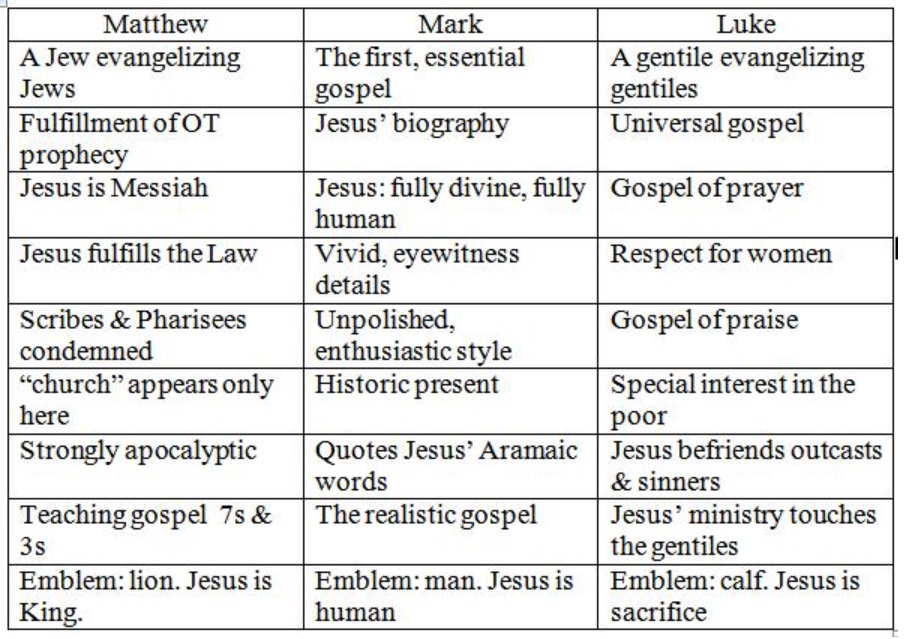
The following table shows how the Gospels tell the story of Jesus from different perspectives, each focusing on different perspectives of Jesus’ life, and each trying to give a different message about the life of Jesus.

Comparison of Gospels
 MatthewMarkLukeJohn
Portrait of JesusKingServantTeacherSon of God
Original readersJewsRomansGreekschurch
Key phrasesKingdom of heaven, fulfilledKingdom of God, Immediately, nowKingdom of God, Son of manBelieve, Word of God, only begotten Son, eternal life
FocusJesus is the Messianic King of the promised Davidic kingdom which fulfills the Old Testament prophecies and claimsJesus is the authoritative Son of God. He is God’s triumphant envoy come to suffer and die in order to claim victory over sin and deathJesus is the perfect Son of Man, the Messiah prophesied by the prophets who came to save and to minister of people of all nations through the power of God the Holy SpiritJesus Christ is the fully divine Son of God who existed before creation. He is the true Lamb of sacrifice through whom we receive the gift of eternal life
Prominent sectionssermonsmiraclesparablesteachings
Genealogytraced to Abrahamnonetraced to Adamnone
Geographic emphasisGalileeGalileeGalileeJudea
Comparison of the Gospels

Observe

Read the chart above. Which gospel is centered in Judea?

Self-sacrificing and Forgiving

Dancing in the Kingdom – Table of Contents

Part 1 – Shadows of the Kingdom, Chapter 3 – The Image-bearers

[Bible references: Romans 6:4-5; 12:1-3; James 2:12-14; 1 Peter 2:10-12]

Our life in God does not begin with anything we have done but rather with the sacrifice made by Christ Jesus, the perfect sacrifice that was made on our behalf to reconcile us to God. When by baptism we join him in his death, we can also be united with him in his resurrection. It is that resurrection power that enables us to present ourselves as living sacrifices, to worship him by continually dying to our sins[1] and offering ourselves to the service of God and to others. And just as the mercies of God flow into our lives, so those mercies should flow over into the mercy we extend to others on God’s behalf.


[1] Piper, John, “Present your bodies as a living sacrifice,” Desiring God, 13 June 2004, http://www.desiringgod.org/messages/present-your-bodies-as-a-living-sacrifice-to-god; Wayne, Luke. “What does it mean to be a living sacrifice;” Gidley, James S. “A Living Sacrifice,” Christian Apologetics and Research Ministry 31 Aug 2016, carm.org/what-does-it-mean-to-be-a-living-sacrifice

Reflect

God did not need to rescue us, but He did, even though it required great sacrifice. As you ponder that, think of how you can show love to those around you?

Observe

Read Romans 12:1-21. Christ’s sacrifice for us included his death on the cross. What kind of sacrifice are we expected to make?

A Brief Account

Dancing in the Kingdom – Table of Contents

Dancing In the Kingdom – Part 1 – Shadows of the Kingdom Chapter 1 – Prelude

A Brief Account

The following is an Extremely Brief Account of the Very Long Story, a summary of the Bible’s story.

There was, and is, and will be, a complex person we call God, who exists as three people that we have come to know as the Father, Son and Holy Spirit. God decided that he wanted to expand the love that was shared between the Father, Son and Holy Spirit. To that end, he created an entire universe so that on one of its planets he could create an abundance of living creatures.

On that planet, he created special creatures, humans, who were made in his image such that they could love him in the way that he loved them. This universe then, would be a form of temple, a place where God can meet with his people. The garden he placed them in was where the dimensions of heaven and earth overlapped. The garden was a place where God’s good and beautiful kingdom of heaven was fully present.

Of course, these humans were not duplicate spiritual beings who were gods themselves, but physical creatures who had enough of God’s characteristics so that they could love in the way God loved. But because love is a voluntary thing that we must choose to do, we cannot love unless we have the option to not love.

God placed his first people in a garden and gave them an assignment. They were to be his representatives, priests if you will, in this garden. They were to take care of it as His representatives, His stewards in the garden. Their long-term task was to multiply and fill the earth so that the whole earth would become the place where God could meet with all his people. The entire earth was intended to be filled with God’s abundant provision for his people who would then take care of what God provided, and all the while giving and receiving and sharing the love which God would freely bestow. In this way, the kingdom of heaven would overlap with the entire kingdom of earth and God would freely mingle with his people.

The option to love or not love was provided by a test of trust. There was in the garden a tree whose fruit not only looked appealing but promised to provide the gift of all knowledge if one ate it. The humans were told to trust God and not eat the fruit of that tree. Eating that fruit would not only provide certain knowledge but would also provide death.

The results of that test are now apparent all around us. Death comes to us not only in the form of physical death, the separation of our souls from physical life, but also in the form of spiritual death, the lack of love which separates us from each other and from God. Fortunately, our current situation is not our destiny – and that is what the rest of the story is about.

God intended that death would not merely be a penalty for not trusting (or loving) but would also be the very mechanism by which he would restore us to himself. From the descendants of the first people, God separated out a family through which he would bring blessing to the entire world. Through that family that a nation would be raised and through that nation the eternal God would choose a family to accomplish the inconceivable. In that chosen family, the eternal God would cause himself to be conceived within the womb of a woman who would then give birth to a being who was both fully God and fully human. He would then be raised as a human and eventually would suffer death by execution as a human and then be resurrected as a human.

In that resurrected human body, the eternal God would return to heaven, but before doing so, he invited us to, in essence, to represent Him on earth by becoming part of his body on earth. By trusting him and accepting his Spirit, we could join with him in His death and resurrection by dying to our own self-interests and uniting with his loving interests.

He then promised to return to us again in bodily form, at which time the kingdoms of heaven and earth will again overlap. Heaven will be rejoined to earth to fulfill the intention God had from the beginning. But meanwhile, in this time between His incarnation and His eventual return, we are still called to be stewards of our currently broken world, bringing slivers of the light and hope of heaven into a world now very dark with evil and suffering and pain.

Reflections

How do you feel in comparison to the immense size of the universe? What does it mean to you, that the universe was designed with you in mind?

Observe

Read Acts 2:22-36; 7:2-50; 10:34-43; 13:16-39; 17:22-31. These passages show the various ways the gospel was presented to various audiences. As you read through the different accounts of the gospel, what stands out to you?