Principles

Dancing in the Kingdom- Table of Contents

Dancing In the Kingdom – Part 3 – Dancing in the Kingdom– Chapter 18 – Entering the Dance

Principles

[Bible references: Genesis 1; Psalm 19:1-4; Isaiah 28:23-29; Romans 1:18-20; 2:14-15; 13:1-2; 1 Peter 2:13]

We cannot establish the kingdom of God nor overcome the powers of evil in our own power. While Jesus has overcome the powers of the world, we do not know when he will return to finish the deed to fully establish his kingdom and fully rid the world of the presence of evil. But we can continue to work on the mandates he gave us at the beginning and rephrased at the Great Commission to make disciples of all nations, teaching them to obey all that I have commanded you, which extends from our original directives to be fruitful and multiply and fill the earth, and to subdue it and rule over all the creatures.

From the beginning of the church, we can see that while some people were sent out with the express purpose of spreading the gospel, most people stayed within whatever vocation they had, living in their own communities, sharing their resources, and supporting one another. Those that stayed in their vocations, did not change their vocations although they may have changed the way they pursued their vocations.

Albert Wolters suggests several principles that can help guide the way in which we pursue our vocations:[1]

  • The universe that God created was good.
  • The structures/institutions created by people should reflect God’s character and his wisdom as revealed through creation and his word.
  • The structures/institutions created by people are vested with God’s authority.
  • The universe reveals God’s glory.
  • Wisdom is “ethical conformity to God’s creation.”
  • The will of God for our life can be known through his creation, our conscience, His word, spiritual discernment.
  • Since God’s initial creative activity in forming the universe, God has been creatively developing the universe either directly through his own work or indirectly through his people. Part of that development includes the development of societal and cultural institutions.
  • Even without the fall, people would still be expected to develop the garden and other aspects of civilization as part of our role in stewarding what God has given us
  • When Christ returns, He will restore the earth.[2]

Whether we are directly communicating the gospel in our vocation or not, we may hold the narrative of the gospel as public truth to be shared.[3] The first communicators of the gospel were eyewitnesses who could say, “That which we have seen and heard … we declare to you.” As the church, we are entrusted with the responsibility of sharing that same truth, not in a forceful way but in the way of Jesus and his apostles who affirmed what they knew and invited others to respond in dialog.


[1] Wolters, Albert M. Creation Regained: Biblical Basics for a Reformational Worldview, William B. Eerdmans Publishing 1985, 2005. eBook Chapter 2

[2] Wolters, Albert M. “Worldview and Textual Criticism in 2 Peter 3:10” Westminster Theological Journal 49 (1987) 405-413 allofliferedeemed.co.uk/Wolters/AMW2Peter3.pdf

[3] Newbigin, Leslie. . “An Introduction to the Theology of Religions: Biblical, Historical & Contemporary Perspectives” Gospel As Public Truth, Intervarsity Press 2003

Observe

Read Psalm 19:1-4. How can our work reflect the glory of God?

New Jerusalem’s Urban Garden

Dancing in the Kingdom- Table of Contents

Dancing In the Kingdom – Part 3 – Dancing in the Kingdom– Chapter 16 – Fixing our eyes

New Jerusalem’s Urban Garden

[Bible references: Genesis 1-2; 1 Corinthians 12; 14;1 Peter 1, 4; Revelation 21-22]

In the now-broken earth, many people think of human civilization only as a corruption and pollution of the earth, that the earth was only meant to be pristine – as it supposedly was before humans started to mess it up. While we certainly have abused the earth in many ways, that does not mean all aspects of human civilization are inherently bad. When we use our God-given capabilities to join God in His kingdom building, that is good. Many of the things that we design, create and build are inherently good. The problem lies in our corruption and the world’s corruption that causes us to misuse every good thing.

When we were charged with filling and subduing the earth, it did not mean that we were to simply expand the Garden of Eden. God had given us many gifts to use, including tremendous creative abilities. We were given various spiritual gifts for the purpose of building one another up; we were given artistic gifts to make articles for the Tabernacle and Temple; we were given gifts of singing, making musical instruments and craftsmanship, hunting, trading, sailing – in general, making the things of civilization.

Those same gifts are available for current task of participating with God in the process of bringing His Kingdom to earth, a process that shall lead to ultimate uniting of heaven and earth, a process that leads not to the original Garden of Eden, but of an urban garden attached to the new Jerusalem.

It is undeniable that, despite the corruption we see, God has provided us an abundance of creative skills for displaying His transcendence and glory in our art, technology, engineering, and sciences. He has also given us social and political skills to create human public and private institutions that can organize our abilities to do good.

But it does not take much observation to also notice the corruption that has permeated our society. It can seem hard to determine if we have misused more than properly used the gifts and abilities God has given us. Nevertheless, as God’s co-regents we have been given a sacred obligation to nurture the place he gave us in anticipation of God’s final restoration of the earth.

Reflect

How can you use the gifts and skills that God has given you to help give people hope for the future?

Observe

Read 1 Peter 1. If our mind is set on seeing Christ soon, how shall we prepare?

Our limits

Dancing in the Kingdom- Table of Contents

Dancing In the Kingdom – Part 3 – Dancing in the Kingdom– Chapter 14 – Remembering our creation

Our Limits

[Bible References: Genesis 1-2; Deuteronomy 15:11; Psalm 40:17; 1 Corinthians 12]

As we seek to fulfill our cultural mandate, there are various constraints which control how we exercise our call.[1] First and foremost, as God’s image-bearers, we are to act in accordance with God’s character: holding to the balance and tension of acting with sovereignty and servitude, mercy and justice, playfulness, and orderliness, along with his attributes of overflowing goodness, generosity and peace, trustworthiness, faithfulness, self-sacrifice and forgiveness. Although we are not transcendent in the same way God is, as his image-bearers his character of transcendence can be reflected in the ways we manifest His other qualities: Our ability to creatively imagine the ways in which we establish dominion, live into our relationships, display fruitfulness, and fulfill our responsibilities as God’s image-bearers.

We also need to remember that there are limits with which we should exercise our responsibilities. God has given us finite resources of materials or time to work with along with the reminder of Sabbath to help us refocus, to remember that although we are designed to work that we are not designed solely for work. It is not work that gives us value, rather it is God who gives us value and our work only has value if it gives God the glory.

Part of our limits are tied to our embodiment. Our earthiness is a reminder of our dependance on the earth, each other, and God. Our earthiness should help us lean into the humility worthy of image-bearers of God. Our need to sleep is a constant reminder that we are not God who never sleeps.

The multi-faceted call God has given us, requires us as God’s stewards to weave together the call to glorify God, to bring to maturity God’s rule over the earth, to reflect God’s triunity within the community of his image-bearers. This call is not for us to fulfill individually, but rather together as the Body of Christ with whatever God provides.


[1] Theology of Work Commentary, “Genesis 1-11 and Work” Hendrickson Publishers Marketing 2015, 2016

Reflect

We have built-in limits to what we, in our bodies, can do. How do these limits remind us of our dependency on the earth where we live, on each other, and on God?

Observe

Read Deuteronomy 15:11; Ps 40:17; 1 Corinthians 12. Why do we need each other?

Playful and orderly

Dancing in the Kingdom- Table of Contents

Dancing In the Kingdom – Part 1 – Shadows of the Kingdom – Chapter 3 – The image-bearers

Playful and orderly

[Bible references: Deuteronomy 12; Exodus 35:30-38; 2 Kings 17:1-41; Nehemiah 8:1-9:38; Psalm 100; John 4:23-24; Acts 6:1-7; 15:1-35; Romans 12:1-2; 1 Corinthians 14:1-40]

There is much that is wrong in the world. People endure pain and suffering sometimes from natural happenings and sometimes from the actions of others. Evil seems persistent and never-ending. When we are called to serve God in this world, we can become overwhelmed by all the work that is to be done. Playfulness can seem out of place. Particularly, any playfulness that emerges from self-centeredness or obsessiveness.

Actually, that is the point we need to assert. Playfulness can be out of place in a world of sin and evil. But playfulness can also be a reminder that the reality in front of us is not the total reality. Our playfulness arises out of the relationship we have with God, the one who has overcome the evil in the world, who will end the suffering and who will restore us and world to be what he intended from the beginning. Playfulness arises out of the hope and joy we have in knowing that the reality in front of us is not the whole reality.

Our imagination can be helpful in this play. As children, we can pretend there is another world and do something like taking a cardboard box and imagining it to be a spaceship and accepting the rules of living in that spaceship. Family traditions (or even community or national traditions) are a form of play, they do not serve a utilitarian purpose, but stem from the creative ways we wish to remember our unique heritage.

This same imaginative playfulness can be useful in reminding us of the reality that lies behind our current reality. Our traditions of worship are a form of play, albeit a more serious play. Our worship traditions represent ways for us to remember our spiritual heritage or to provide imaginative ways to perform biblical sacraments about which we have sparse details on how to perform them. These traditions and liturgies help us point to that other reality, a new Kingdom that began breaking into this world with the incarnation of Jesus.

Christian worship was in fact and from the beginning a festival:  the festival of Christ’s resurrection from the dead … Easter begins with a feast, for Easter is a feast and makes the life of those who celebrate it a festal life … Jesus himself compared the presence of God, which he proclaimed and lived, with the rejoicing over a marriage. His earthly life was a festal life, even if it ended in suffering and death … the early Christians have understood his raising from the dead and the presence of the now-exalted Christ as the beginning of an unending joy and a happiness without end … the risen Christ as ‘the first among those who had fallen asleep’ and as the leader of life; as the leader in the mystic dance and himself as the bride who dances with the others, as the church father Hippolytus put it.  Long before the somber dances of death were painted in medieval times of plague, the figure of the resurrection dance can be seen in the old churches. The modern Shaker song ‘The Lord of the Dance’ brings out very well the dancing Christ:

I am the life that’ll never, never die;
I’ll live in you if you’ll live in me,
I am the Lord of the Dance, said he.[1]

We hope to participate in the inbreaking of the new Kingdom by living according to its rules. When we pray or worship, we are participating in the rules of that new Kingdom. When we come to others and share with them the hope that we have, we ask them to use their imagination to look beyond the current reality and envision the new Kingdom that is already here and is yet to come. When we accept contentment in all situations, when we trust in God, when we comfort others with the hope we have, we are living according to the rules of the new Kingdom.[2]

It is also true, that In this present life there are endless encounters with grief. Although we acknowledge the pain and suffering of that grief, whether that grief is ours or others, we can encompass that grief with hope. Even amid grief we can choose to cling to God and to the hope He brings us. If we can live under the rules of the new Kingdom, we can have assurance that the current grief will pass and will be replaced by future joy and laughter and that every tear that we have cried and will cry and even now cry will be wiped away.

Our hope of the new Kingdom allows us to endure the current pain and suffering knowing that the hard experiences can be redeemed and to be used for good. God can take the pain and suffering we endure to transform us to be more like Christ, who himself suffered for us, transforming the very evil intended for him into the final victory that shall ultimately also make us victorious. This hopeful living then is also a form of play, accepting the rules of a reality we cannot see and choosing to live according to the rules of a Kingdom that we can only realize in part.

That playfulness also emerges in our creativity, which erupts early on in our lives as our desire as children to play and also in the desire we have as parents to play with our children.[3] There is no doubt about how uniquely creative we are in the way we express ourselves, not only in all the various art forms we use but in the ways we can solve all sorts of problems[4] – even to the creative ways we try to cover up our sins.[5] No other creature can come close to expressing creativity the way we can.

Our ability to create and even detect order is also unmatched.[6] Our ability to detect order is evident in the way we can detect patterns in sight or sound. The sense of order is evident in our ability to recognize faces, our ability to recognize the voices of our mothers or fathers as infants and even before we are born.[7] Our sense of order is seen as we grow in our ability to recognize the patterns of letters and sounds and to recognize and respond to language – even languages.

Our sense of order becomes more evident in our ability to create order out of many abstract concepts such as math, science, philosophy, and many other areas.[8] It is our sense of order that allows us to create businesses, governments, and civic organizations to make society productive. When we bring order to farmland, we increase the productivity of the farm.

The visible order within Creation inspired Christians in the past to study Creation. Order within Scripture helps the Bible to be meaningfully used as meditative literature. In the same way, order during worship also helps us to avoid confusion and to focus on God.


[1] Moltmann, Jürgen. “The Living God and the Fullness of Life” trans. Margaret Kohl Westminster John Knox Press, 2015, p.192; Carter, Sydney. Lyrics “Lord of the Dance” (1963) Genius genius.com/Sydney-carter-lord-of-the-dance-lyrics; Tune “Simple Gifts” Brackett Jr., Joseph. (1848) Praise gathering www.praisegathering.com/media-files/pdf/a08380_lyrics.pdf

[2] Edgar, Brian. “The God Who Plays: A Playful Approach to Theology and Spirituality” Cascade Books 2017 (e-book)

[3] Gowman, Vince. “Playful quotes for the child in your heart” Vince Gowman www.vincegowmon.com/playful-quotes-for-the-child-in-your-heart/

[4] Baumgartner, Jeffrey. “The Basics of Creative Problem Solving – CPS” Innovation Management, innovationmanagement.se/imtool-articles/the-basics-of-creative-problem-solving-cps/

[5] Brister, Tim. “6 Destructive Ways We Minimize Our Own Sin” Bible Study Tools www.biblestudytools.com/bible-study/topical-studies/6-destructive-ways-we-minimize-our-own-sin.html

[6] Basulto, Dominic. “Humans Are the World’s Best Pattern-Recognition Machines, But for How Long?” Big Think 24 July 2013 bigthink.com/endless-innovation/humans-are-the-worlds-best-pattern-recognition-machines-but-for-how-long

[7] Pfaff, Leslie Garisto. “6 things you may not know your baby can do” Parents www.parents.com/baby/development/intellectual/6-things-you-may-not-know-your-baby-can-do/

[8] Armstrong, David. “Christianity Absolutely Critical to Origin of Science” Patheos, 18 Oct 2015, www.patheos.com/blogs/davearmstrong/2015/10/christianity-crucial-to-the-origin-of-science.html

Observe

Read Deuteronomy 12; 1 Corinthians 14. These chapters contain explicit instructions about how and how not to worship.  Since we do not yet experience the fullness of the new Kingdom, how can our imagination help us more actively engage in worship?


Reflecting God’s paradoxes

Dancing in the Kingdom- Table of Contents

Dancing In the Kingdom – Part 1 – Shadows of the Kingdom – Chapter 3 – The image-bearers

Reflecting God’s paradoxes

[Bible references: Genesis 1:26-32; 2:4-7,15-25; Matthew 22:36-40; John 15:8-11; Romans 8:20-21; Galatians 5:22-23]

Understanding the character of God, can help us understand what he has intended for creatures that are made in his image. Image-bearing creatures are not gods or duplicates of God, but they are imbued with the character of the God that made them.

It was into this good universe that God prepared beforehand that God created creatures to bear his image. Good creatures, image-bearers, who were given the task of taking care of the good creation that God blessed them with – and God declared his creation to be very good. The image-bearing creatures were created in the complex image of God – the one God who was a community within Himself, the God who was immensely creative, the God who was generous and loving beyond imagination, the God who is sovereign over the universe, the God who is above all things.

There was a danger in God creating image-bearers. To make creatures that were lovers – just as He was a lover – meant giving these image-bearers the freedom to choose whom or what to love. Since we are created as lovers, we are compelled to love, so when we choose to not love one thing  or one person it is only because we have chosen to love someone or something else. Because God’s image-bearers were the capstone of creation, their option to love something more than God risked an awful catastrophe, a catastrophe that could affect the entirety of creation itself. The good creation, all of it, would become not so good.

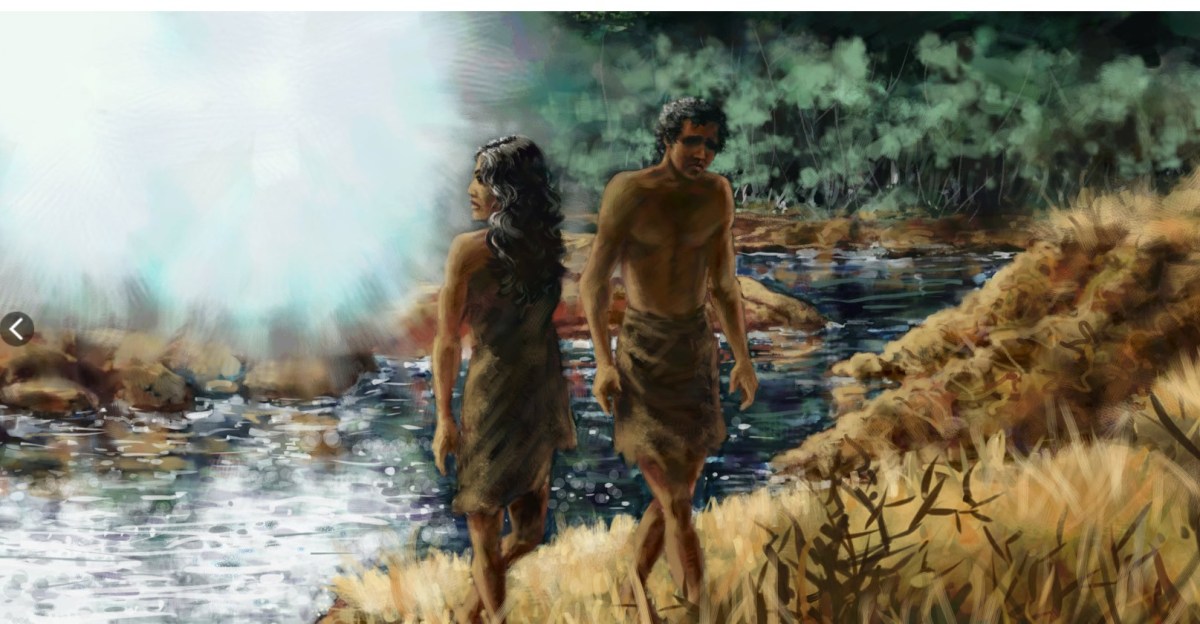
And so it was, after creation was prepared for God’s image-bearers, those creatures who were created in the image of the loving God were given instructions to be stewards of the world God had made. Everything was good, and the first human couple had free access to the provisions in the garden prepared for them. Only one restriction was placed before them, a restriction not meant to deprive them of anything good but meant to provide the opportunity to test their love, by testing their obedience to the one who created them.

We all now know that those creatures failed their test, and we daily experience the consequences of that failure. We also daily experience our own incapacity to restore holiness on our own efforts, our own inability to love God with all our heart and soul and mind and our own inability to fully love God or to fully love our neighbors as ourselves.

The mystery of who we are has to worked out between all the goodness we are endowed with as creatures who bear the image of God and all the evil we are encumbered with as creatures who innately rebel against that same God. Traces of heaven and hell run through each of us and are manifested in our everyday lives. The tongues we praise God with also curse our neighbor. The selflessness we display to others is corrupted by the selfish desires that emerge from the same heart.

Observe

Read Genesis 1:28; 2:15. What tasks did God provide for the humans?

Playful and orderly

Dancing in the Kingdom- Table of Contents

Dancing In the Kingdom – Part 1 – Shadows of the Kingdom – Chapter 2 – The God who created

[Bible references: Genesis 1; 3:6; Job 26:7-14; Psalm 102:25-28; 104:26; Proverbs 8:30-31; Jeremiah 9:24; Zechariah 8:4; Romans 1:18-32; 5:12-20]

It would be more conventional to title this section, “Creative and Orderly,” but creativity is just a part of broader category of play. Although many experts disagree on how to define play[1], we may think of play as activity which is typically not productive and is done only because one wants to do it and is usually a fun activity involving other people and will typically help people bond together.

When it comes to the Creation, God did not have to create anything. God did not need the universe or anything in it – not the planets, nor the stars, nor the creatures. God created the heavens and the earth for the delight of it, and He did it because He wanted to share heaven and earth with his image-bearers. This spirit of playfulness is reflected in many of God’s creatures[2] including Leviathan and humans. God’s playfulness also shows up in other interesting places in the Bible.

When Job complains about the difficulties he is going through, God seems to admonish him by “putting Job in his place” and citing all the ways in which God’s ways are higher than Job’s ways. But God does not follow through with any discipline of Job but rather begins the process of restoring Job’s fortunes. In response, Job confesses, “I spoke of things I did not understand … I retract my words and I repent in dust and ashes.” … And yet, Job changes an interesting behavior – he no longer rose early in the morning to offer burnt offerings for all of his children, worrying that “perhaps they have sinned.” Job seems to have understood what Shams-ud-din Muhammed wrote later on:

the difference between our life and a saint’s is that the saint knows that the spiritual path is like a chess game with God and that God has made such a fantastic move that the saint trips over joy in surrender whereas we think we have a thousand serious moves.[3]

Another instance of playing occurs in Mark 6, when Jesus takes a late-night walk on a very windy lake, walking as if to go by his disciples. Of course, they were initially terrified, thinking they were seeing a ghost. But he got in the boat and the waters calmed down. He could have calmed the waters down before the disciples started to go on the lake. He could have chosen another way to make his point … but he decided to do it that way.

God’s creativity can be seen within the created world in the extremely diverse types of plants and animals: differences in colors and shapes; different ways of digesting food; different ways of moving and observing the environment to name a few. The creativity we see is awesome. From out of nothingness, from no previous model, God created a whole system of particles and energy fields that interact with each other to form the building blocks of subatomic particles which are used to form atoms, which are used to form molecules of all sorts of complexity, which are then used to form planets and stars (actually, the fusion reaction in stars is used to create larger molecules from smaller ones). And at least one planet was used to create living things like plants and animals in all their complexity and then those living things were used to create communities (ecosystems) that allowed living things to thrive and flourish.

Yet, within the overwhelming creativity displayed within all the diversity of living things there is an order that is imposed by natural processes, sometimes called scientific laws. Christians, like Francis Bacon, pursued these laws as an extension of God’s moral laws in the universe, which then led to the development of modern science.[4] It is within science that we examine orderly processes at work that we call the natural laws which describe how all physical things behave: like the forces of gravity, electrical forces, etc.

There is no disobeying these natural laws. If you think that you can try to violate them, you’d be wrong. For instance, if you are on earth and stand on the top of a table and then jump off with the assumption that you will not be subject to gravity but rather float around without falling to the floor, you’d be wrong. You can’t violate gravity. You can try to set up circumstances that will cause other forces to come into play – such as airplanes do when they use aerodynamic forces that counteract gravity – but you simply can’t violate gravity, and there will be consequences if you try.

By observing the laws of the created order, we can ascertain some aspects of the character of God. The natural laws that govern how things are supposed to behave reveals a God who expects things to behave, and that violations are not tolerated. But when image-bearers were brought into the world there was a new level of complexity added to this physical model constrained by natural, physical laws. Because image-bearers were created to reflect God’s transcendence, those image bearers were given moral freedom, the ability to accept or reject God’s rule, the ability to choose to be good or not good. And just like attempts to violate physical laws have consequences, so do attempts to violate moral laws. However, the framework that provides order is also the scaffolding for creativity and play. The order that allows us to study God’s ordered creation also allows us to observe the activity of the living God when He does the unexpected.


[1] Edgar, Brian. “The God Who Plays: A Playful Approach to Theology and Spirituality” Chapter 5: Theology: Ludic(rous) Thinking, Theories of Play Cascade Books 2017 (e-book)

[2] Yu, Alan. “Which animals play, and why?” WHYY 15 Aug 2019 whyy.org/segments/which-animals-play-and-why/

[3] Hafiz (or Shams-ud-din Muhammad Tripping over Joy (translated by Daniel Ladinsky) (c. 1320-1389) wrote about God as his Friend, the Beloved, the Beautiful One. from reference by Edgar, Brian “The God Who Plays: A Playful Approach to Theology and Spirituality” Chapter 4: Spirituality: Playing with friends, Competing with God

[4] Harrison, Peter, “Christianity and the rise of western science” ABC Religion and Ethics, 8 May 2012, www.abc.net.au/religion/articles/2012/05/08/3498202.htm; Armstrong, David, “Christianity Crucial to the origin of science,” Patheos, 18 Oct 2015, www.patheos.com/blogs/davearmstrong/2015/10/christianity-crucial-to-the-origin-of-science.html; Hannam, James. “How Christianity Led to the Rise of Modern Science” Christian Research Institute www.equip.org/articles/christianity-led-rise-modern-science/

Observe

Read Romans 1:18-32.  Reflect on how natural laws reflect the character of God. Based just on natural laws, what kind of character does that reveal about God?

Confronting our freedom

Dancing in the Kingdom- Table of Contents

Dancing In the Kingdom – Part 1 – Shadows of the Kingdom – Chapter 1 – Prelude

Confronting our freedom

[Bible references: Genesis 3:1-24; Deuteronomy 7:6-14; 30:18-20; Joshua 24:14-16; John 7:17; 15:16]

To be creatures designed in the image of the transcendent creative, loving God, we needed a kind of independence so that we could choose to love – or not love – and to be free to imagine and create wildly new and different things as proper for God’s image-bearing creatures. We were free to do this in a place where everything was very good and designed so that we could flourish. However, that very freedom which gave image bearers the possibilities of independent thoughts, also gave those image-bearers the opportunity to also confront temptation.

While the image-bearers were given the opportunity to meet with God and to walk with him in a specially designed garden, they were also allowed the opportunity for questions. They could even question the motives of the God who made them: 

  • Was something good being withheld from them?
  • Were they being deprived of some power?
  • What would be available to them if they violated the restriction?
  • Would they actually die?
  • What special knowledge were they being deprived of – particularly this knowledge of good and evil?
  • Everything they had encountered had been good, why would their thinking about violating this one restriction not be good?
  • Was the Creator so good anyway?”

Observe

Read Deuteronomy 7:7; 30:18-20; Joshua 24:14-16. The ability to love is not possible without the ability to choose. What did the Israelites choose to love (or not love)?

Reflecting God’s Paradoxes

Dancing in the Kingdom – Table of Contents

Part 1 – Shadows of the Kingdom, Chapter 3 – The Image-bearers

[Bible references: Genesis 1:26-32; 2:4-7,15-25; Matthew 22:36-40; John 15:8-11; Romans 8:20-21; Galatians 5:22-23]

Understanding the character of God, can help us understand what he has intended for creatures that are made in his image. Image-bearing creatures are not gods or duplicates of God, but they are imbued with the character of the God that made them. In this chapter we will explore some of the ways God intends for us to reflect his image. In later chapters, we will expound on those characteristics in more detail.

It was into this good universe that God prepared beforehand that God created creatures to bear his image. Good creatures, image-bearers, who were given the task of taking care of the good creation that God blessed them with – and God declared it to be very good. The image-bearing creatures were created in the complex image of God – the one God who was a community within Himself, the God who was immensely creative, the God who was generous and loving beyond imagination, the God who is sovereign over the universe, the God who is above all things.

There was a danger in God creating image-bearers. To make creatures that were lovers – just as He was a lover – meant giving these image-bearers the freedom to choose whom or what to love. We are unable to choose to not love but only who or what to love. Because God’s image-bearers were the capstone of creation, the option to another love than God, risked an awful catastrophe, a catastrophe that could affect the entirety of creation itself. The good creation, all of it, would become not so good.

And so it was, after creation was prepared for God’s image-bearers, those creatures who were created in the image of the loving God were given instructions to be stewards of the world God had made. Everything was good, and the first human couple had free access to the provisions in garden prepared for them. Only one restriction was placed before them, a restriction not meant to deprive them of anything good but meant to provide the opportunity to test their love, by testing their obedience to the one who created them.

We all now know that those creatures failed their test, and we daily experience the consequences of that failure. We also daily experience our own incapacity to restore holiness on our own efforts, our inability to love God with all our heart and soul and mind and our inability to fully love God or to fully love our neighbors as ourselves.

The mystery of who we are has to worked out between all the goodness we are endowed with as creatures who bear the image of God and all the evil we are encumbered with as creatures who innately rebel against that same God. Traces of heaven and hell run through each of us and are manifested in our everyday lives. The tongues we praise God with also curse our neighbor. The selflessness we display to others is corrupted by the selfish desires that emerge from the same heart.

Reflect

How is love dangerous?

Observe

Read Genesis 1:28; 2:15. What tasks did God provide for the humans?