Dancing In the Kingdom – Part 3 – Dancing in the Kingdom–Chapter 14 – Remembering our creation
Our Relationships
[Bible references: 1 Peter 4:7-11]
All of these activities are done in context of our relation to God, to each other, and to our land. God has created us in His image, in the image of a triune God in which Father, Son and Holy Spirit exist as three persons united into one. Within that framework, God created us as male and female, each created as creatures made in God’s image yet different from and interdependent upon each other. When God made a woman for Adam, He specified that the woman would be an ‘ezer kegnedo,’[1] a strength corresponding to him. God created us from the dust of the earth, so although we are stewards of the earth, we are also dependent on the earth. In the earth, God has provided for us the resources we need to do our tasks. In all these relationships, God has intended that we are to live in unity with Him, with one another and with our environment.
Over time, our unity in all these areas got more complicated as our numbers grew. We needed to create organizations which necessarily became more complex as our societies grew and as our collective impact on the earth became more substantial. We needed extra discipline to maintain our relationship with God. We also needed to develop more skills in diplomacy, administration, and hospitality as we deal with more and different people. We needed to pay closer attention to the effects of our culture on the earth and its creatures to minimize the damage from so many people using our physical resources.
All of our work, our stewardship, is intended to have a direction, to bring maturity, fruitfulness, and growth to God’s work. The work we were charged to begin in the Garden of Eden was designed to end in the filling and subduing of the earth, in the cultivation of the whole earth where heaven and earth overlap so that work and worship are the same thing.[2]
It is not just that the world is immensely complex, but it seems to contain unexplainable attributes like Beauty and Truth – and something about us seems designed to need to find a reason for our being and a sense of morality. The tools of philosophy and science have been very helpful in understanding our world – but those tools are limited. Philosophers are constrained by our limits to comprehend our world through using reason alone.
After surveying the significant problems we confront in trying to make sense of this world, [John] Lock remarked: “From all which it is easy to perceive what a darkness we are involved in, how little it is of Being, and the things that are, that we are capable to know.” … [Alexander] Pope concedes that this universe appears to be incoherent and ambiguous. Yet Pope insists that we have to acknowledge the frailty and fallibility of human moral and intellectual capacities in reaching this judgement. … [John Banville] . “I saw a certain kind of pathetic beauty in the obsessive search for a way to be in the world, in the existentialist search for something that would be authentic.” … was forced to deal with the irreducible fragility and provisionality of human knowledge. … The hope of finding the Enlightenment’s Holy Grail, the crystalline clarity of rationalist certainties, gradually gave way to a reluctant realisation of the irreducible complexity of the world, which simply could not be expressed in terms of the clear and necessary ideas that the Enlightenment expected and demanded.[1]
Scientists are equally constrained by our limits to comprehend our world through measurement and experiment alone.
Those who invoke the political nostrum “follow the science” need reminding it is an activity that’s never free of value judgement … scientific findings are empirically-based descriptions of the patterns and regularities that we find in the world around us. They are not the be all and end all of explanation. . They are local explanations of aspects of the world around us, that are provisional in nature…. Science does not say anything about the ‘meaning of life’, the nature of causation, the origins of the universe, whether there is ‘free will’, etc., until its findings are combined with additional premises in an argument. Arguments, being made as they are in human language, are strictly speaking, philosophical in nature … Scientific reasoning can never prove the truth or falsity of its own assumptions (which are values), nor can it have much to say at all about normative questions, only indirectly. A scientific argument can be used to support a premise used in a philosophical argument about some conclusion, but it cannot constitute the argument.[2]
When we look to find meanings in the context of Biblical cultures, we find differences between the Hebrew and Greek cultures. While each culture has its strengths, as we talked about in “Limits of theology” (p.161), the different languages can shape our thinking by focusing on different priorities. The following table presents some of those different focus points.
Hebrew culture
Greek culture
nephesh refers to whole being (soul and body are integrated
not just a soul that exists apart from the body,
shema = listen and obey
Akouo – listen, hear
objects described in terms of function
Objects describe in terms of physical description
supernatural and natural worlds are integrated
supernatural and natural worlds are separate
historical narrative is about meaning
historical narrative is about chronological sequences
material goods measure God’s blessings
material goods measure personal achievement
value is on what we do
value is on what we think
knowledge is about ethics and moral practices
knowledge is about intellectual categories
worship was a function of service, what we do in the body
worship was a function of service what we think
The Hebrew language has fewer words and focuses on creating stories and not creating descriptions. The fewer words that are used can have a wider range of meanings which the Hebrew writers of scripture use to create stories with intentional ambiguities and is sparse in details and descriptions. The Hebrew worldview assumes a world where the natural and supernatural are intertwined and there is an actively involved God. Hebrew ethics are focused on what is done than what is thought.
The Greek language is amenable to creating complex words and is amenable to developing philosophical and scientific thought. Greek story telling is full of details and descriptions and exact definitions. The Greek worldview separates the spiritual world and the physical world, where the spiritual world is considered the most important and that the activity of the gods does not necessarily affect events in the physical realm. Greek ethics are focused more on what is thought than what is done.
The church has been affected by the Greek way of thinking.[3] One idea, called Gnosticism, held that salvation could be obtained through secret knowledge; leading to the development of “secret” societies like the Rosicrucian’s where only those within the society have that knowledge. Another idea was dualism, where spiritual things are considered to be good and material things are considered to be bad. The consequences of that thinking have led to heretical teachings about the nature of Jesus, severe asceticism, unhealthy thinking about sexuality, neglecting our stewardship of creation, rejection of the arts, etc.
One reaction in the church against the Greek philosophies led to a type of anti-intellectualism called fideism,[4] which intended to focus exclusively on a type of faith that ignored the use of reason
The ideas of the Greek philosopher, Aristotle, would resurface later during the Renaissance led to the development of modern science. However, the church hindered the development of astronomy for a while when it stubbornly clung to Aristotle’s geocentric view of the universe.
The church was involved various attempts to reclaim the glories of the past and to elevate the human condition in what used to be called the dark ages.[6] The discovery and rediscovery of the writings of Greek, Latin and Muslim philosophers and scholars enriched the thinking within the Roman empire. The sum of all these eventually led to the period of “Enlightenment.”
9th Century Renaissance.[7] Monasteries were involved in the laborious process of preserving manuscripts by hand-copying them. However, for many years, some of the Latin and Greek classic writers were neglected in favor of Christian works. Charlemagne, the king of the Holy Roman Empire, was interested in giving everyone an education that included the Roman and Greek classic writings (such as the writings of Plato and Cicero). The main impact of this renaissance was on the development of literature.
12th Century Renaissance.[8] Christians escaping the spread the Muslim empire brought new Greek and Arabic writings to the West. These included the writings of Aristotle about logic and Arabic writings about natural philosophy and Latin works about law. This renaissance led to advances in social organization, the law, technology, intellectual pursuits and attempts to make Christianity more human which led a general spirit of optimism and desires for a more personal and intense religious experience.
14th century Renaissance.[9] The continued introduction of Greek texts from Christians fleeing the Ottoman Empire combined with the advent of the printing press made possible the wide publication of Greek ideas, particularly from Plato, whose ideas that some thought were more compatible with Christianity. These discoveries combined with discontent with the church led to the development of humanism, which elevated the capacity of humans. At first, humanism was very much a Christian topic but over time, humanism became an antithesis to Christianity.
18th century Enlightenment.[10] The invention of the printing press in AD 1439 further supported the spread of science as well as humanism and would also be central to the Protestant revolution in the 1500s. During the same period, developments in shipbuilding and technology enabled the development of European empire building and the success of that contributed to the age of Enlightenment (AD 1714-1789) with the emphasis on liberty, progress and reason having priority over theology. The Enlightenment version of humanism, (different than the Christian version of humanism) stated that people are essentially good and do not need God to progressively improve over time. This version impacts even our modern-day culture and sometimes the culture within the church.
Advances in knowledge is a good thing, but knowledge constrained by human pride does not lead to wisdom. The “Enlightenment” was the name given by people who were proud of the age where God was cast off and where human knowledge replaced the wisdom of God.
[Bible references: Matthew 5:6; 7:14; 11:29-30; Luke 17:10; John 6:35; Romans 3:28; Galatians 5:1; Ephesians 2:10; James 2:24]
Paradox: A seemingly absurd or contradictory statement or proposition which, when investigated, may prove to be well founded or true. (The Oxford Dictionary). A situation or statement that seems impossible or is difficult to understand because it contains two opposite facts or characteristics: (Cambridge Dictionary)
Religious truth often pivots on paradox … full truth about Jesus outruns the ability of human reason … all of the core truths of Christianity are twin realities, delicate paradoxes …it is dangerous to insist on flat yes-or-no answers to the big and perennial questions of life … we live in a fast-moving and rootless time when numerous theologians are trying to restate the Christian faith in relative and fluid terms that reflect the mood of our times more than biblical foundations (Callen, Barry L. Caught between Truths: The Central Paradoxes of Christian Faith, Emeth Press, 2007)
Embodying the gospel is … more than individualism. God is a social reality (trinity), faith should be a social reality, the best way to witness on behalf of the church is to be the church … More than rationalism. We are more than rational animals; rationality has its place but there is mystery that only faith can approach. Spiritual experience and interpretive concepts are reciprocally related. Doctrine is important but primacy is given to the transforming personal and community encounter with God in Jesus Christ … More than dualism. We are whole persons. Sin is both personal and systemic … More than knowledge. Knowledge, even biblical knowledge is not good in and of itself. Orthodoxy includes orthopraxy (Callen, Barry L. Caught between Truths: The Central Paradoxes of Christian Faith, Emeth Press, 2007)
The Bible is not written as a textbook that presents a list of topics and propositions. The views and values of the Bible are presented in the context of a story – a story of God and his image-bearers. The Bible’s focus is on relationships, and its views and values are found in the context of the stories of those relationships. Those stories sometimes reveal paradoxes.
One dimension of those paradoxes is revealed in how the values of the Bible are upside down compared to the views of the surrounding cultures. For instance, the Bible presents one God instead of many. The Bible presents a world of order which has a particular end in mind instead of repeated cycles of disorder with no end point in view.
Another dimension of those paradoxes are statements in the Bible which seem to contradict one another. Some examples are:[12]
• “We are worthless servants.” (Luke 17:10) “We are his workmanship.” (Ephesians 2:10)
• “Blessed are those who hunger.” (Matthew 5:6) “No one who comes to me will ever be hungry.” (John 6:35)
• “Take up my yoke and learn from me.” (Matthew 11:29) “Don’t submit again to a yoke.” (Galatians 5:1)
• “A person is justified by faith apart from works of the law.” (Romans 3:28) “A person is justified by works and not by faith alone.” (James 2:24)
• “My yoke is easy.” (Matthew 11:30) “How difficult the road that leads to life.” (Matthew 7:14)
Presenting values by means of paradoxes forces one to more completely understand those values by exploring them in different dimensions.
There is an impossible task set before the believers through the world who comprise what some call the invisible, universal church: Differences have arisen which have caused different local congregations to have some disagreements about what the correct theology is. We will call these differences, distinctives. It is from these distinctives that local congregations divide from one another with some finding themselves aligned into different groups that we call denominations or associations, and some not formally aligning themselves with any other congregation at all.
Although while trying to understand God, we may find that although some things are incomprehensible, other things are knowable. The knowable things make it possible to construct a limited theological framework, despite the tensions cited in Chapter 2 that require us to hold some things in tension.
When distinctives become heresies
Trying to understand a complex, incomprehensible and paradoxical God leads naturally to some diversity of thought. The problem is trying to detect when diversity leads to heresies, ideas that are identifiably contrary to the Biblical message and ought to be rejected by all the major bodies in the church. Heresies typically develop when biblical verses are taken out of context, or when attempts are made to mesh non-Christian ideas with biblical ideas.
The following is a list of some of the most prevalent heresies. For a more comprehensive list of some of the heresies and the terms used for them, read “Appendix F – Partial Listing of Heresies”.:
Matter is inherently evil and only the spiritual is good,
being saved by grace allows us to ignore any laws or norms,
rejection of the Old Testament,
rejection of the Trinity,
only the Father is God,
Gentiles need to be circumcised and follow the Jewish laws,
the validity of sacraments depends on the moral character of the person administering the sacraments,
those guilty of grave sin are permanently excluded from the church,
we can choose to be good apart from God’s grace,
Christ is not fully human and fully divine,
prophets who claim that they supersede the apostles,
all truth and knowledge of God is accessible by the human mind.,
all people will be saved.
Even within our limited framework, it is possible to find that sometimes someone’s theology seems so wrong that it must be corrected and dealt with more strongly. In those cases, the church must determine when some of our distinctives have crossed over from being a ‘distinctive’ to being a ‘heresy,’ teachings that are not just different but cause fundamental theological problems in the teachings of the church. The task of identifying and correcting heresies is a job that must be done but these days is complicated by the divisions within the church. This is one area where we need to recognize Dynamic Tension at work: balancing the need to deal with doctrine and practices that are deemed to be heretical with the need to, as much as possible, retain whatever unity is possible in the church.
There was a time that it was more possible to call together representatives from all parts of the church to discuss difficult issues and come to a common agreement, but that is no longer possible. Between AD325 and AD757 there were seven ecumenical councils[1], councils that were called by the Roman emperor which tried to resolve various questions, at least within the empire, which were dividing the church.
“all the doctrinal definitions of the Seven Ecumenical Councils (councils which have always, and still do, receive the unqualified acceptance of both East and West) … An Ecumenical Synod may be defined as a synod the decrees of which have found acceptance by the Church in the whole world”[2]
One of the most essential products of the councils were increasingly detailed creeds[3] for the church, statements written in response to perceived heresies that were being taught, clarifying what the orthodox teaching of the church ought to be.
Because of the complexities of the different viewpoints, the increasingly detailed creeds were never able to entirely resolve the differences between the Latin speaking and the Greek speaking parts of the church leaving the church with very intense divisions in the aftermath of each of the councils. After the seven Ecumenical Councils, the divisions in the church had become irreconcilable and it is no longer possible to call a council in which all sections of the church would be able to have an agreement on critical theological issues. There have been various ecumenical efforts through the years, including the creation of the World Council of Churches, but such efforts have not been able to overcome those disagreements on critical issues.
This division has complicated the issue of when theological differences become heresies. The inability of the visible church to resolve such issues forces us acknowledge our dependence on Christ; that the Gospel is the good news about our salvation to be found in the grace of Christ – and not in His still fractured church. In the meanwhile, despite the visible fracturing of the visible church, we need to humbly acknowledge the mystery of the unity of the church in Christ.
[2] Schaff, Philip (1819-1893) (Editor) Publisher: Grand Rapids, MI: Christian Classics Ethereal Library, “A select library of the Nicene and Post-Nicene Fathers of the Christian Church. Second Series. Volume XIV. The Seven Ecumenical Councils. For a summary of the seven ecumenical Councils, See Appendix H
Dancing In the Kingdom – Part 1 – Shadows of the Kingdom – Chapter 3 – The image-bearers
Reflecting God’s paradoxes
[Bible references: Genesis 1:26-32; 2:4-7,15-25; Matthew 22:36-40; John 15:8-11; Romans 8:20-21; Galatians 5:22-23]
Understanding the character of God, can help us understand what he has intended for creatures that are made in his image. Image-bearing creatures are not gods or duplicates of God, but they are imbued with the character of the God that made them.
It was into this good universe that God prepared beforehand that God created creatures to bear his image. Good creatures, image-bearers, who were given the task of taking care of the good creation that God blessed them with – and God declared his creation to be very good. The image-bearing creatures were created in the complex image of God – the one God who was a community within Himself, the God who was immensely creative, the God who was generous and loving beyond imagination, the God who is sovereign over the universe, the God who is above all things.
There was a danger in God creating image-bearers. To make creatures that were lovers – just as He was a lover – meant giving these image-bearers the freedom to choose whom or what to love. Since we are created as lovers, we are compelled to love, so when we choose to not love one thing or one person it is only because we have chosen to love someone or something else. Because God’s image-bearers were the capstone of creation, their option to love something more than God risked an awful catastrophe, a catastrophe that could affect the entirety of creation itself. The good creation, all of it, would become not so good.
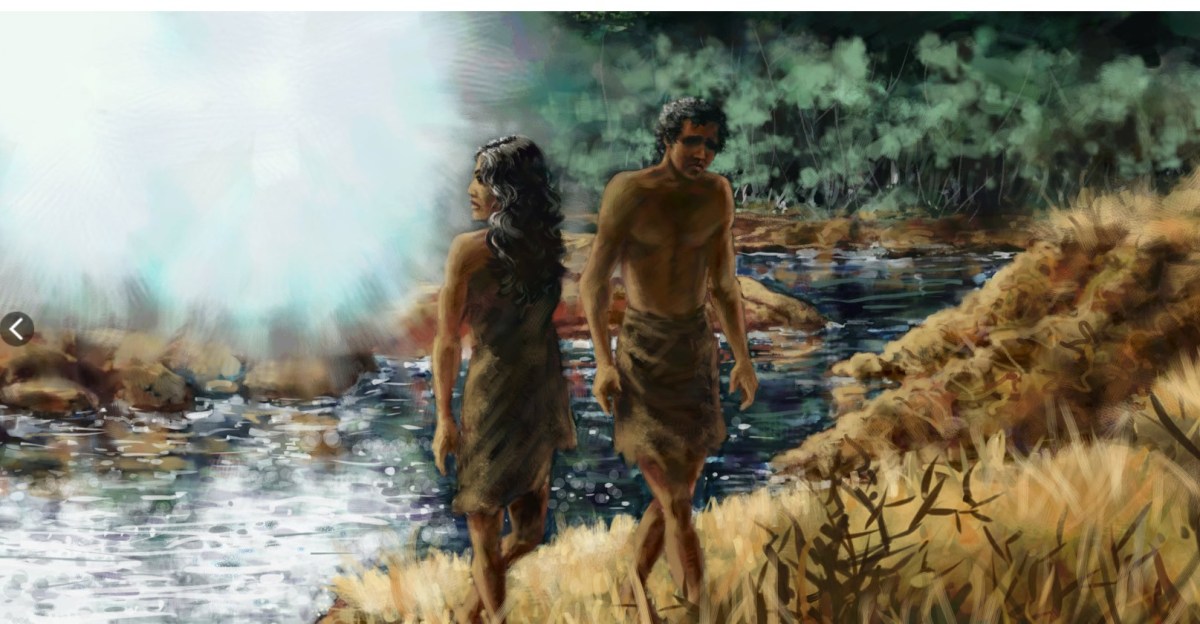
And so it was, after creation was prepared for God’s image-bearers, those creatures who were created in the image of the loving God were given instructions to be stewards of the world God had made. Everything was good, and the first human couple had free access to the provisions in the garden prepared for them. Only one restriction was placed before them, a restriction not meant to deprive them of anything good but meant to provide the opportunity to test their love, by testing their obedience to the one who created them.
We all now know that those creatures failed their test, and we daily experience the consequences of that failure. We also daily experience our own incapacity to restore holiness on our own efforts, our own inability to love God with all our heart and soul and mind and our own inability to fully love God or to fully love our neighbors as ourselves.
The mystery of who we are has to worked out between all the goodness we are endowed with as creatures who bear the image of God and all the evil we are encumbered with as creatures who innately rebel against that same God. Traces of heaven and hell run through each of us and are manifested in our everyday lives. The tongues we praise God with also curse our neighbor. The selflessness we display to others is corrupted by the selfish desires that emerge from the same heart.
Observe
Read Genesis 1:28; 2:15. What tasks did God provide for the humans?



 Dancing In The Kingdom