Faith and the law: heaven and earth joined at the Tabernacle/Temple

Dancing in the Kingdom- Table of Contents

Dancing In the Kingdom – Part 3 – Dancing in the Kingdom– Chapter 19 –The Story of the Kingdom Revisited

The Call: One man chosen from many

[Bible references: Genesis 12:1-3; 15:6; 17:1, 5; 25:26; 32:22-32; 35:22-27; Exodus 1:8, 11]

From one nation in Mesopotamia, God called one man, Abram, to leave his country and go to a “land I will show you.” In that new land, God would use Abraham to create a “great nation.” It would then be through Abram that God would bless those who blessed Abram and curse those who cursed Abram and through Abram blessing all the families in the world.

By faith, Abram listened to God and did as he was told. Even though Abram was not able to do anything to restore his relationship with God, God had a plan in place that would be able to restore that relationship, and in that knowledge, God credited Abram’s faith as righteousness. The nation that God promised would come through Abram would indeed test Abram’s faith. Along the way, God gave Abram a new name, Abraham, meaning “father of many nations.” However, the son that God promised Abraham, did not happen until Abraham was 100 years old. That son, Isaac, only had twins and that did not happen until Isaac was 60. And then it was revealed that only one of those sons, Jacob, was the one that God would create his nation from. Jacob eventually had 12 sons and a daughter.

Abraham and Isaac did not perfectly follow God. Jacob was no exception as he was constantly conniving and trying to get things done his own way. However, despite Jacob’s resistance, God continued to work with Jacob and eventually gave Jacob the name, Israel (meaning wrestles with God). Israel would become the name that Jacob’s descendants would eventually be known by.

Although this slowly growing family was living in the land that God had promised Abram, and the nation-building future now seemed to be coming in sight, God had one more twist to his plans that would seem to throw the plans awry. The family, not yet a nation, would end up in Egypt for many generations, first as guests during a time of famine, then eventually becoming slaves but all the while strongly growing into a nation.

The Call: One Nation chosen out of many

[Bible references: Exodus 11:4-7; 12]

After Israel endured slavery for many years, God raised a man, Moses, to bring the enslaved nation, Israel, out of Egypt, back to the Promised Land, the land that God had promised to Abraham and his descendants. This escape from Egypt was resisted by the king of Egypt and required God to cause many plagues on the Egyptians. The last plague, the one that caused the death of all the first-born Egyptians eventually caused the king to relent. But for the Israelites to protect themselves from that last plague, God told the Israelites to sacrifice a lamb and sprinkle its’ blood on the doorposts and then they were to bake some bread without leavening, because it wouldn’t have time to rise. These actions would become part of Israel’s legacy, Passover, to mark them as God’s people.

The Law

[Bible references: Exodus 19:5-6; Galatians 3:16-18, 24]

After God led the people out of Egypt, with Moses as their leader, God gave this chosen people a set of laws that would also mark them as his own. These laws, which included the Ten Commandments, would prove impossible to keep. It was not God’s intentions to simply be harsh with his chosen people, but to make their sinful condition clear to them and to encourage them to lean on him by faith, as God had done with Abraham, for the covenant of faith was not revoked.

The Tabernacle

[Bible references: Exodus 25:8-9]

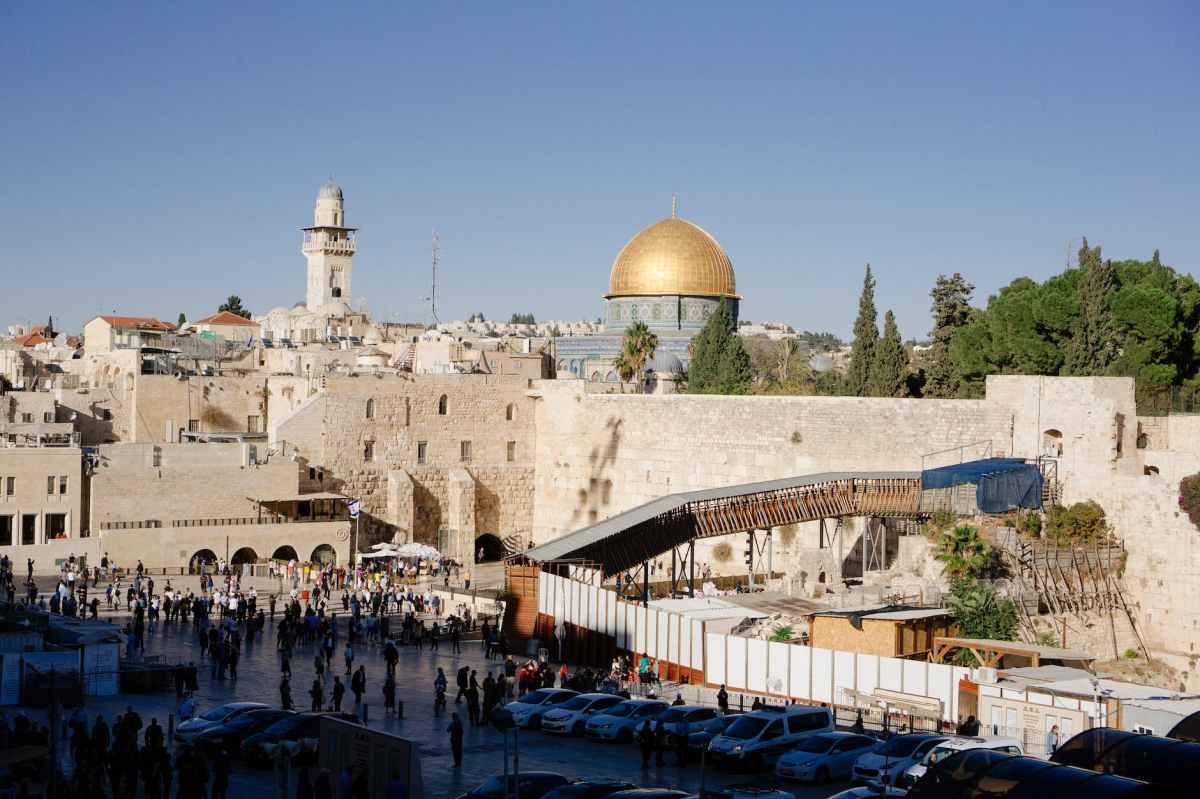
Another prophetic device that God provided was the construction of a Tabernacle, where rituals and sacrifices would be carried out. The Tabernacle would be the place where God would manifest His presence in the midst of His people. At a later point, the Tabernacle would be replaced by a permanent structure, the Temple. The details of the Tabernacle/Temple were meant to provide symbols of how God’s people could relate to him in a similar way to how God met with his people in the Garden of Eden[1].

The Sabbath

[Bible references: Exodus 16:29]

One of the more significant liturgies that God established with Israel was the liturgy of the Sabbath. The Sabbath would point back to the 7th day of creation when God had ceased the ordering of the universe and was now resting, settling into His creation. On the Sabbath, the people of Israel were to cease from their labors as God did from His. It would be a time for them to remember that they do not live for their labors and there is a time to rest – to live in the world in which they labored.

Shadows

[Bible references: Exodus 16:22-23; Hebrews 8; 10]

All these devices, the Laws, the Tabernacle, the Sabbath were also shadows of the future, meant to point to not only what God had done in the past but to what He will do in the future. The Laws would point to the method by which God could resolve the problem of sin. The Tabernacle would point to the way in which God would meet with His people. The Sabbath would point to the ultimate rest that God would provide for His people[2]. But that would be for a promised for future; meanwhile, God’s people, Israel, would live in those shadows.

Those shadows did provide hope for those whose hearts were open.  The Laws were a sign of God’s special covenant relationship with Israel. The rituals of the Tabernacle were a reminder of God’s provision for sin. The weekly Sabbath was a continual gift of rest, a sign of the Israel’s special status as God’s chosen people[3], and a reminder of God’s provision for their daily needs.

The Rebellion Continues

[Bible references: Judges 2:12-19; 21:25; 1 Samuel 8:1-9; 1 Kings 12; Jeremiah 1:15-16; Ezra; Nehemiah]

However, despite the provisions God made for the people of Israel, they had continual trouble holding on to God’s promises. After entering the Promised Land, God’s people would continually put God to the side and follow after the idols of their neighbors, causing God to allow them to be overrun by their neighbors. After spending time in subjection, they would repent and God would rescue them, but they would repeat this same cycle over and over again.

After many cycles of rebellion, repentance, and rescue, instead of thinking about where they fell short of God’s laws, they instead insisted that their problem was the lack of having an earthly king like everybody else. When God finally did provide kings, they discovered that having an earthly king did not resolve their problems. After only three kings, the sins of the kings would cause the kingdom to get split into two parts. Then, despite God’s continuous pleadings through many prophets, the sins of the kings would persist, causing God to discipline His people with temporary exile from the Promised Land. It was then, with the discipline of the exile, that Israel would finally turn from their polytheism[4].

The exile ended when a remnant of the people of Israel, now called Jews, returned to the Promised Land. This time, however, the people of Israel had no independent kingdom, they were only one of many provinces in a vast empire. Despite rebuilding the temple, rebuilding the walls of Jerusalem, and renewing their focus on the Law, they were still as helpless as before – living in the shadows as they had before. Yet, they still had hope for a Messiah, an anointed one, who would rescue them, throw off their oppressors and restore the kingdom of Israel.

Promised Messiah

[Bible references: Isaiah: 32:1; 53; Jeremiah 23:5-6]

There were some hints about the coming of the Messiah: some referring to a king establishing a kingdom but other hints mysteriously referring to a lowly Messiah, a suffering Messiah. It was not easy trying to figure out how that would all go together.

Israel was living in the crossroads of empires:

  • the northern kingdom had been scattered through the Assyrian empire.
  • the southern kingdom had been pulled into exile by the Babylonian empire.
  • the Persian empire had allowed the exilees to return to Jerusalem.
  • the Greek empire overtook the Persian empire, imposed their language and culture on all their conquered peoples and then desecrated the temple which caused a revolt.
  • the Hasmoneans overcame the Greeks and re-established of the kingdom of Israel.
  • but then the Roman empire overtook the Greek empire and turned the kingdom of Israel into a province of the Roman empire[5].

The coming and going of kingdoms and empires created a longing in the Jews for a Messiah to come in and throw out the Roman empire. That solution, however, would not resolve the problem of the rebellious spirit of the Jews, nor of the Gentiles which God had promised would be blessed through the descendants of Abraham. Both Jews and Gentiles needed a solution to their rebellious hearts.


[1] Ragusa, Daniel. “Summarizing the Biblical Theological Case for Eden Being a Temple”  30 July 2016 reformedforum.org/summarizing-biblical-theological-case-eden-temple-garden/ accessed 2/16/2019

[2] Walton, John H. Proposition 4, In Genesis 1, God Orders the Cosmos as Sacred Space” Intervarsity Press, Kindle 2015

[3] Rubenstein, Richard L. “The Covenant: A Relationship With Consequences” My Jewish Learning www.myjewishlearning.com/article/the-covenant-a-relationship-with-consequences/ accessed 2/16/2019

[4] Johnson, Paul. History of the Jews, Harper Perennial 1987 (p.76)

[5] Ekstrand, Dr. D.W. “The Intertestamental Period and Its Significance upon Christianity” The Transformed Soul, www.thetransformedsoul.com/additional-studies/spiritual-life-studies/the-intertestamental-period-and-its-significance-upon-christianity  accessed 2/16/2019
The rebellion: heaven and earth separated

Dancing in the Kingdom- Table of Contents

Dancing In the Kingdom – Part 3 – Dancing in the Kingdom– Chapter 19 –The Story of the Kingdom Revisited

The Choice

[Bible references: Genesis 1:12, 22, 28; 2:9, 17; 3:1-24; Jude 1:6; 2 Peter 2:4; Revelations 12:7-9]

For God to create creatures in His image, He had to take a risk. To make creatures who could freely choose to love, they also had to be able to choose to not love. However, choosing to not love the one who is the very source of goodness is incredibly disastrous; it means putting a barrier between oneself and the source of goodness itself, indeed, it is to take on evil itself.

So that love could be freely chosen, when God created His image-bearers, He placed them where they could make the choice to love and obey. The two image-bearers that we are told about, Adam and Eve, were placed in a garden which had a tree, the Tree of Knowledge, whose fruit they were told not to eat of on the penalty of death. These were good people in a world where everything that was created was good, but there was a possibility that they could make a choice to not love, and to risk death by making something more important than their relationship with the Creator. God’s creation was good, very good, and was destined to mature and grow fuller, giving more and more glory to God.

There were also other beings, angels, that also had the option to obey or disobey God. At some undefined point in time, in the realm of heaven, there was a rebellion among the angels, the chief one being Satan, and they were removed from the presence of God. For reasons known only to God, Satan was allowed to tempt the image-bearers to also rebel. The temptation was accomplished through a serpent[1] who convinced the woman to question God’s intentions and God’s consequences of eating from the Tree of Knowledge. Then the woman, who was deceived, and the man, who was with her and who was not deceived, chose to rebel and eat from that Tree.

The Consequences

[Bible references: Genesis 3:15, 21-24; 5:24; 2 Corinthians 5]

The consequences were immediate and drastic. The signs of deaths affected everything. There was death of relationships:

  • The serpent was cursed, and hostility was declared between the serpent and humans.
  • The relationship between the people and God was broken – this was spiritual death.
  • The relationship between the people themselves was broken.
  • The ground itself became cursed, breaking the relationship between the people and the earth.

Everything was corrupted by the evil that had now entered the world. Fortunately, God had a plan in place to restore all those relationships and to fix the corruption created by the rebellion. But in the meantime, the people were banished from the Garden and from the Tree of Life contained therein.

Not only was there to be spiritual death, separation between the people and God, but the image-bearers would also be separated from the Tree of Life and therefore suffer physical death. However, it would be through those very same curses that God would eventually break the curse caused by the rebellion.

God disciplined the man and woman with the punishment of pain and sweat, but at the same time, He provided a sign of the solution to their rebellion. First, there was a hint of the ultimate solution by a future offspring of the woman, and then, He performed the first sacrifice to provide clothing for the man and woman, a hint of the future sacrifice that would be made on their behalf to provide the ultimate covering they would receive. God was not deterred by these events; He already had plans in place to restore relationships, restore creation, and to bring to completion what He had started.

One of life’s lessons is that processes take time. There’re no shortcuts to building relationships, growing to maturity, or pursuing justice. Adam and Eve couldn’t wait for their time to gain knowledge and they paid the price. God’s solution to the problem of sin was also a process that was going to take time. We don’t know the reasons for God’s timetable for healing the corruption caused by sin, but God has clear processes planned out. In the meantime, God did not reveal a pathway for his image-bearers to reconcile themselves with him, except to walk with him in obedience. Except for Enoch, that seemed to not be possible.

Growth of Sin

[Bible references: Genesis 4:8; 6; 7; 11:5]

As time went on, the curse caused by the rebellion, by that sin, infected all the image-bearers who came after Adam and Eve. Cain and Abel, the sons of Adam and Eve showed that they understood that sin required the penalty of death to reconcile themselves to sacrifices for God as they made sacrifices to God. However, Cain would not offer a proper sacrifice and his sinful attitude gave way to more sin, and then to jealousy of his brother, Abel, and then to killing him. Later on, we see that the effect of sin, separation from God, the source of goodness, continued eventually got so bad that God saw it necessary to start over and kill most of the people on earth through a great flood. But even in the midst of their immense sin, we see signs of the innate potential that the image-bearers possessed as they created cities, musical instruments and tools[2].

Even after the flood, the image-bearers could not turn from their self-centeredness and they refused to disburse throughout the earth, instead they planned to make a name for themselves by building a tower. To fulfill his purpose for mankind, God to confuse their languages which caused them to split up, eventually creating dozens of different nations. From those different nations, God would eventually separate out one individual from which he would form a nation through which He would fulfill the promise given to Adam and Eve and through which He would create a pathway to restore His relationship with His image-bearers.


[1] Hodge, Charles. Systematic Theology. Part II, Chapter VII: The Fall 1871-1873 Eerdmans Publishing Company, (Chapter I: On Method) 1940

[2] Sproul, R.C. “The First City” Ligonier Ministries www.ligonier.org/learn/devotionals/first-city accessed 2/16/2019

The Good earth: heaven and earth joined at the Garden

Dancing in the Kingdom- Table of Contents

Dancing In the Kingdom – Part 3 – Dancing in the Kingdom– Chapter 19 –The Story of the Kingdom Revisited

Infinite God

[Bible references: Genesis 1:1-2; Isaiah 43:7]

With His image-bearing creatures in mind, God created an entire physical universe in which he could display His glory. This well-planned universe would consist of matter and energy which would have just the right properties, natural laws, to support and sustain His image-bearing creatures[1]. It would be an extravagant universe befitting a prodigal God[2] with overwhelming details that range from vast expanses of space with galaxies of stars and planets, down to quantum particles from which the raw elements that the universe is made of. And all this was created to support physical life forms in which the complexity and intricacy of each cell within each of those life forms is greater than any object yet made by human hands.

The intricacy and complexity of the universe is the work of a God whose very nature is complex and intricate. The first hint we see of this is given in the very first verses, “In the beginning, God created …” (Hebrew: Bereshit bara Elohim …). Elohim is a plural word that could be translated as gods, but the verb, bara, is singular. In the second verse we read about the Spirit of God. Later on, in various locations, scripture reveals on the one hand that “The LORD our God, the LORD is one” but on the other hand we see God revealed as God the Father, God the Son, and God the Holy Spirit. Somehow, there is one God, but there are there persons. The shorthand way we refer to this complexity is the Trinity, a combination of the prefix Tri (for three) and the root word unity[3].

Temple Dedication

[Bible references: Genesis 1]

In Genesis 1, the phrases, “And God said, “Let there be … and there was … And there was evening and there was morning …” appears six times for each of the first six days. There has much to do in recent years about how long each day was: six 24-hour days, six ages or other options. However, because we tend to think of creation in physical terms, when we look at this passage, we should try to look at it as the people would have understood it around at the time it was given. This would give us a much different understanding. In the ancient near-east cultures of 3500 years ago, creating something meant not to physically create something but rather to assign a purpose to it. Therefore, in the eyes of ancient near east cultures Genesis 1 would appear to look like the dedication of a temple[4] in which God’s joyful, celebrating, worshiping community of image-bearers would dwell.

With that understanding, we now see in Genesis 1:1-2 that the universe had been physically created but it was formless and void because it had not yet been dedicated to its purpose. Then in the rest of Genesis 1, we see God dedicating the earth, which would become his temple; the place where He would dwell with His image-bearing creatures.

The image-bearers

[Bible references: Genesis 1:26-28, 31; Psalm 19:1-4]

This was only intended to be the beginning. God had created living creatures that were intended to thrive and multiply to the point of filling the earth. Moreover, God’s image-bearing creatures were also, as God’s vice-regents, to fill and take care of the earth. Although God has some characteristics that are unique to Himself, the character of these image-bearing creatures is rooted in the very character of God: creative, intelligent, aesthetic, moral, relational, spiritual[5], able to transcend their circumstances, able to love, and the list goes on.

At the end of six days, the dedication was complete: the sun, the moon, the stars; the sky, the sea, the land; the first of the plants and animals in the sea, the sky and land; and the first of his image-bearing creatures; all of these were now dedicated to the purpose for which God had intended them to be. All the details of this universe were designed to reflect the character of the God who created each thing so that His image-bearing creatures would recognize His imprint everywhere they looked, reflecting the glory of the Creator God. Every image-bearer could look around and see this magnificent temple dedicated to the glory of God.

Seventh Day

[Bible references: Genesis 2:1-3, 15; Deuteronomy 12:10; Matthew 11:28]

After those six days, the seventh day is given without a specified and there was evening and there was morning. After those six days, the dedication of God’s temple was complete, and the seventh day would be that never-ending time when God and his image-bearers would now occupy the temple he had made. The creating, the ordering, the dedication was complete. There was a sense in which the house had become a home and was now ready to live in[6]. When the Bible talks about God resting, surely God did not get tired nor need to relax, rather God was now ready to use this space for the purposes he had intended from the beginning.  This view is reflected later in Deuteronomy where we see that to rest from creating, or from enemies, or from labor is not to cease work, but to enter the work intended from the beginning. But what is that work intended to be?

In the newly ordered creation, the new center of activity is the garden where God would dwell with his image-bearers. The Garden was designed to provide food, not for God who did not need it, but for his image-bearers. It would be in the place that God would have his image-bearers act as farmer-priests, serving God by taking care of the garden[7].

Although we now have the sense that the entire universe could be considered sacred space, a place where God could dwell, God seems to have created a center for the sacred space, the Garden of Eden. The garden contained food for the image-bearers to eat and was the place where God would meet with them. The garden was also the place where there were two unique trees: The Tree of Life and The Tree of Knowledge.

The Mandate

[Bible references: Genesis 2:15; Revelations 22:5; 1 Corinthians 6:3]

From Genesis 1, we see that God’s image-bearers were to fill the earth and rule it. In Genesis 2, we see that they were also called to act as farmer-priests in maintaining the earth. So, after reproducing and filling the garden, what next? Where is this project heading? What will be the developing role of God’s image-bearer co-regents and priests? How will the glory of God be manifested as these creatures who bear the very imprint of God fill the earth? How will this community of people reflect the very image of the community contained in God – the God of great creativity and power?

Genesis 2 begins with “these are the generations (Hebrew: toledot) of the heavens and the earth when they were created”[8]. We will see that pattern repeated nine more times in Genesis as the image-bearers procreate, creating new generations, and begin to spread across the earth. God’s history is now made manifest in human history. As the generations grow, culture and society develop as communities develop across the world, just as through the natural laws, God is constantly creating new living plants and animals. For “resting” in this home does not mean a cessation of activity but living in this home, using the home what it was designed for. So just as the Creator God continues creating, his co-creating image-bearers continue their creating as well[9].

But what will this future look like? The Bible reveals only a few details. It speaks of heaven and earth, not just heaven and the Garden of Eden being joined together[10]. There will be a city as well as a garden[11]. The image-bearers will be reigning and judging the angels. The worship and glorification of God will be more than just being with Him and singing His praises for He has created us for so much more as we will discuss in “The City and the Garden”.


[1] Ananasthwamy, Anil. “Is the Earth Fine-Tuned for Life?” March 7, 2012 www.pbs.org/wgbh/nova/article/is-the-universe-fine-tuned-for-life/ accessed 2/16/2019

[2] Keller, Timothy. The Prodigal God: Recovering the Heart of the Christian Faith Riverhead Books 2008, www.timothykeller.com/books/the-prodigal-god

[3] Perman, Matt. “What Is the Doctrine of the Trinity?”

[4] Walton, John H. The Lost World of Adam and Eve, Proposition 3, Genesis 1 is an Account of Functional Origins, Not Material Origins, InterVarsity Press. 2015 Kindle Edition p. 5

[5] May, Peter. “What is the Image of God?” www.bethinking.org/human-life/what-is-the-image-of-god accessed 2/16/2019

[6] Walton, John H. The Lost World of Adam and Eve, Proposition 4, In Genesis 1, God Orders the Cosmos as Sacred Space InterVarsity Press. 2015 Kindle Edition

[7] Walton, John H. The Lost World of Adam and Eve, Proposition 12, Adam is Assigned as Priest in Sacred Space, with Eve to Help InterVarsity Press. 2015 Kindle Edition

[8] Wolters, Albert M. Creation Regained: Biblical Basics for a Reformational Worldview William B. Eerdmans Publishing Company, Second Edition 2005

[9] Walton, John H. The Lost World of Adam and Eve. Proposition 7, The Second Creation Account (Gen 2:2-24) Can be Viewed as a Sequel Rather Than as a Recapitulation of Day Six in the First Account (Gen 1:1-2:3) InterVarsity Press. 2015 Kindle Edition

[10] Wright, Nicolas Thomas. Surprised by Hope: Rethinking Heaven, the Resurrection and the Mission of the Church. p.110  ePub edition 2008

[11] Honse, Justin. “Pondering Scripture, Eden and the New Jerusalem” June 14 2009 ponderingscripture.wordpress.com/2009/06/14/eden-and-the-new-jerusalem/ accessed 2/16/2019

Before the beginning

Dancing in the Kingdom- Table of Contents

Dancing In the Kingdom – Part 3 – Dancing in the Kingdom– Chapter 19 –The Story of the Kingdom Revisited

Before the Beginning

[Bible references: Genesis 1:1-2]

We are a people of stories. Stories help us make sense of a complex world of which we cannot know everything. Stories help us understand, at least in part, who we are and how we can fit in it.  Stories help us make sense of the world. All our stories begin in a certain place and time because we live in a world constrained by place and time. But to fully understand who we are, we have to begin before time, as it were, began.

Our story in the Bible starts with, “In the beginning, God …,” and then goes on to tell us a story of who God is and how God has interacted with us in the world.  As we dig into the biblical story, we see that before the beginning of creation, in fact, before the beginning of time, God was already there intending to make creatures who would bear his image, creatures who were capable of love, creatures with whom he could expand the sharing of His love. These image-bearing creatures would, in fact, share many of God’s qualities, including the ability to give themselves freely and sacrificially in love to others.

To reflect the giving love of God, these autonomous creatures would have the ability to choose to either love or not love. The incredible thing is, that even knowing that these creatures would, in fact, choose to not love and turn from Him, God’s made plans to overcome that rebellion and restore those image-bearing creatures to himself.

Preamble

Dancing in the Kingdom- Table of Contents

Dancing In the Kingdom – Part 3 – Dancing in the Kingdom– Chapter 19 –The Story of the Kingdom Revisited

We all live our lives according to a particular worldview, even if we don’t know how to articulate that worldview. Our worldview is the summary of what we believe, our philosophy of life, our theology, our model of how we think the world operates. It’s our worldview that determines how we will act or react in different situations and how we take care of ourselves or how we treat others. One part of our worldview is what we think the story of the world is. It is this story, this grand narrative[1] of the world that is at the heart of our worldview. What is being presented here is a grand narrative according to scripture. This narrative not a systematic theology that addresses all the topics presented in the Bible but rather an over-arching story of who we are and how we got here[2].


[1] Wolters, Albert M. “Creation Regained: Biblical Basics for a Reformational Worldview” William B. Eerdmans Publishing 1985, 2005. eBook

[2] Wright, NT. Scripture and the Authority of God: How to Read the Bible Today HarperOne 2013 (pp. 126-127)

Mystery of wisdom

Dancing in the Kingdom- Table of Contents

Dancing In the Kingdom – Part 2 – The Kingdom Revealed – Chapter 13 – Distinctives within the body of Christ

Mystery of wisdom

[Bible references: Exodus 28:3; Deuteronomy 34:9; 1 Kins 3-4; 11:11-16; Psalm 49:3; 90:12; 111:10; Proverbs 1-4; 8; 1 Corinthians 1:18-31; Colossians 2:1-5; 3:15-17; James 1; 3:13-18]

The limits of reason

It is not just that the world is immensely complex, but it seems to contain unexplainable attributes like Beauty and Truth – and something about us seems designed to need to find a reason for our being and a sense of morality. The tools of philosophy and science have been very helpful in understanding our world – but those tools are limited. Philosophers are constrained by our limits to comprehend our world through using reason alone.

After surveying the significant problems we confront in trying to make sense of this world, [John] Lock remarked: “From all which it is easy to perceive what a darkness we are involved in, how little it is of Being, and the things that are, that we are capable to know.” … [Alexander] Pope concedes that this universe appears to be incoherent and ambiguous. Yet Pope insists that we have to acknowledge the frailty and fallibility of human moral and intellectual capacities in reaching this judgement. … [John Banville] . “I saw a certain kind of pathetic beauty in the obsessive search for a way to be in the world, in the existentialist search for something that would be authentic.” …  was forced to deal with the irreducible fragility and provisionality of human knowledge. … The hope of finding the Enlightenment’s Holy Grail, the crystalline clarity of rationalist certainties, gradually gave way to a reluctant realisation of the irreducible complexity of the world, which simply could not be expressed in terms of the clear and necessary ideas that the Enlightenment expected and demanded.[1]

Scientists are equally constrained by our limits to comprehend our world through measurement and experiment alone.

Those who invoke the political nostrum “follow the science” need reminding it is an activity that’s never free of value judgement … scientific findings are empirically-based descriptions of the patterns and regularities that we find in the world around us. They are not the be all and end all of explanation. . They are local explanations of aspects of the world around us, that are provisional in nature…. Science does not say anything about the ‘meaning of life’, the nature of causation, the origins of the universe, whether there is ‘free will’, etc., until its findings are combined with additional premises in an argument. Arguments, being made as they are in human language, are strictly speaking, philosophical in nature … Scientific reasoning can never prove the truth or falsity of its own assumptions (which are values), nor can it have much to say at all about normative questions, only indirectly. A scientific argument can be used to support a premise used in a philosophical argument about some conclusion, but it cannot constitute the argument.[2]

When we look to find meanings in the context of Biblical cultures, we find differences between the Hebrew and Greek cultures. While each culture has its strengths, as we talked about in “Limits of theology” (p.161), the different languages can shape our thinking by focusing on different priorities. The following table presents some of those different focus points.

Hebrew cultureGreek culture
nephesh refers to whole being (soul and body are integratednot just a soul that exists apart from the body,
shema = listen and obeyAkouo – listen, hear
objects described in terms of functionObjects describe in terms of physical description
supernatural and natural worlds are integratedsupernatural and natural worlds are separate
historical narrative is about meaninghistorical narrative is about chronological sequences
material goods measure God’s blessingsmaterial goods measure personal achievement
value is on what we dovalue is on what we think
knowledge is about ethics and moral practicesknowledge is about intellectual categories
worship was a function of service, what we do in the bodyworship was a function of service what we think

The Hebrew language has fewer words and focuses on creating stories and not creating descriptions. The fewer words that are used can have a wider range of meanings which the Hebrew writers of scripture use to create stories with intentional ambiguities and is sparse in details and descriptions. The Hebrew worldview assumes a world where the natural and supernatural are intertwined and there is an actively involved God. Hebrew ethics are focused on what is done than what is thought.

The Greek language is amenable to creating complex words and is amenable to developing philosophical and scientific thought. Greek story telling is full of details and descriptions and exact definitions. The Greek worldview separates the spiritual world and the physical world, where the spiritual world is considered the most important and that the activity of the gods does not necessarily affect events in the physical realm. Greek ethics are focused more on what is thought than what is done.

The church has been affected by the Greek way of thinking.[3] One idea, called Gnosticism, held that salvation could be obtained through secret knowledge; leading to the development of “secret” societies like the Rosicrucian’s where only those within the society have that knowledge. Another idea was dualism, where spiritual things are considered to be good and material things are considered to be bad. The consequences of that thinking have led to heretical teachings about the nature of Jesus, severe asceticism, unhealthy thinking about sexuality, neglecting our stewardship of creation, rejection of the arts, etc.

One reaction in the church against the Greek philosophies led to a type of anti-intellectualism called fideism,[4] which intended to focus exclusively on a type of faith that ignored the use of reason

The ideas of the Greek philosopher, Aristotle, would resurface later during the Renaissance led to the development of modern science.  However, the church hindered the development of astronomy for a while when it stubbornly clung to Aristotle’s geocentric view of the universe.

The limits of enlightenment[5]

[Bible references: Ps 111:10; Proverbs 2; 11:2; 1 Cor 1:18-31; James 3:13-18]

The church was involved various attempts to reclaim the glories of the past and to elevate the human condition in what used to be called the dark ages.[6] The discovery and rediscovery of the writings of Greek, Latin and Muslim philosophers and scholars enriched the thinking within the Roman empire. The sum of all these eventually led to the period of “Enlightenment.”

  1. 9th Century Renaissance.[7] Monasteries were involved in the laborious process of preserving manuscripts by hand-copying them. However, for many years, some of the Latin and Greek classic writers were neglected in favor of Christian works. Charlemagne, the king of the Holy Roman Empire, was interested in giving everyone an education that included the Roman and Greek classic writings (such as the writings of Plato and Cicero). The main impact of this renaissance was on the development of literature.
  2. 12th Century Renaissance.[8] Christians escaping the spread the Muslim empire brought new Greek and Arabic writings to the West. These included the writings of Aristotle about logic and Arabic writings about natural philosophy and Latin works about law. This renaissance led to advances in social organization, the law, technology, intellectual pursuits and attempts to make Christianity more human which led a general spirit of optimism and desires for a more personal and intense religious experience.
  3. 14th century Renaissance.[9] The continued introduction of Greek texts from Christians fleeing the Ottoman Empire combined with the advent of the printing press made possible the wide publication of Greek ideas, particularly from Plato, whose ideas that some thought were more compatible with Christianity. These discoveries combined with discontent with the church led to the development of humanism, which elevated the capacity of humans. At first, humanism was very much a Christian topic but over time, humanism became an antithesis to Christianity.
  4. 18th century Enlightenment.[10] The invention of the printing press in AD 1439 further supported the spread of science as well as humanism and would also be central to the Protestant revolution in the 1500s. During the same period, developments in shipbuilding and technology enabled the development of European empire building and the success of that contributed to the age of Enlightenment (AD 1714-1789) with the emphasis on liberty, progress and reason having priority over theology. The Enlightenment version of humanism, (different than the Christian version of humanism) stated that people are essentially good and do not need God to progressively improve over time. This version impacts even our modern-day culture and sometimes the culture within the church.

Advances in knowledge is a good thing, but knowledge constrained by human pride does not lead to wisdom. The “Enlightenment” was the name given by people who were proud of the age where God was cast off and where human knowledge replaced the wisdom of God.

Accepting paradox[11]

[Bible references: Matthew 5:6; 7:14; 11:29-30; Luke 17:10; John 6:35; Romans 3:28; Galatians 5:1; Ephesians 2:10; James 2:24]

Paradox: A seemingly absurd or contradictory statement or proposition which, when investigated, may prove to be well founded or true. (The Oxford Dictionary). A situation or statement that seems impossible or is difficult to understand because it contains two opposite facts or characteristics: (Cambridge Dictionary)

Religious truth often pivots on paradox … full truth about Jesus outruns the ability of human reason … all of the core truths of Christianity are twin realities, delicate paradoxes …it is dangerous to insist on flat yes-or-no answers to the big and perennial questions of life … we live in a fast-moving and rootless time when numerous theologians are trying to restate the Christian faith in relative and fluid terms that reflect the mood of our times more than biblical foundations (Callen, Barry L. Caught between Truths: The Central Paradoxes of Christian Faith, Emeth Press, 2007)

Embodying the gospel is … more than individualism. God is a social reality (trinity), faith should be a social reality, the best way to witness on behalf of the church is to be the church … More than rationalism. We are more than rational animals; rationality has its place but there is mystery that only faith can approach. Spiritual experience and interpretive concepts are reciprocally related. Doctrine is important but primacy is given to the transforming personal and community encounter with God in Jesus Christ … More than dualism. We are whole persons. Sin is both personal and systemic … More than knowledge. Knowledge, even biblical knowledge is not good in and of itself. Orthodoxy includes orthopraxy (Callen, Barry L. Caught between Truths: The Central Paradoxes of Christian Faith, Emeth Press, 2007)

The Bible is not written as a textbook that presents a list of topics and propositions. The views and values of the Bible are presented in the context of a story – a story of God and his image-bearers. The Bible’s focus is on relationships, and its views and values are found in the context of the stories of those relationships. Those stories sometimes reveal paradoxes.

One dimension of those paradoxes is revealed in how the values of the Bible are upside down compared to the views of the surrounding cultures. For instance, the Bible presents one God instead of many. The Bible presents a world of order which has a particular end in mind instead of repeated cycles of disorder with no end point in view.

Another dimension of those paradoxes are statements in the Bible which seem to contradict one another. Some examples are:[12]

• “We are worthless servants.” (Luke 17:10) “We are his workmanship.” (Ephesians 2:10)

• “Blessed are those who hunger.” (Matthew 5:6) “No one who comes to me will ever be hungry.” (John 6:35)

• “Take up my yoke and learn from me.” (Matthew 11:29) “Don’t submit again to a yoke.” (Galatians 5:1)

• “A person is justified by faith apart from works of the law.” (Romans 3:28) “A person is justified by works and not by faith alone.” (James 2:24)

• “My yoke is easy.” (Matthew 11:30) “How difficult the road that leads to life.” (Matthew 7:14)

Presenting values by means of paradoxes forces one to more completely understand those values by exploring them in different dimensions.


[1] McGrath, Alister. “On Truth, Mystery and the Limits of Human Understanding” Religion and Ethics www.abc.net.au/religion/on-truth-mystery-and-the-limits-of-human-understanding/10096364

[2] Copeland, Peter. “Knowing the Limits of Science” Convivium www.convivium.ca/articles/knowing-the-limits-of-science

[3] Got Questions “What is Hellenism, and how did it influence the early church?” Got Questionswww.gotquestions.org/Hellenism.html

[4] Got Questions “What is Fideism?” Got Questions www.gotquestions.org/fideism.html

[5] Dartmouth. “Medieval Book Production and Monastic Life” Dartmouth sites.dartmouth.edu/ancientbooks/2016/05/24/medieval-book-production-and-monastic-life/; Kreis, Stephen. “Lecture 26 – The 12th Century Renaissance” Mr Mccubbins Classroom folder mccubbin.weebly.com/uploads/2/3/1/5/23153786/lecture_26__the_12th_century_renaissance.pdf

[6] Hughes, Tristan. “Why Was 900 Years of European History Called ‘the Dark Ages’?” Historyhit www.historyhit.com/why-were-the-early-middle-ages-called-the-dark-ages/

[7] Kulik, Rebecca M. Carolingian Renaissance Britannica www.britannica.com/topic/Carolingian-Renaissance

[8] Reeves, Andrew. “The twelfth-century renaissance” LibreTexts, humanities human.libretexts.org/Bookshelves/History/World_History/Book%3A_World_History_-_Cultures_States_and_Societies_to_1500_(Berger_et_al.)/12%3A_Western_Europe_and_Byzantium_circa_1000-1500_CE/12.15%3A_The_Twelfth-Century_Renaissance

[9] Cartwright, Mark. “Renaissance Humanism” World Historywww.worldhistory.org/Renaissance_Humanism/

[10] Encyclopedia.com “The Renaissance and Enlightenment” Encyclopedia.com www.encyclopedia.com/humanities/encyclopedias-almanacs-transcripts-and-maps/renaissance-and-enlightenment

[11] Moen, Skip. “Paradox” Skipmoen Hebrew Word Study skipmoen.com/2020/10/paradox/

[12] Wilson, Aaron. Lifeway Research research.lifeway.com/2019/03/19/14-biblical-paradoxes-every-christian-should-know/

Reflect

Does a person need great knowledge to be wise?

Observe

Read 1 Kings 3:1-28 and 1 Kings 11:1-13. How does someone with Solomon’s wisdom make the kind of failure he did concerning women?

Mystery of our role in the world

Dancing in the Kingdom- Table of Contents

Dancing In the Kingdom – Part 2 – The Kingdom Revealed – Chapter 13 – Distinctives within the body of Christ

Mystery of our role in the world

[Bible references: Genesis 1:26-28; 2:15; Deuteronomy 18:14-22; Proverbs 31:4-9; Isaiah 1:17-20; Jeremiah 7:16-17; 21:11-14; 22:1-5; Amos 7; Micah 6:8; 1 Corinthians 14; 2 Corinthians 6:14-17; 2 Peter 3:10-12]

What is the prophetic role of the church?

In the Old Testament, two words are used to describe the prophet. The earlier of the two is the word ro’eh, which roughly means ‘the one who sees.’ Later, the more common word used for a prophet is nabi, which can be loosely translated as ‘the one who speaks,’ particularly on behalf of another… a prophet is one who sees a different world, and says a different word … A Prophetic church … sees Jesus as King and His Kingdom arriving here and now … Speaks the truth to power …points towards the day when the Kingdom comes in fulness … [1]

As the Body of Christ, the church serves to encourage the weak, bring hope to those without hope, to “comfort the afflicted and afflict the comforted”[2], to warn the powerful, and to call all to repentance, justice, mercy, and humility.

The actual practice of the church through the years has been inconsistent. There have been times where believers were willing to speak for Christ despite the threat of death, were willing to sacrifice time and resources to provide for the poor, were willing to speak out and take action to defend the helpless. But there also have been times when believers closed their community off from outsiders, defended and encouraged the oppressors, showed hatred towards, and persecuted those who were different.

In what ways should Christians be involved in “guarding the sacred
space” [3] entrusted to us?

“Culture care is to provide for our culture’s “soul,” … a well-nurtured culture becomes an environment in which people and creativity thrive.” [4]

Our sacred space includes the “natural world” of God’s direct creation and the cultural world of the society we have created. However, those Christians who either have a Gnostic[5] of the world or who focus on the apparent destruction of the world in 2 Peter 3:10-12, there is no value in trying to redeem either the physical realm around us, or the culture around us.[6]

How should Christians respond to the community around them, particularly the unbelievers?

The caution in 2 Corinthians 6:14-17 cautioning Christians against yoking with unbelievers has led to a variety of responses. One set of responses leads to some form of separation of the church community from the surrounding culture.

  • Creating communities that are isolated in whole or part from the culture around them, such as with the Amish and Mennonites.
  • Other variants of this are the creation of monasteries or convents, where the “spiritual community” where the participants can focus on “spiritual” activities.[7]

Monastic communities were developed as a criticism of the church’s decision to become a large scale, inclusive organization.

  • Some congregations have even separated themselves from other believers whom they consider heretical, or even from other believers whom associate with any heretical congregations,[8] although some congregations desire to be cooperative in some extent with other congregations they are not in total agreement with.[9]
  • Some Christian communities are in outright opposition to the culture around them, creating a “culture war” or “Christ against culture” mentality.[10] Some Christian communities such as the Brethren, Quakers, Mennonites, Amish, Wesleyan Methodists, and Seventh Day Adventists are opposed to particular issues such as the appropriateness of Christians to be involved in the military or with violence in general[11] with others think war, or violence, is justified in certain circumstances.[12]

Moving in the other direction, congregations find themselves adopting the values of the surrounding culture,[13] sometimes to the point of adopting the power narratives of the government.

The intertwining of church and state began with Emperor Constantine, who not only allowed Christianity to be tolerated, but inserted his secular power into the church[14]. There are those who insist that secular law should conform to biblical values,[15] which can result in the conflation of nationalism with patriotism to the point of imposing some variation of Christian values on a pluralistic society.[16] This conflation happened regularly throughout history, particularly in the first millennium of the church because the religion of a nation was seen as a community value (i.e. no one had their own individual religion, the individual simply assumed the religion of the entire community). In practice, it was the local king who determined the religion of his kingdom. The linkage of nation and religion was prevalent until the end of the Holy Roman Empire and continued beyond. One variant of this viewpoint interprets the phrase, “compel them to come in,” (Luke 14:23) to authorize the use of physical force to “compel” people to become Christians.

In between those views of the separation from the state and intertwining with the state is the view that since all humans are image bearers tasked with stewardship of the world, and that we can work co-operatively with non-believers in those tasks in which we have a common interest.


[1] Packiam, Gary. “What does it mean to be a prophetic church?” ChurchLeaders churchleaders.com/pastors/pastor-articles/339974-what-does-it-mean-to-be-a-prophetic-church.html

[2] Deis, Robert. Thisdayinquotes July 30, 2020 www.thisdayinquotes.com/2020/07/comfort-afflicted-and-afflict.html  This often used phrase was originally penned by Finley Peter Dunne on Oct 5, 1902.   The full quote as Dunne wrote it is: “Th’ newspaper does ivrything f’r us. It runs th’ polis foorce an’ th’ banks, commands th’ milishy, conthrols th’ ligislachure, baptizes th’ young, marries th’ foolish, comforts th’ afflicted, afflicts th’ comfortable, buries th’ dead an’ roasts thim aftherward.” Originally published in the column, “Mr. Dooley on Newspaper publicity”

[3] Walton, John H. “The Lost Word of Adam and Eve” InterVarsity Press. 2015 Kindle Edition (pp.104-105)

[4] Fujimura, Makoto. Culture Care, “Chapter 2 Culture Care Defined” Intervarsity Press 2014

[5] Theopedia “Gnosticism” Theopedia www.theopedia.com/gnosticism

[6] The overall concept of being stewards of what God has provided for us is sometimes called “Creation Care.”

[7] McCulloch, Diarmaid. Christianity The First Three Thousand Years.  Viking Press. 2009 (p. 200)

[8] Van Gelderen, John. “Separation: Primary Vs. Secondary” Revival Focus 30 May 2018 Revival Focus www.revivalfocus.org/separation-primary-vs-secondary

[9] Theopedia “Ecumenism” Theopedia theopedia.com/ecumenism

[10] Stanley, Chris. “The 5 views of Christ and Culture” Culture Redeemed cultureredeemed.com/the-5-views-of-christ-and-culture

[11] This viewpoint is known as pacifism.

[12] Mosley, Alexander. “Just War Theory” Internet Encyclopedia of Philosophy iep.utm.edu/justwar/

[13] Theopedia “Syncretism” Theopedia theopedia.com/syncretism

[14] : McCulloch, Diarmaid. Christianity the First Three Thousand Year “Chapter 6. The Imperial Church” Viking Press. 2009 Shortly after Constantine issued the Edict of Toleration, the Church found itself embroiled in an internal dispute which caused Constantine to call a council of bishops to resolve the issue. This precedent combined with those in the Church who sought the favor of the emperor began an intertwining of church and state.

[15] Theopedia “Theonomy” Theopedia theopedia.com/theonomy

[16] Encyclopedia Britannica “Christendom”  Encyclopedia Britannia Britannica.com/place/Christendom

Reflect

How should the church be involved in taking care of our “sacred space?” Should congregations join with non-Christians in that effort?

Observe

Read Deuteronomy 18:14-22; Proverbs 31:4-9; Isaiah 1:17-20; Jeremiah 7:16-17; 21:11-14; 22:1-5; Amos 7; Micah 6:8; 1 Corinthians 14. What is the prophetic role of the church?

Mystery of the church

Dancing in the Kingdom- Table of Contents

Dancing In the Kingdom – Part 2 – The Kingdom Revealed – Chapter 13 – Distinctives within the body of Christ

Mystery of the church

[Bible references: Acts 2:42-47; 1 Corinthians 12:17, 27; 2 Corinthians 5:20; 1 Peter 2:9]

What is the church?

As commonly used in current times, the “church” is a building to go to. In biblical terms it referred to an assembly of believers (called out ones).[1] How we understand this idea can influence our behavior. There are a few biblical metaphors that describe the church.

  • The body of Christ – This metaphor brings the ideas: that Christ is the head of the church, and we are His presence in the world, that each of us has a unique role in bringing Christ’s presence in the world. Our unique roles are distinguished by the spiritual gifts imparted to each of us to enable us to build each other in our faith.
  • A holy priesthood – This metaphor brings the idea that we have a relationship with God and can act as intermediaries.
  • A temple – This metaphor describes each individual as a stone in the temple and that it is all of us together who make up the temple, that is, the place where God resides on earth.
  • Ambassadors – This metaphor highlights our role in representing God’s to those not reconciled to God.

In the beginning, the organization of the church was not given in detail but seemed to be a cohesive group that “devoted themselves to the apostles’ teaching and to fellowship, to the breaking of bread and to prayer … had everything in common … broke bread in their homes and ate together with glad and sincere hearts.”

Is the church more than a Jewish sect?

[Bible references: Romans 11:17; Ephesians 3:6]

At first the church was mainly a Jewish sect. Jesus focused his ministry within the borders of Israel and his disciples were mainly Jewish. After Jesus died, that situation did not change much until Jesus took definitive steps with Peter and Paul to reach the non-Jews (Gentiles). Until that happened, the church mainly consisted of Jews who happened to also be believers, and as Jews, kept up many Jewish practices. But when Gentiles started to be included, there was the question of whether they needed to become Jewish to belong. It took a council of the church to determine that Gentiles were not bound by the Jewish practices. But even after that council, the debate persisted.[2]

In the Old Testament, we are told that Israel will be a blessing to the rest of the world, but it was not revealed just how that would happen. In Ephesians 3, the apostle Paul explains that “through the gospel the Gentiles are heirs together with Israel, members together of one body, and sharers together in the promise in Christ Jesus.” And then in Romans 11, Paul explains that the Gentiles were “grafted” into the family of believing Jews, of whom Abraham is the root, so that the Gentiles may receive all the same blessings.

What is the visible and invisible church?

The invisible church consists of all those, past, present, and future, who have put their trust in Christ. Only God knows who they all are. The visible church is the groups of people gathered together as communities. Both believers and unbelievers may be in the visible church.

Some congregations/ denominations are very strict about how to interpret scripture and/or have a limited view of forgiveness, and so would put limits on who they would consider to be in the church.[3] Other congregations/denominations have an extreme view that all of society should be under Christian rule[4] and then misused Luke 14:23, “Go out into the highways and hedges and compel them to come in,” that they would even resort to torture in order to persuade a people to make a “confession of faith.” Then there are those who think that everyone will ultimately be saved.[5]

Who has authority in the church?

As the church grew and spread throughout the Roman Empire, the natural development was to “institutionalize” the church, trying to make the church more effective with more formal organization. While the apostles were still alive, it was possible to unify the church around the apostles, but of course that was temporary.

Over time, different governance models emerged within the church as there was no model within the church except for the synagogue. In the episcopal model, there is a single leader, or bishop, who oversees a group of congregations and selects the pastors for each congregation. In the presbyterian model, there is a “plurality” of elders, who oversee a congregation or a group of congregations – the congregation may elect their pastor, but the Presbytery has to approve whoever is selected. In the congregational model, the congregation itself is its ultimate overseer and selects its pastor.

Some congregations are independent from one another, and some are affiliated with other congregations. The affiliation may be a denomination where there is strong oversight by the denomination over the individual congregations, but some affiliations are mainly an association for the purpose of sharing resources, but the association has no oversight function.

Some congregations emphasize the importance of maintaining apostolic authority by maintaining the transfer of authority of the apostles and trace the leadership of the church from one generation to the next beginning with the apostles.[6] The Roman Catholic denomination further emphasizes their authority is transferred from the apostle Peter, whom they think was given the most authority from Jesus. Other denominations will maintain that they are apostolic because of their faithfulness to scripture and therefore to the apostolic teachings.

One issue related to authority within the church is related to gender roles. Due to apparent conflicts in some Bible passages, two main views have emerged regarding the role of women in the church On one side, there is no restriction of ministry roles because of gender, but on the other side, women are restricted from any role in which they have spiritual authority over men.

What is the role of elder, bishop, deacon, priest?

The New Testament doesn’t clearly specify how to organize a congregation and that has resulted in congregations organizing themselves in a variety of ways. The New Testament does show examples of elders (aka bishops) serving as spiritual leaders of a congregation and deacons serving the physical needs of the congregation. Priests, in the Old Testament performed duties for God on behalf of the other people. The New Testament talks about Christ being the high priest for all of us but then talks about all Christians as being priests since we all have direct access to God and our role as Christians is to present ourselves as a living sacrifice to God.

The first denominations that emerged did keep the title of a priest, no longer offering the Old Testament sacrifices but rather now sharing the sacrament of the Last Supper. The Orthodox and Catholic traditions consider the bishops who oversee the priests to be the elders of the denomination. The priests are chosen to serve the sacraments, although they also serve in other ways with deacons helping the priests in carrying out the liturgy in the worship service or serving in other ways as well. In this context, the spiritual leadership of bishops or priests is recognized by the use of honorific titles such as Reverend or Father.

Protestant traditions vary. Anglican and Episcopal congregations retain the title of priest, while in other Protestant traditions congregations are led by pastors or elders.[7]

In some congregations, the pastor is considered to be the elder and the lay leaders are considered to be deacons. In other congregations the pastor is considered to be a teaching elder (if that title is used) while the lay leaders are considered to be ruling elders, or just elders. Some congregations are governed primarily by the pastor, some by a group (plurality) of elders, and some by the congregation itself.

What is the function of a creed?

As explained at the beginning of this chapter, there is much of God that is beyond comprehension. So, when God revealed himself through the prophets, the revelations were more in the form of stories and the interactions of God with the world than a spelled-out theology. That type of revelation requires us to do some of amount of interpretation as we try to better understand God, and that process of interpretation has been the function of the church at large. However, some individuals in the church came up with teachings that seemed to be more than minor differences and actually opposed the more accepted teachings of the church. Those ideas were considered to be heretical. Over time, to combat the heresies that arose, the church developed abbreviated teachings of the church called creeds.

As conflicts within the church developed, different sets of creeds started to emerge. The Protestant section of the church caused even more divergence with the creation of more detailed creedal statements called “confessions of faith,” while other congregations claimed to be non-creedal, stating that the Bible as a whole was their creed because creedal statements are limited and could never present a comprehensive theology of the church.

How can broken people within broken congregations can be instruments of God?

[Bible references: Romans 7:7-25; 1 Timothy 5:10; 2 Timothy 2:21; 3:17; Ephesians 2:10; Colossians 1:10; Hebrews 13:21]

In this time between the Kingdom has come and is yet to come in full, even those of us who trust in Christ have wills that are internally divided between the desire to do good and the desire to do evil. Despite our brokenness, God still desires to use us to accomplish His will on earth. He did not remove the mandates given to us back in Genesis. We may be broken instruments, but God knows how to use broken instruments.

Is the church an Organism or an Organization?

[Bible references: Matthew 28:16-20; 1 Timothy 3:1-6; Titus 1:6-9; 1 Peter 5:1-3]

When Jesus gave the command to “go into all the world” he didn’t specify how to do it, particularly how they should organize themselves to do it. They were to be his body, that is, his hands, feet, legs, eyes, ears, etc. on the earth to continue to do what he had begun. He left no instructions that we know of on how to organize themselves to complete the mission.

The apostles did have the model of synagogue that they could refer to.[8] The first people they reached out to were already in synagogues. But the Bible makes no specific mention of them using that model to organize themselves. In the apostles’ letters to churches and individuals that we have preserved in the Bible, there are some details from which various organizational models have been proposed, ranging from congregation choosing their own leaders to leaders over the congregations choosing leaders for each congregation.

What the Bible is clear on, is the qualifications for those who would lead the church. Some of those qualifications are to be blameless, even tempered, hospitable, to love what is good, to be disciplined, and to encourage others with sound doctrine. The biblical focus seems not to be on how leaders organize their congregations but on the qualifications that those leaders should have.


[1] Biblehub. “1577. Ekklesia” Bible Hub biblehub.com/Greek/1577.htm

[2] Marcos, Juan. Gutierrez, Bejarano. “The Judaisms of Jesus’ Followers” (Chapter 10, The Church Fathers and Jesus Oriented Judaisms) Yaron Publishing, 2017. Nazarenes held orthodox beliefs except in their adherence to Jewish law. Not deemed heretical until the fourth century. Ebionites, possibly a splinter group from the Nazarenes held that circumcision is necessary for salvation.

[3] This “rigorist” viewpoint was held by various people such as the “Novationists” (third century) and “Donatists” (fourth century).

[4] This idea is known as Christendom. Mere Orthodoxy mereorthodoxy.com/christendom-1200-words-give-take/

[5] Encyclopedia Britannica, “Universalism” Encyclopedia Britannia www.britannica.com/place/Universalism

[6] Encyclopedia Britannia “Apostolic succession” Encyclopedia Britannia www.britannica.com/topic/apostolic-succession

[7] Whitaker, Alexander. “The Protestant Problem with Priesthood” The North American Anglican 8 June 2020 northamanglican.com/the-protestant-problem-with-priesthood; Patheos “Leadership”

[8] Burtchaell, James Tunstead. “From Synagogue to Church: Public Services and Offices in the Earliest Christian Communities” Cambridge University Press 1992 (pp.349-352)

Reflect

The quality of church governance is more dependent on the quality of the leaders than the type of governance structure. What qualities do you think church leaders should have?

Observe

Read 1 Corinthians 12:17, 27; 2 Corinthians 5:20; 1 Peter 2:9. How does the different metaphors for the church help you to understand the church?

Paradox of responsibility

Dancing in the Kingdom- Table of Contents

Dancing In the Kingdom – Part 2 – The Kingdom Revealed – Chapter 12 – Launching the church

Paradox of responsibility

[Bible references: Jeremiah 3:1-9; 31:1-4; Zechariah 8:16; Ephesians 4; Philippians 2:1-18]

This then is our paradox; we are given the responsibility of correctly handling the Truth of God even when we cannot completely understand what that Truth is. For instance, how can we understand that there is one person, God, and yet have God revealed in three personalities:  God the Father, God the Son and God the Holy Spirit? How can the God who exists outsides the confines of time and space, confine Himself to a particular space and time and come to be born and then to live and die as a normal human being? How can these things be?

As we look across the breadth of the history of the church, we see the church wrestling with these paradoxes and others. The result of that wrestling sometimes has gotten downright ugly with the church sometimes quite literally killing each other about it, not only with those outside the church but within it. In fact, if one were to look across the world at the state of Christianity, it might seem to one of the most fractious and divided groups ever.

How can it be that God would entrust this church with the task of bringing that His Truth to others and from one generation to the next, the church that has from time to time seemed to fail the apostle Paul’s challenge to be “one in the Spirit.”

Reflect

When children are not compliant as they grow up, do we just give up on them?

Observe

Read Zechariah 8:16; Ephesians 4; Philippians 2:1-18. What should the church look like as it handles its responsibility to presenting the truth of God to each other and to the world?

Paradise and resurrection

Dancing in the Kingdom- Table of Contents

Dancing In the Kingdom – Part 2 – The Kingdom Revealed – Chapter 11 – The Kingdom Enters

Paradise and Resurrection

[Bible references: Matthew 27:45-53; Luke 23:42-44; John 20; 1 Corinthians 15; 2 Corinthians 12:3-5; Revelation 2:6-8; 21:1-27; 22:1-5]

His final words were, “It is finished.” Later that day, the other criminals also died, and the confessed criminal joined Jesus in paradise (heaven), the place where God resided.[1] But that is not the end of the journey.

We have to confess that we don’t understand how this happens, but in heaven, God’s creatures, the angels, etc. do not have physical bodies. This however is the place where God’s image-bearing creatures initially go when they die.

There is much we can’t understand about heaven, which is probably less a place “up there” but more like an alternate dimension where God dwells. It seems to overlap with the physical universe such as it did at the Garden Eden or the Tabernacle or the Temple or the body of Jesus or in all who are “in Christ.”  It seems also to the place where those who are “in Christ” initially go after death, to be separated from the physical world until the final resurrection when the earth is transformed into a new earth and when we receive transformed bodies. It is in heaven where God’s creatures can be in unbroken communion with God. For those who have chosen to stay in rebellion against God, there desire will be their destiny, permanently separated from the source of goodness. [2]

The final step will occur sometime later, when not only will Jesus return to earth but heaven itself will be rejoined to earth. At that time, the resurrection of the dead will occur and then, in their new resurrected bodies, all the elect of God will dwell with God in the new earth while the rest will suffer eternal separation from the God who created them. We will discuss what that will look like in the last chapter.


[1] Got Questions “Where was Jesus for the three days between His death and resurrection” Got Questions www.gotquestions.org/where-was-Jesus.html; Compelling Truth “Is Paradise the same thing as heaven? What is paradise” Compelling Truth www.compellingtruth.org/paradise.html; Welllman, Jack. “Is Paradise and Heaven the same thing?” What Christians want to know www.whatchristianswanttoknow.com/is-paradise-and-heaven-the-same-thing/

[2] Migliore, Daniel Le. “Faith Seeking Understanding” William B. Eerdmans Publishing, third edition. 1991 (p. 8)

Observe

Read Matthew 27:45-53; John 20; 1 Corinthians 15; Revelation 21-22. What will our resurrected bodies be like?

Kingdom questions and parables

Dancing in the Kingdom- Table of Contents

Dancing In the Kingdom – Part 2 – The Kingdom Revealed – Chapter 11 – The Kingdom Enters

Kingdom questions and parables

[Bible references: Matthew 13:11-17; 21:18-46; Romans 1:18-21]

One time, some people challenged Jesus about the source of his authority. Jesus challenged them back with a question about where they thought the baptism of John was from, “Was it from heaven or earth?” That was only one of many times when Jesus would answer questions with questions.[1] Jesus’ questions were not to gather information for himself but for other reasons: sometimes to force the questioners to deal with their own hearts and motivations.[2] Jesus even sometimes asked if people really wanted to be healed; we know that sometimes people don’t like to change or to take up new responsibilities.

Jesus taught the crowds about the values of the kingdom and the attitude of those in the kingdom by using parables. Many things about the kingdom were quite different from conventional values – they sometimes seemed to be upside-down.[3] Parables used everyday metaphors and examples that could be understood by those whose hearts are open.[4] However, those whose hearts are not open cannot understand the parables. This is like the testimony of those who look at creation: those whose hearts are open can look at creation and see the handiwork of God, but others, whose hearts are not open will not see the handiwork of God – yet no one will have excuse.


[1] Pope, Charles. “100 Questions Jesus Asked and You Should Answer” Community In Mission, Archdiocese of Washington 18 April 2021 blog.adw.org/2021/04/100-questions-jesus-asked-and-you-should-answer.

[2] Arch, David “Ask Questions Like the Master Teacher” Christianity Today www.christianitytoday.com/biblestudies/articles/churchhomeleadership/040602.htm

[3] Thompson, Mark. “Upside Down Kingdom Parables: The Lavish Love of God” Remedy Church 29 Oct 2017 remedylodi.com/upside-down-kingdom-parables-the-lavish-love-of-god

[4] Blue Letter Bible “Our Lord’s Parables” Blue Letter Bible www.dailywordofgodgroup.com/why-jesus-taught-in-parables.htm; Edersheim, Alfred. “Why did Jesus teach in Parables?” Christianity.com www.christianity.com/jesus/life-of-jesus/parables/why-did-jesus-teach-in-parables.html

Observe

Read Matthew 21:23=27. Jesus’ questions are often used to pierce to our hearts. How do you answer Jesus’ question in this passage?

The Kingdom is near again

Dancing in the Kingdom- Table of Contents

Dancing In the Kingdom – Part 2 – The Kingdom Revealed – Chapter 11 – The Kingdom Enters

The Kingdom is near again

[Bible references: Matthew 3:1-2; 4:12-17; 26:61]

There was a common message that John preached – and that Jesus preached after John was arrested, – “Repent, for the kingdom of heaven is near.” The kingdom of heaven once overlapped the earth within the Garden of Eden and then again on the mercy seat within the Holy of Holies in the tabernacle at which time we had limited access because of our sin. Before the temple was built to replace the tabernacle, there was a period during David’s reign when the ark was not kept in Moses’ tabernacle but in Jerusalem where everyone had access (See Chapter 9, The strange story of the ark and the tabernacle). When the temple was built, the ark was placed inside the Holy of Holies once again, and again, only the high priest had could have access. But now the kingdom of heaven was present within Jesus,[1] and as with David’s tabernacle, everyone would have access again.


[1] The Bible Project “Heaven and Earth” Bible Project www.pursuegod.org/biblical-themes-an-animated-explanation-of-heaven-earth

Read Matthew 26:61. Jesus refers to his body as the temple, the place where God dwells. Jesus was, of course, accessible to everyone around him. Jesus was Immanuel, God with us. Jesus’ very presence was an invasion of the Kingdom of God on earth, and whose power was shown in the healings Jesus performed. Is that presence of the kingdom available now?

Gracious, merciful and just

Dancing in the Kingdom- Table of Contents

Dancing In the Kingdom – Part 1 – Shadows of the Kingdom – Chapter 2 – The God who created

Gracious, merciful and just

[Bible references: Deuteronomy 7:8; 2 Chronicles 2:11; Jeremiah 31:3;2 Samuel 24:14; Psalm 5; 85; 88; Matthew 18:21-35; Romans 9:22-24]

There is a common misunderstanding of how God is seen in the Old Testament vs. how God is seen in the New Testament. This perceived contrast has caused reactions such as thinking that there must be two different gods or the desire to ignore the Old Testament while focusing exclusively on the New Testament. It is easy to see how these misperceptions happen while looking cursorily at the Bible, but this misperception can be resolved by looking more carefully into the text. We can see that God’s love, mercy and grace is found not just in the New but also the Old Testament. We can also see that God’s wrath and justice is found not just in the Old but also in the New Testament.

God’s love, mercy and grace can be seen in the Old Testament right near the beginning.[1] There is grace in the placing the image of God on creatures that did nothing to earn it. There is mercy in the judgements meted onto Adam and Eve after their sin and grace in the provision of covering for their nakedness. While we could look at more other instances of mercy and grace in the Old Testament[2], let’s just consider the meanings of the Hebrew words that have been translated as “mercy.”[3]  One Hebrew word, “racham,” can also be translated as compassion and another word, “chesed,” can be translated as steadfast loyalty and is seen as God’s steadfast compassion and loyalty to Israel even after repeated rejections from his image-bearers.

But even beyond mercy and grace, God’s compares his love with his chosen people with the love of a husband to a wife. This Hebrew word that God often used for love, “ahavah,” refers to a giving type of love, which indeed was the way God showed his love to his chosen ones; even though time after time his people rejected him, God patiently worked through it all giving us a chance to see ourselves as we really are and the chance to put our trust in his unfailing love.

Wrath and justice in the New Testament can be seen in God’s strong desire expressed as zeal or jealousy concerning the welfare of his image bearers. In both the Old and New Testaments, God is clear about his desire for justice and righteousness. God expresses his anger very clearly when we try to cover-up our lack of justice with religious exercises or pretentiousness.

God’s response to injustice is his wrath. Although God’s wrath has been long covered by his patience and his desire that all people would come to him, his wrath will eventually be revealed when he comes back to earth to fully restore his kingdom on earth. While he cautions us to allow him to carry out vengeance, that does not mean we should not be concerned by the injustice that we see. The Greek term “dikaiosuné” which is usually translated as “righteousness” can also be translated as “justice.”[4]  Jesus exemplified justice throughout his ministry, and he encourages us to practice justice as well.

That concern for justice and desire to eliminate sin is explicitly expressed in Jesus’ statements in Matthew 10:34 (“Do not suppose that I have come to bring peace to the earth. I did not come to bring peace, but a sword.”) and Luke 12:49 (“I have come to bring fire on the earth, and how I wish it were already kindled!”). Then later in Revelation 19:11-21, however real or metaphoric this passage may seem to be, the passage clearly expresses in very warlike terms, Jesus’ concern to eliminate evil.

So, on the one hand, God’s often responds to the injustice in the world with patience and mercy – and we all need the kindness of God so that we can respond with repentance and receive forgiveness. On the other hand, God will eventually respond to unrepented injustice with righteousness, justice, and wrath.


[1] Arsenault, Bill. “Grace vs. Mercy – What’s the Difference?” Faith Island 10 Sept 2017 faithisland.org/grace/grace-vs-mercy-whats-the-difference/

[2] Forest, Joe. “A Better Way to Read the Old Testament” 29 June 2018 Instrument of Mercy instrumentofmercy.com/2018/06/29/a-better-way-to-read-the-old-testament/ ; Deem, Richard. “The Mercy of God as found in the Old Testament” God and Science www.godandscience.org/apologetics/mercy_of_god.html; Beale, Stephen. “God’s Tender Mercy in the Old Testament” Catholic Exchange 10 Feb 2021 catholicexchange.com/gods-tender-mercy-in-the-old-testament

[3] Schmalz, Matthew. “What is the true meaning of mercy?” The Conversation, College of the Holy Cross, 8 Feb 2017, theconversation.com/what-is-the-true-meaning-of-mercy-72461

[4] Foster, Robert L. “Understandings of Justice in the New Testament” Society of Biblical Literature www.sbl-site.org/assets/pdfs/TBv2i5_Fosterjustice.pdf; Grimsrud, Ted. “Justice in the New Testament” Peace Theology esuitesneakpeek.com/justice-in-new-testament

Observe

Read Deuteronomy 7:8; 2 Chronicles 2:11; Jeremiah 31:3. The Hebrew word for “love” in these passages is the same as used in the Song of Solomon describing marital love. How does that affect the way you perceive God’s mercy, grace, righteousness and wrath?

Overview of the Gospels

Dancing in the Kingdom- Table of Contents

Dancing In the Kingdom – Part 1 – Shadows of the Kingdom – Chapter 1 – Prelude

Overview of the Gospels

[Bible references: Matthew, Mark, Luke, John]

The New Testament begins with a set of four biographies about Jesus. They are referred to as the Gospels of Matthew, Mark, Luke and John. It is possible to think about the Old Testament as the inspired introduction to the New Testament, foretelling of the Person, work and kingdom of Christ. Old Testament quotes, allusions, and types are woven into the Gospels.

Christ is presented as king (who rules over all things), prophet (who represents God to the church) and priest (who intercedes for the church).  All the gospels record: the unique revelation of Christ, the ministry of John the Baptist, the feeding of the 5,000, Christ’s offer of Himself as King, the betrayal by Judas; the denial by Peter, the trial and crucifixion and bodily resurrection of Christ, events during the forty days of the post-resurrection ministry of Christ, the hope of His second coming.

The following table shows how the Gospels tell the story of Jesus from different perspectives, each focusing on different perspectives of Jesus’ life, and each trying to give a different message about the life of Jesus.

Comparison of Gospels
 MatthewMarkLukeJohn
Portrait of JesusKingServantTeacherSon of God
Original readersJewsRomansGreekschurch
Key phrasesKingdom of heaven, fulfilledKingdom of God, Immediately, nowKingdom of God, Son of manBelieve, Word of God, only begotten Son, eternal life
FocusJesus is the Messianic King of the promised Davidic kingdom which fulfills the Old Testament prophecies and claimsJesus is the authoritative Son of God. He is God’s triumphant envoy come to suffer and die in order to claim victory over sin and deathJesus is the perfect Son of Man, the Messiah prophesied by the prophets who came to save and to minister of people of all nations through the power of God the Holy SpiritJesus Christ is the fully divine Son of God who existed before creation. He is the true Lamb of sacrifice through whom we receive the gift of eternal life
Prominent sectionssermonsmiraclesparablesteachings
Genealogytraced to Abrahamnonetraced to Adamnone
Geographic emphasisGalileeGalileeGalileeJudea
Comparison of the Gospels

Observe

Read the chart above. Which gospel is centered in Judea?

Creation

Dancing in the Kingdom- Table of Contents

Dancing In the Kingdom – Part 1 – Shadows of the Kingdom – Chapter 1 – Prelude

Creation

[Bible references: Genesis 1:26:28; 2:15; 3:6; Jeremiah 29:11; Revelation 21; 22]

Studies of Ancient Near East cultures have found that the creation account could be looked at as the dedication of a temple, where God was creating a place for him to reside with us and we would join him as co-regents[1]. On the seventh day, God had finished the dedication of the “temple,” but it was not a time where He ceased to do everything. Rather, it was the time where the “temple” was now ready, both for God and for us as co-regents, to begin settling in and doing the things that the temple was designed for. Jesus in John 5:1-7 clarified this idea where he explained, “My Father is always at his work to this very day, and I too am working.” Living into this sacred space would entail us taking part with God in his continual acts of creating and sustaining the universe. When Eve gave birth to Cain, she recognized that “I’ve created a man with Yahweh.”[2]

Although these image-bearers had close, unhindered, intimate contact with their Creator, there was enough space given them to think freely, as if they were not being watched all the time. It was in this space that they – and we – were given the responsibility of being stewards over all the earth and over all other creatures. We were given the assignment to fill all the earth, discover its possibilities and care for the world in the same way that God would care for the world[3]. Just as God continues to create more living things and sustaining all that he has created, we can join him in creating  and in sustaining those things entrusted to our care.

There are two ways in which God imposes his law on the cosmos, two ways in which his will is done on earth as in heaven. He does it either directly, without mediation, or indirectly, through the involvement of human responsibility. Just as a human sovereign does certain things himself, but gives orders to his subordinates for other things, so with God himself. He put the planets in their orbits, makes the seasons come and go at the proper time, makes seeds grow and animals reproduce, but entrusts to mankind the tasks of making tools, doing justice, producing art, and pursuing scholarship. In other words, God’s rule of law is immediate in the nonhuman realm but mediate in culture and society. In the human realm men and women become coworkers with God; as creatures made in God’s image they too have a kind of lordship over the earth, are God’s viceroys in creation. [4]

The work that we were designed to do was more than just tending the garden. In Genesis 2:15, we were given a mandate to “work” and “take care of” the garden God created[5]. These tasks, looked at in light of Ancient Near East culture, were more of a priestly nature[6], taking care of this temple where we reside with God. We were to take care of this place which was designed to be a “very good” place for us to flourish in, and for us to create whatever structures we needed to as we would “increase in number, fill the earth and subdue it.” This task, this mandate, meant that we would eventually go beyond the capacity of gardening and create not just a bigger garden but cities, a flourishing civilization as pictured in Revelation 21 and 22[7].

When examined closely, we can see the breadth of work committed to Adam and Eve. Subduing the earth would entail many physical, social and intellectual activities. In the gardening, we can see cultivation and farming; in the taking care of the animals, we can see shepherding and domestication; in the naming of the animals, we can see a cultural and scientific activity which required understanding the nature and attributes of the animals and establishing authority over them. We can see that God had created things to be beautiful and as his image-bearers we would be expected to also create beautiful things. Later on, in scripture we will see even more extended uses of the work God has intended for us.


[1] Walton, John H. “In Genesis 1, God Orders the Cosmos as Sacred Space” The Lost World of Adam and Eve: Genesis 2-3 and the Human Origins Debate InterVarsity Press. Kindle Edition.

[2] Friedman, Richard Elliot, Commentary on the Torah, Location 6942 of 37412, Harper Collins, 2003

[3] Crouch, Andy. “What is the Cultural Mandate,”,” The Village Church, 6 Jan 2017 www.thevillagechurch.net/resources/videos/what-is-the-cultural-mandate

[4] Wolters, Albert M. Creation Regained: Biblical Basics for a Reformational Worldview” William B. Eerdmans Publishing 1985, 2005. eBook (Kindle Locations 203-208).

[5] Walton, John H. The Lost World of Adam and Eve: Genesis 2-3 and the Human Origins Debate (p. 105-106). InterVarsity Press. Kindle Edition. The verbs ʿbd and šmr (NIV: “work” and “take care of”) are terms most frequently encountered in discussions of human service to God rather than descriptions of agricultural tasks… ‘bd can refer to … work connected with one’s vocation.. to religious service deemed worship … šmf is used in the contexts of the Levitical responsibility of guarding sacred space, as well as in the sense of observing religious commands and responsibilities.

[6] Walton, John H. The Lost World of Adam and Eve: Genesis 2-3 and the Human Origins Debate (p. 106). InterVarsity Press. Kindle Edition. “it is likely that the tasks given to Adam are of a priestly nature: caring for sacred space. In ancient thinking, caring for sacred space was a way of upholding creation.”

[7] Buzenitz, Nathan. “The New Jerusalem”, Cripplegate, 8 April 2017 thecripplegate.com/the-new-jerusalem-2/

Observe

Read Genesis 1:26-28. How do we fulfill the instructions to rule over the other creatures?

Biblical eras

Dancing in the Kingdom- Table of Contents

Dancing In the Kingdom – Part 1 – Shadows of the Kingdom – Chapter 1 – Prelude

Biblical eras

The following table provides a quick outline of the different periods of history covered in the Bible and can serve as a guide as you read different sections of the Bible. The table is followed by a brief outline just a bit to help see the larger story whose details are filled out in the rest of the book.[1]

Biblical eventSummary
CreationGod dedicates the universe as His temple, a place for him to be with his people.
SinGod created us in his image, which included the ability to freely love. But we freely to not love God with devastating consequences
NationsGod floods the world and restarts the human project. The beginning of nation forming.
PatriarchsOut of all the nations, God chooses one nation through whom his people can be redeemed. The new nation, which is promised a land of their own, starts with the family line of Abraham, Isaac, Jacob
ExodusGod’s new nation begins its formation in Egyptian slavery and then leads them out to the land he promised them.
JudgesOnce settled in the Promised Land, God raises up people to lead and administer justice
KingsThe people reject God’s kingship and demand human kings like the nations around them. Sin initially causes the kingdom to be split into two and further sin causes the two kingdoms to be sent into exile
ExileThe Northern kingdom is captured by and exiled into Assyria then disappears from history, leaders from the Southern kingdom are brought into Babylon. which is eventually overtaken by the Persians who allow the exiles to return home
Return from exileOnly some of the exilees return. Against opposition they attempt rebuild the temple and the wall around Jerusalem, but not to its previous splendor
IntertestamentThere is a gap between the last inspired text written in the Old Testament and first inspired texts written for the New Testament
GospelsGod takes on human form in Jesus, grows up in Galilee, begins his ministry and then is executed and resurrected
ChurchUpon receiving the Spirit, the apostles begin building the church
MissionsThe church is scattered and begins spreading around the Roman Empire
End timesJesus’ return and His restoration of the Kingdom

[1] For a more detailed timeline see Appendix E – Bible Timeline

The paradox of authority

Dancing in the Kingdom- Table of Contents

Dancing In the Kingdom – Part 1 – Shadows of the Kingdom – Chapter 1 – Prelude

The paradox of authority

[Bible references: Jeremiah 29:7; Matthew 18:16-20, 21:22-24; 28:16-20; Romans 13:1-3; 1 Corinthians 2:6-13; 13:9-11; 1 Timothy 3:1-12; 1 Peter 2:12-14]

On the one hand, we consider scripture to be inspired by God and therefore to be authoritative and a means by which God can speak to each of us. On the other hand, scripture was determined by the operation and traditions of the church because the church, as the Body of Christ was given the authority to preserve, teach and preach God’s Word.[1] This process creates a tension concerning authority when there is an apparent conflict between the authority of scripture and the traditions of the church. One of those conflicts resulted in the Protestant Reformation when the Reformers, seeing the corruption inside the Roman Catholic Church, wanted to place the Bible’s authority over the traditions of the Church.[2]


[1] Terry, Tom. “The Power and the Authority of the Church” Preachitteachit, preachitteachit.org/archives/12186; Uttinger, Greg “The Power and Authority of the Church” Chalcedon Foundation, chalcedon.edu/resources/articles/the-power-and-authority-of-the-church

[2] History.com “The Reformation” History.com, www.history.com/topics/religion/reformation

Reflect

When you assemble a gathering of imperfect Christians, they will make an imperfect congregation. And yet, as a part of the Body of Christ, they have the authority to preserve, teach and preach God’s Word. In our current day, many people are dissatisfied with the organized church. Why do you think this is?

Observe

Read Matthew 28:16-20; Romans 13:1-3. What do we do if there is a conflict between the authority of the government with our authority as Jesus’ disciples to make disciples?

A meaning in the patterns

Dancing in the Kingdom- Table of Contents

Dancing In the Kingdom – Preface

A meaning in the patterns

One of the patterns of history is that humans have been a mess since the beginning of humanity. The mess shows up throughout biblical history, church history, and even today. Another pattern is how God has been working his plan throughout that messy history – and his plan uses those messy humans to carry out his plan. The charge He gave to the first humans to be stewards of His creation was never revoked. Neither was His love and faithfulness that has persisted despite the persistent rebellion of generations of His image-bearers. And biblical history and church history and the history we make today reveals the pattern of His continued faithfulness.

Patterns of community

Dancing in the Kingdom- Table of Contents

Dancing In the Kingdom – Preface

Patterns of community

[Bible ref: Hebrews 10:23-25]

After decades of learning the Bible and church history, I could see the pattern of how the everything connected all the way from Genesis to Revelation and to all of church history, past and present. In preparing this project, all those patterns were reinforced in ways I never expected. One of the patterns that we see from the beginning is the use of stories. God is complicated and we are complicated, and we find that stories are sometimes the best way to explain everything from who God is to who we are.

To best understand the complications of who God is and who we are, this book is best processed in a small group setting so that we can work our own ideas with the ideas from other people. Furthermore, in our Western culture which prioritizes individuality, we sometimes find it hard to see the significance of the Biblical texts being addressed to the church rather to individuals within the church. We can better understand the texts if we can grasp that aspect.
Lastly, as we study the Bible, we need to remember that the goal of any Bible study is not to love the Bible but rather the One who gave it to us. That means, though, that we should love the church, which is Christ’s Body, Christ’s assembly of believers whom He loves.

And that love is not just an emotion or an idea, but a lifestyle of joy and self-sacrifice, receiving and giving, caring in word and deed, engaging with an interdependent community and with God in a dance, the Kingdom Dance, participating with God in restoring the Kingdom, turning the mourning of a broken world into the joy of a reunited heaven and earth.

Reflections – The Life Map exercise

The first step to see how our life’s story fits into God’s story, is to take the time to see how God may have already been working in your life. Plan on at least a half hour for this exercise.

Brainstorming:

Use only single words, short phrases or quick sketches to make these lists. Jot these items down as they come to you.

  • Make a list of significant things (events, people, places, etc.) in your life. People may include family members, influential people, teachers, authors, or influencers. Places may include where you’ve lived, places you’ve visited, places you want to go. Events may include family life and traditions, marriages, divorces, education, church, social organizations, jobs, or hobbies.
  • Make a list of successes or failures. These can include things that delighted you or disappointed you, relationships, things that you’ve done or things that have happened to you.

Rearrange the items in these lists in chronological order. Take some time to think of how God may have directed you in the midst of your story and talk to him about it. Think of how you would tell this story to other people.

There are other resources on the internet about make Life Maps:

Revisit in the future: As you work your way through Dancing in the Kingdom, you may want to further reflect on or revise your Life Map.

Patterns in the text

Dancing in the Kingdom- Table of Contents

Dancing In the Kingdom – Preface

Patterns in the text

[Bible references: 2 Samuel 11]

It should not be a surprise that although the Bible has some facts about the nature of the world, it is not a science text. Neither should it be a surprise that although the bible contains narratives of historical events, that it is not a history book. It should make sense that the Bible is primarily a theological text. When read carefully, the biblical text reveals patterns, patterns that are not only in the text (and they are abundant), but patterns for us to live into.

The careful attention to the sevenfold structure indicates that Genesis in its final form is a liturgical text. We may go further and state that, in fact, Genesis 1 reads as a sort of liturgical hymn.[1]

One of the problems that has obscured our understanding of the biblical text is the way we tend to read that text through modern western eyes instead of how the text was meant to be read when it was written 2000-3500 years ago. The historical accounts contained in the Hebrew Bible are not framed in a modern historical chronological framework, but are historical accounts written in a theological framework.

Biblical authority is tied inseparably to the author’s intention … when we read Genesis, we are reading an ancient document and should begin by using the assumptions that would be appropriate for the ancient world. We must understand how the ancients thought and what ideas underlay their communications … although the Bible is written for us (indeed, for everyone), it is not written to us … If we read modern ideas into the text, we skirt the authority of the text and in effect compromise it.[2]

This is not to say that the chronological and other details or those accounts did not happen as recounted but were framed for us to remember within a theological framework. The Bible is, in fact, a sophisticated book using literary techniques that were ahead of its time.

The Bible’s verbal artistry, without precedent in literary history and unrivaled since, operates by passing off its art for artlessness, its sequential linkages and supra-sequential echoes for unadorned parataxis, its density of evocation for chronicle-like thinness and transparency. Yet those who are take in will rarely fell the difference, however much they may miss, because they will not feel out of their depth.[3]

One such technique that is remarkably present in the book of Mark,[4] but also is used in the Hebrew Bible, is the technique of inserting a story within a story, and done is such a way, that sometimes it is obvious that the way the story is presented is not the exact chronological sequence of events.

Another technique is the heavy use of patterns such as the pattern of 7[5]. In Genesis 1 there are several items that occur 7 (or a multiple of 7) times:

  • 7 words in Gen 1:1,
  • 14 words in Gen 1:2,
  • 7 commands “let there be”
  • 7 paragraphs in Gen 1:1-2:3 marked by the phrase “evening and morning,” 
  • With the concluding (7th) paragraph begins with 3 lines of 7 words
  • the words “God” appears (7×5) 35 times, “land” (7×3) 21 times, “skies” (7×3) 21 times.

The ubiquitous use of these patterns can make one wonder whether such details exactly portray what really happened or whether the narrator of the Biblical text adapted the details to make a particular theological point. While it is impossible to verify what actually happened, we don’t need to question the reality of the basic events recounted but we can accept the events as given, trying to understand the theological points being presented. So, as we encounter patterns within the historical accounts, we should keep in mind that events are not necessarily organized in a chronological framework, but rather organized in a thematic framework, where themes are used to organize how events are presented, in our case, theological themes. The chronological context of the biblical narration is secondary to theological themes.

In modern days, we sometimes remember events, not on the actual calendar date of the events but according to some other scheme, like we want to remember the event on a Monday because of the priority of the weekend. It is similar In Biblical texts, where events are remembered in a theological context. This is particularly evident in Exodus where theologians through the years have recognized that the events are not narrated in the actual chronological order. [6]

Another aspect to consider is that the Hebrew Bible, more typically referred to by Christians as the Old Testament, is a collection of Ancient Near East texts that were originally not so much designed to be read but rather to as to be listened to and meditated upon. If we examine those texts in that light, we can see how literary techniques are used to connect passages together and deepen the meaning each text.[7]

As you study scripture, be on the lookout for themes that get repeated.

———————

You will find that there are patterns in this book as well. They are there for a reason. There are many ways to tell our own story and God’s story and one goal is to give everyone an opportunity to see different ways to see God’s story so that we can figure out how to fit our story into God’s story. It turns out that most of us learn best by hearing stories which is why TV channels are primarily filled with different kinds of stories. So we can best understand God’s story if we can see how our story fits into it.


[1] Morrow, Jeff. “Creation as Temple-Building and Work as Liturgy in Genesis 1-3” Wisdom in Torah Seton Hall University www.wisdomintorah.com/wp-content/uploads/Creation-as-Temple-Building-and-Work-as-Liturgy-in-Genesis-1-31.pdf

[2] Walton, John. “The Lost World of Adam and Eve: Proposition 1: Genesis is an Ancient Document” InterVarsity Press. 2015 Kindle Edition.

[3] Sternberg, Meir. “The Poetics of Biblical Narrative” Ecosophia 2004 www.ecosophia.net/civilizations-fall-theory-catabolic-collapse

[4] Edwards, James R. “Markan Sandwiches: The Significance of Interpolations in Markan Narratives” 1989 Novum Testamentum XXXI, 3 193-216 jbburnett.com/resources/mark/Edwards_Markan-Sandwiches.pdf

[5] Rodriguez, Angel Manuel. “Genesis 1 and the building of the Israelite sanctuary” Ministry: International Journal for Pastors Feb 2002 www.ministrymagazine.org/archive/2002/02/genesis-1-and-the-building-of-the-israelite-sanctuary.html

[6] Sailhammer, John. “Introduction to Old Testament Theology: Appendix B: Compositional Strategies in the Pentateuch ” Zondervan 2010.  This thematic arrangement is also evident in the different Gospel accounts where the different authors related the events of Jesus’ life according to their own particular theological context.

[7] Palmer, Stephen. “Biblical Chiasm Exchange”; Christadelphians www.chiasmusxchange.com. One of the common literary techniques is the use of Chiasms. This website shows the extensive use of chiasms throughout both the Old and New Testaments.