Trustworthy and faithful

Dancing in the Kingdom- Table of Contents

Dancing In the Kingdom – Part 1 – Shadows of the Kingdom – Chapter 2 – The God who created

Trustworthy and faithful

[Bible references: Exodus 34:6; Deuteronomy 7:9; Psalm 100; Zechariah 8; Hebrews 10:23]

God has continued to offer us lives of goodness, generosity and shalom despite our continued waywardness. Our opportunity to experience the faithfulness of God comes as we hold to his promises – and even when we fail to hold to his promises. Scripture is full of passages of God’s commitment to faithfulness despite the lack of our own[1] and those examples are helpful for us to hold onto as we experience our own trials and difficulties in life.

The faithfulness of God is starkly evident in His relationship with the people of Israel. God made a land covenant with Abraham (patriarch of many nations) and has never withdrawn what He has promised. Though the Jewish people have been scattered around the world, God promised they would return to the land He promised Abraham, Isaac, Jacob, and all their descendants (Zechariah 8:7-8).

God’s faithful promise was fulfilled in the New Testament when He sent Jesus to atone for our sins. No matter what sins we have committed, no matter how “bad” we are, God is faithful to forgive us if we accept Jesus and repent of our sins. [2]


[1] Got Questions “How Can I Trust in the Faithfulness of God” Got Questions www.gotquestions.org/faithfulness-of-God.html; Christiansen, Connie Ruth. “The Story Behind The Hymn: Great Is They Faithfulness” Independent Baptist.com /www.independentbaptist.com/great-is-thy-faithfulness1/

[2] All About God “Faithfulness of God” All About Godallaboutgod.com/faithfulness-of-god.htm

Observe

Read Zechariah 8. Zechariah’s prophecies were written it the nation of Israel many years after the nation had been taken in exile. What effect do you think these promises of God would have had on the exiles?

Generous and overflowing shalom

Dancing in the Kingdom- Table of Contents

Dancing In the Kingdom – Part 1 – Shadows of the Kingdom – Chapter 2 – The God who created

[Bible references: Genesis 1; Psalm 69:16; Zechariah 8; Luke 15:11-32; Romans 1:20; 8:18-23; 2 Corinthians 3:18; 9:8; Revelation 21-22] 

When God created the universe, he was creating order out of disorder, assigning purposes for everything in the universe. When he assigned purposes to the places and things in the universe, when things functioned according to how he created them … they were “good.”[1]  And when in the midst of all those good things he placed image-bearing creatures that also reflected his character, everything was “very good.”

God is good because he delights in the existence of something other than himself.[2]

However, when in the midst of that very good universe, those image-bearers rebelled, they and the world they inhabited suffered the consequences. Yet, in spite of that rebellion, God relentlessly pursued those image-bearers with the intent of restoring not only them but restoring all of creation to the good condition that He originally intended. The Bible is the story of how God’s original purposes will be carried out despite the constant rebellion of his image-bearing creatures – and how the good and very good, creation will endure the brokenness of the rebellion to be finally restored to the good and very good purpose that God had intended.

Within that story of creation and the relentless pursuit which followed, God’s character is revealed as he poured himself out even to the point of taking on the form of a man and the giving of himself to the humility and suffering of being tortured to death on a cross. Even though all of creation is now marred by the rebellion, it is possible to examine the character of God as it is revealed in this outpouring of himself into his creation and into his image-bearers.

Revisiting Genesis 1:1, we see God creating … everything in the heavens and the earth. The rest of that passage shows the orderliness in how the creation happened. We see that as God creates each set of creatures or things that God declares them to be good. Then after God creates humans, he declares “it was very good.” We will see later in Genesis those things got messed up, but at this point the core of everything in the universe, everything was good and beautiful and working as it should. Certainly, as we look around us now, it would be hard to say that everything is working as it should, but at the beginning, everything was good.

That goodness was further amplified when, despite the rebellion of his image-bearers, God tirelessly invited them over-and-over again to come back to him even though they would continue rebelling over-and-over again. The generous invitation and re-invitation would be highlighted by Jesus’ parable which has been commonly called the “Prodigal Son” (Luke 15:11-32) in reference to the wastefully spending son. But the parable could equally be called the “Prodigal God”[3] in reference to the father who represents extravagant giving of God.

These continuous and generous offers from God are meant to draw us to himself so that he could restore to us the good and generous life that God has intended from the beginning, life free from suffering and pain, life full of joy and peace, wholeness and health, contentment and completeness,[4] which is all captured by the Hebrew word, shalom.

“The webbing together of God, humans, and all creation in justice, fulfillment, and delight is what the Hebrew prophets call shalom. We call it peace, but it means far more than mere peace of mind or a cease-fire between enemies. In the Bible, shalom means universal flourishing, wholeness, and delight — a rich state of affairs in which natural needs are satisfied and natural gifts fruitfully employed, a state of affairs that inspires joyful wonder as its Creator and Savior opens doors and welcomes the creatures in whom he delights.” [5]


[1] Walton, John, H. “The Lost World of Adam and Eve: Genesis 2-3 and the Human Origins Debate. (Proposition 5) InterVarsity Press. 2015 Kindle Edition. “good” refers to a condition in which something is functioning optimally as it was designed to do in an ordered system – it is working the way God intended”

[2] Weil, Simone.

[3] Keller, Timothy. “The Prodigal God” Riverhead Books 2008, www.timothykeller.com/books/the-prodigal-god

[4] Refiners Fire ‘Meaning of the word “Shalom;”’ Blue Letter Bible “Word search: Shalom” Refiners Fire www.therefinersfire.org/meaning_of_shalom.htm

[5] Plantinga Jr., Cornelius. “Not the Way It’s Supposed to Be: A Breviary of Sin,” Eerdmans Publishing Co – A. Kindle Edition. (p. 10)

Observe

Read 2 Corinthians 3:18. Discipleship is a process of “being transformed”. Ultimately it is something that happens to us – but it is something we can co-operate with by engaging is spiritual disciplines. What kinds of changes need to happen in our lives that would make it natural to invite someone else into discipleship?

Playful and orderly

Dancing in the Kingdom- Table of Contents

Dancing In the Kingdom – Part 1 – Shadows of the Kingdom – Chapter 2 – The God who created

[Bible references: Genesis 1; 3:6; Job 26:7-14; Psalm 102:25-28; 104:26; Proverbs 8:30-31; Jeremiah 9:24; Zechariah 8:4; Romans 1:18-32; 5:12-20]

It would be more conventional to title this section, “Creative and Orderly,” but creativity is just a part of broader category of play. Although many experts disagree on how to define play[1], we may think of play as activity which is typically not productive and is done only because one wants to do it and is usually a fun activity involving other people and will typically help people bond together.

When it comes to the Creation, God did not have to create anything. God did not need the universe or anything in it – not the planets, nor the stars, nor the creatures. God created the heavens and the earth for the delight of it, and He did it because He wanted to share heaven and earth with his image-bearers. This spirit of playfulness is reflected in many of God’s creatures[2] including Leviathan and humans. God’s playfulness also shows up in other interesting places in the Bible.

When Job complains about the difficulties he is going through, God seems to admonish him by “putting Job in his place” and citing all the ways in which God’s ways are higher than Job’s ways. But God does not follow through with any discipline of Job but rather begins the process of restoring Job’s fortunes. In response, Job confesses, “I spoke of things I did not understand … I retract my words and I repent in dust and ashes.” … And yet, Job changes an interesting behavior – he no longer rose early in the morning to offer burnt offerings for all of his children, worrying that “perhaps they have sinned.” Job seems to have understood what Shams-ud-din Muhammed wrote later on:

the difference between our life and a saint’s is that the saint knows that the spiritual path is like a chess game with God and that God has made such a fantastic move that the saint trips over joy in surrender whereas we think we have a thousand serious moves.[3]

Another instance of playing occurs in Mark 6, when Jesus takes a late-night walk on a very windy lake, walking as if to go by his disciples. Of course, they were initially terrified, thinking they were seeing a ghost. But he got in the boat and the waters calmed down. He could have calmed the waters down before the disciples started to go on the lake. He could have chosen another way to make his point … but he decided to do it that way.

God’s creativity can be seen within the created world in the extremely diverse types of plants and animals: differences in colors and shapes; different ways of digesting food; different ways of moving and observing the environment to name a few. The creativity we see is awesome. From out of nothingness, from no previous model, God created a whole system of particles and energy fields that interact with each other to form the building blocks of subatomic particles which are used to form atoms, which are used to form molecules of all sorts of complexity, which are then used to form planets and stars (actually, the fusion reaction in stars is used to create larger molecules from smaller ones). And at least one planet was used to create living things like plants and animals in all their complexity and then those living things were used to create communities (ecosystems) that allowed living things to thrive and flourish.

Yet, within the overwhelming creativity displayed within all the diversity of living things there is an order that is imposed by natural processes, sometimes called scientific laws. Christians, like Francis Bacon, pursued these laws as an extension of God’s moral laws in the universe, which then led to the development of modern science.[4] It is within science that we examine orderly processes at work that we call the natural laws which describe how all physical things behave: like the forces of gravity, electrical forces, etc.

There is no disobeying these natural laws. If you think that you can try to violate them, you’d be wrong. For instance, if you are on earth and stand on the top of a table and then jump off with the assumption that you will not be subject to gravity but rather float around without falling to the floor, you’d be wrong. You can’t violate gravity. You can try to set up circumstances that will cause other forces to come into play – such as airplanes do when they use aerodynamic forces that counteract gravity – but you simply can’t violate gravity, and there will be consequences if you try.

By observing the laws of the created order, we can ascertain some aspects of the character of God. The natural laws that govern how things are supposed to behave reveals a God who expects things to behave, and that violations are not tolerated. But when image-bearers were brought into the world there was a new level of complexity added to this physical model constrained by natural, physical laws. Because image-bearers were created to reflect God’s transcendence, those image bearers were given moral freedom, the ability to accept or reject God’s rule, the ability to choose to be good or not good. And just like attempts to violate physical laws have consequences, so do attempts to violate moral laws. However, the framework that provides order is also the scaffolding for creativity and play. The order that allows us to study God’s ordered creation also allows us to observe the activity of the living God when He does the unexpected.


[1] Edgar, Brian. “The God Who Plays: A Playful Approach to Theology and Spirituality” Chapter 5: Theology: Ludic(rous) Thinking, Theories of Play Cascade Books 2017 (e-book)

[2] Yu, Alan. “Which animals play, and why?” WHYY 15 Aug 2019 whyy.org/segments/which-animals-play-and-why/

[3] Hafiz (or Shams-ud-din Muhammad Tripping over Joy (translated by Daniel Ladinsky) (c. 1320-1389) wrote about God as his Friend, the Beloved, the Beautiful One. from reference by Edgar, Brian “The God Who Plays: A Playful Approach to Theology and Spirituality” Chapter 4: Spirituality: Playing with friends, Competing with God

[4] Harrison, Peter, “Christianity and the rise of western science” ABC Religion and Ethics, 8 May 2012, www.abc.net.au/religion/articles/2012/05/08/3498202.htm; Armstrong, David, “Christianity Crucial to the origin of science,” Patheos, 18 Oct 2015, www.patheos.com/blogs/davearmstrong/2015/10/christianity-crucial-to-the-origin-of-science.html; Hannam, James. “How Christianity Led to the Rise of Modern Science” Christian Research Institute www.equip.org/articles/christianity-led-rise-modern-science/

Observe

Read Romans 1:18-32.  Reflect on how natural laws reflect the character of God. Based just on natural laws, what kind of character does that reveal about God?

Gracious, merciful and just

Dancing in the Kingdom- Table of Contents

Dancing In the Kingdom – Part 1 – Shadows of the Kingdom – Chapter 2 – The God who created

Gracious, merciful and just

[Bible references: Deuteronomy 7:8; 2 Chronicles 2:11; Jeremiah 31:3;2 Samuel 24:14; Psalm 5; 85; 88; Matthew 18:21-35; Romans 9:22-24]

There is a common misunderstanding of how God is seen in the Old Testament vs. how God is seen in the New Testament. This perceived contrast has caused reactions such as thinking that there must be two different gods or the desire to ignore the Old Testament while focusing exclusively on the New Testament. It is easy to see how these misperceptions happen while looking cursorily at the Bible, but this misperception can be resolved by looking more carefully into the text. We can see that God’s love, mercy and grace is found not just in the New but also the Old Testament. We can also see that God’s wrath and justice is found not just in the Old but also in the New Testament.

God’s love, mercy and grace can be seen in the Old Testament right near the beginning.[1] There is grace in the placing the image of God on creatures that did nothing to earn it. There is mercy in the judgements meted onto Adam and Eve after their sin and grace in the provision of covering for their nakedness. While we could look at more other instances of mercy and grace in the Old Testament[2], let’s just consider the meanings of the Hebrew words that have been translated as “mercy.”[3]  One Hebrew word, “racham,” can also be translated as compassion and another word, “chesed,” can be translated as steadfast loyalty and is seen as God’s steadfast compassion and loyalty to Israel even after repeated rejections from his image-bearers.

But even beyond mercy and grace, God’s compares his love with his chosen people with the love of a husband to a wife. This Hebrew word that God often used for love, “ahavah,” refers to a giving type of love, which indeed was the way God showed his love to his chosen ones; even though time after time his people rejected him, God patiently worked through it all giving us a chance to see ourselves as we really are and the chance to put our trust in his unfailing love.

Wrath and justice in the New Testament can be seen in God’s strong desire expressed as zeal or jealousy concerning the welfare of his image bearers. In both the Old and New Testaments, God is clear about his desire for justice and righteousness. God expresses his anger very clearly when we try to cover-up our lack of justice with religious exercises or pretentiousness.

God’s response to injustice is his wrath. Although God’s wrath has been long covered by his patience and his desire that all people would come to him, his wrath will eventually be revealed when he comes back to earth to fully restore his kingdom on earth. While he cautions us to allow him to carry out vengeance, that does not mean we should not be concerned by the injustice that we see. The Greek term “dikaiosuné” which is usually translated as “righteousness” can also be translated as “justice.”[4]  Jesus exemplified justice throughout his ministry, and he encourages us to practice justice as well.

That concern for justice and desire to eliminate sin is explicitly expressed in Jesus’ statements in Matthew 10:34 (“Do not suppose that I have come to bring peace to the earth. I did not come to bring peace, but a sword.”) and Luke 12:49 (“I have come to bring fire on the earth, and how I wish it were already kindled!”). Then later in Revelation 19:11-21, however real or metaphoric this passage may seem to be, the passage clearly expresses in very warlike terms, Jesus’ concern to eliminate evil.

So, on the one hand, God’s often responds to the injustice in the world with patience and mercy – and we all need the kindness of God so that we can respond with repentance and receive forgiveness. On the other hand, God will eventually respond to unrepented injustice with righteousness, justice, and wrath.


[1] Arsenault, Bill. “Grace vs. Mercy – What’s the Difference?” Faith Island 10 Sept 2017 faithisland.org/grace/grace-vs-mercy-whats-the-difference/

[2] Forest, Joe. “A Better Way to Read the Old Testament” 29 June 2018 Instrument of Mercy instrumentofmercy.com/2018/06/29/a-better-way-to-read-the-old-testament/ ; Deem, Richard. “The Mercy of God as found in the Old Testament” God and Science www.godandscience.org/apologetics/mercy_of_god.html; Beale, Stephen. “God’s Tender Mercy in the Old Testament” Catholic Exchange 10 Feb 2021 catholicexchange.com/gods-tender-mercy-in-the-old-testament

[3] Schmalz, Matthew. “What is the true meaning of mercy?” The Conversation, College of the Holy Cross, 8 Feb 2017, theconversation.com/what-is-the-true-meaning-of-mercy-72461

[4] Foster, Robert L. “Understandings of Justice in the New Testament” Society of Biblical Literature www.sbl-site.org/assets/pdfs/TBv2i5_Fosterjustice.pdf; Grimsrud, Ted. “Justice in the New Testament” Peace Theology esuitesneakpeek.com/justice-in-new-testament

Observe

Read Deuteronomy 7:8; 2 Chronicles 2:11; Jeremiah 31:3. The Hebrew word for “love” in these passages is the same as used in the Song of Solomon describing marital love. How does that affect the way you perceive God’s mercy, grace, righteousness and wrath?

Sovereign and Servant

Dancing in the Kingdom- Table of Contents

Dancing In the Kingdom – Part 1 – Shadows of the Kingdom – Chapter 2 – The God who created

Sovereign and Servant

[Bible references: Psalm 147:5; Isaiah 52; Matthew 20:25-27; Romans 11:33-35; Philippians 2:1-11]

There is a contemporary name for this juxtaposition of attributes: servant leadership. In this case, the one who is the creator and sustainer of all things does not wield that power in a self-centered way but uses that power to serve the needs of the very beings he created – even though they defied his authority and cost him much anguish.

When the Creator decided to make creatures in his image, creatures that had the ability to love (and therefore the ability to choose whom to love or whom to not love), he imbued these creatures with the ability to make independent decisions. Doing that required releasing some control and then providing enough space be given so that those creatures would be free to make choices.

However, those creatures violated that love and incurred an awful penalty. Fortunately, the Creator did not just mete out the penalty, but with compassion, and at great cost to himself, put in place a plan that would restore his relationship with his image-bearers. This costly plan would highlight an attribute that already had been revealed, the attribute of servanthood in which the Creator acts on behalf of his creatures.

Not to be overlooked, the ability to create and sustain the universe needs tremendous knowledge and wisdom as does the ability to create creatures in his image and then to guide them amid their missteps and varied circumstances. Although God, through his sovereign will and power, could simply control each and every action in the universe, he gives us the option for his creatures to act according to his desires or not.[1] We cannot even begin to understand the vast knowledge and wisdom that God needs in order to carry out His will despite our continued insistence on disobeying his desired will. In fact, His wisdom is so pervasive, not only in creation but as part of the many ways God interacts with us, that Wisdom is metaphorically portrayed to us in Proverbs as a person.


[1] Piper, John, “What is the Will of God and How Do We Know It” Desiring God, 22 Aug 2004, www.desiringgod.org/messages/what-is-the-will-of-god-and-how-do-we-know-it

Reflect

God’s rule is contingent on God’s love. His power is not focused on controlling but on releasing his image-bearers to participate with him in taking care of his creation and of each other. In what ways do humans misuse their power over others?

Observe

Read Isaiah 52. The end of this chapter gives a picture of the Sovereign God who goes before us and behind us and then prophesies about Servant Jesus dying on the cross for us. How should we respond?

Timeless and in time

Dancing in the Kingdom- Table of Contents

Dancing In the Kingdom – Part 1 – Shadows of the Kingdom – Chapter 2 – The God who created

Timeless and in time

[Bible references: Psalm 102:25-29]

Closely related to the paradox of how God is both transcendent and immanent is how God is both timeless and in time. Many scholars in philosophy and science have trouble trying to resolve questions such as: How can God even have both attributes? Did God create time or is God himself confined by time? Is time static such that the past, present and future all exist simultaneously, and God sees them all at once, or is time dynamic such that the future does not yet exist – and therefore God does not yet know it?[1]  

It is not practical to try to summarize all the arguments with all their nuances here. For our purposes, we will not try to resolve the many difficult theological/philosophical issues[2] but, as Psalm 102 does, accept the finite mortality of our life on earth and the fact that God is both with us in the midst of our distress yet also exists outside of that.


[1] Closer to Truth “Is God Temporal or Timeless” This is a series of interviews showing different views on the subject of God’s timelessness. Closter to Truth www.closertotruth.com/series/god-temporal-or-timeless

[2] McKnight, Scott. “Is God Timeless” Patheos, Jesus Creed, 23 Feb 2013,  www.patheos.com/blogs/jesuscreed/2015/02/23/is-god-timeless/; Craig, William Lane. “God, Time and Eternity” Reasonable Faith, www.reasonablefaith.org/writings/scholarly-writings/divine-eternity/god-time-and-eternity/; Ganssle, Gregory E. Review of “The End of the Timeless God by RT Mullins The Gospel Coalition,  themelios.thegospelcoalition.org/review/the-end-of-the-timeless-god; All About God “God is Infinite Bible Verses” All About God www.allaboutgod.com/god-is-infinite-bible-verses-faq.htm

Observe

Read Psalm 102.  Reflect on how both anguish and hope are expressed. What speaks to you from that Psalm? How does God’s unchangeability provide hope in the midst of difficult circumstances?

Transcendent and Immanent

Dancing in the Kingdom- Table of Contents

Dancing In the Kingdom – Part 1 – Shadows of the Kingdom – Chapter 2 – The God who created

Transcendent and Immanent

[Bible references: Genesis 1; Psalm 139:2-3; Isaiah 6:1-5; 40:21-31; Jeremiah 23:23-24; Matthew 10:29-31; Acts 17:27; Romans 8:29; Philippians 2:5-11; Colossians 1:17; Hebrews 1:3]

Genesis tells us there was a time when the universe, the heavens, and the earth, began to exist. Before that moment of time, they did not exist – but before that beginning there was God and then God created the universe. From that starting point, we can see the transcendent nature of God. He was not part of the universe but apart from the universe. Fortunately, we are not simply left with a God who is unreachably “out there” leaving us to fend for ourselves. In some incomprehensible fashion, while God is “out there” existing outside of Creation, He is simultaneously inside Creation … everywhere at once.[1]

This paradox of God’s transcendence (existing outside of Creation) and immanence (existing everywhere within Creation) has sometimes bewildered many who try to examine it through sheer logic.

God is other and set apart from everything else, that he is in a class by himself. God is not just quantitatively greater than us, but qualitatively different in his greatness. He is transcendent, infinitely above or beyond us. The true God is distinct, set apart, from all that he has made as the only truly self-sufficient Being. All his creatures depend on him; he alone exists from within himself. “And the true God is distinct, set apart, from all that is evil. His moral perfection is absolute. His character as expressed in his will forms the absolute standard of moral excellence. God is holy, the absolute point of reference for all that exists and is good. Across the board he is to be contrasted with his creatures. At heart he is a glowing-white center of absolute purity … But thankfully for us, God is not just transcendent; he is also immanent. Simply put, God is near. God is wholly present with and active in the created order. God is near us, present with us, active on earth and involved in our world. He is present and active in nature, in history, in our lives. He acts in this world and dwells with his people … Both truths must be affirmed. The two ideas must be kept together in biblical balance. Only Christianity has the right mix. Pantheism denies God’s transcendence. Deism denies God’s immanence. Only Christianity affirms both, especially as seen in the incarnation. [2]

As we unwrap the significance of this paradox, we discover many interesting attributes of God. Here are a few:

Regarding God’s Transcendence

  • God’s existence apart from creation, and apart from the brokenness of the world is described as his holiness. This holiness is so profound that mortal, sinful people (as we all are) could not stand to be his presence.
    • God’s omnipotence is seen in his ability to not only create the universe, but in his ability to sustain it.

    • God’s omniscience is seen in his knowledge about the hairs on our head, our everyday actions and even in our destiny.
  • God is omnipresent, present everywhere all at once.

Regarding God’s Immanence

  • Although God is apart from the universe, He is the one who holds the universe together.
  • God is present throughout the earth and available to all who call for him and even to those who are not calling for him.

In the chapters ahead, we will examine many of the ways God has inserted himself into the middle of creation and even address how God is involved in ways we can’t even imagine.


[1] Compelling Truth. “What is the meaning of ‘perichoresis’?” Compelling Truth www.compellingtruth.org/perichoresis.html

[2] Meuhlenberg, Bill. “On God’s Immanence and Transcendence, Culture Watch, 5 Aug 2013 billmuehlenberg.com/2013/08/05/on-gods-immanence-and-transcendence . The first portion is a quote from Thomas Trevethan

Reflect

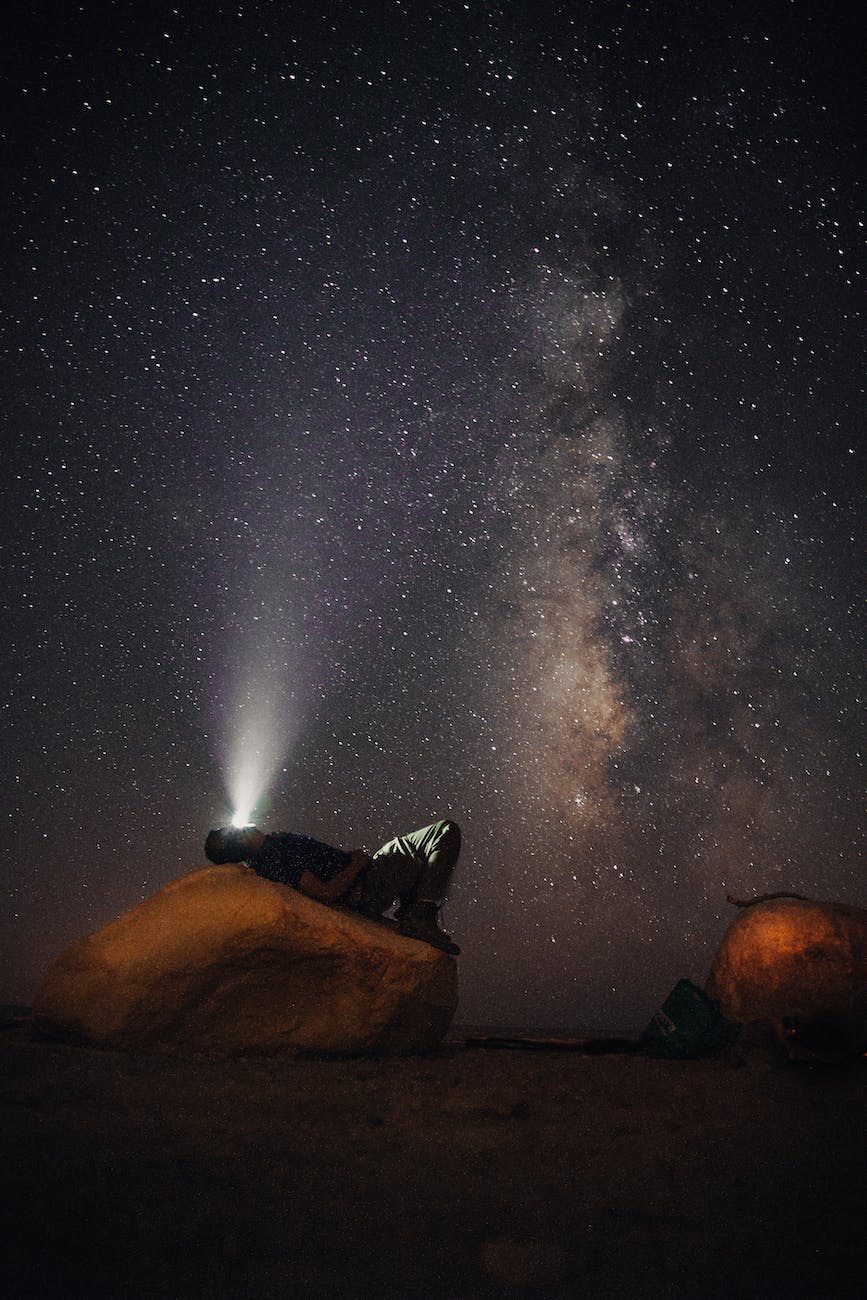
If you’ve had a chance to look at the stars at night or at large landscape scene that’s miles long, what goes through your mind? (e.g., Getty Images, “Stars in the sky”; Fine Art America, Landscape photographs fineartamerica.com/art/photographs/landscape )


Observe

Read Isaiah 40:21-31. How does knowing s knowing Yahweh give us hope?

Mystery of God’s name

Dancing in the Kingdom- Table of Contents

Dancing In the Kingdom – Part 1 – Shadows of the Kingdom – Chapter 2 – The God who created

Mystery of God’s name

[Bible references: Exodus 2-3]

 Many English-speaking Christians would say that, of course we know God’s name – it’s “Jesus,” or if you want to pronounce it in Hebrew it would be “Yeshua.” That would be true for the name of the Son of God. But what about God? The mystery of the name of God in the Old Testament has to do with the original Hebrew.

When God introduced himself to Moses, His name using modern Hebrew letters[1] would look like the next to the last line in the picture above. In older Hebrew it would have looked like the lines above it – the original characters are the top line . The original Hebrew language had no written down vowels, so these letters all represent consonants. In modern reading practices we mostly read silently to ourselves, but for most of history, it was more common to read out loud, so having written words with no vowel marks would not be a problem, because everyone would always be hearing the vowel sounds.

The difficulty in this case, is that in Old Testament times when Israel was in exile in Babylon, it came to be considered that the name of God was too holy to be pronounced. So, whenever someone would read that name, they would substitute the word “LORD,” which in Hebrew would be “Adonai.” In less formal settings, the Hebrew word, “Hashem,” which means “the name” would be used.

 That means that over time, the actual pronunciation of the word became forgotten. By the time English translations were produced, the translators adopted the Hebrew practice of using the word “LORD,” however, to distinguish the special name, the practice was to use a special way of spelling, “LORD.” What you will see in the English Old Testament, is the word “LORD,” using a capital “L” followed by “ORD” in smaller capitals.

As the centuries went on, Hebrew in general started to become less used and there was a concern about the pronunciation of all the Hebrew words. So back between the 7th and 10th centuries AD, a group of Jews called the Masoretes, added vowel markings to the Hebrew letters, except for the name of God.

During “Enlightenment,” many Christians started to feel less constrained by the holiness of God. So back in the 1800s, when Germany was center of the academic world, and the Christian academics made an attempt to try to pronounce the long unpronounced יהוה. In Hebrew, the letters are written right-to-left and corresponded to the English letters YHVH. The next step was to figure out the vowels, so they used the vowels for the Hebrew word for God, Eloah. And then, because the German language didn’t handle words beginning in “Y,” the “Y” became “J” with the resulting pronunciation being “Jehovah.” So that became the standard pronunciation in English for more than a century.

In recent decades there has been accelerating research in archeology of the Ancient Near East and researchers started to question the standard pronunciation. Currently, most scholars are in agreement to use ‘Y’ instead of ‘J’ as the first consonant and now understand that in Old Hebrew the third consonant should have a “W” pronunciation instead of “V.” Then they determined that they should use the vowels from the word “Hashem” which led to the pronunciation of “Yahweh” for the Hebrew name of God.

A new level of understanding can be obtained if we take another type of look at the letters in the name, יהוה or  . Particularly, if we look at the older letters of the Hebrew language, we can see that the letters are pictorial, that is they represent objects or actions.  The first letter represents either a hand or an activity of doing something. The second and fourth letters represent windows or revealing something. The third character represents a nail or fastening something. That means that the name God revealed to Moses means, according to the letters, “Hand revealed, Nail revealed.”


[1] Shurpin, Yehuda. “What is the Authentic Ancient Hebrew Alphabet?” Chabad.org www.chabad.org/library/article_cdo/aid/3582435/jewish/What-Is-the-Authentic-Ancient-Hebrew-Alphabet.htm

Observe

Read Exodus 3. What difference would it make to the Israelites that their God has a name?

The plural God in the New Testament

Dancing in the Kingdom- Table of Contents

Dancing In the Kingdom – Part 1 – Shadows of the Kingdom – Chapter 2 – The God who created

The plural God in the New Testament

The Father, Son and Holy Spirit are all God

[Bible references: John 14:26; 1 Corinthians 1:1; 8:6; Colossians 2:9]

There is one person God (1 Corinthians 1:1) and yet there is God the Father (1 Corinthians 8:6), God the Son (Colossians 2:9) and God the Holy Spirit (John 14:26)

Father, Son and Holy Spirit are people with intellect, emotion and will

[Bible references: Genesis 1:3 Psalm 78:14; 135:14; 139:17; Isaiah 1:18; John 14:26; Romans 15:30; 1 Corinthians 1:1; 12:11; Colossians 1:16; Hebrews 12:2]

Scripture reveals that the Father (Genesis 1:3 Psalm 135:14; Isaiah 1:18), the Son (Colossians 1:16; Hebrews 12:2) and the Holy Spirit (John 14:26; Romans 15:30; 1 Corinthians 12:11) each have the property of intellect, emotions and will, which indicate that the properties of all people. We also can state that God is a person (Psalm 139:17; 78:14; 1 Corinthians 1:1)

Observe

Read John 14:26; 1 Corinthians 1:1; 8:6; Colossians 2:9. How do we explain that there is one God but the Father, Son and Holy Spirit are God?

The plural God in the Old Testament

Dancing in the Kingdom- Table of Contents

Dancing In the Kingdom – Part 1 – Shadows of the Kingdom – Chapter 2 – The God who created

The Name Elohim

[Bible references: Genesis 1:1; Deuteronomy 6:4; Isaiah 48:14-16; Matthew 3:16-17]

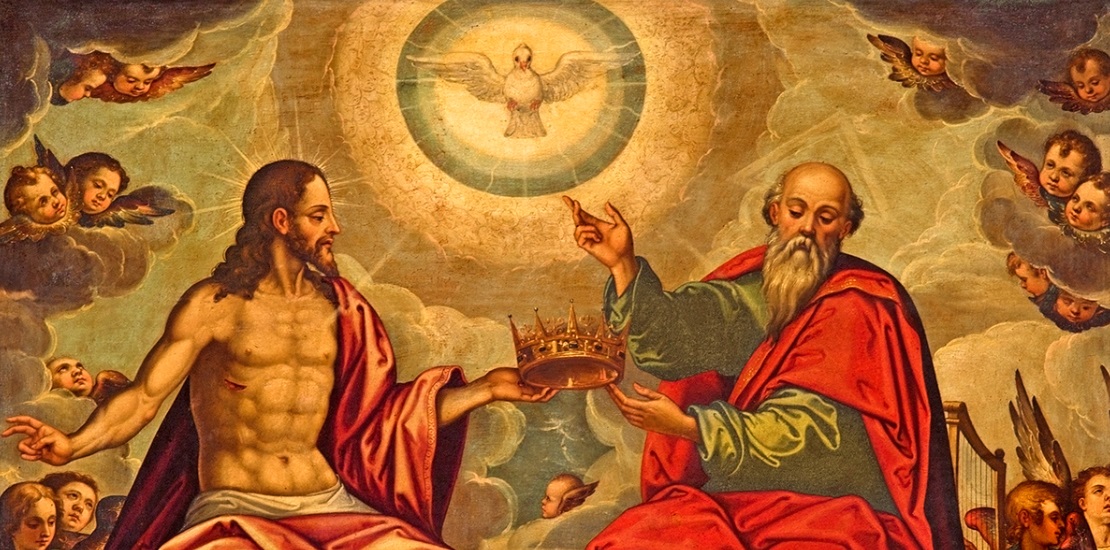
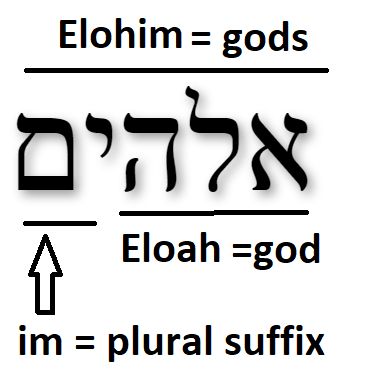
Elohim is a plural noun having the masculine plural ending “im,” but when referring to God, is often used with a singular verb, whereas in other instances, “elohim” is used to refer to other (multiple) gods. Although the Hebrew language could be said to be using ‘Elohim’ as an intensive plural [1](i.e., it could be translated as ‘Great God’), it could be said to hint at the later revelations of the God as Father, Son and Holy Spirit.

  • Genesis 1:1, “In the beginning God (Elohim) created the heavens and the earth,”
  • Exodus 20:3, “You shall have no other gods (elohim) before Me,”
  • Deuteronomy 13:2, “…Let us go after other gods (elohim)…”
Plural Pronouns

[Bible references: Genesis 1:26; 3:22; 11:7; Isaiah 6:8]

Often when God speaks of himself, he clearly uses the plural pronoun:

  • Genesis 1:26: Then God (Elohim) said, “Let Us make man in Our image, according to Our likeness.…”
  • Genesis 3:22: Then the LORD God (Yahweh Elohim) said, “Behold, the man has become like one of Us…”
  • Genesis 11:7: “Come, let Us go down, and there confuse their language…”
  • Isaiah 6:8: “Also I heard the voice of the LORD, saying, “Whom shall I send, and who will go for Us?”
The Name Eloah

The use of Elohim with a singular verb is a deliberate act, otherwise the Bible could just have used the singular form of Elohim, Eloah. This singular form could have easily been used consistently. Yet it is only used 250 times, while the plural form is used 2,500 times. The far greater use of the plural form again turns the argument in favor of plurality in the Godhead rather than against it.

The Shema

[Bible references: Genesis 1:5; 2:4; Deuteronomy 6:4; Ezra 2:64; Ezekiel 37:17]

Deuteronomy 6:4, known as the Shema, has always been Israel’s great confession which says “Hear (Shema), O Israel (yisrael): The LORD (Yahweh) our God (Eleheinu) , the LORD (Yahweh) is one (echad)!”

Yahweh is the Hebrew personal name of God. Whenever you see LORD in the Old Testament, it is referring to this name.

Eloheinu is theHebrew way of saying “our Elohim”.

Echad does not mean an absolute “one” but a compound “one.” For instance, in Genesis 1:5, the combination of evening and morning comprise one (echad) day. In Genesis 2:24, a man and a woman come together in marriage and the two “shall become one (echad) flesh.” In Ezra 2:64, we are told that the whole assembly was as one (echad), though of course, it was composed of numerous people. Ezekiel 37:17 provides a rather striking example where two sticks are combined to become one (echad). The use of the word echad in Scripture shows it to be a compound and not an absolute unity. There is a Hebrew word that does mean an absolute unity and that is yachid, which is found in many Scripture passages, the emphasis being on the meaning of “only.” If Moses intended to teach God’s absolute oneness as over against a compound unity, this would have been a far more appropriate word.

God Is One and Three

[Bible references: Genesis 2; 6:3; 16:7; 16:13; 22:11-12; Exodus 23:20-23; Job 33:4; Psalm 51:11; 139:7; Isaiah 11:2]

If the Hebrew Scriptures truly do point to plurality, the question arises, how many personalities in the Godhead exist? It is possible to find three distinct personalities that may be considered divine, although in the Jewish conception of monotheism, the following examples are just different expressions of the presence of God and do not necessarily indicate the different persons of the Trinity.

  1. First, there are the numerous times when there is a reference Yahweh often translated as “the LORD”. This usage is so frequent that there is no need to devote space to it.
  2. A second personality is referred to as the Angel of Yahweh. This individual is always considered distinct from all other angels and is unique. In almost every passage where He is found He is referred to as both the Angel of Yahweh and Yahweh Himself. For instance, in Genesis 16:7 He is referred to as the Angel of Yahweh, but then in 16:13 as Yahweh Himself. In Genesis 22:11 He is the Angel of Yahweh, but God Himself in 22:12. Other examples could be given. A very interesting passage is Exodus 23:20-23 where this angel has the power to pardon sin because God’s own name Yahweh is in him, and, therefore, he is to be obeyed without question. This can hardly be said of any ordinary angel. But the very fact that God’s own name is in this angel shows His divine status.
  3. A third major personality that comes through is the Spirit of God, often referred to as simply the Ruach Ha-kodesh. There are a good number of references to the Spirit of God among which are Genesis 1:2, 6:3; Job 33:4; Psalm 51:11; Psalm 139:7; Isaiah 11:2, etc. The Holy Spirit cannot be a mere emanation because He contains all the characteristics of personality (intellect, emotion and will) and is considered divine.
The Three Personalities in the Same Passage

[Bible references: Isaiah 48:2-16; 63:7-14]

The Hebrew Scriptures have not neglected to put all three personalities of the Godhead together in one passage. It should be noted that the speaker refers to himself as the one who is responsible for the creation of the heavens and the earth. It is clear that he cannot be speaking of anyone other than God.

In Isaiah 48:2-16, the speaker refers to himself using the pronouns of I and me and then distinguishes himself from two other personalities. He distinguishes himself from the Lord Yahweh and then from the Spirit of God. The Tri-unity as clearly defined as the Hebrew Scriptures make it.

In Isaiah 63:7-14, there is a reflection back to the time of the Exodus where all three personalities were present and active. The LORD Yahweh is referred to in verse 7, the Angel of Yahweh in verse 9 and the Spirit of God in verses 10, 11 and 14. While often throughout the Hebrew Scriptures God refers to Himself as being the one solely responsible for Israel’s redemption from Egypt, in this passage three personalities are given credit for it. Yet, no contradiction is seen since all three comprise the unity of the one Godhead.


[1] Josh. “Hebrew plural: Used with an intensive meaning as well?”  WordReference.com Language Forums 8 Nov 2010 forum.wordreference.com/threads/hebrew-plural-used-with-an-intensive-meaning-as-well.1971563/

Reflect

In modern English, the word, “you” can be either a singular or plural word. How do we distinguish which meaning it has in a sentence?

Observe

Read Genesis 1:26-27. In Hebrew, the verb comes before the subject of a sentence. In Genesis 1 and elsewhere, the verb for create, bara, is 3rd person singular. The Hebrew word, elohim, is a plural word, it is translated as God because in Genesis 1 it says bara elohim, or “he created God …” And then Gen 1:26-27 says “let us make mankind … male and female he created them.” What does that suggest about the relationship between male and female?

The “impossible” Trinity and the nature of God

Dancing in the Kingdom- Table of Contents

Dancing In the Kingdom – Part 1 – Shadows of the Kingdom – Chapter 2 – The God who created

The “impossible” Trinity and the nature of God

[Bible references: Exodus 3:1-4:17]

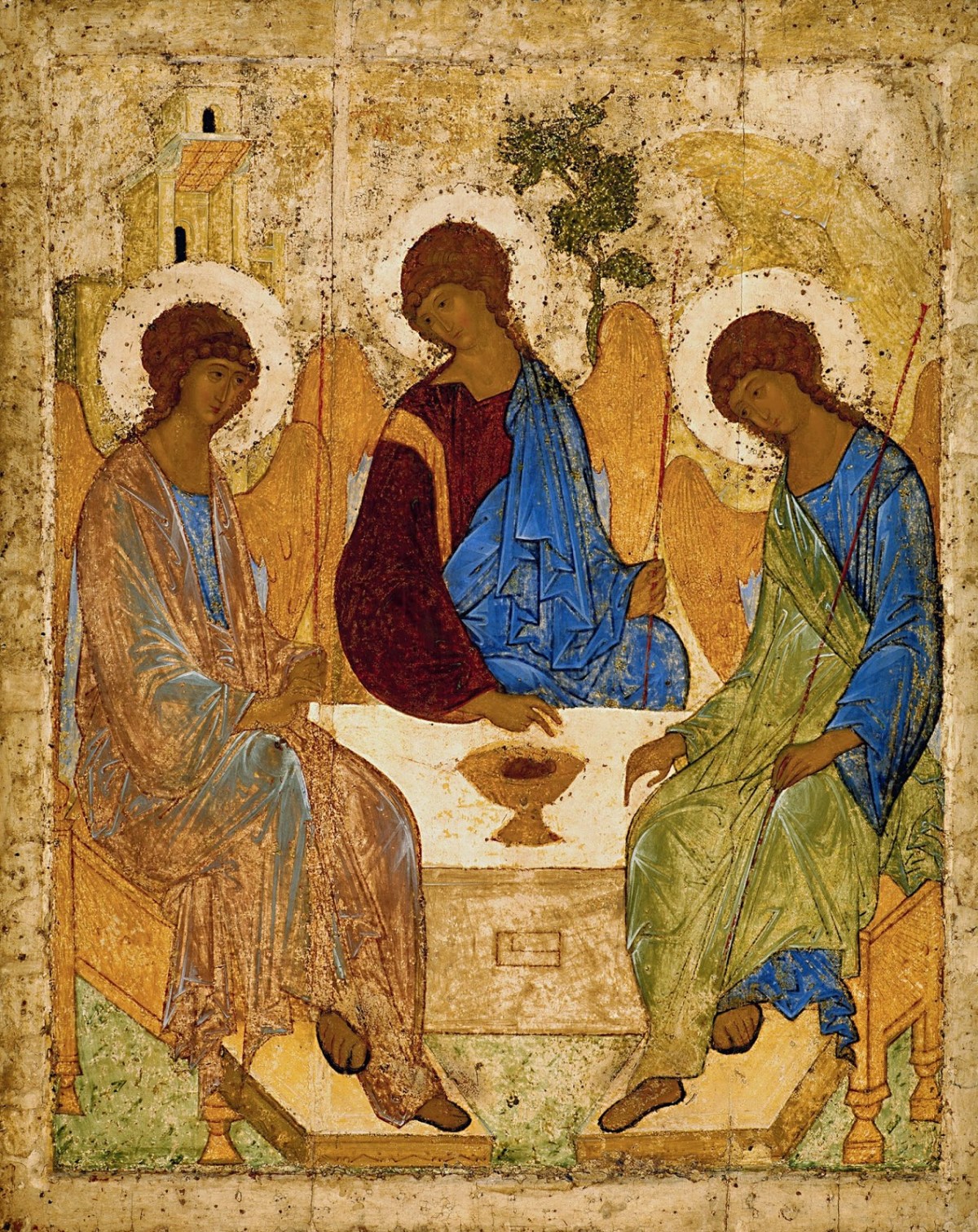
It didn’t take long for the church to develop different ways to try to understand how there is only One God but there also is God the Father, God the Son, and God the Holy Spirit[1]. Can Jesus or the Holy Spirit be God if there is only one God? How can Jesus be God and human? Are the Father, Son and Holy Spirit three persons, or three representations of God? What is a person? If we accept that people have souls with minds, wills, and emotions, what does that mean about God? Yahweh seems to have a mind, will and emotions. We can also ascribe mind, will and emotions to God the Father, God the Son and God the Holy Spirit.

There is no logical human explanation and yet the church has managed to split over how to explain this. One explanation is that God is one in Essence, and three in Person. The complication is that Yahweh has the characteristic of a person, but do we say that Yahweh is an essence and not a person? The Bible doesn’t explain what we call the Trinity, it just reveals that there apparently is one God, who seems to have the characteristics of a person and apparently also three persons in God the Father and God the Son and God the Holy Spirit.

The doctrine of the Trinity is impossible to fully understand. How can there be the one person God and yet we have three persons: God the Father, God the Son and God the Holy Spirit? And how do the Father, Son and Holy Spirit relate to each other? How do we explain Jesus? If he is God, then how can God, who exists outside of and is independent of the universe He created, yet become a part of it, taking on flesh and blood? These problems have caused endless debate and division within the church, resulting in schisms that persist to this day.

The Bible doesn’t even try to explain this situation, it just hints at it in some spots and presents it in others. The New Testament church didn’t even try to clarify it for a hundred years. And when the church did begin the process of trying to define and explain it, the conversation got complicated by Greek philosophy and language differences between Greek and Latin. When Jesus stated that He was equal with the Father, many Jews considered it blasphemy. After all, as part of their discipleship process, one of the most important scripture verses that they memorized was the Sh’ma, “Hear O Israel, the LORD our God, the LORD is one.” What separated Israel from the cultures around them was that Israel professed to have one God but those around them had many gods.


[1] Ligonier Editorial. “The Trinity” Ligonier www.ligonier.org/guides/the-trinity; Taylor, Justin. “What do we mean by Person and Essence in the Doctrine of the Trinity” Gospel Coalition www.thegospelcoalition.org/blogs/justin-taylor/what-do-we-mean-by-person-and-essence-in-the-doctrine-of-the-trinity/; Perman, Matt. “Understanding the Trinity: How Can God Be Three Persons in One?” Cru www.cru.org/us/en/train-and-grow/spiritual-growth/core-christian-beliefs/understanding-the-trinity.html; Encyclopedia.com “Person (In Theology)” Encylcopedia.com www.encyclopedia.com/religion/encyclopedias-almanacs-transcripts-and-maps/person-theology

Observe

Read Exodus 3:1-4:17. We know from Moses’ story that he knew about his Hebrew roots, although the stories of Abraham, Isaac and Jacob probably sounded like fantastic stories to a people living in captivity. Would your response be like Moses?

Dynamic Tension

Dancing in the Kingdom- Table of Contents

Dancing In the Kingdom – Part 1 – Shadows of the Kingdom – Chapter 2 – The God who created

[Bible references: Luke 17:1-10; Ephesians 2;1-10]

Dynamic Tension

When we encounter Biblical statements that seem to conflict with each other, we need to hold to one of the principles of biblical interpretation, we need to examine any interpretation in the light of all other scripture – that is, let scripture interpret scripture. Even so, our best interpretations may still leave us with tensions between apparently conflicting statements. In those cases, we should acknowledge and accept those tensions rather than try to force those statements to a particular resolution.

The study of biology may provide good analogues in dealing with those tensions. For instance, in biological life, it seems that there are no simple formulas, no simple rules. While there are underlying precisely defined processes like the laws of chemistry and physics, there are also overlying complex and variable biological processes that are adaptable to circumstances around them.

Even more, living organisms by themselves are noted by intricately balanced but unstable processes that, if the balance between processes fails, there is a most certain death. One of the standard definitions of life is that living things must evade the decay to equilibrium while at the same time maintaining internal order and organization.[1]  One example that we live with all the time is with our skin – every day our skin is shedding cells and creating new cells such that, on average, every 27 days an entire layer of skin is being replaced. Our skin seems “stable” and seems to stay the same even though entire layers of skin are constantly being replaced.

That type of process holds true for all the processes happening in all the cells of living organisms; The internal structures seem to be stable, while matter and energy are constantly flowing through them and the materials within the internal structures are being constantly refreshed. More remarkably, if we examine all of this activity, we discover that this activity is sustained by an array of complex sets of interdependent processes where one set of processes feeds off the by-products of other processes and visa-versa. All this activity is delicate in one sense, if some processes fail at one point the result can be death. In another sense, the processes are flexible, allowing an organism to live in a wide variety of circumstances (environments). Thus, we have a paradox of systems that are simultaneously fragile and robust.

This dynamic tension can be seen on another level with the interactions of bone and muscle. In a given skeletal muscle, some fibers are attached to one bone in one direction and some fibers are attached to another bone in another direction. For instance, in your bicep muscles, some fibers attach to the shoulder and the other fibers attach to the elbow. As the fibers within a muscle pull against one another the bones they are attached to move. You can see this activity when you “make a muscle.” As you draw your forearm towards your shoulder, you see the biceps start to bulge in the middle as the opposing fibers pull into each other.

Exactly which way the bones move is determined by the creature that controls the muscles as the creature interacts with the environment, determining what direction to go or what task to do. While it seems at one level that in a given muscle the fibers are working against one another and seem to work opposite to one another, they are in fact on a larger scale working with each other to accomplish particular tasks.

All of this seems to reflect what we see in spiritual life. On one level, the attributes we see in the living God, His holiness, grace, etc. never change although they are constantly interacting with different circumstances. As circumstances change, although it may seem that God’s responses may change, it is not because God has changed, only that God’s dynamic response to different circumstances, whether globally or locally, has changed.

So, as we consider this, it may seem that some of God’s characteristics conflict with each other or seem to pull against one another. For instance, how is God’s perfect desire for justice able to be reconciled with God’s grace? Or how is it that He can be the Lord of all and able to also be the Servant of all? In fact, God is interacting with the world, determining what He wants to do and then coordinating His attributes to do what He desires. For example, although God’s authority and servanthood seem to be in tension with one another, He is coordinating them to deal with our individual circumstances. These apparent tensions are resolved, strengthened and harmonized in God himself.

I call this interaction, Dynamic Tension; a process controlled by a person or an organism in which the attributes seem to be pulling in different directions but are in fact working in concert with one another to accomplish particular goals. These tensions carry over into many areas of theology. We see that as different congregations wrestle with apparently conflicting issues, they make decisions based on their particular situations. Different congregations in different situations will come to different resolutions.

We are blessed to have both God’s creation itself and God’s revelation available to us as we try to try to learn about the living Creator. Fortunately, it is to our blessing that we don’t have to know everything about God for us to know or understand him, because we can at best only know Him in part. But meanwhile we have some paradoxes about God for us to examine and we will start exploring some of those paradoxes now.

“… many of the great theologians and leaders of the church—including Justin Martyr, Irenaeus of Lyons, Origen of Alexandria, Augustine of Hippo, Thomas Aquinas, Martin Luther, John Calvin, and John Wesley—in various ways believed that Creation bears witness to the glory and truth of its Creator and that this witness is fully compatible with the witness of Scripture.” [2]


[1] Weber, Bruce. “Life” Stanford Encyclopedia of Philosophy 7 Nov 2011, plato.stanford.edu/entries/life

[2] Mann, Mark H. “The Church Fathers and Two Books Theology” Biologos 4 Nov 2012 biologos.org/articles/the-church-fathers-and-two-books-theology

Observe

Read Luke 17:1-10; Ephesians 2:1-10. Verse 10 in both of these passages seems to say the opposite thing. How does the context of Luke 17:10 and Ephesians 2:10 help to resolve these two verses?

Paradoxes and Mysteries

Dancing in the Kingdom- Table of Contents

Dancing In the Kingdom – Part 1 – Shadows of the Kingdom – Chapter 2 – The God who created

Paradoxes and Mysteries

[Bible references: Genesis 1-2; Job 9; Psalm 8; 19; 103, 104; 139; Proverbs 8; Job 38-39; Isaiah 55:9]

When we look at a work of art, what can we tell about the artist? What can we find from the skill in using materials, the subject matter, the emotional content, the values? We may be able to figure out a few things, but all-in-all we can discern very little. To learn much more we need the artist to reveal not just more about the artwork but also about him or herself.

“People always want to know what inspires you to make art … think beyond the artist statement. Artists are living beings with thoughts, feelings, and ideas … explain who you really are” [1]

 “Besides making art, storytelling skills are the most valuable in achieving a gratifying journey as an artist. Your storytelling skills enhance your ability to achieve your goals. Art and stories, both written and told, are powerful tools to touch people. When art and stories are woven to work together, they create a compelling experience for artists and their followers.”[2]

So, as we begin to explore what we can know about the Creator, we also begin by looking at his artwork (that is, the creation)[3] but then we need to hear what the Creator has revealed about himself to us (that is, through the Holy Bible).[4]

So, let us begin by looking at the living things God created. Sometimes, we think we can look around us and figure out what is living and what is not; but when look at the spectrum of living things, especially through the eyes of the scientists who specialize in it, it becomes more difficult to try to come up with a definition for life. In fact, one organization catalogued over one hundred definitions[5] … and none of those definitions satisfy everybody. What does that say about the one who created those living things?

If we get so confused about what was created, it is likely that we will get confused about the Creator. When Job challenged God, Yahweh responded, “Where were you when I laid the foundations of the earth?” In Isaiah, God explicitly says, “My ways are higher than your ways.” There simply are things about God that are beyond our comprehension, mysteries, which should give us a spirit of humility.

Because much about God is mysterious and beyond understanding, we naturally find that the Creator is full of paradoxes: characteristics that seem to oppose each other. When we do encounter apparently conflicting statements about God, we must hold those qualities in tension with each other. Sometimes we might not totally understand how these characteristics can all be true together, but that is what we should expect. If we cannot fully comprehend the creation, why should we think that we can fully comprehend the Creator. We should also consider that if we ever think that we totally understand the Creator of the universe then we probably are not understanding things correctly – we are probably creating a god in our own image rather than the other way around.

This inability to totally understand God leaves us often making speculations as we try to find a way to reason things about God. We then have to be careful, if we make dogma out of our speculations, we will likely create all sorts of arguments with each other. We will see in future chapters that various theologians and congregations have sometimes split up over some of those very issues which no one can fully understand.


[1] Sayej, Nadjz. “How Artists Use Video Storytelling to Connect with Their Audience” Artrepeneur, 21 Feb 2018, abj.artrepreneur.com/video-storytelling

[2] Davey, Barney. “Personal Storytelling for Artists & Creatives” Marketing Courses, mymarketingcourses.com/p/personal-storytelling

[3] Ross, Hugh. “The Major Biblical Creation Texts/Creation Accounts” Reasons to Believe 1 Aug 2008 reasons.org/explore/publications/articles/the-major-biblical-creation-texts-creation-accounts

[4] Rusbult, Craig. “How should we interpret the Two Books of God, in Scripture & Nature” American Scientific Affiliation www.asa3.org/ASA/education/origins/two-books.htm

[5] Chamary, JV. “A Biologist Explains: What is Life”, Forbes 27 Mar 2019; Zimmer, Carl. “What is Life? Its Vast Diversity Defies Easy Definition” Quantamagazine, www.quantamagazine.org/what-is-life-its-vast-diversity-defies-easy-definition-20210309/

Reflect

Observe

What speaks to you, or confuses you about God’s character when you look at Creation?

Read Psalms 8; 139. The One who created the outermost part of the universe also knows the innermost part our lives. What difference should that make in our lives?

Dancing through the pain

Dancing in the Kingdom- Table of Contents

Dancing In the Kingdom – Part 1 – Shadows of the Kingdom – Chapter 1 – Prelude

Dancing through the pain

[Bible references: Luke 17:20-21; Hebrews 12; Revelation 21:1-3; 22:1-5]

Right now, it might seem hard to see images of the Dance of God’s Kingdom. We look at the news and wonder where things are headed to. Sometimes we look at our own lives and wonder … If there is a God where is God? What’s His plan for the world – for the church – for us? Then we pick up a book called the Holy Bible and read the stories and wonder how they all fit together. Then we look at the church – well, churches, there are so many of them – and wonder why it’s so complicated and messy and wonder if anybody’s got it right. And, what about me, my story, my mess? How do I fit into it all that?

But hints of God’s activity with His people are there to be found. God has been working through and intervening in the lives of many people that have been dancing the Kingdom Dance through the years, bringing hope and healing to the world. Their stories can be found in the Bible and in the rest of history[1] and sometimes even inserted into the news of the day, in the middle of all the stories of our brokenness.

I dance because it makes me happy! My experience is that when I dance, I can express something from my heart to God that cannot be expressed in words. Dancing is a point of contact with God for me. It gives me an experience of God as the origin of creativity and beauty … “I dance because I want to spread a message of love, joy, hope and faith to the world … Among the dimensions added by the dance expression itself is the meta-message that there is room for the whole human being and life in its fullness in a Christian religious setting. Dance can teach children and adults a body-embracing way of living, believing and being in God’s world. One participant says that through dance in general, “we want to communicate heaven to people down here, the message of salvation, our freedom in God, the joy in God, and the joy of dancing with fellow Christians.” … Through dance these Christian dancers experience and practice their religion in a bodily way. This means that their spirituality takes an embodied form and that dance for them is not only a bodily practice, but also a spiritual one.[2]

Dancing seems to be a human attribute, not necessarily linked to just Christianity[3], it is a gift from God that can be used in the manner expressed here; to be a human means of expressing our God-given joy through our bodies. While dancing can be done alone, when done in community it can help to bind participants together. Joy and community are part of God’s purpose for us. We are tasked as God’s image-bearers to be his representatives and stewards. But our tasks are not to be burdensome but rather they are meant to be joyful. If you will, our tasks are meant to be a joyful dance we do with each other and with our Creator.

For us to dance the Kingdom Dance we don’t have everything figured out, He does. We don’t even have to worry about the results of the dance because the results are not dependent on us but on Him, who is working through us. As much as we have messed things up and will continue to do so, He will ultimately restore us and the rest of creation, making us all into what He had intended from the beginning.

Among all the creatures that God created, we are uniquely made, even if we are not the physical center of the universe as some people may have thought at one time. Through the pursuit of science, we now have instruments that make it very clear that we are not physically at the center of everything, not that we can prove anyway. We are only specks on a small planet spinning around a star in an apparently random solar system in an apparently random galaxy in a universe we cannot even see the edges of. Although we don’t know where the center is, the universe seems to have been created with us in mind. The properties of the universe, the physical constants, the atomic structures, were all created such that it would support our existence.[4] Interestingly, although we are creatures made of the stuff of the universe, not only can we study and reflect on the properties of that stuff, but we can also study and reflect on and even reflect the one who created us.

In the meantime, we do not know when He will return, and we find ourselves in the middle, in-between those two times, between the beginning of the restoration of God’s kingdom on earth and the time when it will be fully accomplished. In this in-between time, sometimes we see some signs of God’s restoration – and sometimes we can’t – and it’s hard to figure out what God is doing, especially when there are times that He seems to be absent. In those times, we need to call upon our faith to hold onto the hope that God is still working out His plans. We need to recall all the times that we did see Him at work, and then we also need to remember that getting to the end of the plans that He intends for us may require some pain on our part just as it required pain on His part. And like Him, our pain will be ultimately overwhelmed with the glory that will be revealed.

Our ultimate destination is not a mere returning to the way we started out, but to the full flourishing of our potential, where God will establish a kingdom of image-bearers released to display God’s character and reflect His glory.

“And salvation only does what it’s meant to do when those who have been saved, are being saved, and will one day fully be saved realize that they are saved not as souls but as wholes and not for themselves alone but for what God now longs to do through them. The point is this. When God saves people in this life, by working through his Spirit to bring them to faith and by leading them to follow Jesus in discipleship, prayer, holiness, hope, and love, such people are designed—it isn’t too strong a word—to be a sign and foretaste of what God wants to do for the entire cosmos. What’s more, such people are not just to be a sign and foretaste of that ultimate salvation; they are to be part of the means by which God makes this happen in both the present and the future. That is what Paul insists on when he says that the whole creation is waiting with eager longing not just for its own redemption, its liberation from corruption and decay, but for God’s children to be revealed.” [5]

With that in mind, we can not only wait and hope. We can participate with God in bringing His kingdom to earth and bringing a taste of healing and hope into a broken world that desperately needs it.

“Within the biblical story, the Christian discovers a constant call for justice on behalf of the weak and forgotten. In the biblical tradition, justice is an aspect of God’s shalom, a notion that carries with it the idea of completeness, soundness, well-being, and prosperity, and includes every aspect of life – personal, relational, and national.”[6]

The suffering and pain in the world can be overwhelming, challenging our ability to maintain hope and persist in our effort as we try to bring shalom. That challenge forces us to focus on the taste of shalom that God has given to us knowing that it is just a foretaste of the fullness of the shalom that awaits us in the fully restored earth.


[1] See Appendix G – The contributions of the Church for some examples

[2] Schurr, Hildegunn Marie T. “Dancing Towards Personal and Spiritual Growth” Nordic Journal of Dance – volume 3, 2012 (pp. 31-40)

[3] La Mothe, Kimerer. “The dancing species: how moving together in time helps make us human” Aeon aeon.co/ideas/the-dancing-species-how-moving-together-in-time-helps-make-us-human

[4] Slezak, Michael. “The human universe: Was the cosmos made for us?” New Scientist, 29 April 2015. www.newscientist.com/article/mg22630190-400-the-human-universe-was-the-cosmos-made-for-us

[5] Wright, N.T. Surprised by Hope, Rethinking Heaven, The Resurrection and the Mission of the Church. Harper Collins 2008. Kindle Edition

[6] Katongole, Emmanuel. Rice, Chris. “Reconciling All Things: A Christian Vision for Justice, Peace and Healing,” Intervarsity Press, 2009 (p. 72)

Reflect

Think about how the universe seems designed for us, our capacity to think about and explore it and then think about our capacity to reflect on the One who created it all. What does that suggest to you about what God has intended for us?

Observe

Read Hebrews 12. What does this passage say about how we should be living now?

Brooding, moving, dancing

Dancing in the Kingdom- Table of Contents

Dancing In the Kingdom – Part 1 – Shadows of the Kingdom – Chapter 1 – Prelude

Brooding, moving, dancing

[Bible references: Genesis 1; Jeremiah 29:11; Romans 8:19-21; Galatians 3:13-14; Ephesians 3:20; 1 Peter 5:10]

In the beginning, God created the heavens and the earth … and the Spirit of God brooded[1] over the face of the waters …

Like a bird sitting on eggs keeping them warm until the eggs would hatch and bring forth new birds, the Spirit hovered, brooded, over the earth ready to bring forth life of all sorts, but particularly creatures that would be like God, creatures that would reflect the character of God: transcendent, loving, wise, fruitful, etc. This is how the story begins, full of anticipation and hope for what must be a grand and wonderful future. But even before the story begins, we may contemplate another mystery, the mystery of how there can be one God and also three persons identified as God: God the Father, God the Son, and God the Holy Spirit. The early church[2] struggled with this concept and eventually, in the second century, a Christian apologist, Tertullian, coined the term “Trinity” to describe this 3 persons in 1 God concept.

However, that tidy little term can mask over the impossible to understand idea of God being one person and three persons at the same time. There is Greek word available to us that addresses the complexity of this three-in-oneness, “perichoresis[3] which comes from two Greek words which mean “around,” and “to give way” or “to make room.” This is meant to describe the interpenetration or mutual indwelling of Father, Son, and Holy Spirit.

“In that regard the term “perichoresis” (meaning “interpenetration,” “circumincession” or “mutual indwelling”) has been used theologically at least since the time of John of Damascus to refer to the way the three divine persons live in joyful, dynamic communion without merging, loss, or distinction. It is said to be derived from the Greek term perchoreuo meaning “to dance around.” However, the evidence indicates that the term is derived from the different though similar looking perichoreo which refers to “interpenetration” but does not refer to dancing…. this does not mean that the concept itself is inappropriate, as evidenced by those who appreciate its use in that way.” [4]

While this term may be partly helpful in understanding this impossible to understand concept, there is another word that is very similar to another Greek which means “to dance around,” which gives us a word picture of our living and complex God in which the Father, Son and Holy Spirit not only interpenetrate but interact with one another, in a freewheeling but synchronized dance. This means that, as God’s image-bearers, we can reflect the image of the loving, interpenetrating, interacting, and dancing God as we participate in His work of taking care of His Creation and of one another.[5]

This dance which started before Creation, has been joined by God’s image-bearers since the beginning of humanity. It is now our turn. We just need to learn the moves and join the dance.


[1]  Biblehub “Genesis 1:2” Bible Hub biblehub.com/commentaries/genesis/1-2.htm Most translations or this phase use the terms “hovering” or “moving,” but there is also a case for using the term, “brooding,” as in a bird sitting on a nest of eggs.

[2] Van Ee, Joshua J. “The Church in the Old Testament” Westminster Seminary California 9 Nov 2017 www.wscal.edu/blog/the-church-in-the-old-testament The term “church” as used in this book will refer to what may more properly be called the “new testament church.” I wish to make that distinction because the term “church” may be properly applied to all of those who are “called out” to follow Yahweh.

[3] Compelling Truth. “What is the meaning of ‘perichoresis’?” Compelling Truth www.compellingtruth.org/perichoresis.html

[4] Edgar, Brian. “The God Who Plays: A Playful Approach to Theology and Spirituality,” Cascade Books 2017 (e-book) Chapter 9: Kingdom: Playing with God, The Dance of Life

[5] Miller, Darrow. “Perichoresis: Great Dance of God and Creation” Darrow Miller and Friends 16 July 2018 darrowmillerandfriends.com/2018/07/16/perichoresis-great-dance-god-creation/

Observe

Read Genesis 1.  Think of the Spirit of God hovering, moving and brooding over the earth. In your imagination, think about a spiritual being “giving birth” to physical living things, what would you expect to happen?

Reprise with variations

Dancing in the Kingdom- Table of Contents

Dancing In the Kingdom – Part 1 – Shadows of the Kingdom – Chapter 1 – Prelude

Reprise with variations

[Bible references:  Genesis 1; Psalm 8; 111; Exodus 8:16-19; John 21:1-14; Romans 8:19-22; 1 Corinthians 15; 1 Thessalonians 4; 5; 2 Peter 3; Revelation 21-22]

“The creation of the world seems to have been especially for this end, that the eternal Son of God might obtain a spouse towards whom he might fully exercise the infinite benevolence of his nature, and to whom he might, as it were, open and pour forth all that immense fountain of condescension, love, and grace that was in his heart, and that in this way God might be glorified. [1]

God created the universe for his glory, and within that, humans were created to experience the true joy of living, to bear the fruit of His nature, to reflect His presence. We are designed to be image-bearers of God himself, stewards of the creation He inserted us into as we reflect the very character of God. The exercise of stewardship is seen in the process of “subduing” and “having dominion” over the earth (its creatures and it resources), and in being “fruitful” and filling the earth. God’s initial reaction to creating us was, “It was very good.” His intent was that we would fill and take care of the earth, all the while reflecting His character to each other and to His creation.

In the beginning, heaven and earth were joined at the Garden of Eden. It was a place where the Creator could have communion with his image-bearers and walk in the garden with them. The garden was the perfect place for the image-bearers to develop and begin working out the intended future of filling the earth and ruling over it as co-regents with God.

He gave us unimaginable delight and freedom, but that very freedom He gave us was joined to a responsibility, a responsibility that was wrongly used and caused immense far-reaching damage – damage we could not possibly undo – the whole universe is groaning, waiting for to be restored. Our pride-laden rebellion damaged the relationships between each other, between us and God, between us and the world and even between heaven and earth; but God had a plan from the beginning, a plan which is now underway, to ultimately restore what was lost and undo that damage[2] and bring us to our intended destination – an earth filled with and ruled by image-bearers and where heaven and earth are rejoined so that the image-bearers can walk with God once again.

“Jesus’ own teaching during his brief public career simply reinforced the Jewish picture. He redefined a lot of ideas that were current at the time – notably, of course, kingdom of God itself, explained in many coded parables and symbolic actions that God’s sovereign, saving rule was now breaking in, even though it didn’t look like what his contemporaries had imagined and wanted.”[3]

Ultimately, we will be freed from the bondages of sin and death and all the relationships that are now damaged will be restored. In fact, in a timeline that we cannot fully grasp, God waited from the beginnings of mankind until 2000 years ago to defeat the power of sin and death and begin the process of restoring His kingdom on earth. Then He told us that someday, he will complete that process and he will return in the fullness of his glory to fully restore all things at that time. We just don’t know when that will be.

Our hope looks at the resurrection of Jesus as a harbinger of the resurrection that awaits all those of us who will be united with Him in our own transformed bodies in the new heavens and the new earth.

‘… what is the ultimate Christian hope? …what hope is there for change, rescue , transformation, new possibilities within the world in the present … if the Christian hope is for God’s new creation, for “new heavens and new earth,” and if that hope has already come to life in Jesus of Nazareth, then there is every reason to join the two questions together … “God’s kingdom” in the preaching of Jesus refers not to postmortem destiny, not to our escape from this world into another one, but to God’s sovereign rule coming “on earth as it is in heaven.” [4]

Furthermore, our hope doesn’t ask for us to simply wait for that time when the Kingdom of God is fully restored, but that we can be part of God’s plan to bring the Kingdom of God into our broken world.


[1] Edwards, Jonathan, “Works of Jonathan Edwards, Volume Two,” SERMON II. THE CHURCH’S MARRIAGE TO HER SONS, AND TO HER GOD. Ed. John E. Smith, Yale University Press, 2009(p. 62)

[2] Bible Project “Pursuing God, Heaven and Earth,” Bible Project www.pursuegod.org/biblical-themes-an-animated-explanation-of-heaven-earth

[3] Wright, N.T. “Surprised by Hope: Rethinking Heaven, The Resurrection, and the Mission of the Church” Harper Collins 2008. Kindle Edition(p. 18).

[4] Wright, N.T. “Surprised by Hope” Harper Collins 2008. Kindle Edition (pp. 4-5, 18)

Reflect

Speaking strictly from what we know from science, we seem to be random life forms on a random planet in a random spot in the universe. In that perspective, having an anthropocentric view of the universe seems absurd. But knowing what the Creator of heaven and earth has revealed to us, the universe was designed to be inhabited … by us! How does that change your view of the universe?

Observe

Read John 21:1-14. What does this passage suggest about our resurrection bodies?

Interlude

Dancing in the Kingdom- Table of Contents

Dancing In the Kingdom – Part 1 – Shadows of the Kingdom – Chapter 1 – Prelude

Interlude

[Bible references: Psalm 19]

As I was working one warm summer night at a convenience store with the door open, it was not unexpected to see a moth fly in through the door. Normally, moths are attracted to light sources, but this time the moth was attracted to the white top of a garbage container. The moth was distracted by the light reflected off the garbage container. That describes a lot of human behavior; we get distracted by the pretty garbage.

Since the time of Adam and Eve we’ve had the temptation to place ourselves at the center of the universe, dismissing the idea that we did not create the natural beauty of the world around us but that we can possess and control it ourselves, that we are the masters of all we see. We are tempted to dismiss the reality that we are part of a universe we did not create with the idea that we can define the universe which we think revolves around us.

In the meantime, there is a story that began long ago when God brought into being creatures made in his image, a story about his plans for those creatures, plans for them to fill the earth and making the whole earth a place of love and goodness, but a place where that love and goodness would be disrupted by our rebellion. Fortunately, that disruption did not deter God from continuing his plans for his image-bearing creatures and that story is still in the making. That story is now our story.

What can get confused is that this story is contained in the Bible which is often presented as a disconnected story. The Old and New Testaments of the Bible can seem disconnected because of the cultural barriers between us and the testaments. Some people even think the God described in the Old Testament is different from the God in the New Testament.

That disconnect is exasperated by the long and messy history of the church. The church seems very divided on how to interpret those writings and how to live into them, leaving us with a confusion of various interpretations and practices that seem to contradict one another. How is one supposed to make sense of it all?

However, it is possible to obtain a clearer understanding of how both Testaments make one cohesive story, a story into which we can fit. When we see how the unified story than runs from Creation to Revelation, we can then see how we, as part of God’s church, are intended to participate in that story. God did not need to create us or the universe, He did it out of a desire to share his love and delight. God’s creation was more an act of play than of work and He desires that we actively play with him, if you will, to dance with him in His Kingdom.

The Kingdom Dance is not meant to be a solo effort, we are to dance with God and with his people. To that end, while this book can simply be read as a solo exercise, there are additional ways to engage with the material.

  • Biblical references are provided extensively through the book. They are there to support the text. If you read them, particularly the shorter passages, take the time to slow down and let God the Spirit speak to you. The Bible has been described as ancient Jewish Meditation Literature.[1] It is best read when you give yourself time to absorb it.
  • There are extensive footnotes throughout the book. Whenever possible, I have provided hyperlinks to online materials to make the additional materials easily available to you. If you spend time investigating the footnotes, you will notice that I am not drawing from only one Christian tradition, but from a variety of them, allowing the richness of the different traditions to form a more complete story. To form a more complete story I also, particularly in the beginning, will use materials from the “Second Book of God” that is, book of Creation.[2]

“God has, in fact, written two books, not just one. Of course, we are all familiar with the first book he wrote, namely Scripture. But he has written a second book called creation.”[3]

  • For those who are not practiced in studying the Bible, Appendix A gives a summary of techniques that could be used to help understand scripture. This may prove useful for understanding when you study the Biblical references given throughout this book.
  • Reading the material with a group can make the most impact. There are questions at the end of each chapter that ask you to reflect on the material and then read related biblical passages to think more deeply about various issues. These exercises and questions will help you engage with the material by first asking you to think about how each section applies to your life and secondly to share your thoughts with others in the group so that together you can more thoughtfully “Enter the Dance” with God, with all the others that have come before, with those that are coming now and with that will continue to come until Heaven and Earth are reunited.
  • Finally, the best participation will be not to just read and reflect, but to dance the Kingdom dance with God. Part 3 of this book will suggest ways to take part in his activity in bringing healing to the world he loves, broken now but to be finally and fully restored when He rejoins heaven and earth.

The Bible is a complex collection of literature, using many literary styles and techniques and it can be difficult to understand some parts, particularly when one part seems to contradict another. I have found a useful principal in studying the Bible which I call “Conflicts are Clues” which says that any apparent conflict or confusion in Scripture should be handled as clues to look further instead of thinking that the conflicts create contradictions which reduce the integrity of the Bible.

In our age, many regard science and theology to be in conflict. In years past, however, the issue was not about conflict but about which discipline rules over or undergirds all the other disciplines. These ideas were expressed in ways such as “theology is the queen of all sciences,” “math is the queen of all sciences,” “philosophy is the queen of all sciences,” “philosophy is the handmaid of all sciences.”

The biblical perspective is that God speaks to us both through two books, the book of Creation and the Bible. Theology’s main goal is to understand spiritual reality and science’s main goal is to understand physical reality, but both fields can inform the other about the nature of God.

This principle of “Conflicts are Clues” applies not just to the “First Book of God” (that is, Scripture) but also to the “Second Book of God” (that is, Creation) which is practiced by the testing and revisions of theories, but also between the Two Books. During the course of history, the study of the Two Books got separated and some of those in science rejected Scripture and some of those who were Christian rejected science, leaving conflicts unresolved as contradictions. But moving forward, this does not prevent us from considering apparent conflicts between the books as clues to be investigated further.


[1] Bible Project “Ancient Jewish Meditation Literature” Bible Project bibleproject.com/explore/video/bible-jewish-meditation-literature-h2r/

[2] Rusbult, Craig. “How should we interpret the Two Books of God, in Scripture & Nature” American Scientific Affiliation www.asa3.org/ASA/education/origins/two-books.htm

[3] Bacon, Francis. “The Two Books of Francis Bacon of the Proficience and Advancement of Learning, Divine and Human.” The First Book. Section.VI.Paragraph.16 1605

Observe

Read Psalm 19. This Psalm captures a response to what Francis Bacon called the two books of God:  the Book of Creation and the Book of Scripture. How do you respond to the “two books”?

A brief account

Dancing in the Kingdom- Table of Contents

Dancing In the Kingdom – Part 1 – Shadows of the Kingdom – Chapter 1 – Prelude

A brief account

[Bible references: Acts 17:22-31]

The following is an Extremely Brief Account of the Very Long Story.

There was, and is, and will be, a complex person we call God, who exists as three people that we have come to know as the Father, Son, and Holy Spirit. God decided that he wanted to expand the love that was shared between the Father, Son, and Holy Spirit. To that end, he created an entire universe so that on one of its planets he could create an abundance of living creatures.

On that planet, he created special creatures, humans, who were made in his image such that they could love him in the way that he loved them. This universe then, would be a form of temple, a place where God can meet with his people. The garden he placed them in was where the dimensions of heaven and earth overlapped. The garden was a place where God’s good and beautiful kingdom of heaven was fully present.

Of course, these humans were not duplicate spiritual beings who were gods themselves, but physical creatures who had enough of God’s characteristics so that they could love in the way God loved. But love is a voluntary thing that we must choose to do, we cannot love unless we have the option to not love.

God placed his first people in a garden and gave them an assignment. They were to be his representatives, priests if you will, in this garden. They were to take care of it as His representatives, His stewards in the garden. Their long-term task was to multiply and fill the earth so that the whole earth would become the place where God could meet with all his people. The entire earth was intended to be filled with God’s abundant provision for his people who would then take care of what God provided, and all the while giving and receiving and sharing the love which God would freely bestow. In this way, the kingdom of heaven would overlap with the entire kingdom of earth and God would freely mingle with his people.

The option to love or not love was provided by a test of trust. There was in the garden a tree whose fruit not only looked appealing but promised to provide the gift of all knowledge if one ate it. The humans were told to trust God and not eat the fruit of that tree. Eating that fruit would not only provide certain knowledge but would also provide death.

The results of that test are now apparent all around us. Death comes to us not only in the form of physical death, the separation of our souls from physical life, but also in the form of spiritual death, the lack of love which separates us from each other and from God. Fortunately, our current situation is not our destiny – and that is what the rest of the story is about.

God intended that death would not merely be a penalty for not trusting (or loving) but would also be the very mechanism by which he would restore us to himself. From the descendants of the first people, God separated out a family through which he would bring blessing to the entire world. Through that family that a nation would be raised and through that nation the eternal God would choose a family to accomplish the inconceivable. In that chosen family, the eternal God would cause himself to be conceived within the womb of a woman who would then give birth to a being who was both fully God and fully human. He would then be raised as a human and eventually would suffer death by execution as a human and then be resurrected as a human.

In that resurrected human body, the eternal God would return to heaven, but before doing so, he invited us, in essence, to represent Him on earth by becoming part of his body on earth. By trusting him and accepting his Spirit, we could join with him in His death and resurrection by dying to our own self-interests and uniting with his loving interests.

He then promised to return to us again in bodily form, at which time the kingdoms of heaven and earth will again overlap. Heaven will be rejoined to earth to fulfill the intention God had from the beginning. But meanwhile, in this time between His incarnation and His eventual return, we are still called to be stewards of our currently broken world, bringing slivers of the light and hope of heaven into a world now very dark with evil and suffering and pain.

Observe

Read Acts 17:22-31. How could we use Paul’s gospel message to people we speak to today?

New Testament Missions

Dancing in the Kingdom- Table of Contents

Dancing In the Kingdom – Part 1 – Shadows of the Kingdom – Chapter 1 – Prelude

New Testament Missions

[Bible references: Acts 8-28; Romans 9-10]

In the Bible, the most extensive effort to bring the Gospel to the world was carried out by Paul. Paul’s efforts are recorded in the book of Acts and in the letters Paul wrote. Paul undertook four missionary journeys. The first journey covered parts of what is now Turkey. The second and third journeys expanded the mission in that area and then also expanded into the area we now call Greece. Paul’s fourth journey was to Rome. [The Bible hints about the possibility that Paul went to the are we now call Spain, but there is no corroborative evidence of that.]

The Bible doesn’t talk much about what journeys the other apostles went on, but there is evidence that the other apostles did their own missionary journeys. According to the information we have, Peter went to Rome, Andrew to the Greek city of Patras, James stayed in Jerusalem, John to Ephesus, Philip to the Greek city of Hierapolis, Bartholomew and Thomas to India, Matthew to Ethiopia, James of Alphaeus to Egypt.

Observe

Read Romans 9:1-19; 10:1-7.  The early church was mainly Jews and did not seek out non-Jews on their own initiative but eventually God directed the church to do so. What would God need to do to convince you to serve in a place where you were not comfortable?

New Testament Church

Dancing in the Kingdom- Table of Contents

Dancing In the Kingdom – Part 1 – Shadows of the Kingdom – Chapter 1 – Prelude

New Testament Church

[Bible references: Acts 1-7]                             

Jesus’ ministry was primarily to the Jews. After Jesus resurrection and return to heaven, the disciples, following Jesus’ instructions, waited for the Holy Spirit to come upon them. That did not happen until ten days after Jesus’ ascension to heaven during the feast of Pentecost.

With the power of the Holy Spirit, the church expanded. For nearly 14 years the focus was on expanding the church through the Jewish community, so the church primarily consisted of Jews who became followers of Christ. The church then was filled with practicing Jews who were also Christians.

 But then God intervened twice to refocus the church expansion to include the Gentiles. In the first case, through visions, God arranged a meeting between the apostle Peter and a centurion named Cornelius. In the second case, God called someone who was a persecutor of the church, Saul, to be an apostle to the Gentiles.

As Gentiles came into a church filled with practicing Jews, some people in the church thought that the Gentiles should also become Jewish in order to then become Christians. But in a church council, the church confirmed that Gentiles did not have to become Jews in order to follow Christ. James, acting as the leader of the council, quoted Amos 9:11-14, to confirm the ministry to the Gentiles.

Observe

Read Acts 2:42-47; 6:1-7. What would you be willing to do in order to be in a church like the one described here?