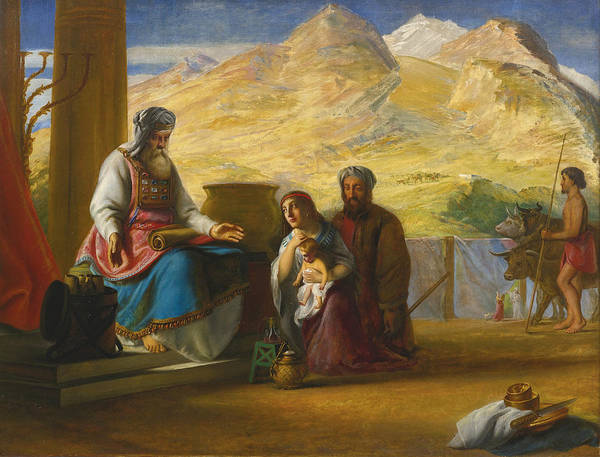
The Ark in the Promised Land

Dancing in the Kingdom- Table of Contents

Dancing In the Kingdom – Part 1 – Shadows of the Kingdom – Chapter 9 – The Prophets and writings

The Ark in the Promised Land

[Bible references: Joshua 4-5; Joshua 18:1; 1 Samuel 4-6; 5:1-2; 6:19; 21-22; 2 Samuel 6:5-7; 12-13; 1 Kings 8:27; 1 Chronicles 21:29; 2 Chronicles 1:13;]

After Israel entered the Promised Land, the tabernacle and all its furnishings were originally placed in Gilgal.[1] After the land was settled the tabernacle was then set up in Shiloh where it stayed for two hundred years. During the time of Samuel, Samuel’s sons, without consulting God, removed the ark from the tabernacle to take it into battle with the Philistines who not only won the battle but took the ark with them. The Philistines found that although Yahweh did not see fit to help Israel win the battle, Yahweh did create issues with the Philistines. The Philistines responded by moving the ark a couple of times, but the problems did not disappear and so the ark was sent back to Israel.

The ark initially ended up in Beth Shemesh, but after 70 people died when they tried to look in the ark, the people of Beth Shemesh sent the ark to Kiriath Jearim where it stayed for 92 years. The Bible is not explicit about when it happened, but sometime during the reign of King Saul, the tabernacle, sans the ark, was moved to Nob and then to Gibeon.

After David established the capital in Jerusalem, King David set up his own tabernacle and then moved the ark there. In moving the ark, David had to learn a lesson. He first tried to have the ark carried in a cart, but when the ark started to slip out of the cart, the people died who touched the ark to prevent it from slipping out. So, the ark ended up in Obed-Edom’s house for a while. Hophni and Phineas learned the hard way that you don’t necessarily take the presence of God when you take the ark, but David learned the hard way that you can’t ignore the presence of God when you take the ark. David was successful in moving the ark to Jerusalem after he had the ark moved according to the instructions that God had given Moses.


[1] Joshua 4-5 – Although the tabernacle is not specifically mentioned, Gilgal seems to be the place where Israel settled until the land was divided and is where Passover was celebrated. In Joshua 9, Gilgal is where the Gibeonites come to make a treaty with Israel.

Reflect

Some people use objects or rituals as “good luck charms.” How does the story of the ark relate to that? Have you used a “charm” instead seeking the will of God?

Observe

Read 1 Samuel 4:1-11; 5:1-12. Contrast how God acts differently between these two passages.

Messengers of a Greater Power

Dancing in the Kingdom- Table of Contents

Dancing In the Kingdom – Part 1 – Shadows of the Kingdom – Chapter 9 – The Prophets and writings

Messengers of a Greater Power

[Bible references: 1 Samuel 9-10; 13:8-14; 2 Samuel 12; Jeremiah 2:28; Matthew 5:17; 13:54-57; Acts 13:1; 1 Corinthians 14:29-33;  2 Corinthians 4:1-22]

During the entire time when Israel had kings, it also had prophets. Some prophets like and Elijah and Elisha did not leave any writings, although sixteen prophets did.[1] The prophets focused more on “forth-telling” (telling about changes that the kings and/or the people needed to make immediately) than “fore-telling” (telling about some future events) and were a constant reminder that God was acting in ways that transcended the earthly kingdom. Sometimes the prophets were there to encourage and sometimes to challenge the kings: The prophet Samuel was used to anoint Saul as king, then later had to let Saul know that God had rejected him. Samuel was also used to anoint David as king. Later, the prophet Nathan was used to let David know that God was aware of David’s sin with Bathsheba.

When we look at Jesus’ life and ministry, we see that he is uncompromisingly prophetic in a whole host of ways:

  • He is the revelation of the Father: he perfectly shows us what God is like.
  • He is the Word of God in flesh.
  • He is the mediator of the New Covenant between God and people.
  • He confronts evil and breaks the power of sin.
  • He calls people to return to God and live righteously.
  • He speaks truth to power (both religious and secular).
  • He only does what he sees the Father doing.
  • He is led by the Spirit and ministers in the power of the Spirit.
  • He prioritizes prayer and worship.
  • He speaks prophetically of the future.
  • He discerns the hearts and minds of people.
  • He challenges injustice and unrighteousness.

Jesus is the perfect expression of the prophet and so gives us the blueprint for a mature, holistic, multi-faceted way of being the prophetic church. We need to be prophetic in the way that Jesus was prophetic. Not just as individuals but as a Body with a collective prophetic consciousness.[2]

The Prophets of the Old Testament were precursors of the prophetic ministry of Jesus. And now the church, as the Body of Christ, has the privilege of carrying on that ministry.


[1] Isaiah, Jeremiah, Ezekiel, Daniel, Hosea, Joel, Amos, Obadiah, Jonah, Micah, Nahum, Habakkuk, Zephaniah, Haggai, Zechariah, Malachi

[2] Accessible Prophecy, “Understanding the Prophetic Function” Accessible Prophecy accessibleprophecy.com/2019/02/13/understanding-the-prophetic-function/

Reflect

Based on what we know about the role of prophets, how should today’s churches carry out the prophetic function within our church or within our surrounding culture?

Observe

Read 2 Samuel 12. How did God use Nathan to bring David to repentance?

Rejecting God as King

Dancing in the Kingdom- Table of Contents

Dancing In the Kingdom – Part 1 – Shadows of the Kingdom – Chapter 8– Kings and kingdoms

Rejecting God as King

[Bible references: Judges 2:10-23; 21:25; 1 Samuel 8:1-22; Psalm 81:8-16]

Ever since the time of Adam and Eve, we have had a problem of thinking that we know better than God. After Israel started to settle into the Promised Land, that same problem appeared again with the diagnoses, “everyone did what was right in his own eyes.” That problem caused the cycle of 1) God disciplining Israel by allowing them to be dominated by one of the nations, which then caused 2) the people to cry for help, after which 3) God raised up a leader who overcame the dominating nation, 4) then once Israel is freed up, they turned from Yahweh and … the cycle repeated.

Eventually, Israel figured that they thought they knew what the problem was … that they needed a king … like everyone else. When the prophet, Samuel, was old and people became uncomfortable with Samuel’s sons leading the nation (Note: It seemed that Samuel had the same kind of problem with his sons as Eli had with his sons), the people rebelled against God and asked the prophet Samuel to ask God to give them a king. Samuel was troubled because he knew that their diagnosis was wrong. Yahweh confirmed that when he told Samuel that the real problem was not that they rejected Samuel, but rather they’ve rejected Yahweh as king. Unexpectedly, Yahweh said that he would grant their wish anyway. They will get a king (!!!) … like everyone else!!!. One of the lessons from this event is that we need to be careful; in our rebellion, God may condemn us to what we want.

Observe

Read 1 Samuel 8. Knowing that God may discipline us by giving us what we want instead of what we need, how should we then pray?

God raising his people

Dancing in the Kingdom- Table of Contents

Dancing In the Kingdom – Part 1 – Shadows of the Kingdom – Chapter 7– Settlement

God raising his people

[Bible references: 1 Samuel 1-2; Ruth 1-4; Matthew 1:1-16; Luke 3:21-38; 1 Corinthians 25; (See also, Sarah (Genesis 16-18) Rebekah (Genesis 25:19-26) Elizabeth (Luke 1:5-25))]

During the time of the judges, while the nation of Israel struggled and failed to follow God, we find that God was raising judges in response to Israel’s cry for help in their ongoing cycle of sin, God was also quietly working in the background through individuals to carry out His larger plan.

During the period of the Judges, God used drought to cause Elimelech and his wife Naomi and their two sons to move to Moab. Both of her sons got married in Moab and one of them married a woman named Ruth. When Naomi’s husband and sons were tragically killed, Naomi moved back home to Israel. While Ruth could have stayed in Moab, Ruth desired to follow Naomi and particularly to follow Naomi’s God. God used that act of faith to arrange for Ruth to meet and married Boaz, thus inserting a Moabite woman into the lineage of people who would become the ancestors of Jesus.

There is a recurring story that began in Genesis with Abraham and Sarah, where God works through women who have difficulties in pregnancy. In the time of Judges, the woman was Hannah. In her struggle to become pregnant, Hannah leaned on God. One day, while she was praying at the tabernacle, the priest, Eli, saw her and asked God to grant Hannah her wish. Shortly thereafter, Hannah became pregnant and gave birth to a son, Samuel. In an act of gratefulness, after giving birth to Samuel, Hannah committed Samuel to serve at the tabernacle with Eli. Little did Eli know at the time that God would raise up Samuel to be a priest in place of his sons. When Eli’s sons had become corrupt and unfit to serve as priests, God worked within Hannah’s fervent worship to raise up Samuel and eventually called Samuel to replace Eli as priest. Samuel ended up being a prophet for Israel and served as the last of the judges.

Reflect

We can get distracted by events around us and lose sight of the fact that God is always working around us, even when things seem to be in turmoil. How can that help us in our daily lives?

Observe

Read 1 Samuel 1-2. Consider how God worked through Hannah’s life to prepare Samuel to be the next priest. How can God use the trials in your life to bring glory to Himself?

A higher order

Dancing in the Kingdom- Table of Contents

Dancing In the Kingdom – Part 1 – Shadows of the Kingdom – Chapter 5– Patriarchs

A higher order

[Bible references: 1 Samuel 3-4, 15-16; Matthew 8:5-13]

The case of Jacob and Esau is not the only example where Yahweh would choose to upset the common order of things. In this case, it was side-stepping the normal primogeniture and instead having the older sibling serving the other sibling. In other times it would be stronger serving the weaker, or sons being displaced by someone outside the family. This occurred when Samuel became high priest after Eli instead of Eli’s sons and when David became king after Saul instead of Saul’s son. In all these cases, we see God preparing someone new to lead while he arranged to end another’s leadership.

Reflect

Sometimes what looks like chaos to us is actually a pattern that we haven’t figured out. One example is encoded messages – we can’t read them without knowing the underlying order. What patterns from God confuse you?

Observe

Read 1 Samuel 3-4, 15-16; Matthew 8:5-13. The role of priest passed down from generation to generation, but God interrupted the process at least twice. How did that prepare the way for this story in Matthew?

Earthly kings and the rejection of God as king

Dancing in the Kingdom- Table of Contents

Dancing In the Kingdom – Part 1 – Shadows of the Kingdom – Chapter 1 – Prelude

Earthly kings and the rejection of God as king

[Bible references:1 and 2 Samuel, 1 and 2 Kings; 1 and 2 Chronicles]               

The last of judges was Samuel, who also functioned as a priest. By this point in time, Israel was convinced that their continuing problems were, of course, not themselves. They thought that their problem was that they didn’t have a king like everyone else. Actually, God was their king and Samuel was His representative. But the Israelites were not satisfied with God choosing prophets who would speak for Him. So, God gave them a king, like everyone else, Saul. While it did not take Saul a long time to turn from God so completely that God rejected him, Saul was able to reign for 40 years. David, who was described as someone after God’s own heart, replaced Saul. David expanded the kingdom from the Orontes River in the north to the Sinai peninsula in the south.[1] Solomon, building off of David’s legacy, did not focus on expanding the kingdom as much as building its wealth. Solomon’s wealth increased not only in riches of gold and silver, but also in wives and concubines. His love towards his wives and concubines overrode his love for God, so at Solomon’s death, the kingdom split in two parts.

Ten tribes who rebelled against Solomon’s son, aligned with the northern kingdom, which became named Israel.  Of the other 2 tribes, the tribe of Judah was most prominent. Both kingdoms were eventually conquered by neighboring empires: the northern kingdom by Assyria and the southern kingdom by Babylon.


[1] Archaeologists have had difficulty locating evidence of the kingdoms of David and Solomon. That is due, in part, to the Israelites tendency to adopt the customs of the Palestinian nations, making their artifacts indistinguishable from the nations they displaced.

Reflect

From what we see in the world around us, how often do people take responsibility for their own problems?

Observe

Read 1 Samuel 15:15. What’s the clue that Saul was no longer following God?