The Spirit and the scattering

Dancing in the Kingdom- Table of Contents

Dancing In the Kingdom – Part 2 – The Kingdom Revealed – Chapter 12 – Launching the church

The Spirit and the Scattering

[Bible references: Acts 5:12-16; 6:1-15; 7:1-60; 8:1-3, 14-24; 10; 9:1-19; 13:16-47; 17:16-31]

Since Jesus focused his effort almost exclusively on the Jewish population, it was natural that in the early years of the church, nearly all the believers were Jewish. It also happened that the apostles started off by focusing on the area around Jerusalem. So, while the believers were Jewish, the opposition to the believers was primarily Jewish as well; particularly, the Sanhedrin which was heavily controlled by the non-resurrection-believing Sadducees. It was difficult for the Sanhedrin to control the apostles because their miraculous healings made them exceedingly popular among the people. Even the deacon, Stephen, who was performing signs and wonders was creating a problem for the Sadducees. So some men created a conspiracy against Stephen, creating lies that resulted in Stephen becoming the first recorded martyr for the faith. Stephen was quite eloquent in defending the faith before the Sanhedrin, laying out the history of Israel and then accusing the Sanhedrin of continuing the persecution of God’s prophets. This enraged the Sanhedrin so much, that even after Stephen was put to death, the persecution of the church began in earnest, causing the first scattering of the church, although the apostles remained in Jerusalem.

With the scattering came new opportunities and challenges. When it was discovered that the Samaritans had received the gospel, the apostles gladly received the news. But when some of the Samaritans received the Holy Spirit, there were some kinds of signs (we aren’t told what they were) that excited a magician, who was one of the ones who received Christ. The magician then offered money to the apostles so that he could get the power to lay his hands on people and give them the Holy Spirit. The apostles had to strongly rebuke him. He repented – but this was a sign of how things could go astray.

After sending the gospel to the Samaritans, the next step was to reach out to the Gentiles. This step was initiated by God who first worked with the apostle Peter and a devout Gentile man named Cornelius. God had given visions to both Cornelius and Peter to create a reason for them to meet. When Cornelius visibly received the gift of the Holy Spirit, Peter was convinced that the gospel was meant for the Gentiles as well.

To further spread the gospel among the Gentiles, God called Saul, a well-educated man who was familiar not only with the Jews but also with the Gentiles. Saul was a zealous Pharisee, whose zeal originally caused him to participate in the persecution of the church, but God used that same zeal to make Saul (also called Paul) not only one of the primary missionaries to the Gentiles but also a writer of half of the documents that comprise the New Testament. Even though Saul became converted after the ascension of Jesus, it was Jesus himself who encountered Saul who was on his way to persecute the Christians, making Saul a direct witness to the ministry of Jesus.

Whether the gospel was shared with the Jews or with the Gentiles there was a story to tell. The Jews needed to understand how the story of Jesus fit into their history – their story – and the Gentiles needed to know how it fit into their story. We all have a worldview – a story of the world that we use to interpret the world around us – and the gospel is most effectively shared when there’s a way to reach inside the others’ worldview.

Observe

Read Acts 13:1647; 17:16-31. What was the difference between how Paul told the gospel to people in the synagogue vs. the people in the Athens marketplace?
Originalism vs. Living interpretation

Dancing in the Kingdom- Table of Contents

Dancing In the Kingdom – Part 2 – The Kingdom Revealed– Chapter 10 – The Class of Apparitions

Originalism vs. Living interpretation

[Bible references: Mark 7:1-23; Acts 23:1-8]

In contrast to the Pharisees, both the Essenes and the Sadducees rejected the oral law,[1] and insisted that only that the books written by Moses were valid. In today’s Christian viewpoint, the Biblical canon has long considered to have been fixed (although there is disagreement between the Orthodox, Roman Catholic and Protestant traditions about what books to include in the canon) even though the accepted methods of interpretation have changed through the years. Outside the church, there is a debate about whether our national Constitution should be interpreted strictly as the writers of the Constitution intended in their context or whether it should be adapted to current circumstances.


[1] Chabad.org “The Oral Law” Chabod.org www.chabad.org/library/article_cdo/aid/2056/jewish/The-Oral-Law.htm

Observe

Read Mark 7:1-23; Acts 23:1-8. The Sadducees restricted their scripture to only Moses’ writings (the Torah). The Pharisees included those writings that were defined as “the prophets and the writings” as well as commentary written in the collections known as the Talmud and the Mishna. Jesus critique of the Sadducees was to have almost ignored the them altogether. Jesus’ criticism of the Pharisees was quite abundant. What were their errors?

For or against the secular culture

Dancing in the Kingdom- Table of Contents

Dancing In the Kingdom – Part 2 – The Kingdom Revealed– Chapter 10 – The Class of Apparitions

For or against the secular culture

[Bible references: Ezra 6:19-22; 2 Corinthians 6:14-18; Matthew 5:13-16; 28:18-20]

There are many ways people try to hold onto their subculture when they sense that the main culture around them has a corrupting influence.[1] The Sadducees were trying to blend in with the culture of the empire. The Essenes kept themselves as an isolated, communal society.[2] The Pharisees were trying to hold fast to the rules specified by Moses.[3]


[1] Elshtain, Jean Bethke. “With or Against Culture” Books and Culture www.booksandculture.com/articles/2006/sepoct/20.30.html; Niebuhr, Richard M. “Christ and Culture” Harper & Row 1951

[2] Gutierrez, Juan Marcos Bejarano, Forgotten Origins: The Lost Jewish History of Jesus and Early Christianity, Yaron Publishing, 2017 (Location 2343)

[3] Gutierrez, Juan Marcos Bejarano. The Judaisms of Jesus’ Followers: An introduction to Early Christianity in its Jewish Context, Yaron Publishing, 2017 (Locations: 738, 929)

Reflect

Do you try to blend in with the culture or do you try some method of keeping from being absorbed into the culture around you?

Observe

Read Matthew 5:13-16: How can one be “salt” and “light” within our world?

Effects of wealth and power

Dancing in the Kingdom- Table of Contents

Dancing In the Kingdom – Part 2 – The Kingdom Revealed– Chapter 10 – The Class of Apparitions

Effects of wealth and power

[Bible references: Mark 10:17-31; Luke 1:46-55]

In our current environment, we see a widening gap between the wealthy and the poor.[1] The Sadducees[2] were more identified with the rich and the politically powerful. The Pharisees were more identified with the lower and middle class and thus were more popular.


[1] Gregoire, Carolyn. “How Money Changes the Way You Think and Feel” Greater Good Magazine greatergood.berkeley.edu/article/item/how_money_changes_the_way_you_think_and_feel

[2] Riches, John. “The World of Jesus: First Century Judaism in Crisis” Cambridge University Press, 1990 (pp.59-60)

Reflect

In what ways can money affect how we think?

Observe

Read Luke 1:46-55. What does it mean that the rich are “sent away empty?”

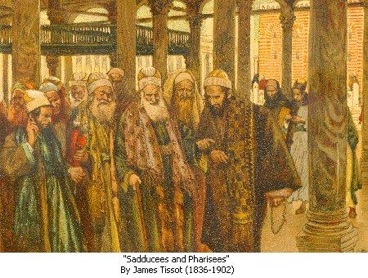
Sadducees

Dancing in the Kingdom- Table of Contents

Dancing In the Kingdom – Part 2 – The Kingdom Revealed– Chapter 10 – The Class of Apparitions

Sadducees

[Bible references: 2 Samuel 8:15-18; Ezra 7; Matthew 3:7; 16:1-11; 22:23-34; Mark 12:18; Luke 20:27; Acts 4:1; 5:17; 23:6-8]

The Sadducees were priests who based their legitimacy on their descendance from Zadok, a priest who lived at the time of King David. It was the Zadokite line of priests that emigrated back to Jerusalem when Persians allowed the Israelites to return from captivity. They were intent on holding onto their power which came through the ministry of the temple. Like the Samaritans, the Sadducees regard only the writings of Moses to be scripture and they interpreted them very literally.

The corrupting influence of power caused them to cooperate with the Greeks when Israel became a client kingdom of the Greek empire. Although Pharisees were also in the Sanhedrin, the Sadducees became the prominent group controlling the Sanhedrin notably during the Greek and Roman occupation.

Because the Sadducees only included the books of Moses in the scripture, they did not develop any beliefs in the resurrection, which caused conflicts with both with Jesus and the Pharisees. The interactions that are recorded are all confrontational. There is an obvious tension between Jesus and the Sadducees. Jesus came to undergo death and resurrection and to eliminate the need for continual temple sacrifices, but the Sadducees did not believe in resurrection and their status was dependent on the continuation of the temple sacrifices. In contrast to the poor and needy ‘lost sheep of Israel,’ the Sadducees were the rich upper class. The Sadducees disappeared from history upon the destruction of the temple by the Romans in AD 70.

Observe

Read Matthew 16:5-11. What is the yeast of the Sadducees?

Pharisees

Dancing in the Kingdom- Table of Contents

Dancing In the Kingdom – Part 2 – The Kingdom Revealed– Chapter 10 – The Class of Apparitions

Pharisees

[Bible references: Matthew 5:20; Luke 13:31’ John 3:1-15]

The Pharisees developed out of the scribes who were copying the writings of Moses and, in doing so, were concerned with knowledge of the law, as well the writing of the prophets who came after Moses and the traditions of elders (rabbis). They were also concerned with how to interpret the law to make applicable to everyday life and there were many teachers of the law who wrote commentaries on the law, and the Pharisees also studied these commentaries. The people identified as rabbis came from this group.

The Pharisees became more identified with the everyday people, as opposed to the Sadducees who were identified with the wealthy ruling class. It is not known exactly when the Pharisees were identified as a group but may have happened as their opposition to the teachings of the Sadducees developed.

Jesus had a lot of interactions with the Pharisees. Most of what is recorded in scripture is confrontational, but the dynamics were more nuanced and could be misunderstood. By the times of Jesus, there were two main schools of rabbinic thought: the rigorist school of thought, led by Shammai the Elder, insisted on getting every detail right, particularly in the area of cleanliness, and was beyond the possibility of normal Jews to live out; the humanist school of thought, led by Hillel, was more intent on getting the spirit of the law right and was therefore within the realm of normal Jews.[1]

Another nuance had to do with the normal culture of conflict within Judaism (after all, ‘Israel’ means ‘wrestles with God’). It would have been normal for the scribes and Pharisees to question this new teacher, Jesus, and test his knowledge to see if he knew what he was talking about, although there may be a question about their motives – was the testing done to gain understanding or was the testing done to try to discredit Jesus. We shouldn’t forget the time that some Pharisees warned Jesus about Herod’s plot to kill him.


[1] Johnson, Paul. “A History of the Jews” Harper Perennial 1987 (p 127)

Observe

Read John 3:1-15. A closer reading of scripture shows that Jesus did not just have a confrontational relationship with the Pharisees but had a more nuanced relationship. This can be particularly seen with Jesus’ interaction with Nicodemus. Describe the type of interaction between Nicodemus and Jesus.

Herodians

Dancing in the Kingdom- Table of Contents

Dancing In the Kingdom – Part 2 – The Kingdom Revealed– Chapter 10 – The Class of Apparitions

Herodians

[Bible references: Matthew 22:16; Mark 3:6; 8:15; 12:13]

The Herodians were a political party who were openly supportive of King Herod and therefore opposed to all who were considered enemies of Herod, including Jesus. To that end they associated with the Sadducees in their support of King Herod. However, they were known to have joined forces with the Pharisees in trying to entrap Jesus.

Observe

Read Mark 8:1-27. What was Jesus referring to when He warned His disciples to avoid the leaven of Herod?