Reconciliation

Dancing in the Kingdom- Table of Contents

Dancing In the Kingdom – Part 3 – Dancing in the Kingdom– Chapter 18 – Entering the Dance

Reconciliation

[Bible references: Luke 19:11-27; John 13:34-35; 14:15-31; 16:7-15, 33; Romans 5:1-11]

Keeping in mind that we serve as Christ’s ambassadors to the world with the message of reconciliation, Emmanuel Katongole and Chris Rice have summarized ten aspects of that reconciliation:[1]

  • Reconciliation is God’s gift to the world. Healing of the world’s deep brokenness does not begin with us and our action, but with God and God’s gift of new creation.
  • Reconciliation is not a theory, achievement, technique, or event, It is a continuous process, a dance if you will, with our fellow image-bearers.
  • The end toward which the journey of reconciliation leads is the shalom of God’s new creation — a future not yet fully realized, but holistic in its transformation of the personal, social, and structural dimensions of life.
  • The journey of reconciliation requires the discipline of lament.
  • In a broken world God is always planting seeds of hope, though often not in the places we expect or even desire.
  • There is no reconciliation without memory, because there is no hope for a peaceful tomorrow that does not seriously engage both the pain of the past and the call to forgive.
  • Reconciliation needs the church, but not as just another social agency or NGO,
  • The ministry of reconciliation requires and calls forth a specific type of leadership that is able to unite a deep vision with the concrete skills, virtues, and habits necessary for the long and often lonesome journey of reconciliation.
  • There is no reconciliation without conversion, the constant journey with God into a future of new people and new loyalties.
  • Imagination and conversion are the very heart and soul of reconciliation.

The heart of reconciliation is love. When we love and reconcile one another with others in the body of Christ, that is, if we can love the people we don’t like and become reconciled, that becomes the visible grace of God that can even be recognized by those outside the church and draws them to that same love and grace of God. Our task from the beginning was to serve the earth. Jesus lived that out, not by growing crops but by healing the sick and loving the outcasts. We continue that task by “Dancing in the Kingdom,” expanding God’s flourishing glory as we respond to Jesus’ call to us to “occupy till I come.”


[1] Katongole, Emmanuel & Rice, Chris. Reconciling All Things: A Christian Vision for Justice, Peace, and Healing Intervarsity Press, 2009

Observe

Read Romans 5:1-11. How do we prepare ourselves for the work of reconciliation?

Ministry of Reconciliation

Dancing in the Kingdom- Table of Contents

Dancing In the Kingdom – Part 3 – Dancing in the Kingdom– Chapter 16 – Fixing our eyes

Ministry of Reconciliation

[Bible references: Matthew 10; Mark 1:40-45; 5:1-20; Acts 2:42-47; 3:20-26; 17:16-34; Romans 8:18-39; 12; 2 Corinthians 5:18-20; Ephesians 4:1-16; 6:18-20; Philippians 3:25-21; 1 Thessalonians 5:11-28; John 13:34-35; Revelation 21:1-2]

When Jesus came the first time, people were looking for a Messiah to overthrow the Roman government, but Jesus’ message was to repent and be baptized for the forgiveness of sin. That is the message we need to respond to and the message we need to bring to others. The gospel is the good news of forgiveness that we can receive if we respond by repentance. The gospel is the good news of God’s Kingdom come to earth to transform us as well as all of creation so that heaven and earth can be fully joined as God had intended from the beginning.

Once we have become transformed, we are able to invite others to repent and accept the grace of God in transforming their lives as well and then join us in the work of discipleship and restoring the world beginning with the call to reconciliation, that is to engage in the work of evangelism. Some people are better equipped to do evangelism than others, but that does not leave the rest of us with no part in the work.

Evangelism, like other aspects in the life of the church, is a work of the body of the church. It is also a work of the Spirit. Evangelism involves persuading, proclaiming, and teaching the gospel and is a call for others to come to Christ, His Body, and to discipleship. We do not convert people to Christ, which is the work of the Spirit; but we are called to join Spirit in His work in the world. The church is called to be the church and display the gospel at work; the gospel which calls us to be transformed, calls us unity with others in the body of Christ and calls us to join Christ’s work of reconciliation and restoration.

That means that we all have a part to play in the body of Christ, to help build one another up so that we may all become mature members of the body of Christ, displaying the love of the transcendent God towards each other. If we are each transformed by Christ, then we should be able to “give a reason for the hope” we have. A hope that we can hold onto even as we live amid a church that is transformed and yet broken by sin.

The call to discipleship is a call to reconcile all the parts of our lives to the Lordship of Christ. This includes not only all our relationships, particularly with those in the body of Christ, but all of our stewardship responsibilities for all of creation. The evangel, the good news, is not just that our personal relationship with God can be restored, but that all of creation will be restored.

It is for the sake of love that God suffered for us that he might redeem us. The greatest commandments that He gave to his image-bearers, were about love: loving God and loving our neighbor. The good news is about that love – a love that reaches out to us and through us amidst all our brokenness. a love expressed in word and deed.

The remaining parts of this book are about the breadth of expressing that love. Certainly, if we love someone who does has not heard the gospel, it would be loving to share that news with them. And if we are truly loving that other, the words of that news should be happening amid all we do to show that love in our deeds as well as in our words. It may be that the deeds of love will help open-up hearts to hear about that love; a love that reflects God’s prodigal love for each of us, a love that desires to take care of all that God has given us – God’s creation and God’s creatures, God’s image-bearers, and the gifts he has given each one of us. God’s extravagant love should be reflected in the way we love God with all our heart, mind, soul and strength and the way we love our neighbor as ourselves.

God’s image-bearers, the ones who call him Lord and Father, are God’s chosen vehicles to proclaim and demonstrate his love as his ambassadors. God’s proclamation and demonstration of love is not constrained by our different personalities and circumstances, for our limitations are not his limitations but rather our weaknesses are His strength, and our little demonstrations of love are the reflections of His powerful love to us and to the world.

Within ourselves, we may be small and insignificant, but we are not just isolated individuals. We are part of Christ’s body, physical manifestations of Christ

  • Past, present, and future
  • Around the world
  • In all our different ways with whatever resources Christ has given us
  • In whatever place and time he chose for us, with whatever strengths and weaknesses we have

We are the creatures whom God has empowered to rule the earth as his gardener-priests. That empowerment has not changed even though we are broken people living in a broken world. The charge he had given us still remains. Therefore, within our brokenness we need to take whatever Christ has given us and proclaim and demonstrate God’s unsurpassed, overwhelming love to the world, a love that not only wants to reconcile all people but literally all the world to Himself … to reunite heaven and earth.

 The challenge we have as God’s ambassadors, is for us to be proclaiming and living the gospel amid the cultures that are sometimes indifferent and sometimes hostile. Therefore, in our tasks, if we are to be effective ambassadors then we must be, “wise as serpents and innocent as doves,” as we try to discern how to effectively persuade others to follow Jesus. Of course, keeping in mind that it is not we who ultimately persuade others to follow Christ, rather that is the work of the Holy Spirit. But how can we participate with the Holy Spirit?

Different people are persuaded by different means. Sometimes, people are persuaded by logic as we could see in the life of the apostle Paul. Sometimes people are persuaded by personal relationships and are drawn by a personality that looks attractive as we could see in the lives of people who were drawn to Jesus. Sometimes people are persuaded by seeing something different in the life another.

With that in mind, then how do we put ourselves in the place where we are most effective? The answer is: the church. The church is the body of Christ whose members are called to build up one another and to demonstrate a love for one another such that others will recognize us as belonging to Christ. When the church gathers to worship and express it’s love to God, that same desire should lead to expressions of love to one another which pour out into love of neighbor as the church scatters during the week. That desire to love should then draw us to desire to learn how to love in the best way possible. Love leads to love. The love of God leads us to love, love of one another and a love of the world that God loves.

Exactly how that love will flow depends on the particulars of each individual in their particular circumstances. We are all born with different personalities and different bodies, and are equipped differently according to the Holy Spirit, and find ourselves in different cultures within the church and within our communities. Some individuals will find themselves in a very individual ministry and some will be called to a broader ministry to the world. Also, different church communities will even find different approaches in how they interact with the cultures around them.[1]


[1] Finn, Nathan A, Whitfield, Keith S. “Spirituality for the Sent” Chapter 5 Missional Spirituality and Cultural Engagement IVP Academic 2017

Reflect

Discipleship is a process of “being transformed” (2 Corinthians 3:18). Ultimately it is something that happens to us – but it is something we can co-operate with by engaging is spiritual disciplines. What kinds of changes need to happen in our lives that would make it natural to invite someone else into discipleship?

Observe

Read Romans 12. How do we help those around us to be reconciled to each other and to God?

Discipline of Fasting

Dancing in the Kingdom- Table of Contents

Dancing In the Kingdom – Part 3 – Dancing in the Kingdom– Chapter 15 – Reforming our Souls

Discipline of Fasting

[Bible references: Isaiah 58:1-14; Ezra 8:21-23; Matthew 6:16-18]

By the help of the merciful Lord our God, the temptations of the world, the snares of the Devil, the suffering of the world, the enticement of the flesh, the surging waves of troubled times, and all corporal and spiritual adversities are to be overcome by almsgiving, fasting, and prayer.[1]

“More than any other Discipline fasting reveals the things that control us.” [2]

Fasting breaks up habits to let us see our lives in new ways or to enable us to pray at new times or in new ways. Because we are stopping something for a finite period of time, there’s an unfamiliarity and discomfort to it that can be very instructive, open up time for prayer, and draw us closer to God.”[3]

“In every culture and religion in history, fasting has been an instinctive and essential language in our communication with the Divine.”[4]

The pursuit of God can be described as in Psalm 37, to trust in, to delight in, to commit to, to wait on, and to be silent before the Lord; these are words of “giving up” of “going without” whatever the world offers and instead resting in God. The discipline of fasting then looks like learning to go without while learning to rest in, to fight through our appetites so that we can remain focused on the act of pursuing God and loving others, to push through our hunger pains so that we can discover we’re just fine on the other side of them, to look to God, to talk to him, to open ourselves to him in confession, to not so much as give up anything, but to commit to hearing the voice of God in our lives. The goal of fasting is to pursue God, to turn our hearts and our loves towards God and neighbor.

There are many reasons Christians are led by the Holy Spirit to the spiritual discipline of fasting, a few of them are: to strengthen one’s prayer life, to seek direction for one’s life, to express grief and loss, to seek deliverance and protection for life, to express repentance and reconciliation with God. to humble oneself, to express concern for the work of God, to minister to the needs of others, to overcome temptation and rededicate oneself to God, to express love, devotion, and worship of God, to establish rhythms between absence and abundance.

Simplicity and Gratitude can be precursors to fasting. Once we have determined how to order our lives then we are better equipped to identify those things that stand in our way and in the lives of those around us, not only the good vs. bad things, but the good things that detract us from the best things. The Gratitude for God and His provision can set our attitude in preparation for fasting.


[1] Sister Mary Sarah Muldowney The Fathers of the Church: A New Translation Writings of Saint Augustine Vol 17 Fathers of the Church 1959 Sermon 207 (p. 89)

[2] Foster, Richard J. Celebration of Discipline.  Harper & Row Publishers ©1978 (p. 48)

[3] Baab, Lynne M. “The Surprise of Fasting” Lynnebaab.com www.lynnebaab.com/blog/the-surprise-of-fasting

[4] Ryan, Thomas. The Sacred Art of Fasting: Preparing to Practice Skylight Paths 2005

Observe

Read Isaiah 58:1-14; Ezra 8:21-23; Matthew 6:16-18. The benefit of fasting does not come just from deprivation. What should accompany fasting?

Rejoicing in the hope of God

Dancing in the Kingdom- Table of Contents

Dancing In the Kingdom – Part 3 – Dancing in the Kingdom– Chapter 14 – Remembering our creation

Rejoicing in the hope of God

[Bible references: Psalm 42; Isaiah 40; Romans 5:1-11; 2 Corinthians 5:11-21]

The relationship between lament and hope is crucial. Reconciliation without lament cheapens hope. To be deeply bothered about the way things are is itself a sign of hope.[1] It is because of our great hope that we can face the brokenness around us and within us, knowing that God still rules over all things and above all things, knowing that He has not and will not cease working to bring his mercy and justice, and knowing that God will eventually restore all of creation to what He has intended from the beginning.

That is the hope we can remember each time we share communion. In the broken bread we remember: Christ broken for us; our sharing in His brokenness; the Body of Christ, that the church now broken will be made whole when our joy will be consummated at the Wedding Feast of the Lamb. In the wine we remember: Christ’s blood shed for us; our sharing in His suffering; the Blood of Christ which cleanses and redeems us so that with pure hearts and with one heart, we may enjoy the glorious presence of our Lord. And so it is, after facing the reality of our brokenness, acknowledging it with our lament, looking forward to the reality of the hope we have in God and seeking His desire to restore all things to Himself, that we can face the reality of what we need to do, so that we can join Christ in his redemptive work. If we have truly faced the reality of our brokenness then we will not be deceived by the illusion of progress in our culture, which ultimately is unable to overcome evil.[2] Our hope is fixed solely in Christ who has defeated evil.


[1] Katongole, Emmanuel. Reconciling All Things: A Christian Vision for Justice, Peace, and Healing  Intervarsity Press, 2009; Wright N.T. “Five Things to know about lament” NT Wright Online www.ntwrightonline.org/five-things-to-know-about-lament

[2] Wright, N.T. Surprised by Hope: Rethinking, Heaven, the Resurrection, and the Mission of the Church  Harper Collins 2008. Kindle Edition (p.84-86)

Reflect

How can communion provide us hope within the brokenness that we live in?

Observe

Read 2 Corinthians 5:11-21. What do we need to experience before we can act a ambassadors of Christ?

Mystery of the sacraments

Dancing in the Kingdom- Table of Contents

Dancing In the Kingdom – Part 2 – The Kingdom Revealed – Chapter 13 – Distinctives within the body of Christ

Mystery of the sacraments

[Bible references: Matthew 26:17-35; Exodus 30:17-20; Mark 1:1-11; Acts 2:38, 41-42; Romans 6:1-23; 1 Corinthians 11:17-34]

Defining Sacraments

Sacraments, the rituals of belonging

“The language surrounding ‘sacraments’ did not develop in the church for some time. We hear of a ritual of baptism in the Christian community of the Acts of the Apostles, and of the ‘breaking of bread’ (Acts 2:38, 41- 42). These celebrations were called by their name, there was no generic term that grouped these experiences together. It was not until the third century that the word mysteries (Greek: ‘mysterion’), a word that the pagans used to describe rites of initiation, also began to be used to describe Christian rites. The Eastern Orthodox church still uses the term ‘mysterion’ to describe these practices.

However, in the Latin wing of the church, in order to avoid any confusion with pagan thinking the church began to use the Latin word, ‘sacramentum’ for ‘mysterion’ to describe baptism. Sacramentum was also used to describe a sacred oath of allegiance that a Roman soldier would make to the emperor. It was suggested that just as the soldier’s oath was a sign of the beginning of a new life, so too was initiation into the Christian community through baptism and eucharist.[1]

“St Augustine of Hippo in the 5th century developed the notion that a sacramentum is a sign that sanctifies – makes holy – because it is efficacious – produces the intended effect. For instance, Christ and the Holy Spirit make effective, through grace, the cleansing that water signifies in baptism. It was Augustine who called a sacrament ‘a visible sign of invisible grace.’ He also, in his letters referred to a sacramentum as a sacrum signum ‘sign of a sacred thing’ It is worth mentioning that Augustine did not consider only rituals but also acts or deeds or things that point to Christian mysteries to be sacraments – and listed over 300 such signs.[2] The Church gradually reduced this by differentiating between rituals and signs and symbols that assist people in prayer and devotion such as holy water, palms, ashes etc. These latter are sometimes called “sacramentals.”[3]

Some congregations hold that sacraments administered by the church convey, by means of the Holy Spirit, grace to the recipients while some hold that the sacraments are only outward signs of an inward grace. Other differences are whether the sacraments are an objective reality that are effective in and of themselves or whether the effectiveness of the sacraments depends on the faith response of the recipients. Either way, the purpose of the sacraments is to make people holy, to build up the body of Christ, to teach, and to give worship to God.

Since the 16th century, the Orthodox and Roman Catholics recognize seven sacraments (The Orthodox church stipulates that there are even more but does not formally name them). Protestants only recognize baptism and the Lord’s Supper as sacraments. Some Anabaptist and Brethren groups consider foot-washing to be a sacrament. “Some Protestant groups, notably the Quakers and the Salvation Army, do not use sacraments.”[4]

Baptism and the mikva’ot

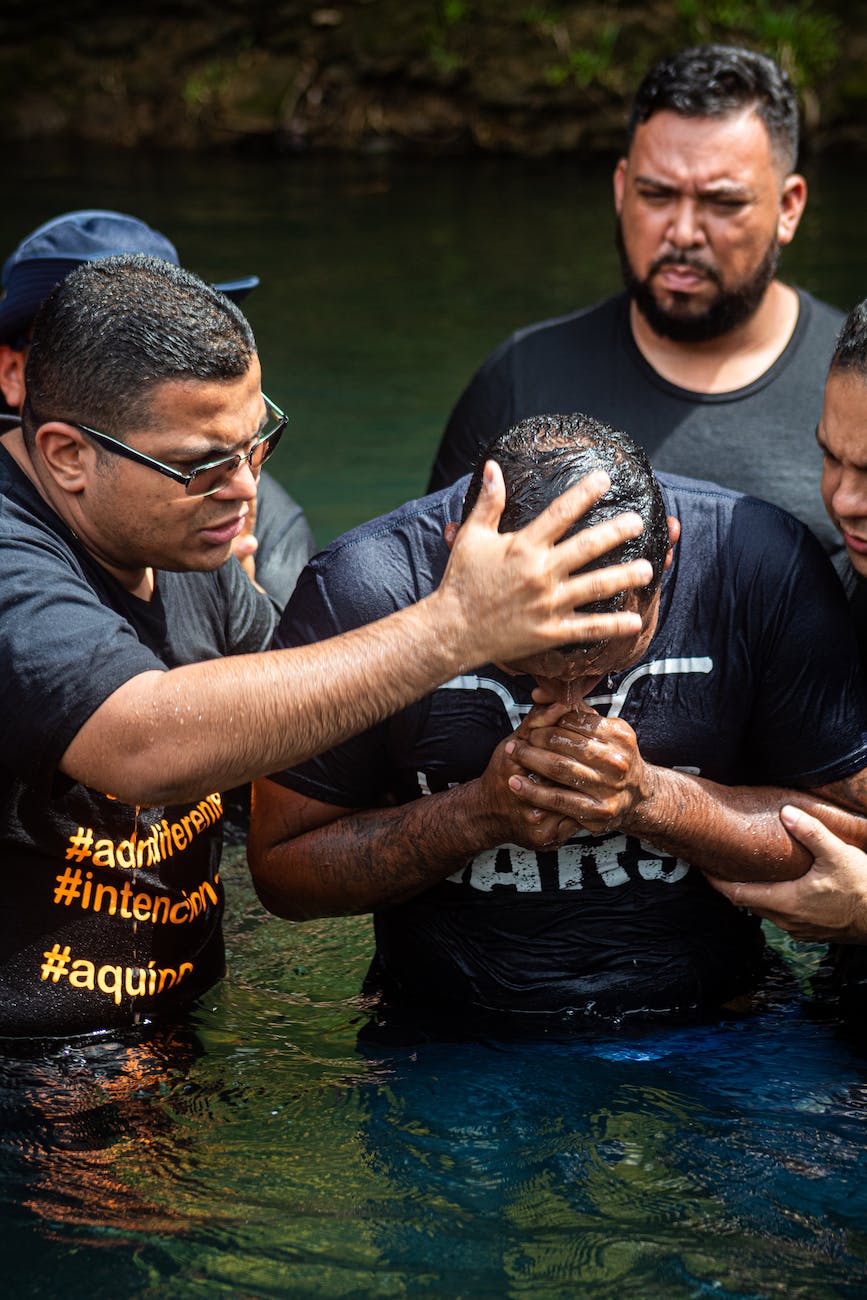
The word ‘baptism’ is a transliteration of a Greek word that meant to immerse. The Old Testament introduces us to the idea that we need to be cleansed before entering the presence of God (Exodus 30:17-20). By Jesus’ time, the city of Jerusalem had many buildings with a ritual bath (mikveh) in them where people could ritually cleanse themselves by dipping themselves in the mikveh. The mikveh can signify: a collection of water, something waited for, abiding, gathering together.[5]

In the New Testament, we are introduced to John the Baptist preaching about the coming of the Lord – and it was a time when many people were expecting the coming of the Messiah. John was baptizing people as they confessed their sins and as these people were being baptized, they would have understood that they were being cleansed and being gathered together for the coming Messiah.

When Jesus was ready to begin his time of ministry, he told John to baptize him. This obviously confused John who knew that Jesus did not need to be cleansed from sin, but Jesus had come to identify himself with us in baptism.

We see the practice of adults confessing their sins and then being baptized continue throughout the New Testament. After the New Testament we now enter an era of confessing adults bringing up their children. In the Jewish tradition, baby boys would be circumcised when they were 8 days old as a way of bringing them into the Jewish community. It is not long after the New Testament times that we see parts of the church using infant baptism as a way of bringing their children into the Christian community. The infants are obviously not confessing believers but believing parents can raise them up with the hope that they will later confirm their baptism. This issue of child baptism would later become an issue that the church would divide over.

Communion and the Passover Feast

The Communion celebration, sometimes called the Eucharist (from the Greek word for grateful or thanksgiving) is tied back to the Jewish Passover Feast. The Passover Feast was a commemoration of God’s work that convinced the Egyptian Pharaoh to let the Israelite slaves to leave. God’s work was to send an angel to kill all the firstborn children of the Egyptians but to “pass over” those Israelite homes that had the blood of a perfect lamb sprinkled on the doorposts of their homes. Every year after that, the Israelites were to commemorate that event with a Passover Feast that would include eating, among other items, bread with no yeast to remember the time they had to leave in haste from Egypt. The Passover meal would be one of many celebrations in the Old Testament that pointed to their fulfillment in the New Testament times.

At the end of Jesus’ earthly ministry, he gathered with his disciples to celebrate the Passover Feast; it would be his “last supper” with them before his crucifixion. He shared with them the bread and wine, but now adding their intended significance: the bread would represent his body that would be sacrificed for the world and the wine would represent his blood shed for the world.

There are differences about whether, during the Communion service, that the bread and wine actually become transformed into Jesus body and blood, or whether his body and blood are present with the bread and wine or whether the bread and wine only metaphorically represent Jesus’ body and blood.

What are the sacraments and how do we practice them?

Sacrament is Latin translation (sacramentum) of the Greek “Mysterion,” which means mystery.  The sacraments are used to refer to different rituals/activities conducted by the church.

There is agreement about the sacraments being a sign of grace imparted to those receiving sacraments, but there is disagreement (naturally, since we’re talking about mysteries) about how that grace works. Some consider the sacraments to be an objective reality that are effective for imparting grace in and of themselves,[6] others think that the effectiveness of the sacraments to impart grace depends on the faith response of the recipients, while others think that the sacraments are more simply a sign of grace.

Since the 16th century, the Orthodox and Roman Catholic recognize seven sacraments (The Orthodox church stipulates that there are even more but does not formally name them). Protestants only recognize baptism and the Lord’s Supper as sacraments. Some Anabaptist and Brethren groups consider foot-washing to be a sacrament. “Some Protestant groups, notably the Quakers and the Salvation Army, do not use sacraments.” [7]

  • Baptism – The first step in a lifelong journey of commitment and discipleship. Immersion identifies us with the death and resurrection of Christ.
  • Eucharist (or Communion) – In a re-enactment of the Last Supper, we share elements that remind us of Jesus’ sacrifice for us. 
  • Reconciliation (or Penance) – Has three elements: conversion, confession, and celebration.
  • Confirmation – An initiation into the church. It is most often associated with the gifts of the Holy Spirit.
  • Marriage – A public sign that one gives oneself totally to this other person. It is also a public statement about God: the loving union of husband and wife speaks of family values and also God’s values.
  • Holy Orders – The priest being ordained vows to lead other Catholics by bringing them the sacraments (especially the Eucharist), by proclaiming the Gospel, and by providing other means to holiness.
  • Anointing of the Sick (Last Rites) – A ritual of healing appropriate not only for physical but also for mental and spiritual sickness.

What are the different views on communion?

There are different views on what happens to the communion elements: bread and wine become literal flesh and blood, bread and wine become spiritual flesh and blood, or the elements are simply to remind us Jesus’ sacrifice for us.[8]

There are also different views on who can take communion: whether any Christians present may participate, or only members of local congregation or denomination may participate.[9]

Do we represent Jesus’ body with leavened or unleavened bread. Do we represent Jesus’ blood with wine or grape juice? Are both elements shared or is just the bread shared? Are only designated representatives of the church allowed to administer the elements?

What are different views on baptism?

There are different views on who may be baptized:  Adults only (Believer baptism, only people old enough to confess their faith may be baptized) Infants (infants of believers are baptized as acknowledgement of the infant as a new member in the church community and in hope that they will make a commitment in the future).

There are different views of what happens during baptism: baptism overcomes original sin, frees the baptized from powers of darkness, Baptism in the Holy Spirit – When someone is saved, the Holy Spirit overcomes the person and causes that person to speak “in tongues.”

There are different views of how many times the recipient is immersed: Once (there are differences in whether the words to use are “in the name of Jesus” or “in the name of the Father, and the Son, and the Holy Spirit), Three times (once for each of the Godhead: Father, Son, Holy Spirit).

There are different views on how the baptism is performed: Immersion (recipient is completely immersed in water), Pouring (water is poured on the head of the recipient), Sprinkling (water is sprinkled on the head of the recipient).


[1] Szczesny, Mike. “[Greek] μυστήριον (mystērion), [Latin] sacramentum” Resounding the faith resoundingthefaith.com/2016/10/27/greek-%CE%BC%CF%85%CF%83%CF%84%CE%AE%CF%81%CE%B9%CE%BF%CE%BD-mysterion-latin-sacramentum/

[2] Tennent, Timothy. “The Body and The Sacraments as a Means of Grace” Seedbed seedbed.com/the-body-and-the-sacraments-as-a-means-of-grace/

[3] Catholic Answers“Sacramentals” Catholic Answers www.catholic.com/encyclopedia/sacramentals

[4] Theopedia “Sacraments” Theopedia www.theopedia.com/sacraments

[5] One for Israel. “The Jewish Roots of Baptism” One for Israel www.oneforisrael.org/bible-based-teaching-from-israel/was-baptism-originally-jewish/

[6] Theopedia “Sacramentalism”  Theopedia theopedia.com/sacramentalism; Phillips, Matthew. “Augustine, Luther, and the Sacraments” Gospel Notes steadfastlutherans.org/2013/06/augustine-luther-and-the-sacraments

[7] Theopedia “Sacraments” Theopedia www.theopedia.com/sacraments

[8] Zondervan Academic Blog “Transubstantiation, Consubstantiation, or Something Else? Roman Catholic vs. Protestant View of the Lord’s Supper” Zondervan Academic 20 Oct 2017 zondervanacademic.com/blog/transubstantiation-consubstantiation-catholic-protestant

[9] Truediscipleship “Communion – Is it Open or Closed? True Discipleship truediscipleship.com/communion-is-it-open-or-closed

Hope in the brokenness

Dancing in the Kingdom- Table of Contents

Dancing In the Kingdom – Part 1 – Shadows of the Kingdom – Chapter 4– Retreating to chaos

Hope in the brokenness

[Bible references: Genesis 2:16-17; 3:14-15, 23; Psalm 4; 102; Isaiah 1:26; Jeremiah 29:11; Acts:318-26; Galatians 3:13-14; Ephesians 1:11-12; Romans 5:12; 8:18-3; Hebrews 1:1-4]

Grief is the normal response to loss or separation. We may grieve when we lose dreams, jobs, health, family members or friends and many other things. Death is separation. Physical death is the separation of the soul from the body. Spiritual death is the separation of the soul from God.

The first humans voluntarily separated themselves from God so that they could grab what they wanted. This was spiritual death. When the non-physical angels rebelled against God, they too suffered spiritual death. For the angels, the separation was permanent with no hope of reconciliation with their Creator. But the first humans were given the possibility of hope.

Humans were also physical creatures, with mortal bodies, physical bodies that could die. Indeed, the humans needed access to the Tree of Life in order to keep on living. When the humans rebelled, they immediately suffered spiritual death. When the humans were also denied access to the Tree of Life, then their physical death was ensured. Spiritual death followed by physical death. A double grief. But the double grief contained the possibility of hope.

The consequences of rebellions created a great tragedy that could not be undone, not by the image bearers. But even so, as we look around us, we can see that despite the tragedy around us, things aren’t totally bad. Even though evil is very evident around us, goodness is also evident. It is in that observation that we can glimpse the possibility of hope. Amidst the consequences of rebellion, there are hints of hope.

When God confronted the first humans with the consequences for their rebellion, He also gave them a hint of the undoing of death, a solution to the problem created by sin. This hint would only be the first of many other hints to come that we can see revealed in the Biblical text.

We can also see evidence for hope in the continued creation by God, as he continues to sustain the universe he created, continuing to create new living things, plants, and animals alike. There is also hope hidden in the mandate given to the image-bearers. Their mandate of stewardship of God’s creation was still in force, although there would now be suffering involved in the fulfillment of the mandate. There was hope hidden in the name of God’s Son.[1] There was also a strange hope in the banishment from the Tree of Life; the consequence of physical death would provide a way to free us from an eternity of being separated from God and open a way for our redemption.

The sacrifice of Jesus followed a life in which Jesus successfully waited to receive those things that His Father intended to give, resisting the temptation to grab those things for himself. In his life and death, Jesus successfully accomplished what Adam and all those who came after Adam had not.

In the beginning, we were eager to grasp for ourselves wisdom and the knowledge of good and evil on our own terms. What we didn’t plan on was the consequences that would follow. Sometimes God gives us what we think we want even though it would bring us the suffering that God was trying to steer us from. It’s a continuing pattern we see from the beginning until now, that it is not always a good thing when we get what we think we want.[2]

But Jesus life did not end with his crucifixion. Jesus’ resurrection was the proof of redemption and of the hope of restoration. Sin had corrupted all of creation and all of creation is groaning and awaiting its restoration.

The universe is not what it’s supposed to be. We are not what we are supposed to be. We are creatures created with the imprint of the image of God but broken in body, soul and spirit. Our brokenness shows up in our actions, words and thoughts. Our brokenness shows up in the way we are treated and the way we treat others. And our brokenness even shows up in the bodies we are born with. But in His death and resurrection, God is able to redeem and restore all of us, all of who we are, all of what we have done, all of what has been done to us, and even all of creation. God is able to use all of our suffering and use it for our good, making something beautiful out of what was broken.


[1] See Chapter 2, The Mystery of God’s Name

[2] See Chapter 8. Rejecting God as King

Reflect

It’s not hard to see signs of brokenness around us. Are there any signs of hope that can be seen?

Observe

Read Isaiah 1:26; Jeremiah 29:11; Matthew 17:11; Acts 3:18-26; Galatians 3:13-14; Ephesians 1:11-12;. Throughout the Bible, God has chosen to share his future plans in pieces at a time. What those plans are, have been the subject of much debate within the church. What is your understanding of God’s plans for the future?