Sadducees

Dancing in the Kingdom- Table of Contents

Dancing In the Kingdom – Part 2 – The Kingdom Revealed– Chapter 10 – The Class of Apparitions

Sadducees

[Bible references: 2 Samuel 8:15-18; Ezra 7; Matthew 3:7; 16:1-11; 22:23-34; Mark 12:18; Luke 20:27; Acts 4:1; 5:17; 23:6-8]

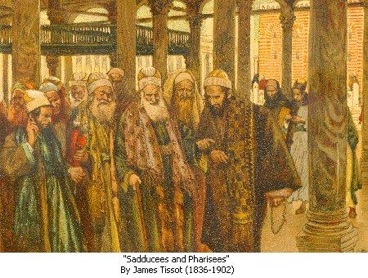
The Sadducees were priests who based their legitimacy on their descendance from Zadok, a priest who lived at the time of King David. It was the Zadokite line of priests that emigrated back to Jerusalem when Persians allowed the Israelites to return from captivity. They were intent on holding onto their power which came through the ministry of the temple. Like the Samaritans, the Sadducees regard only the writings of Moses to be scripture and they interpreted them very literally.

The corrupting influence of power caused them to cooperate with the Greeks when Israel became a client kingdom of the Greek empire. Although Pharisees were also in the Sanhedrin, the Sadducees became the prominent group controlling the Sanhedrin notably during the Greek and Roman occupation.

Because the Sadducees only included the books of Moses in the scripture, they did not develop any beliefs in the resurrection, which caused conflicts with both with Jesus and the Pharisees. The interactions that are recorded are all confrontational. There is an obvious tension between Jesus and the Sadducees. Jesus came to undergo death and resurrection and to eliminate the need for continual temple sacrifices, but the Sadducees did not believe in resurrection and their status was dependent on the continuation of the temple sacrifices. In contrast to the poor and needy ‘lost sheep of Israel,’ the Sadducees were the rich upper class. The Sadducees disappeared from history upon the destruction of the temple by the Romans in AD 70.

Observe

Read Matthew 16:5-11. What is the yeast of the Sadducees?

Sacrifice and death

Dancing in the Kingdom- Table of Contents

Dancing In the Kingdom – Part 1 – Shadows of the Kingdom – Chapter 6– A nation emerges

Sacrifice and death

[Bible references: Genesis 4:4; 8:20; 36-39; Leviticus 1-7; Psalm 51; Romans 12:1-2; Hebrews 7:27-28]

God also gave detailed instructions about how and when to conduct the rituals surrounding the tabernacle. Burnt offerings[1] had been offered before the tabernacle was built but now there were additional offerings to be made.[2] In the case of all the offerings, something had to die. The cost of sin was death, and it takes death to restore one’s relation with God. Moreover, the animals presented for sacrifice for the burnt offerings needed to be pure and without blemish or defect.

These “perfect” sacrifices were pointing to our ultimate need for a truly perfect sacrifice made on our behalf. The sacrifice would have to be more than an animal with no visible blemishes. The sacrifice would have to be made by a perfect human whose identity would gradually and prophetically be revealed … a new “Adam” who would succeed where the first Adam failed.

Sacrificial death, though, can take a different form than we expect. In Psalm 51, David declares,

“For you will not delight in sacrifice, or I would give it; you will not be pleased with a burnt offering. The sacrifices of God are a broken spirit; a broken and contrite heart, O God, you will not despise.” (Psalm 51:16-17 ESV)

and Micah declares.

“With what shall I come before the LORD, and bow myself before God on high? Shall I come before him with burnt offerings, with calves a year old? Will the LORD be pleased with thousands of rams, with ten thousands of rivers of oil? Shall I give my firstborn for my transgression, the fruit of my body for the sin of my soul?” He has told you, O man, what is good; and what does the LORD require of you but to do justice, and to love kindness, and to walk humbly with your God?” (Micah 6:6-8, ESV)

and later, the apostle Paul declares,

“I appeal to you therefore, brothers, by the mercies of God, to present your bodies as a living sacrifice, holy and acceptable to God, which is your spiritual worship. Do not be conformed to this world, but be transformed by the renewal of your mind, that by testing you may discern what is the will of God, what is good, acceptable, and perfect. (Romans 12:1-2, ESV)

I have been crucified with Christ. It is no longer I who live, but Christ who lives in me. And the life I now live in the flesh I live by faith in the Son of God, who loved me and gave himself for me. (Galatians 2:20, ESV)

These passages indicate a sacrifice of dying to oneself, of laying one’s own interests aside for the sake of another … for the sake of Christ. A sacrifice not made to “make things right” with God but rather a sacrifice made because things are right.


[1] Hal, Doulos. The Fire Sacrifices and Offerings of Israel – The Burnt Offering” Impact Bible.org blogs 4 Apr 2020 blogs.bible.org/the-five-fire-sacrifices-and-offerings-of-israel-the-burnt-offering. Burnt offerings are sometimes called whole offerings (because none of the offering is put aside for eating) or ascent offerings.

[2] Tam, Stephen, “The Five Offerings in the Old Testament” Moses Tabernacle 2003-2018 www3.telus.net/public/kstam/en/tabernacle/details/offerings.htm ; Bible.org “The Law of Burnt Offerings” Bible.org bible.org/seriespage/law-burnt-offerings-leviticus-11-17

Observe

Read Psalm 51; Romans 12:1-2. We do not have a temple to make animal sacrifices. What we do have is the opportunity to offer ourselves as a daily sacrifice. What is meant by a broken spirit?

A brief account

Dancing in the Kingdom- Table of Contents

Dancing In the Kingdom – Part 1 – Shadows of the Kingdom – Chapter 1 – Prelude

A brief account

[Bible references: Acts 17:22-31]

The following is an Extremely Brief Account of the Very Long Story.

There was, and is, and will be, a complex person we call God, who exists as three people that we have come to know as the Father, Son, and Holy Spirit. God decided that he wanted to expand the love that was shared between the Father, Son, and Holy Spirit. To that end, he created an entire universe so that on one of its planets he could create an abundance of living creatures.

On that planet, he created special creatures, humans, who were made in his image such that they could love him in the way that he loved them. This universe then, would be a form of temple, a place where God can meet with his people. The garden he placed them in was where the dimensions of heaven and earth overlapped. The garden was a place where God’s good and beautiful kingdom of heaven was fully present.

Of course, these humans were not duplicate spiritual beings who were gods themselves, but physical creatures who had enough of God’s characteristics so that they could love in the way God loved. But love is a voluntary thing that we must choose to do, we cannot love unless we have the option to not love.

God placed his first people in a garden and gave them an assignment. They were to be his representatives, priests if you will, in this garden. They were to take care of it as His representatives, His stewards in the garden. Their long-term task was to multiply and fill the earth so that the whole earth would become the place where God could meet with all his people. The entire earth was intended to be filled with God’s abundant provision for his people who would then take care of what God provided, and all the while giving and receiving and sharing the love which God would freely bestow. In this way, the kingdom of heaven would overlap with the entire kingdom of earth and God would freely mingle with his people.

The option to love or not love was provided by a test of trust. There was in the garden a tree whose fruit not only looked appealing but promised to provide the gift of all knowledge if one ate it. The humans were told to trust God and not eat the fruit of that tree. Eating that fruit would not only provide certain knowledge but would also provide death.

The results of that test are now apparent all around us. Death comes to us not only in the form of physical death, the separation of our souls from physical life, but also in the form of spiritual death, the lack of love which separates us from each other and from God. Fortunately, our current situation is not our destiny – and that is what the rest of the story is about.

God intended that death would not merely be a penalty for not trusting (or loving) but would also be the very mechanism by which he would restore us to himself. From the descendants of the first people, God separated out a family through which he would bring blessing to the entire world. Through that family that a nation would be raised and through that nation the eternal God would choose a family to accomplish the inconceivable. In that chosen family, the eternal God would cause himself to be conceived within the womb of a woman who would then give birth to a being who was both fully God and fully human. He would then be raised as a human and eventually would suffer death by execution as a human and then be resurrected as a human.

In that resurrected human body, the eternal God would return to heaven, but before doing so, he invited us, in essence, to represent Him on earth by becoming part of his body on earth. By trusting him and accepting his Spirit, we could join with him in His death and resurrection by dying to our own self-interests and uniting with his loving interests.

He then promised to return to us again in bodily form, at which time the kingdoms of heaven and earth will again overlap. Heaven will be rejoined to earth to fulfill the intention God had from the beginning. But meanwhile, in this time between His incarnation and His eventual return, we are still called to be stewards of our currently broken world, bringing slivers of the light and hope of heaven into a world now very dark with evil and suffering and pain.

Observe

Read Acts 17:22-31. How could we use Paul’s gospel message to people we speak to today?

Co-Sovereigns and Servants

Dancing in the Kingdom – Table of Contents

Part 1 – Shadows of the Kingdom, Chapter 3 – The Image-bearers

[Bible references: Genesis 1:26-28; Exodus 18:4; 19:6; Leviticus 26:17; Numbers 24:19; Deuteronomy 33:7, 26, 29; 1 Kings 4:24; Psalm 33:20, 115:9–11, 124:8, 146:5; Ezekiel 34:1-10; Matthew 3:16-17; 20:27-28; 23:11; Luke 22:26-27; Acts 2; 1 Corinthians 12:12-13; 1 Peter 2:9]

God is the master of all creation, yet he has given to us the responsibility to take care of the earth. It is out of that mastery that we have managed to use the resources of the earth to create all the technological advances that we have. Unfortunately, in many cases we have abused our abilities; abusing not just the resources of the earth but often abusing each other.

In our sinfulness, we typically appeal to our call to sovereignty while forgetting our call to service. This very issue Jesus took care to remind us of on many occasions. If we mistreat the earth that we are placed in or if we mistreat others, then we dishonor not only the one in whose image we are made but even the other image-bearers of God. In fact, it is out of our call to sovereignty and service that we are called to love, to willingly give of ourselves to the service of God just as God gave of himself to us.

It is under the constraint of God’s love that he tells us to “subdue” and “have dominion” over his creation. As God’s stewards, our sovereignty means we have the responsibility to maintain the good in God’s creation, to bring order to it and to help his creatures flourish and fill the earth.

There are two dimensions to our responsibility to subdue and have dominion.

When Genesis 1 was written, it was hard work to cultivate the rocky soil and people had little control of the elements; people were more powerless than powerful. In that context we see the forceful aspect of radah (ruling the earth) that is evident in other instances in the Bible when that word is used. That is one dimension of our responsibility.

But another dimension of our responsibility to have “dominion” is tempered by gentleness, such as when God spoke through Ezekiel’s to the “shepherds of Israel” and reprimanded them for using cruelty and violence and caring more about themselves than the people they were responsible for, serving themselves instead of the people.

In our service, we are dependent one another. We were not made to be self-sufficient; we not only need to have a relationship with God but also with each other. God allowed the first man to see that he needed another human before God presented the man with a woman to be his ‘ezer kegnedo. In Hebrew, ‘ezer is usually translated as “helper” or “deliverer” and is most often used to describe God delivering his people; kegnedo is usually translated as “in front of” or “opposite” or “parallel to”.[1]

Later on, in scripture we see that we are called to be a nation of priests and a body where all the different parts have a purpose as they work together. We are called not just to a restored relationship with the one who made us but are called together as a people to serve each other and to serve the world around us.


[1] Blue Letter Bible “ezer”; Bible Hub “Neged” biblehub.com/hebrew/5048.htm

Reflect

God provides the model of servant-leadership (see Chapter 2). What are some ways in which that should affect the way we take care of the earth and each other?

Observe

Read Mark 10:35-41. Think about how love relates both to sovereignty and service. What implications does that have for how we treat others?

A Brief Account

Dancing in the Kingdom – Table of Contents

Dancing In the Kingdom – Part 1 – Shadows of the Kingdom Chapter 1 – Prelude

A Brief Account

The following is an Extremely Brief Account of the Very Long Story, a summary of the Bible’s story.

There was, and is, and will be, a complex person we call God, who exists as three people that we have come to know as the Father, Son and Holy Spirit. God decided that he wanted to expand the love that was shared between the Father, Son and Holy Spirit. To that end, he created an entire universe so that on one of its planets he could create an abundance of living creatures.

On that planet, he created special creatures, humans, who were made in his image such that they could love him in the way that he loved them. This universe then, would be a form of temple, a place where God can meet with his people. The garden he placed them in was where the dimensions of heaven and earth overlapped. The garden was a place where God’s good and beautiful kingdom of heaven was fully present.

Of course, these humans were not duplicate spiritual beings who were gods themselves, but physical creatures who had enough of God’s characteristics so that they could love in the way God loved. But because love is a voluntary thing that we must choose to do, we cannot love unless we have the option to not love.

God placed his first people in a garden and gave them an assignment. They were to be his representatives, priests if you will, in this garden. They were to take care of it as His representatives, His stewards in the garden. Their long-term task was to multiply and fill the earth so that the whole earth would become the place where God could meet with all his people. The entire earth was intended to be filled with God’s abundant provision for his people who would then take care of what God provided, and all the while giving and receiving and sharing the love which God would freely bestow. In this way, the kingdom of heaven would overlap with the entire kingdom of earth and God would freely mingle with his people.

The option to love or not love was provided by a test of trust. There was in the garden a tree whose fruit not only looked appealing but promised to provide the gift of all knowledge if one ate it. The humans were told to trust God and not eat the fruit of that tree. Eating that fruit would not only provide certain knowledge but would also provide death.

The results of that test are now apparent all around us. Death comes to us not only in the form of physical death, the separation of our souls from physical life, but also in the form of spiritual death, the lack of love which separates us from each other and from God. Fortunately, our current situation is not our destiny – and that is what the rest of the story is about.

God intended that death would not merely be a penalty for not trusting (or loving) but would also be the very mechanism by which he would restore us to himself. From the descendants of the first people, God separated out a family through which he would bring blessing to the entire world. Through that family that a nation would be raised and through that nation the eternal God would choose a family to accomplish the inconceivable. In that chosen family, the eternal God would cause himself to be conceived within the womb of a woman who would then give birth to a being who was both fully God and fully human. He would then be raised as a human and eventually would suffer death by execution as a human and then be resurrected as a human.

In that resurrected human body, the eternal God would return to heaven, but before doing so, he invited us to, in essence, to represent Him on earth by becoming part of his body on earth. By trusting him and accepting his Spirit, we could join with him in His death and resurrection by dying to our own self-interests and uniting with his loving interests.

He then promised to return to us again in bodily form, at which time the kingdoms of heaven and earth will again overlap. Heaven will be rejoined to earth to fulfill the intention God had from the beginning. But meanwhile, in this time between His incarnation and His eventual return, we are still called to be stewards of our currently broken world, bringing slivers of the light and hope of heaven into a world now very dark with evil and suffering and pain.

Reflections

How do you feel in comparison to the immense size of the universe? What does it mean to you, that the universe was designed with you in mind?

Observe

Read Acts 2:22-36; 7:2-50; 10:34-43; 13:16-39; 17:22-31. These passages show the various ways the gospel was presented to various audiences. As you read through the different accounts of the gospel, what stands out to you?