Mystery of the church

Dancing in the Kingdom- Table of Contents

Dancing In the Kingdom – Part 2 – The Kingdom Revealed – Chapter 13 – Distinctives within the body of Christ

Mystery of the church

[Bible references: Acts 2:42-47; 1 Corinthians 12:17, 27; 2 Corinthians 5:20; 1 Peter 2:9]

What is the church?

As commonly used in current times, the “church” is a building to go to. In biblical terms it referred to an assembly of believers (called out ones).[1] How we understand this idea can influence our behavior. There are a few biblical metaphors that describe the church.

  • The body of Christ – This metaphor brings the ideas: that Christ is the head of the church, and we are His presence in the world, that each of us has a unique role in bringing Christ’s presence in the world. Our unique roles are distinguished by the spiritual gifts imparted to each of us to enable us to build each other in our faith.
  • A holy priesthood – This metaphor brings the idea that we have a relationship with God and can act as intermediaries.
  • A temple – This metaphor describes each individual as a stone in the temple and that it is all of us together who make up the temple, that is, the place where God resides on earth.
  • Ambassadors – This metaphor highlights our role in representing God’s to those not reconciled to God.

In the beginning, the organization of the church was not given in detail but seemed to be a cohesive group that “devoted themselves to the apostles’ teaching and to fellowship, to the breaking of bread and to prayer … had everything in common … broke bread in their homes and ate together with glad and sincere hearts.”

Is the church more than a Jewish sect?

[Bible references: Romans 11:17; Ephesians 3:6]

At first the church was mainly a Jewish sect. Jesus focused his ministry within the borders of Israel and his disciples were mainly Jewish. After Jesus died, that situation did not change much until Jesus took definitive steps with Peter and Paul to reach the non-Jews (Gentiles). Until that happened, the church mainly consisted of Jews who happened to also be believers, and as Jews, kept up many Jewish practices. But when Gentiles started to be included, there was the question of whether they needed to become Jewish to belong. It took a council of the church to determine that Gentiles were not bound by the Jewish practices. But even after that council, the debate persisted.[2]

In the Old Testament, we are told that Israel will be a blessing to the rest of the world, but it was not revealed just how that would happen. In Ephesians 3, the apostle Paul explains that “through the gospel the Gentiles are heirs together with Israel, members together of one body, and sharers together in the promise in Christ Jesus.” And then in Romans 11, Paul explains that the Gentiles were “grafted” into the family of believing Jews, of whom Abraham is the root, so that the Gentiles may receive all the same blessings.

What is the visible and invisible church?

The invisible church consists of all those, past, present, and future, who have put their trust in Christ. Only God knows who they all are. The visible church is the groups of people gathered together as communities. Both believers and unbelievers may be in the visible church.

Some congregations/ denominations are very strict about how to interpret scripture and/or have a limited view of forgiveness, and so would put limits on who they would consider to be in the church.[3] Other congregations/denominations have an extreme view that all of society should be under Christian rule[4] and then misused Luke 14:23, “Go out into the highways and hedges and compel them to come in,” that they would even resort to torture in order to persuade a people to make a “confession of faith.” Then there are those who think that everyone will ultimately be saved.[5]

Who has authority in the church?

As the church grew and spread throughout the Roman Empire, the natural development was to “institutionalize” the church, trying to make the church more effective with more formal organization. While the apostles were still alive, it was possible to unify the church around the apostles, but of course that was temporary.

Over time, different governance models emerged within the church as there was no model within the church except for the synagogue. In the episcopal model, there is a single leader, or bishop, who oversees a group of congregations and selects the pastors for each congregation. In the presbyterian model, there is a “plurality” of elders, who oversee a congregation or a group of congregations – the congregation may elect their pastor, but the Presbytery has to approve whoever is selected. In the congregational model, the congregation itself is its ultimate overseer and selects its pastor.

Some congregations are independent from one another, and some are affiliated with other congregations. The affiliation may be a denomination where there is strong oversight by the denomination over the individual congregations, but some affiliations are mainly an association for the purpose of sharing resources, but the association has no oversight function.

Some congregations emphasize the importance of maintaining apostolic authority by maintaining the transfer of authority of the apostles and trace the leadership of the church from one generation to the next beginning with the apostles.[6] The Roman Catholic denomination further emphasizes their authority is transferred from the apostle Peter, whom they think was given the most authority from Jesus. Other denominations will maintain that they are apostolic because of their faithfulness to scripture and therefore to the apostolic teachings.

One issue related to authority within the church is related to gender roles. Due to apparent conflicts in some Bible passages, two main views have emerged regarding the role of women in the church On one side, there is no restriction of ministry roles because of gender, but on the other side, women are restricted from any role in which they have spiritual authority over men.

What is the role of elder, bishop, deacon, priest?

The New Testament doesn’t clearly specify how to organize a congregation and that has resulted in congregations organizing themselves in a variety of ways. The New Testament does show examples of elders (aka bishops) serving as spiritual leaders of a congregation and deacons serving the physical needs of the congregation. Priests, in the Old Testament performed duties for God on behalf of the other people. The New Testament talks about Christ being the high priest for all of us but then talks about all Christians as being priests since we all have direct access to God and our role as Christians is to present ourselves as a living sacrifice to God.

The first denominations that emerged did keep the title of a priest, no longer offering the Old Testament sacrifices but rather now sharing the sacrament of the Last Supper. The Orthodox and Catholic traditions consider the bishops who oversee the priests to be the elders of the denomination. The priests are chosen to serve the sacraments, although they also serve in other ways with deacons helping the priests in carrying out the liturgy in the worship service or serving in other ways as well. In this context, the spiritual leadership of bishops or priests is recognized by the use of honorific titles such as Reverend or Father.

Protestant traditions vary. Anglican and Episcopal congregations retain the title of priest, while in other Protestant traditions congregations are led by pastors or elders.[7]

In some congregations, the pastor is considered to be the elder and the lay leaders are considered to be deacons. In other congregations the pastor is considered to be a teaching elder (if that title is used) while the lay leaders are considered to be ruling elders, or just elders. Some congregations are governed primarily by the pastor, some by a group (plurality) of elders, and some by the congregation itself.

What is the function of a creed?

As explained at the beginning of this chapter, there is much of God that is beyond comprehension. So, when God revealed himself through the prophets, the revelations were more in the form of stories and the interactions of God with the world than a spelled-out theology. That type of revelation requires us to do some of amount of interpretation as we try to better understand God, and that process of interpretation has been the function of the church at large. However, some individuals in the church came up with teachings that seemed to be more than minor differences and actually opposed the more accepted teachings of the church. Those ideas were considered to be heretical. Over time, to combat the heresies that arose, the church developed abbreviated teachings of the church called creeds.

As conflicts within the church developed, different sets of creeds started to emerge. The Protestant section of the church caused even more divergence with the creation of more detailed creedal statements called “confessions of faith,” while other congregations claimed to be non-creedal, stating that the Bible as a whole was their creed because creedal statements are limited and could never present a comprehensive theology of the church.

How can broken people within broken congregations can be instruments of God?

[Bible references: Romans 7:7-25; 1 Timothy 5:10; 2 Timothy 2:21; 3:17; Ephesians 2:10; Colossians 1:10; Hebrews 13:21]

In this time between the Kingdom has come and is yet to come in full, even those of us who trust in Christ have wills that are internally divided between the desire to do good and the desire to do evil. Despite our brokenness, God still desires to use us to accomplish His will on earth. He did not remove the mandates given to us back in Genesis. We may be broken instruments, but God knows how to use broken instruments.

Is the church an Organism or an Organization?

[Bible references: Matthew 28:16-20; 1 Timothy 3:1-6; Titus 1:6-9; 1 Peter 5:1-3]

When Jesus gave the command to “go into all the world” he didn’t specify how to do it, particularly how they should organize themselves to do it. They were to be his body, that is, his hands, feet, legs, eyes, ears, etc. on the earth to continue to do what he had begun. He left no instructions that we know of on how to organize themselves to complete the mission.

The apostles did have the model of synagogue that they could refer to.[8] The first people they reached out to were already in synagogues. But the Bible makes no specific mention of them using that model to organize themselves. In the apostles’ letters to churches and individuals that we have preserved in the Bible, there are some details from which various organizational models have been proposed, ranging from congregation choosing their own leaders to leaders over the congregations choosing leaders for each congregation.

What the Bible is clear on, is the qualifications for those who would lead the church. Some of those qualifications are to be blameless, even tempered, hospitable, to love what is good, to be disciplined, and to encourage others with sound doctrine. The biblical focus seems not to be on how leaders organize their congregations but on the qualifications that those leaders should have.


[1] Biblehub. “1577. Ekklesia” Bible Hub biblehub.com/Greek/1577.htm

[2] Marcos, Juan. Gutierrez, Bejarano. “The Judaisms of Jesus’ Followers” (Chapter 10, The Church Fathers and Jesus Oriented Judaisms) Yaron Publishing, 2017. Nazarenes held orthodox beliefs except in their adherence to Jewish law. Not deemed heretical until the fourth century. Ebionites, possibly a splinter group from the Nazarenes held that circumcision is necessary for salvation.

[3] This “rigorist” viewpoint was held by various people such as the “Novationists” (third century) and “Donatists” (fourth century).

[4] This idea is known as Christendom. Mere Orthodoxy mereorthodoxy.com/christendom-1200-words-give-take/

[5] Encyclopedia Britannica, “Universalism” Encyclopedia Britannia www.britannica.com/place/Universalism

[6] Encyclopedia Britannia “Apostolic succession” Encyclopedia Britannia www.britannica.com/topic/apostolic-succession

[7] Whitaker, Alexander. “The Protestant Problem with Priesthood” The North American Anglican 8 June 2020 northamanglican.com/the-protestant-problem-with-priesthood; Patheos “Leadership”

[8] Burtchaell, James Tunstead. “From Synagogue to Church: Public Services and Offices in the Earliest Christian Communities” Cambridge University Press 1992 (pp.349-352)

Reflect

The quality of church governance is more dependent on the quality of the leaders than the type of governance structure. What qualities do you think church leaders should have?

Observe

Read 1 Corinthians 12:17, 27; 2 Corinthians 5:20; 1 Peter 2:9. How does the different metaphors for the church help you to understand the church?
Essenes

Dancing in the Kingdom- Table of Contents

Dancing In the Kingdom – Part 2 – The Kingdom Revealed– Chapter 10 – The Class of Apparitions

Essenes

[Bible references: Leviticus 11; 15:31; Ezra 10:11]

And when they prepare the table to dine or the new wine for drinking, the priest shall stretch out his hand as the first to bless the first fruits of the bread {or the new wine for drinking, the priest shall stretch out his hand as the first to bless the first fruits of the bread} and of the new wine. [1]

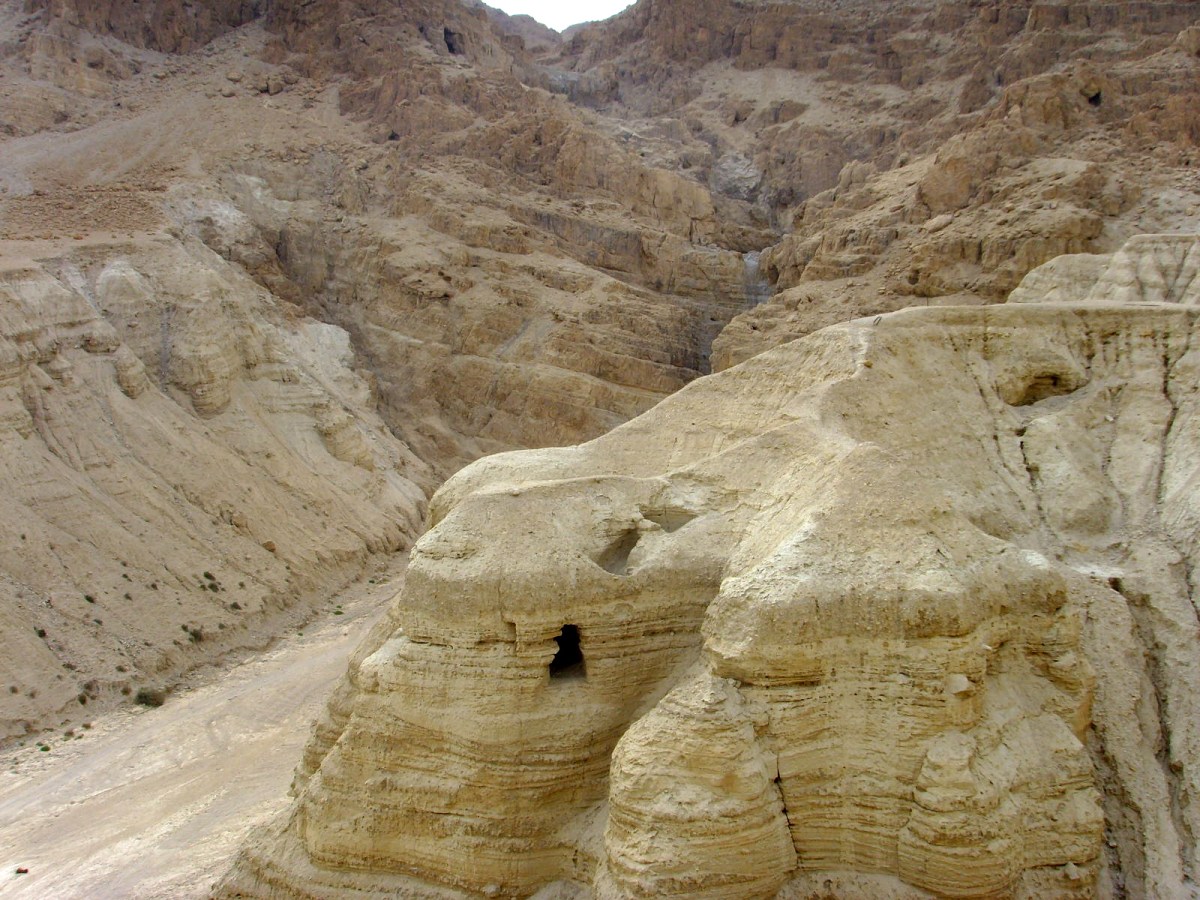
The origin of the Essenes[2] is somewhat mysterious and was largely unknown until the discovery of the Dead Sea Scrolls[3]. The Essenes were a sect that isolated themselves in the desert and maintained minimal contact with outsiders. They are possibly an offshoot of the “Hasideans” (aka “the pious ones”), mentioned in 1 Maccabees. They considered the temple and its practices to be corrupted and considered themselves to be the ‘chosen ones’ who would be saved at the end times. They lived communally and celibately and had a 3-year probationary process before accepting new members. There are unproven speculations that John the Baptist and Jesus were affiliated with the Essenes.

Although there is no direct evidence of Jesus interacting with the Essenes, the criticisms that Jesus raised against the Pharisees were similar to the criticisms that the Essenes had. Later on, as we examine the practices of the early church, we will also see parallels to the Essenes. Jesus’ followers and the Essenes anticipated an eschatological restoration of Israel, and both groups also believed in the necessity of national purification.


[1]  Martinez, Florentino Garcia. “The Dead Sea Scrolls Translated,” Community Rule 1QS Column 6:4-6 (p79)

[2] Riches, John. “The World of Jesus: First Century Judaism in Crisis,” Cambridge University Press, 1990; Gutierrez, Juan Marcos Bejarano. “The Judaisms of Jesus’ Followers” Yaron Publishing, 2017; Gutierrez, Juan Marcos Bejarano. “Forgotten Origins” Yaron Publishing, 2017; Crossan, John Dominic. “The Birth of Christianity” HarperSanFrancisco 1999; NIV Cultural Backgrounds Study Bible, Zondervan 2016 Kindle book (locations 214907, 22713); NIV First-Century Study Bible, Biblica 1973 Kindle book (Location: 91578)

[3][3] The Dead Sea Scrolls are considered by many to be the most significant archaeological find of the 20th century. From 1947 to 1956, thousands of scroll fragments were uncovered from the caves near Qumran, located on the northwestern shore of the Dead Sea. (Biblical Archaeology Society, “What are the Dead Sea Scrolls”  www.biblicalarchaeology.org/daily/biblical-artifacts/dead-sea-scrolls/what_are_the_dead_sea_scrolls.

Observe

Read Leviticus 11; 15:31; Ezra 10:11. The Israelites could not follow all the laws concerning cleanliness without keeping some degree of separation from cultures around them. But it seems that the Israelites kept getting drawn away from following Yahweh. What temptations draw Christians away from following Yahweh?

A set-apart people

Dancing in the Kingdom- Table of Contents

Dancing In the Kingdom – Part 1 – Shadows of the Kingdom – Chapter 6– A nation emerges

A set-apart people

[Bible references: Exodus 23; Leviticus 11, 17; Deuteronomy 14; Hebrews 4:1-13; 10:24-25]

What does it mean to be created in the image of a holy God? What do we mean when we say, “God is holy?” We first encounter the term in Genesis 2:3 when God indicates that the seventh day will be made holy, the seventh day was to be set apart from the other days. When Moses encountered God’s presence in a burning bush, Moses was told to remove his sandals because the ground was holy. It was also God’s intention to make Israel a holy nation, set apart from other nations and through which all the nations on earth would be blessed.

There were a couple of ways in which the nation of Israel would be greatly distinguished from the nations around them, the food, and the calendar. There were some restrictions on the food they could eat (such as certain meats, fish, birds, and insects) and how they had to prepare their food that would have prevented them from intermingling with the peoples around them. But the calendar provides an even more distinguishing difference. While some cultures had recognized a seven-day calendar, it was the Israelites who set aside the seventh day of the week as a Sabbath on which no work was supposed be done. But that is not the only distinguishing characteristic of the calendar.

In the present day we have a universal calendar, and we prioritize journalistic chronology. That is, we remember historical events on the particular day that the events happened according to our calendar. For us, it is important for us to track events in the chronological order in which they happened. However, there are a few exceptions that we should note. Sometimes we don’t set aside remembrance days according to the actual date of the event but rather according to other values – for instance, we always celebrate days such as Martin Luther King’s birthday, not on his actual birth date, but always on a Monday because of our priority for extended weekends.

For the Israelite calendar, the priority was not chronology but liturgy. The remembrance days for events were not set according to the actual historical date on which they occurred but were set according to the liturgical calendar. This practice become clear when you trace out the timing of events in the Pentateuch (first five books of the Hebrew Bible) and compare them to the remembrance dates. It was more important to have events in the context of God’s activity rather than the contexts of the events themselves.

This concept provides the background for celebration of the Sabbath. The Sabbath was such an important concept for the Jews, that the account of creation in Genesis 1 was used to present the concept of Sabbath.[1] When we think about God’s creating activities, God did not need six days to carry out creation, nor did he need to stop working. So why do set up the remembrance of God’s creation in a seven-day timeframe? Once again, the important point is not the chronology but the liturgy.

The important point about the creation event was not the event itself, but what it was for. The purpose of creation was to create a “temple,” a place where God could be with his people. That’s the main point. “Resting” on the seventh day is not about “not working,” because God has not stopped doing things. The point of “resting” is to focus on doing what the temple was all about, which is to be with His people. For us to practice the Sabbath, the point is to be with God and join him in his creative work in the universe – the point is to be with God. When you look at Genesis 1-2, you will notice that the first six days have a defined beginning and end, an evening, and a morning. The seventh day, however, does not have a defined beginning and ending – that implies that we are in the seventh day. This “day,” or age, that we are in, is the “day” that we “rest” with God. It was intended at the beginning that all our activities done with, “at rest with,” God.

This brings us to a second distinguishing characteristic of the Jewish Biblical calendar: the first month was during the spring equinox, harvesting time, whereas in the surrounding cultures the first month of the calendar was set in the fall equinox, crop planting time. The difference in meaning was that since Israel’s year started with God’s work, the year begins God’s provision of the harvest which fed the nation and provided seed for the fall. This contrasted to the surrounding cultures which began their calendar with their work, so their year began with their work that provided for the next harvest.[2]

What can be confusing is that in current practice, Jews do not use the biblical (or liturgical) calendar but the civil calendar which places the first month in the fall instead of the spring. Christians do have an equivalent practice: our civil calendar begins in January, which was set by the Roman government and coincided with Roman elections whereas some in the Christian community observe a liturgical calendar which begins in the fall with the season of Advent.

The liturgical focus of the calendar with its de-emphasis of the chronology of historical events helps explain some interesting discontinuities and apparent conflicts in the Biblical text. If we allow the events described in Exodus to be interpreted liturgically instead of chronologically, we can make better sense of the flow of Exodus.

One of the “apparent conflicts” occurs in Exodus 19 when the Israelites arrived at Mount Sinai. At the beginning of the chapter, Yahweh made a covenant similar to the one with Abraham and declared that they were to be a “kingdom of priests,” and that all the Israelites were to prepare to go up the mountain after the sounding of the ram’s horn. And yet, at the end of the same chapter, Yahweh told Moses to not let the people, except thepeople designated to be priests, to go up the mountain. By noticing such apparent conflicts, we can better chronologically rearrange the events in Exodus so that they make better sense to chronologically minded folks such as we are.

A possible chronological arrangement of events looks like:[3]

  • The initial, Abrahamic-like covenant was given (including building earthen altars) followed by the Decalogue (10 Commandments).
  • The golden calf incident occurred.
  • There was a covenant renewal.
  • The code for priests was given along with instructions for building a tabernacle.
  • Another incident with idols, this time goats, was documented.
  • A Holiness code was given to the people.
  • The covenant is renewed again.

While the rearrangement may help us who are chronologically minded make better sense of the text, in the end we are left with Israel now being a nation with priests and the community centering its worship around a large tent called the Tabernacle. The liturgical intent of the text as it is written, is to focus on the immediate outcome, that Israel will be a nation under the Mosaic covenant, a nation with priests serving a holy God who may reside among them but who is not directly accessible. This is the necessary outcome until the Redeemer comes. The obscured intent was that Israel was meant to be a nation under the Abrahamic covenant, a nation of priests of faith, but now a nation that could not materialize until after the Redeemer comes. That is the present intent of the Christian community, by recognizing Jesus as our  Redeemer we can be a “nation” of priests serving a holy God who resides among us.

Worship at the tabernacle was a community event. No one could do this by themselves. Different people were assigned to different tasks, which not only included direct involvement in worship but also in the care of the tabernacle and its furnishings. Even one’s individual sins required the use of priest to handle the sacrifice. Before the tabernacle, offerings could be made by anyone, but with the tabernacle, only designated priests could perform the sacrificial offerings.

This arrangement continues the pattern of representing the holiness of God in creation. God’s image-bearing creatures are set aside from all other creatures; Sinful humans are separated from the Garden of Eden; Noah and his family are set aside in the ark from all other people; Abraham is set aside from all other people to usher in the blessing of all people; Moses is set apart from the other Israelites to see God face-to-face; the Levites are the tribe set apart from the other tribes to manage the care of the tabernacle; the priests are set apart from the other Levites to carry out the rituals in the tabernacle; the Sabbath is set apart from all the other days as a reminder of God’s provision– and the list goes on.


[1] LeFebvre, Michael. “The Liturgy of Creation: Understanding Calendars in Old Testament Context” Intervarsity Press 2019

[2] LeFebvre, Michael. “The Liturgy of Creation: Understanding Calendars in Old Testament Context” Intervarsity Press 2019

[3] Sailhammer, John. “Introduction to Old Testament Theology” (Appendix B) Random Publishing Theology 1995

Reflect

What does it mean that we are created in the image of a holy God?

Observe

Read Exodus 23:10-13. What is the purpose of the Sabbath observance?

Overview of the Gospels

Dancing in the Kingdom- Table of Contents

Dancing In the Kingdom – Part 1 – Shadows of the Kingdom – Chapter 1 – Prelude

Overview of the Gospels

[Bible references: Matthew, Mark, Luke, John]

The New Testament begins with a set of four biographies about Jesus. They are referred to as the Gospels of Matthew, Mark, Luke and John. It is possible to think about the Old Testament as the inspired introduction to the New Testament, foretelling of the Person, work and kingdom of Christ. Old Testament quotes, allusions, and types are woven into the Gospels.

Christ is presented as king (who rules over all things), prophet (who represents God to the church) and priest (who intercedes for the church).  All the gospels record: the unique revelation of Christ, the ministry of John the Baptist, the feeding of the 5,000, Christ’s offer of Himself as King, the betrayal by Judas; the denial by Peter, the trial and crucifixion and bodily resurrection of Christ, events during the forty days of the post-resurrection ministry of Christ, the hope of His second coming.

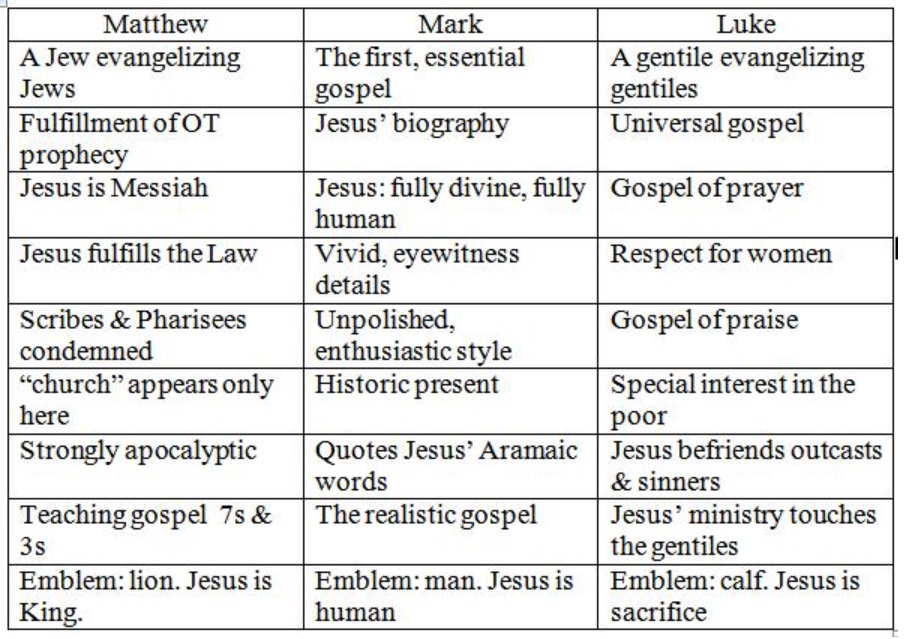
The following table shows how the Gospels tell the story of Jesus from different perspectives, each focusing on different perspectives of Jesus’ life, and each trying to give a different message about the life of Jesus.

Comparison of Gospels
 MatthewMarkLukeJohn
Portrait of JesusKingServantTeacherSon of God
Original readersJewsRomansGreekschurch
Key phrasesKingdom of heaven, fulfilledKingdom of God, Immediately, nowKingdom of God, Son of manBelieve, Word of God, only begotten Son, eternal life
FocusJesus is the Messianic King of the promised Davidic kingdom which fulfills the Old Testament prophecies and claimsJesus is the authoritative Son of God. He is God’s triumphant envoy come to suffer and die in order to claim victory over sin and deathJesus is the perfect Son of Man, the Messiah prophesied by the prophets who came to save and to minister of people of all nations through the power of God the Holy SpiritJesus Christ is the fully divine Son of God who existed before creation. He is the true Lamb of sacrifice through whom we receive the gift of eternal life
Prominent sectionssermonsmiraclesparablesteachings
Genealogytraced to Abrahamnonetraced to Adamnone
Geographic emphasisGalileeGalileeGalileeJudea
Comparison of the Gospels

Observe

Read the chart above. Which gospel is centered in Judea?

Earthly kings and the rejection of God as king

Dancing in the Kingdom- Table of Contents

Dancing In the Kingdom – Part 1 – Shadows of the Kingdom – Chapter 1 – Prelude

Earthly kings and the rejection of God as king

[Bible references:1 and 2 Samuel, 1 and 2 Kings; 1 and 2 Chronicles]               

The last of judges was Samuel, who also functioned as a priest. By this point in time, Israel was convinced that their continuing problems were, of course, not themselves. They thought that their problem was that they didn’t have a king like everyone else. Actually, God was their king and Samuel was His representative. But the Israelites were not satisfied with God choosing prophets who would speak for Him. So, God gave them a king, like everyone else, Saul. While it did not take Saul a long time to turn from God so completely that God rejected him, Saul was able to reign for 40 years. David, who was described as someone after God’s own heart, replaced Saul. David expanded the kingdom from the Orontes River in the north to the Sinai peninsula in the south.[1] Solomon, building off of David’s legacy, did not focus on expanding the kingdom as much as building its wealth. Solomon’s wealth increased not only in riches of gold and silver, but also in wives and concubines. His love towards his wives and concubines overrode his love for God, so at Solomon’s death, the kingdom split in two parts.

Ten tribes who rebelled against Solomon’s son, aligned with the northern kingdom, which became named Israel.  Of the other 2 tribes, the tribe of Judah was most prominent. Both kingdoms were eventually conquered by neighboring empires: the northern kingdom by Assyria and the southern kingdom by Babylon.


[1] Archaeologists have had difficulty locating evidence of the kingdoms of David and Solomon. That is due, in part, to the Israelites tendency to adopt the customs of the Palestinian nations, making their artifacts indistinguishable from the nations they displaced.

Reflect

From what we see in the world around us, how often do people take responsibility for their own problems?

Observe

Read 1 Samuel 15:15. What’s the clue that Saul was no longer following God?

Living Temples

Dancing in the Kingdom – Table of Contents

Part 1 – Shadows of the Kingdom, Chapter 3 – The Image-bearers

[Bible references: Genesis 3:6; Isaiah 54:10; Jeremiah 29:1-23; John 2:19-21; 1 Corinthians 3:16; 6:19-20; 2 Corinthians 6:16; Ephesians 2:21; Revelations 15:8; 21:22]

Although God’s first image-bearers had close, unhindered, intimate contact with their Creator, there was enough space given them to think freely, as if they were not being watched all the time. It was in this space that they – and we – were given several mandates: procreation (be fruitful and multiply), stewardship (subdue the earth and have dominion over its creatures), and a cultural mandate (work it and take care of it).[1] We were given the assignment to be fruitful, to fill all the earth, discover its possibilities and care for the world in the same way that God would care for the world.[2] Just as God continues to create more living things and sustain all that he has created, we as his co-regents[3], can join him in sustaining and creating those things entrusted to our care.

  “There are two ways in which God imposes his law on the cosmos, two ways in which his will is done on earth as in heaven. He does it either directly, without mediation, or indirectly, through the involvement of human responsibility. Just as a human sovereign does certain things himself, but gives orders to his subordinates for other things, so with God himself. He put the planets in their orbits, bits, makes the seasons come and go at the proper time, makes seeds grow and animals reproduce, but entrusts to mankind the tasks of making tools, doing justice, producing art, and pursuing scholarship. In other words, God’s rule of law is immediate in the nonhuman realm but mediate in culture and society. In the human realm men and women become coworkers with God; as creatures made in God’s image they too have a kind of lordship over the earth, are God’s viceroys in creation.” [4]

We were also given the responsibility to subdue the earth and have dominion over its creatures. When there is resistance, we still have the responsibility to bring the rule of God to the world. Then we are given the responsibility to work and take care of the earth, this will expand from taking care of the garden to taking care of all of God’s creations. Implied in all these things is that we should do everything in context of God’s love, to care for each other and to care for the earth and its creatures with the mind of the God who created us for love.

The work that we were designed to do was more than just tending the garden. In Genesis 2:15, we were given a mandate to “work” and “take care of” the garden God had created. These tasks in light of Ancient Near East culture, were more of a priestly nature, taking care of this temple where we reside with God.

“The verbs ʿbd and šmr (NIV: “work” and “take care of”) are terms most frequently encountered in discussions of human service to God rather than descriptions of agricultural tasks… ‘bd can refer to … work connected with one’s vocation, to religious service deemed worship … šmr is used in the contexts of the Levitical responsibility of guarding sacred space, as well as in the sense of observing religious commands and responsibilities … it is likely that the tasks given to Adam are of a priestly nature: caring for sacred space. In ancient thinking, caring for sacred space was a way of upholding creation.”[5]

We were to take care of this place which was designed to be a “very good” place for us to flourish in, creating whatever structures we needed to “increase in number, fill the earth and subdue it.” This task, this mandate, meant that we would eventually go beyond the capacity of gardening and create not just a bigger garden but cities, a flourishing civilization as pictured in Revelation 21 and 22.[6]

When examined closely, we can see the breadth of what was committed to Adam and Eve. Subduing the earth would entail many physical, social, and intellectual activities. In the gardening we can see cultivation and farming; in taking care of the animals, we can see shepherding and domestication; in the naming of the animals, we can see a cultural and scientific activity which required understanding the nature and attributes of the animals and establishing authority over them. We can see that God had created things to be beautiful and as his image-bearers we would be expected to also create beautiful things.

In the new earth, nature’s comeliness will reach its pinnacle; the wilderness itself will burst into blossom, and streams will gush in the desert (Is 35). To complement all this natural beauty, human culture will flourish. All the great creativity of humankind-artistry in music, dance, painting, woodcrafts, sculpture, architecture and more-will be brought into the New Jerusalem (Is 60).[7]

There is a sense in which we, as members of the Kingdom of God, now seem to be living in a foreign land. This puts us in a similar position as the Israelites were when they were taken in exile into Babylonia. During their stay in Babylonia, God’s instructions were to settle down, build houses, get married, have children and to seek the prosperity of the city they were sent to, for “if it prospers, you too will prosper.”

But above all these things we can do, we should not lose focus on who we are. We are creatures designed by God to be like God to be in relationship with Him, the God who is a community in Himself: Father, Son, and Holy Spirit. Everything we do should be done in context of who we are. We should remember that we were designed to be human “beings,” not human “doings.” This viewpoint become clear when we compare the Biblical view of creation to the view of other Ancient Near East cultures. For the surrounding cultures humans beings were created to feed the gods and serve the gods who created them, whereas the Biblical viewpoint sees God being the provider for the people.[8]

Originally, we see Creation designed as a temple, a place for us to “be” with God. Later on, Jesus refers to himself as the temple, a human in whom God resides. Later on, Paul declares that our own bodies are a temple of the Holy Spirit. So here again, we see the mystery of perichoresis, where we are distinct from the Holy Spirit, yet the Holy Spirit becomes a part of who we are. In this we see the mystery of perichoresis unifying the persons within God, unifying the body, soul and spirit within humans, and unifying God and humans.


[1] Jacobsen, Eric O. The Space Between: A Christian Engagement with the Built Environment, Baker Academic, 2012, Page 20.

[2] Crouch, Andy. “What is the Cultural Mandate,” The Village Church, 6 Jan 2017 http://www.tvcresources.net/resource-library/talks/what-is-the-cultural-mandate

[3] Walton, John H. “The Lost World of Adam and Eve: Genesis 2-3 and the Human Origins Debate (Proposition 4) InterVarsity Press. 2015 Kindle Edition.

[4] Albert M. Wolters. Creation Regained: Biblical Basics for a Reformational Worldview (Locations 203-208) Wm. B. Eerdmans Publishing Co. 2005 Kindle Edition.

[5] Walton, John H. The Lost World of Adam and Eve: Genesis 2-3 and the Human Origins Debate (p. 105-106). InterVarsity Press. 2015 Kindle Edition.

[6] Busenitz, Nathan. “The New Jerusalem” Cripplegate, 8 April 2017 thecripplegate.com/the-new-jerusalem-2/

[7] Sherman, Amy L. Kingdom Calling: Vocational Stewardship for the Common Good. Intervarsity Press, 2011 eBook location 291

[8] Walton, John. “The Lost World of Adam and Eve,” I “Proposition 12: Adam is Assigned as Priest in Sacred Space, with Eve to Help” (p.104) InterVarsity Press. 2015 Kindle Edition.

Reflect

If the universe is God’s temple and we are now living in the 7th day, that is, the Sabbath, how are we supposed to live?

Observe

Read Genesis 1; 1 Corinthians 3:16; 6:19-20; 2 Corinthians 6:16. What difference does it make if the universe is God’s temple or that our bodies are God’s temple?