Discipline of Distress

Dancing in the Kingdom- Table of Contents

Dancing In the Kingdom – Part 3 – Dancing in the Kingdom– Chapter 15 – Reforming our Souls

Discipline of Distress[1]

[Bible references: Psalm 11:1-7; 24:1-10; Acts 4:23-31]

“Whenever you are in a time of stress, you should go to the Psalms. They have a medicine for everything, they depict every situation that a human being can be in, and they’ve addressed every emotion you could ever have. They also tell you how to process that emotion or about that situation before God.” [2]

Often in times of difficulty we are prone to turn our focus on whatever it is that is bothering us. This spiritual discipline, sometimes known as “don’t waste an illness,” helps us to confront what has caused us distress, and then to use our distress as an opportunity to lean more fully on God. Instead of being preoccupied by a difficulty we can learn to become occupied with the presence of God.

There are three ways distress can affect us.

  • Distress tends to cause us to focus on the problem in front of us. Like Peter, when He saw Jesus walk on the water, tried to also walk on the water but he became distracted by the winds and waves and lost his focus on Jesus.
  • At other times, distress can make us lean into whatever means of control we have, but again, we focus on the means of control that are right in front of us, forgetting that we are not the ones really in control.
  • Also, as part of needing to control our circumstances, we may avoid acknowledging our suffering or our fears instead of being honest about them to God, which will allow those things to control us later.

When we are confronted by things that cause us distress, we can train ourselves to focus more on God than the situation immediately in front of us, to remember that the Lord is on the throne, that He knows our situation, that He is in control, and that He knows our fears and concerns, that He has a plan. In the future, we may be able to look back like Peter and Joseph and see God’s hand at work in times of distress.[3]

In difficult times, worrying may indicate that we are thinking that we know more than God about how things should be working, and we are worrying that He is not going to get it right. In fact, God may also be testing us, to help us come to grips with what is in our heart, to better understand ourselves, to grow in the faith and to examine our priorities.


[1] Keller, Tim. “Disciplines of Distress” Redeemer City to City 26 Mar 2020 redeemercitytocity.com/articles-stories/tim-keller-disciplines-of-distress

[2] Keller, Tim. “Disciplines of Distress” Redeemer City to City 26 Mar 2020 redeemercitytocity.com/articles-stories/tim-keller-disciplines-of-distress

[3] Peter is remembering that Herod, Pontius Pilate, the Gentiles, and Israelites were anointed to do what God had already predestined them to do. Gen 5:20, Joseph is telling his brothers that the very things that they had intended to do evil, God was going to use it for the good.

Observe

Read Psalm 11:1-7; 24:1-10; Acts 4:23-31. In these passages, what did the people concentrate on in their distress?
The Tabernacle and the Temple

Dancing in the Kingdom- Table of Contents

Dancing In the Kingdom – Part 1 – Shadows of the Kingdom – Chapter 9 – The Prophets and writings

The Tabernacle and the Temple

[Bible references: I Kings 6-8; 7:13-51; 1 Chronicles 6:31-32; 2 Chronicles 6:18; Amos 9:11-15; Acts 15:1-21]

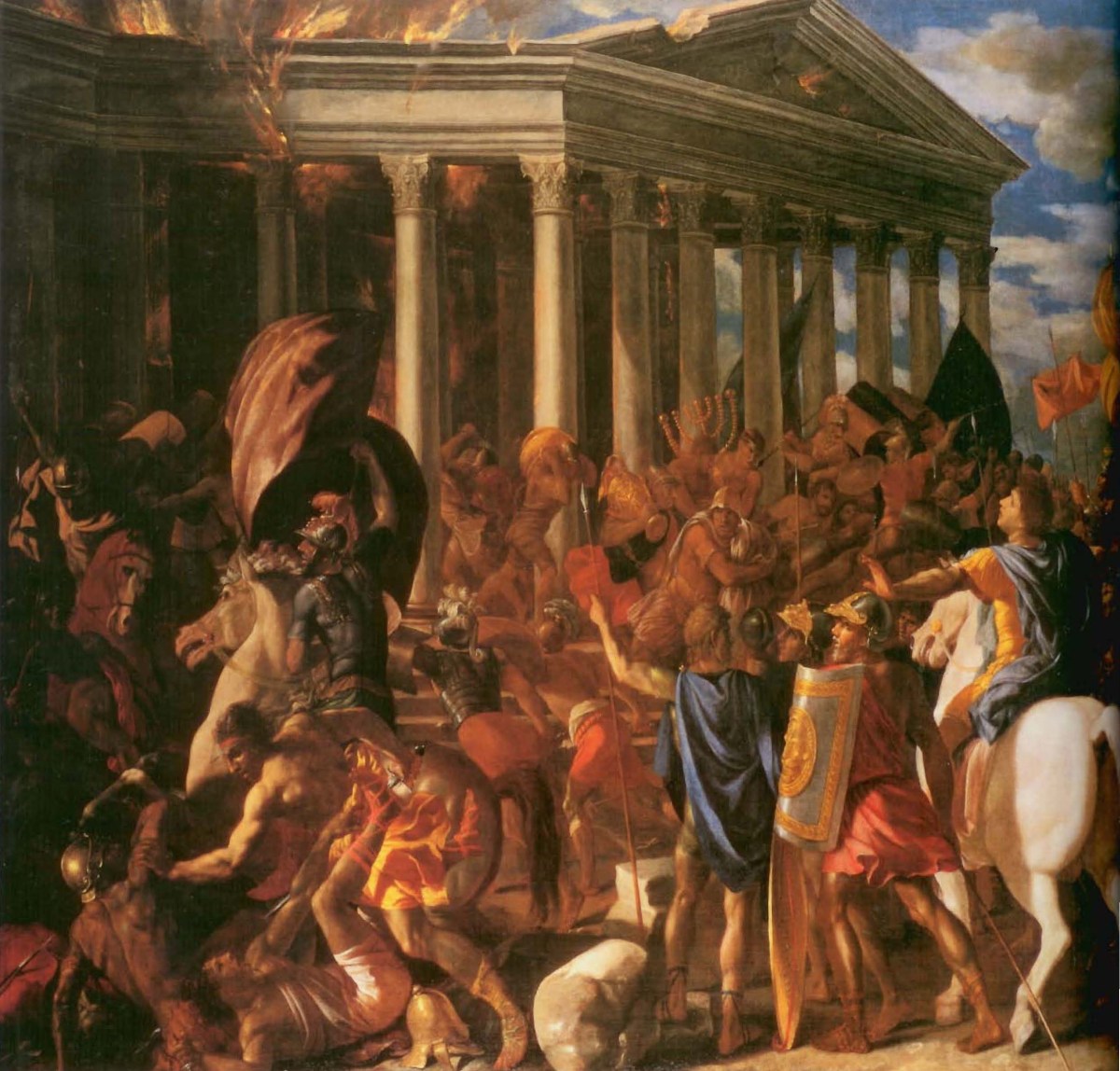
During the time of Solomon, the temple was built to replace the tabernacle. All the furnishings except the ark itself were built by a foreigner named Hiram from Tyre. The original furnishings of the tabernacle were probably put into storage in the temple. Although the temple was much more grandiose than the tabernacle, Solomon recognized that it still could not hold God. Solomon’s temple was eventually destroyed by the Babylonians.[1]

The interesting thing with this history is that during the time of King David all the rituals of Moses were carried out at the tabernacle in Gibeon where there was no ark (and therefore no “presence of God”), while the ark itself, with the presence of God, was in Jerusalem where there was a service of joy, dancing and singing instead of the ritual sacrifices. Also, the ark was no longer concealed in the Holy of Holies where there was limited access, it was now in a place where everyone could access it.

This brings us to the prophet Amos who prophesied that God was going to destroy most of Israel, except for a remnant, but that David’s tabernacle will be restored – not the one at Gibeon, not the temple Solomon built, but David’s tabernacle. This scripture passage in the Old Testament was quoted in Acts 15 where it was determined that Amos was referring to Gentiles now being accepted into the kingdom of God. The tabernacle of Moses and the temple of Solomon were restricted to the nation of Israel, but God was now going to make himself available to the whole world, Jews and Gentiles alike.


[1] Jewish Bible Quarterly “Reconstructing the Destruction of the Tabernacle at Shiloh” Jewish Bible Quarterly January – March 2016 jbqnew.jewishbible.org/jbq-past-issues/2016/441-january-march-2016/reconstructing-destruction-tabernacle-shiloh/

Observe

Read Amos 9:11-15; Acts 15:1-21. How was Amos’ prophecy used by the apostles to allow Gentiles into the church without needing to submit to Jewish practices?

The Tabernacle, shadow of something greater

Dancing in the Kingdom- Table of Contents

Dancing In the Kingdom – Part 1 – Shadows of the Kingdom – Chapter 6– A nation emerges

The Tabernacle, shadow of something greater

[Bible references: Exodus 25-27; Numbers 2; Hebrews 8:1-18; 10:1-18]

During the time in the wilderness, God instructed the Israelites to build a tabernacle that would serve as the point of presence for Yahweh in the community. Through the tabernacle, God would be seen both as an unapproachable and transcendent God[1] and as a personal, immanent God living among his people.[2] The tabernacle would serve to display the shadow of a deeper reality.


[1] The Holy of Holies could only be accessed once a year and only by the high priest.

[2] The presence of God was indicated by the pillar of fire by night and smoke by day where the people could see it. Also, Moses was able to have face-to-face contact with God.

Reflect

For the nation of Israel, the tabernacle and its rituals provided a visible reminder of that the presence of God was among them, but God was still not accessible except once a year by the high priest. Does God seem like that to you?

Observe

Read Hebrews 8:1-18; 10:1-18. What were the Tabernacle and the Old Testament Laws designed to point to?

Generous and overflowing shalom

Dancing in the Kingdom- Table of Contents

Dancing In the Kingdom – Part 1 – Shadows of the Kingdom – Chapter 3 – The image-bearers

Generous and overflowing shalom

[Bible references: Deuteronomy 30:9; Psalm 37; 65; 72; 92; Isaiah 9:6; John 10:10; 14:25-31; 20:19-23; Philippians 4:4-9]

The church has a stake in human flourishing. The challenge for the church is to define and promote human flourishing (which we might otherwise describe as human well-being, human happiness) in accordance with biblical teaching, to present and commend its alternative approach to human flourishing in the face of competing cultural visions, and to embody human flourishing in the presence of God amid a culture of death and destruction. Christian theology has a role to play in assisting the church to meet this challenge.[1]

“God made us: invented us as a man invents an engine. A car is made to run on petrol, and it would not run properly on anything else. Now God designed the human machine to run on Himself. He Himself is the fuel our spirits were designed to burn, or the food our spirits were designed to feed on. There is no other. That is why it is just no good asking God to make us happy in our own way without bothering about religion. God cannot give us a happiness and peace apart from Himself because it is not there.”[2]

Goodness, generosity and shalom all fit together. We begin with the premise that we are representatives of the Prince of Peace. Scripture is full of encouragement for us to live in peace because it is through shalom that much else flows, including goodness and generosity. Goodness flows out of the shalom which is concerned with the overall well-being of others and is necessarily linked to justice, mercy, and humility – and we are not to be content with helping God to usher in only the minimal amounts of justice, mercy into the world but the fullness of justice and mercy that stems from the overflowing goodness of God.

Our Creator and Temple-maker intended for us to enjoy his overflowing love and goodness. He provided us with a place of abundance where all our needs could be met, where He had a purpose for us as His stewards and His co-creators and where we could enjoy him and enjoy each other. This overflowing can actually be overwhelming when we consider the breadth, the beauty, the abundance, and the complexity of this temple he has provided. And we can marvel at the breadth, the beauty, the abundance and the complexity of the skills and abilities He has provided for us as his stewards and co-creators. Just look at what He has done and what we have done with what He has given us!


[1] Swain, Scott. “Psalm 19 and human flourishing” Reformation21 www.reformation21.org/blogs/psalm-19-and-human-flourishing.php

[2] Lewis, C.S. “Mere Christianity” Samizdat 2014 (p. 31)

Reflect

In what ways can the shalom of God flow over from our lives to the lives of others?

Observe

Read Psalm 37. How do we experience shalom when we see injustice?

The Tabernacle and the Law – Part 1

Dancing in the Kingdom – Table of Contents

Part 1 – Shadows of the Kingdom, Chapter 6 – A Nation Emerges

The Tabernacle, shadow of something greater

[Bible references: Exodus 25-27; Numbers 2; Hebrews 8:5-6; 10:1-18]

During the time in the wilderness, the Israelites were instructed to build a tabernacle that would serve as the point of presence for Yahweh in the community. God would be seen both as an unapproachable and transcendent God[1] and as a personal, immanent God living among his people.[2] The tabernacle would serve to display the shadow of a deeper reality.

Art and artists

[Bible references: Exodus 20:4-6; 31:2-3; 35:4-9,32-35; 36:1-7]

The instructions are quite detailed. The materials used to build the tabernacle were gifts given to the Israelites as they left Egypt. Those materials were then freely shared to be used as materials used to construct the tabernacle. God dedicated the workmen for building the various parts of the tabernacle, filling them with his Spirit and then giving the skills and abilities they needed. God gave everything needed for the construction of the tabernacle. Between the detailed instructions, the materials provided by the Egyptians and the skills of the craftsmen, the tabernacle would be a beautiful work of art. Although the Israelites were told not to make graven images to worship as idols, that obviously did not mean that they couldn’t create works of art, in this case works that would be used to enable worship.

Law and Love

[Bible references: Exodus 20:1-17; Leviticus 1-7; 19:18, 34; Deuteronomy 4:27-31; 6:1-6; John 13:35; 1 Timothy 1:5]

The amount of killing carried out in the tabernacle to fulfill the necessary sacrifices would be a constant, grisly reminder of the cost of our sin. There were sacrifices to be made for many types of occasions: burnt (or ascension) offerings, sin offerings, guilt offerings and others. There was much bloodletting from the many animals sacrificed on the altar, a constant reminder of the cost of our sins.

In addition to the rules of the tabernacle, God also gave other rules that covered other areas of life. Most of us are familiar with the moral code we know as the ten Commandments, but there were many other laws that covered other situations as well. Of the 613 rules (mitzvot) that can be found,[3] they can all be summarized in the commands: Love God with all your heart, soul, mind, and strength; Love your neighbor as yourself. Whether in the ten commandments or in the 613 mitzvot, all the rules are predicated on love, thankfulness and pleasing one another. All the instructions point to practical ways for us to love God and one another.[4]


[1] The Holy of Holies could only be accessed once a year and only by the high priest.

[2] The presence of God was indicated by the pillar of fire by night and smoke by day where the people could see it. Also, Moses was able to have face-to-face contact with God.

[3] Judaism 101, “List of the 613 Commandments” Judaism 101 http://www.jewfaq.org/613.htm

[4] Isaacs, Ronald H. “Rabbinic Reasons for the Mitzvot;” Messianic Jewish Bible Society “Love and the Hebrew language” myjewishlearning.com http://www.myjewishlearning.com/article/rabbinic-reasons-for-the-mitzvot/; Levinson, John D. “The Shema and the Commandment to Love God in its ancient context” The Torah http://www.thetorah.com/article/the-shema-and-the-commandment-to-love-god-in-its-ancient-contexts

Reflect

For the nation of Israel, the tabernacle and its rituals provided a visible reminder of that the presence of God was among them, but God was still not accessible except once a year by the high priest. Does God seem like that to you?

Observe

Read Hebrews 8:5-6; 10:1-18, 1 Peter 2:9. The Tabernacle was designed to represent a greater reality. Our relationships among people also represent a greater reality. What is it?

Reflect

Arts and crafts, as long as they enhance and don’t distract from the worship of God, are useful in the worship experience. What are some ways can you express the worship of God?

Observe

Read Exodus 20:4-6; 31:2-3; 35:4-9,32-35; 36:1-7. What kinds of arts and crafts went into the construction of the tabernacle?

Reflect

If you had to live through the experience of seeing many animals slaughtered as sacrifices for the sake your sins and others’ sins, how would that affect your thinking?

Observe

Read Matthew 22:37-40. The Great Commandment is about loving God and neighbor. Keeping that commandment, is just as difficult as following the 613 other commands that can be found in the Old Testament. What do you think your life would look like if you fully lived into the Great Commandment?