Mystery of the sacraments

Dancing in the Kingdom- Table of Contents

Dancing In the Kingdom – Part 2 – The Kingdom Revealed – Chapter 13 – Distinctives within the body of Christ

Mystery of the sacraments

[Bible references: Matthew 26:17-35; Exodus 30:17-20; Mark 1:1-11; Acts 2:38, 41-42; Romans 6:1-23; 1 Corinthians 11:17-34]

Defining Sacraments

Sacraments, the rituals of belonging

“The language surrounding ‘sacraments’ did not develop in the church for some time. We hear of a ritual of baptism in the Christian community of the Acts of the Apostles, and of the ‘breaking of bread’ (Acts 2:38, 41- 42). These celebrations were called by their name, there was no generic term that grouped these experiences together. It was not until the third century that the word mysteries (Greek: ‘mysterion’), a word that the pagans used to describe rites of initiation, also began to be used to describe Christian rites. The Eastern Orthodox church still uses the term ‘mysterion’ to describe these practices.

However, in the Latin wing of the church, in order to avoid any confusion with pagan thinking the church began to use the Latin word, ‘sacramentum’ for ‘mysterion’ to describe baptism. Sacramentum was also used to describe a sacred oath of allegiance that a Roman soldier would make to the emperor. It was suggested that just as the soldier’s oath was a sign of the beginning of a new life, so too was initiation into the Christian community through baptism and eucharist.[1]

“St Augustine of Hippo in the 5th century developed the notion that a sacramentum is a sign that sanctifies – makes holy – because it is efficacious – produces the intended effect. For instance, Christ and the Holy Spirit make effective, through grace, the cleansing that water signifies in baptism. It was Augustine who called a sacrament ‘a visible sign of invisible grace.’ He also, in his letters referred to a sacramentum as a sacrum signum ‘sign of a sacred thing’ It is worth mentioning that Augustine did not consider only rituals but also acts or deeds or things that point to Christian mysteries to be sacraments – and listed over 300 such signs.[2] The Church gradually reduced this by differentiating between rituals and signs and symbols that assist people in prayer and devotion such as holy water, palms, ashes etc. These latter are sometimes called “sacramentals.”[3]

Some congregations hold that sacraments administered by the church convey, by means of the Holy Spirit, grace to the recipients while some hold that the sacraments are only outward signs of an inward grace. Other differences are whether the sacraments are an objective reality that are effective in and of themselves or whether the effectiveness of the sacraments depends on the faith response of the recipients. Either way, the purpose of the sacraments is to make people holy, to build up the body of Christ, to teach, and to give worship to God.

Since the 16th century, the Orthodox and Roman Catholics recognize seven sacraments (The Orthodox church stipulates that there are even more but does not formally name them). Protestants only recognize baptism and the Lord’s Supper as sacraments. Some Anabaptist and Brethren groups consider foot-washing to be a sacrament. “Some Protestant groups, notably the Quakers and the Salvation Army, do not use sacraments.”[4]

Baptism and the mikva’ot

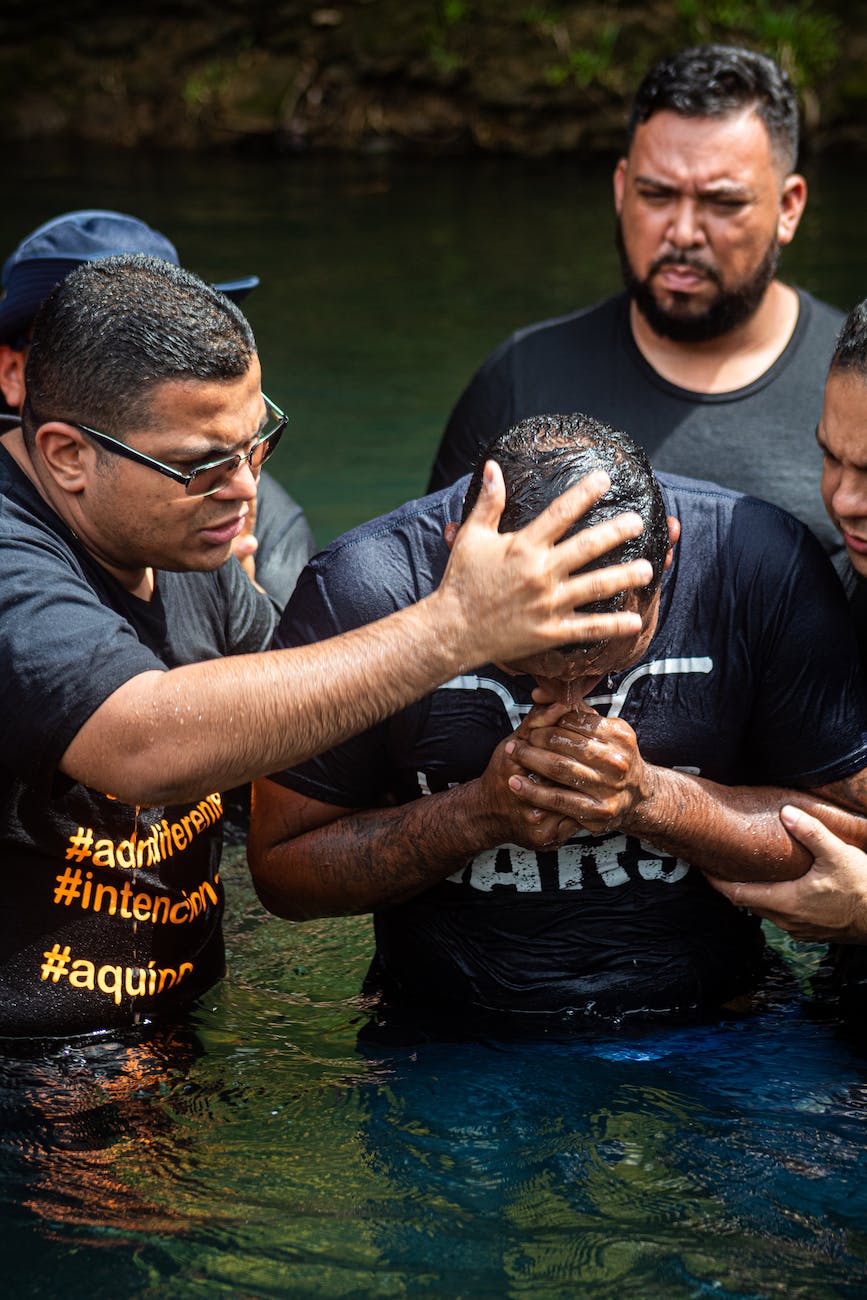
The word ‘baptism’ is a transliteration of a Greek word that meant to immerse. The Old Testament introduces us to the idea that we need to be cleansed before entering the presence of God (Exodus 30:17-20). By Jesus’ time, the city of Jerusalem had many buildings with a ritual bath (mikveh) in them where people could ritually cleanse themselves by dipping themselves in the mikveh. The mikveh can signify: a collection of water, something waited for, abiding, gathering together.[5]

In the New Testament, we are introduced to John the Baptist preaching about the coming of the Lord – and it was a time when many people were expecting the coming of the Messiah. John was baptizing people as they confessed their sins and as these people were being baptized, they would have understood that they were being cleansed and being gathered together for the coming Messiah.

When Jesus was ready to begin his time of ministry, he told John to baptize him. This obviously confused John who knew that Jesus did not need to be cleansed from sin, but Jesus had come to identify himself with us in baptism.

We see the practice of adults confessing their sins and then being baptized continue throughout the New Testament. After the New Testament we now enter an era of confessing adults bringing up their children. In the Jewish tradition, baby boys would be circumcised when they were 8 days old as a way of bringing them into the Jewish community. It is not long after the New Testament times that we see parts of the church using infant baptism as a way of bringing their children into the Christian community. The infants are obviously not confessing believers but believing parents can raise them up with the hope that they will later confirm their baptism. This issue of child baptism would later become an issue that the church would divide over.

Communion and the Passover Feast

The Communion celebration, sometimes called the Eucharist (from the Greek word for grateful or thanksgiving) is tied back to the Jewish Passover Feast. The Passover Feast was a commemoration of God’s work that convinced the Egyptian Pharaoh to let the Israelite slaves to leave. God’s work was to send an angel to kill all the firstborn children of the Egyptians but to “pass over” those Israelite homes that had the blood of a perfect lamb sprinkled on the doorposts of their homes. Every year after that, the Israelites were to commemorate that event with a Passover Feast that would include eating, among other items, bread with no yeast to remember the time they had to leave in haste from Egypt. The Passover meal would be one of many celebrations in the Old Testament that pointed to their fulfillment in the New Testament times.

At the end of Jesus’ earthly ministry, he gathered with his disciples to celebrate the Passover Feast; it would be his “last supper” with them before his crucifixion. He shared with them the bread and wine, but now adding their intended significance: the bread would represent his body that would be sacrificed for the world and the wine would represent his blood shed for the world.

There are differences about whether, during the Communion service, that the bread and wine actually become transformed into Jesus body and blood, or whether his body and blood are present with the bread and wine or whether the bread and wine only metaphorically represent Jesus’ body and blood.

What are the sacraments and how do we practice them?

Sacrament is Latin translation (sacramentum) of the Greek “Mysterion,” which means mystery.  The sacraments are used to refer to different rituals/activities conducted by the church.

There is agreement about the sacraments being a sign of grace imparted to those receiving sacraments, but there is disagreement (naturally, since we’re talking about mysteries) about how that grace works. Some consider the sacraments to be an objective reality that are effective for imparting grace in and of themselves,[6] others think that the effectiveness of the sacraments to impart grace depends on the faith response of the recipients, while others think that the sacraments are more simply a sign of grace.

Since the 16th century, the Orthodox and Roman Catholic recognize seven sacraments (The Orthodox church stipulates that there are even more but does not formally name them). Protestants only recognize baptism and the Lord’s Supper as sacraments. Some Anabaptist and Brethren groups consider foot-washing to be a sacrament. “Some Protestant groups, notably the Quakers and the Salvation Army, do not use sacraments.” [7]

  • Baptism – The first step in a lifelong journey of commitment and discipleship. Immersion identifies us with the death and resurrection of Christ.
  • Eucharist (or Communion) – In a re-enactment of the Last Supper, we share elements that remind us of Jesus’ sacrifice for us. 
  • Reconciliation (or Penance) – Has three elements: conversion, confession, and celebration.
  • Confirmation – An initiation into the church. It is most often associated with the gifts of the Holy Spirit.
  • Marriage – A public sign that one gives oneself totally to this other person. It is also a public statement about God: the loving union of husband and wife speaks of family values and also God’s values.
  • Holy Orders – The priest being ordained vows to lead other Catholics by bringing them the sacraments (especially the Eucharist), by proclaiming the Gospel, and by providing other means to holiness.
  • Anointing of the Sick (Last Rites) – A ritual of healing appropriate not only for physical but also for mental and spiritual sickness.

What are the different views on communion?

There are different views on what happens to the communion elements: bread and wine become literal flesh and blood, bread and wine become spiritual flesh and blood, or the elements are simply to remind us Jesus’ sacrifice for us.[8]

There are also different views on who can take communion: whether any Christians present may participate, or only members of local congregation or denomination may participate.[9]

Do we represent Jesus’ body with leavened or unleavened bread. Do we represent Jesus’ blood with wine or grape juice? Are both elements shared or is just the bread shared? Are only designated representatives of the church allowed to administer the elements?

What are different views on baptism?

There are different views on who may be baptized:  Adults only (Believer baptism, only people old enough to confess their faith may be baptized) Infants (infants of believers are baptized as acknowledgement of the infant as a new member in the church community and in hope that they will make a commitment in the future).

There are different views of what happens during baptism: baptism overcomes original sin, frees the baptized from powers of darkness, Baptism in the Holy Spirit – When someone is saved, the Holy Spirit overcomes the person and causes that person to speak “in tongues.”

There are different views of how many times the recipient is immersed: Once (there are differences in whether the words to use are “in the name of Jesus” or “in the name of the Father, and the Son, and the Holy Spirit), Three times (once for each of the Godhead: Father, Son, Holy Spirit).

There are different views on how the baptism is performed: Immersion (recipient is completely immersed in water), Pouring (water is poured on the head of the recipient), Sprinkling (water is sprinkled on the head of the recipient).


[1] Szczesny, Mike. “[Greek] μυστήριον (mystērion), [Latin] sacramentum” Resounding the faith resoundingthefaith.com/2016/10/27/greek-%CE%BC%CF%85%CF%83%CF%84%CE%AE%CF%81%CE%B9%CE%BF%CE%BD-mysterion-latin-sacramentum/

[2] Tennent, Timothy. “The Body and The Sacraments as a Means of Grace” Seedbed seedbed.com/the-body-and-the-sacraments-as-a-means-of-grace/

[3] Catholic Answers“Sacramentals” Catholic Answers www.catholic.com/encyclopedia/sacramentals

[4] Theopedia “Sacraments” Theopedia www.theopedia.com/sacraments

[5] One for Israel. “The Jewish Roots of Baptism” One for Israel www.oneforisrael.org/bible-based-teaching-from-israel/was-baptism-originally-jewish/

[6] Theopedia “Sacramentalism”  Theopedia theopedia.com/sacramentalism; Phillips, Matthew. “Augustine, Luther, and the Sacraments” Gospel Notes steadfastlutherans.org/2013/06/augustine-luther-and-the-sacraments

[7] Theopedia “Sacraments” Theopedia www.theopedia.com/sacraments

[8] Zondervan Academic Blog “Transubstantiation, Consubstantiation, or Something Else? Roman Catholic vs. Protestant View of the Lord’s Supper” Zondervan Academic 20 Oct 2017 zondervanacademic.com/blog/transubstantiation-consubstantiation-catholic-protestant

[9] Truediscipleship “Communion – Is it Open or Closed? True Discipleship truediscipleship.com/communion-is-it-open-or-closed
Mystery of our humanity

Dancing in the Kingdom- Table of Contents

Dancing In the Kingdom – Part 2 – The Kingdom Revealed – Chapter 13 – Distinctives within the body of Christ

Mystery of our humanity

[Bible references: Genesis 1:26-28; 2:18-25; Isaiah 59:1-21; Matthew 5:32; 19:4-6; John 8:31-47; Romans 5:12-21; 6:1-23; 7:1-25; 8:18-25; 12:3-8; I Corinthians 2:14; 7:1-40; 12:1-31; Ephesians 2:1-3; 4:11-16; 5:21-33; Hebrews 3:12-14; 3:4]

What is the role of spiritual gifts?

God gives spiritual gifts that to different individuals for the building of the body of Christ. These gifts include exhortation, giving, leadership, mercy, prophecy, service, teaching, administration, apostle, discernment, faith, healings, helps, knowledge, miracles, prophecy, teaching, tongues, tongues interpretation, wisdom, apostle, evangelism, pastor, prophecy, teaching, celibacy, hospitality, martyrdom, missionary, voluntary poverty. Different congregations stress different sets of gifts and some congregations will claim that some of the gifts have ceased.

What are the roles of families, marriage, and singleness?

There is a sense in which the church family transcends the biological family. The church family consists of every baptized adult, single or married and all adults can be considered as a parent to all those who are baptized after their own baptism. In a healthy congregation, the single and married adults socialize and serve together.[1]

There has been some contention regarding the roles of male and female. In some congregations, male and female are considered to be equal in all ways, but in others, they consider men and women to have equal value but complementary roles in marriage and within the congregation, where women are not allowed to have authority over men.[2]

Some congregations exalt the value of marriage and the value of procreation. Certainly, marriage reflects the Trinity, but the exaltation of marriage is sometimes done to the denigration of singleness, where the unmarried are not considered to be as mature or fulfilled as the married. In the other direction, singleness is sometimes held in high view, as the unmarried are seen as available to serve the church more whole-heartedly without the distractions that come with marriage. This view is particularly seen in the Roman Catholic denomination where convents and monasteries are available for the unmarried to serve the church and where unmarried men are available to serve as priests and bishops.

What is the role of sexuality?

Most of the church has regarded heterosexual sex within the bond of marriage and celibacy outside of marriage to be the norm, but an increasing number of congregations have become affirming of same-sex marriage. Added to that, post-modern thinking has led to the degradation of gender identification according to biological characteristics while promoting gender identification according to cultural or personal feelings. This transition has led to a rejection of the traditional male/female identification in favor of an unending array gender identities and to an increasing acceptance of transsexuality even within parts of the church.

Some congregations have fallen into the habit of choosing to simply reject people who don’t conform to the overall culture of the congregation, with this rejection being amplified by those people who don’t conform to the congregation’s sexual or gender norms. This is contrasted to other congregations that while not affirming non-heterosexual sexuality or the non-binary gender identification, desire to show acceptance to people who experience same-sex attraction or gender dysphoria without outrightly affirming same-sex marriage or gender transitioning.

How is our sexuality not just a physical issue but also a spiritual one?

There is a profound difference between human sexuality and the sexuality of other creatures. Because humans are made in the image of God, the union of husband and wife reflects the union of Christ and the church. The physical and emotional intimacy and intensity reflects of the intimacy and intensity between Christ and the church. The love and sacrifice of Christ for the church should be reflected in the love and sacrifice of the husband for his wife. The sexual union is not just a physical union, but it is a spiritual one.


[1] Hackman, Gordon. “Hauerwas on Marriage, Singleness, and the Church as First Family”North of the Tracks 3 Mar 2007 gordonhackman.blogspot.com/2007/03/hauerwas-on-marriage-singleness-and.html ; Griffith, Ryan. “Single in a Church of Families” Desiring God 16 July 2021 www.desiringgod.org/articles/single-in-a-church-of-families; Ware, Graham. “Marriage, Singleness, “Family Values,” and the Church” Pass the Salt Shaker 19 Mar 2015 www.desiringgod.org/articles/single-in-a-church-of-families; Treweek, Dani. “Singleness Lessons I Learned from the Early Church” Christianity Today 2 December 2021 www.christianitytoday.com/ct/2021/december-web-only/celibacy-singleness-early-church-lessons.html

[2] Roat, Alyssa. “What are Complementarianism and Egalitarianism? What’s the Difference?” Christianity.com www.christianity.com/wiki/christian-terms/what-are-complementarianism-and-egalitarianism-what-s-the-difference.html

Observe

Read I Corinthians 12:1-31. How does the distribution of spiritual gifts relate to the church as a body?

The Spirit and the power

Dancing in the Kingdom- Table of Contents

Dancing In the Kingdom – Part 2 – The Kingdom Revealed – Chapter 12 – Launching the church

The Spirit and the power

[Bible references: Genesis 25-19-21; 1 Samuel 1;1-20; 2 Samuel 7; Proverbs 2:1-5; Matthew 7:7-8; Mark 11:12-26; Luke 11:113; 12-26; John 20:21-23; 3:14-16; Acts 1:1-14; 2:1-41; 1 Peter 5:6-7]

There are remarkable parallels between Genesis 2:7 and John 20:22. We see from Chapter 2 that in Genesis 2, God breathed life into Adam who was then commissioned to take care of the sacred space that God had created. That sacred space was initially identified as the Garden of Eden, but we know from Genesis 1 that God had dedicated the entire universe as his temple. We also know that since God’s image-bearers were given the commission to “be fruitful and fill the earth” that the sacred space allotted to the care of the image-bearers was intended to be the entire earth.

After the resurrection, when Jesus met with the apostles in a locked room, He breathed on (or into) them.[1] This is the same word used in the Septuagint version of the Old Testament describing God breathing life into Adam and thereby giving him life. Immediately after this gesture, Jesus instructed the apostles to “Receive the Holy Spirit” who were then commissioned to continue the task that Jesus had begun.[2]

“The very same Greek verb (here only in N.T.) is used by the LXX. in Genesis 2:7 (Wis 15:11) of breathing life into Adam. This Gospel of the new Creation looks back at its close, as at its beginning (John 1:1), to the first Creation. We are probably to regard the breath here not merely as the emblem of the Spirit (John 3:8), but as the means by which the Spirit was imparted to them. ‘Receive ye,’ combined with the action of breathing, implies this. This is all the more clear in the Greek, because pneuma means both ‘breath’ and ‘spirit,’ a point which cannot be preserved in English; but at least ‘Spirit’ is better than ‘Ghost’ We have here, therefore, an anticipation and earnest of Pentecost; just as Christ’s bodily return from the grave and temporary manifestation to them was an anticipation of His spiritual return and abiding Presence with them ‘even unto the end of the world.’” [3]

Previously, in John’s gospel, we saw that “the Son of Man must be lifted up, that everyone who believes may have eternal life in him.” Now that Jesus was crucified and was soon ascend to heaven, the apostles were given the task of sharing the gospel so that people may believe unto eternal life. It is at this moment, in the locked room, that the apostles were given the commission to share the news of forgiveness.

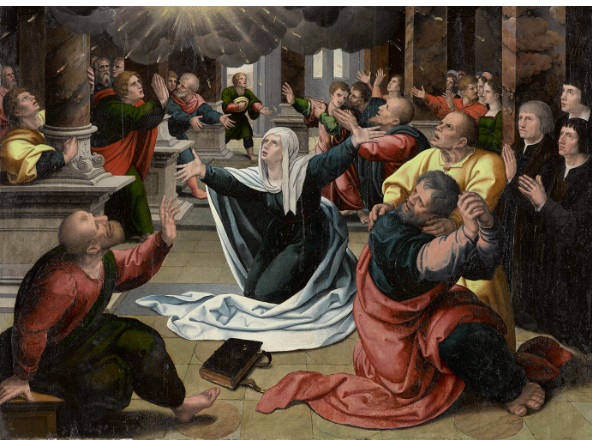
Ten days after Jesus ascended, fifty days after Passover, the disciples were gathered in Jerusalem, waiting for “what the Father had promised.” It was the time of Shavuot, which was known in Greek as the Pentecost. Shavuot is one of three pilgrimage festivals where Jews are supposed to travel to Jerusalem so Jews from all over the Roman Empire were in Jerusalem.

It was at this gathering that Spirit came upon the disciples in great power, revealing the fulfillment of Shavuot. While the disciples were gathered in a room, the Holy Spirit manifested himself with a great wind and tongues of fire that touched the apostles. The apostles then proceeded to prophecy and the people who were there from around the world were able to hear them speaking in their own languages. On that day 3000 people accepted Jesus as their Lord.

The full meaning of Passover and Shavuot was now revealed.

  • Jesus was executed on Passover, a holiday commemorating the celebration of freedom from slavery in Egypt which was observed by the slaying of the Passover lamb whose blood protected all the Israelites from the angel of death who had killed all the firstborn children in Egypt.
  • The miraculous outpouring of the Holy Spirit on the apostles which enabled them to speak in many different languages occurred on Shavuot, which had many different meanings for the Jews. Shavuot was associate with:

  • the giving of the commandments 50 days after the liberation from Egypt. Now the commandments were written on hearts instead of stone.
    • the first harvest of crops in the year, with those first portions being given to God, the provider of harvest. There were now 3000 souls harvested for God.
    • marriage, where Passover was considered the betrothal and Shavuot the marriage where the bride and groom commit themselves to each other. The period in-between the betrothal and marriage can be considered as a time of testing and waiting as the bride and groom prepare for life together. With His sacrifice, Jesus, the Bridegroom committed himself to the Church, His Bride.

Waiting. The virtue we want to bypass. Yet even though God has set seasons and times before us and insists on letting his ordained processes complete, from the beginning, we have wanted things immediately and we have been paying the price ever since. But there was a process God wanted to complete. After His resurrection, Jesus waited for the apostles to gather before He came to them, Jesus waited for many days to go by while He interacted with various groups of his disciples, then after His ascension, Jesus waited for his disciples to stay in Jerusalem, while they waited for the “gift His Father promised … to be baptized with the Holy Spirit.” And so, the apostles waited and prayed.


[1] Biblehub ἐνεφύσησεν Bible Hub biblehub.com/greek/enephyse_sen_1720.htm

[2] Scrivener, Glen. “What does John 20:21-23 mean” Christ the Truth christthetruth.net/2013/03/26/what-does-john-2021-23-mean; Skinner, Matt. “Commentary on John 20:19-23” Working Preacher www.workingpreacher.org/preaching.aspx?commentary_id=887; Lewis, Karoline. “Commentary on John 20:19-23” Working Preacher www.workingpreacher.org/preaching.aspx?commentary_id=76; Flattery, George. “John 20:19-23 Receive the Holy Spirit” Global Christian globalchristiancenter.com/sermons/dr-g-flattery-sermons-on-gospel-of-john/26192-john-2019-23-receive-the-holy-spirit

[3] Biblehub “John 20:22”Cambridge Bible for Schools and Colleges biblehub.com/commentaries/john/20-22.htm

Reflect

There are times when we need to take action and times when we need to wait for maturity or for “the fullness of time.” How can we discern the difference?

Observe

Read Mark 11:12-26; Luke 11:1-13. What should we expect when we pray?

Playful and orderly

Dancing in the Kingdom- Table of Contents

Dancing In the Kingdom – Part 1 – Shadows of the Kingdom – Chapter 3 – The image-bearers

Playful and orderly

[Bible references: Deuteronomy 12; Exodus 35:30-38; 2 Kings 17:1-41; Nehemiah 8:1-9:38; Psalm 100; John 4:23-24; Acts 6:1-7; 15:1-35; Romans 12:1-2; 1 Corinthians 14:1-40]

There is much that is wrong in the world. People endure pain and suffering sometimes from natural happenings and sometimes from the actions of others. Evil seems persistent and never-ending. When we are called to serve God in this world, we can become overwhelmed by all the work that is to be done. Playfulness can seem out of place. Particularly, any playfulness that emerges from self-centeredness or obsessiveness.

Actually, that is the point we need to assert. Playfulness can be out of place in a world of sin and evil. But playfulness can also be a reminder that the reality in front of us is not the total reality. Our playfulness arises out of the relationship we have with God, the one who has overcome the evil in the world, who will end the suffering and who will restore us and world to be what he intended from the beginning. Playfulness arises out of the hope and joy we have in knowing that the reality in front of us is not the whole reality.

Our imagination can be helpful in this play. As children, we can pretend there is another world and do something like taking a cardboard box and imagining it to be a spaceship and accepting the rules of living in that spaceship. Family traditions (or even community or national traditions) are a form of play, they do not serve a utilitarian purpose, but stem from the creative ways we wish to remember our unique heritage.

This same imaginative playfulness can be useful in reminding us of the reality that lies behind our current reality. Our traditions of worship are a form of play, albeit a more serious play. Our worship traditions represent ways for us to remember our spiritual heritage or to provide imaginative ways to perform biblical sacraments about which we have sparse details on how to perform them. These traditions and liturgies help us point to that other reality, a new Kingdom that began breaking into this world with the incarnation of Jesus.

Christian worship was in fact and from the beginning a festival:  the festival of Christ’s resurrection from the dead … Easter begins with a feast, for Easter is a feast and makes the life of those who celebrate it a festal life … Jesus himself compared the presence of God, which he proclaimed and lived, with the rejoicing over a marriage. His earthly life was a festal life, even if it ended in suffering and death … the early Christians have understood his raising from the dead and the presence of the now-exalted Christ as the beginning of an unending joy and a happiness without end … the risen Christ as ‘the first among those who had fallen asleep’ and as the leader of life; as the leader in the mystic dance and himself as the bride who dances with the others, as the church father Hippolytus put it.  Long before the somber dances of death were painted in medieval times of plague, the figure of the resurrection dance can be seen in the old churches. The modern Shaker song ‘The Lord of the Dance’ brings out very well the dancing Christ:

I am the life that’ll never, never die;
I’ll live in you if you’ll live in me,
I am the Lord of the Dance, said he.[1]

We hope to participate in the inbreaking of the new Kingdom by living according to its rules. When we pray or worship, we are participating in the rules of that new Kingdom. When we come to others and share with them the hope that we have, we ask them to use their imagination to look beyond the current reality and envision the new Kingdom that is already here and is yet to come. When we accept contentment in all situations, when we trust in God, when we comfort others with the hope we have, we are living according to the rules of the new Kingdom.[2]

It is also true, that In this present life there are endless encounters with grief. Although we acknowledge the pain and suffering of that grief, whether that grief is ours or others, we can encompass that grief with hope. Even amid grief we can choose to cling to God and to the hope He brings us. If we can live under the rules of the new Kingdom, we can have assurance that the current grief will pass and will be replaced by future joy and laughter and that every tear that we have cried and will cry and even now cry will be wiped away.

Our hope of the new Kingdom allows us to endure the current pain and suffering knowing that the hard experiences can be redeemed and to be used for good. God can take the pain and suffering we endure to transform us to be more like Christ, who himself suffered for us, transforming the very evil intended for him into the final victory that shall ultimately also make us victorious. This hopeful living then is also a form of play, accepting the rules of a reality we cannot see and choosing to live according to the rules of a Kingdom that we can only realize in part.

That playfulness also emerges in our creativity, which erupts early on in our lives as our desire as children to play and also in the desire we have as parents to play with our children.[3] There is no doubt about how uniquely creative we are in the way we express ourselves, not only in all the various art forms we use but in the ways we can solve all sorts of problems[4] – even to the creative ways we try to cover up our sins.[5] No other creature can come close to expressing creativity the way we can.

Our ability to create and even detect order is also unmatched.[6] Our ability to detect order is evident in the way we can detect patterns in sight or sound. The sense of order is evident in our ability to recognize faces, our ability to recognize the voices of our mothers or fathers as infants and even before we are born.[7] Our sense of order is seen as we grow in our ability to recognize the patterns of letters and sounds and to recognize and respond to language – even languages.

Our sense of order becomes more evident in our ability to create order out of many abstract concepts such as math, science, philosophy, and many other areas.[8] It is our sense of order that allows us to create businesses, governments, and civic organizations to make society productive. When we bring order to farmland, we increase the productivity of the farm.

The visible order within Creation inspired Christians in the past to study Creation. Order within Scripture helps the Bible to be meaningfully used as meditative literature. In the same way, order during worship also helps us to avoid confusion and to focus on God.


[1] Moltmann, Jürgen. “The Living God and the Fullness of Life” trans. Margaret Kohl Westminster John Knox Press, 2015, p.192; Carter, Sydney. Lyrics “Lord of the Dance” (1963) Genius genius.com/Sydney-carter-lord-of-the-dance-lyrics; Tune “Simple Gifts” Brackett Jr., Joseph. (1848) Praise gathering www.praisegathering.com/media-files/pdf/a08380_lyrics.pdf

[2] Edgar, Brian. “The God Who Plays: A Playful Approach to Theology and Spirituality” Cascade Books 2017 (e-book)

[3] Gowman, Vince. “Playful quotes for the child in your heart” Vince Gowman www.vincegowmon.com/playful-quotes-for-the-child-in-your-heart/

[4] Baumgartner, Jeffrey. “The Basics of Creative Problem Solving – CPS” Innovation Management, innovationmanagement.se/imtool-articles/the-basics-of-creative-problem-solving-cps/

[5] Brister, Tim. “6 Destructive Ways We Minimize Our Own Sin” Bible Study Tools www.biblestudytools.com/bible-study/topical-studies/6-destructive-ways-we-minimize-our-own-sin.html

[6] Basulto, Dominic. “Humans Are the World’s Best Pattern-Recognition Machines, But for How Long?” Big Think 24 July 2013 bigthink.com/endless-innovation/humans-are-the-worlds-best-pattern-recognition-machines-but-for-how-long

[7] Pfaff, Leslie Garisto. “6 things you may not know your baby can do” Parents www.parents.com/baby/development/intellectual/6-things-you-may-not-know-your-baby-can-do/

[8] Armstrong, David. “Christianity Absolutely Critical to Origin of Science” Patheos, 18 Oct 2015, www.patheos.com/blogs/davearmstrong/2015/10/christianity-crucial-to-the-origin-of-science.html

Observe

Read Deuteronomy 12; 1 Corinthians 14. These chapters contain explicit instructions about how and how not to worship.  Since we do not yet experience the fullness of the new Kingdom, how can our imagination help us more actively engage in worship?