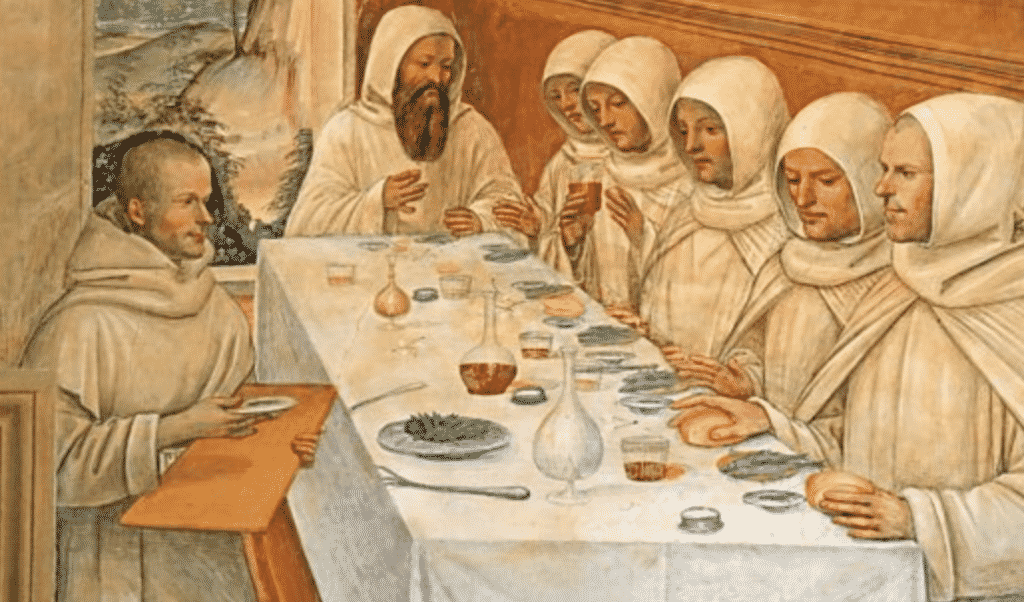
Discipline of Fasting

Dancing in the Kingdom- Table of Contents

Dancing In the Kingdom – Part 3 – Dancing in the Kingdom– Chapter 15 – Reforming our Souls

Discipline of Fasting

[Bible references: Isaiah 58:1-14; Ezra 8:21-23; Matthew 6:16-18]

By the help of the merciful Lord our God, the temptations of the world, the snares of the Devil, the suffering of the world, the enticement of the flesh, the surging waves of troubled times, and all corporal and spiritual adversities are to be overcome by almsgiving, fasting, and prayer.[1]

“More than any other Discipline fasting reveals the things that control us.” [2]

Fasting breaks up habits to let us see our lives in new ways or to enable us to pray at new times or in new ways. Because we are stopping something for a finite period of time, there’s an unfamiliarity and discomfort to it that can be very instructive, open up time for prayer, and draw us closer to God.”[3]

“In every culture and religion in history, fasting has been an instinctive and essential language in our communication with the Divine.”[4]

The pursuit of God can be described as in Psalm 37, to trust in, to delight in, to commit to, to wait on, and to be silent before the Lord; these are words of “giving up” of “going without” whatever the world offers and instead resting in God. The discipline of fasting then looks like learning to go without while learning to rest in, to fight through our appetites so that we can remain focused on the act of pursuing God and loving others, to push through our hunger pains so that we can discover we’re just fine on the other side of them, to look to God, to talk to him, to open ourselves to him in confession, to not so much as give up anything, but to commit to hearing the voice of God in our lives. The goal of fasting is to pursue God, to turn our hearts and our loves towards God and neighbor.

There are many reasons Christians are led by the Holy Spirit to the spiritual discipline of fasting, a few of them are: to strengthen one’s prayer life, to seek direction for one’s life, to express grief and loss, to seek deliverance and protection for life, to express repentance and reconciliation with God. to humble oneself, to express concern for the work of God, to minister to the needs of others, to overcome temptation and rededicate oneself to God, to express love, devotion, and worship of God, to establish rhythms between absence and abundance.

Simplicity and Gratitude can be precursors to fasting. Once we have determined how to order our lives then we are better equipped to identify those things that stand in our way and in the lives of those around us, not only the good vs. bad things, but the good things that detract us from the best things. The Gratitude for God and His provision can set our attitude in preparation for fasting.


[1] Sister Mary Sarah Muldowney The Fathers of the Church: A New Translation Writings of Saint Augustine Vol 17 Fathers of the Church 1959 Sermon 207 (p. 89)

[2] Foster, Richard J. Celebration of Discipline.  Harper & Row Publishers ©1978 (p. 48)

[3] Baab, Lynne M. “The Surprise of Fasting” Lynnebaab.com www.lynnebaab.com/blog/the-surprise-of-fasting

[4] Ryan, Thomas. The Sacred Art of Fasting: Preparing to Practice Skylight Paths 2005

Observe

Read Isaiah 58:1-14; Ezra 8:21-23; Matthew 6:16-18. The benefit of fasting does not come just from deprivation. What should accompany fasting?


Inheriting the kingdom

Dancing in the Kingdom- Table of Contents

Dancing In the Kingdom – Part 2 – The Kingdom Revealed – Chapter 11 – The Kingdom Enters

Inheriting the Kingdom

[Bible references: Matthew 5:1-12; 18:1-9; 19:13-14; 25:34; Luke 18:15-17; John 3:1-8; James 1:4]

The Beatitudes are not parables but rather descriptions of the type of people who are in the kingdom of heaven (first and last beatitudes) and the blessings that they shall obtain.[1] The poor in spirit are those who see themselves powerless, helpless in themselves and unworthy regarding Yahweh;[2] they know that they may be loved by God, but they are broken and not worthy of that love. Those who mourn are those who mourn for their sin, for loss, injustice, etc.[3] The meek are those who trust in Yahweh are will wait for Yahweh even in the face of opposition.[4] Those who hunger and thirst after righteousness are those who want justice as much as they do food and are willing to take action for it.[5] The merciful are those who respond to the mercy shown them by Yahweh by showing mercy to those who need it.[6] The pure in heart are those who stay away from deceit and want the glory of Yahweh.[7] The peacemakers are those who pray for and pursue peace even for those who persecute them.[8] Those who are persecuted for righteousness’ sake are those who are persecuted because of their pursuit of righteousness but not because they were not merciful or not poor in spirit.[9] The beatitudes show the rewards and blessings and shalom  (peace, wholeness, and well-being) for all those types of people.

No one enters the kingdom of Yahweh by their own merit, it is strictly only by family ties. Children only. Only those who are born-again, that is born into the family of Yahweh, are eligible to inherit the kingdom of God. The beatitudes describe the kind of children that one should find in the kingdom. Jesus reinforces this again when answering the question about who is greatest in the kingdom of God. Furthermore, Jesus cautions the adults in this world that not only should they become like children but that they should not cause problems for the children in this world.


[1] Piper, John. “The Beatitudes and the Gospel of the Kingdom” Desiring God 26 Jan 1986 www.desiringgod.org/messages/the-beatitudes-and-the-gospel-of-the-kingdom ; Kauffman, Richard A. “Blessed are those who mourn” Christianity Today www.christianitytoday.com/ct/2007/july/22.50.html

[2] Piper, John. “Blessed are the Poor in Spirit who Mourn” Desiring God 2 February 1986 www.desiringgod.org/messages/blessed-are-the-poor-in-spirit-who-mourn

[3] Biblehub “Matthew 5:3” Biblehubbiblehub.com/matthew/5-3.htm

[4] Piper, John “Blessed are the meek” Desiring God 9 Feb 1989 www.desiringgod.org/messages/blessed-are-the-meek

[5] Piper, John “Blessed are those who hunger and thirst after righteousness” Desiring God 16 Feb 1986 www.desiringgod.org/messages/blessed-are-those-who-hunger-and-thirst-for-righteousness

[6] Piper, John, “Blessed are the Merciful” Desiring God 23 Feb 1986 www.desiringgod.org/messages/blessed-are-the-merciful

[7] Piper, John, “Blessed are the Pure in Heart” Desiring God 2 Mar 1986 www.desiringgod.org/messages/blessed-are-the-pure-in-heart

[8] Piper, John, “Blessed are the Peacemakers” Desiring God 9 Mar 1986 www.desiringgod.org/messages/blessed-are-the-peacemakers

[9] Piper, John, “Blessed are the Persecuted” Desiring God 16 Mar 1986 www.desiringgod.org/messages/blessed-are-the-persecuted

Observe

Read Luke 18:15-17; James 1:4. James encourages us to become mature in the faith. Luke encourages us to receive the kingdom of God like a little child. How do we reconcile these two thoughts?

Hope in the brokenness

Dancing in the Kingdom- Table of Contents

Dancing In the Kingdom – Part 1 – Shadows of the Kingdom – Chapter 4– Retreating to chaos

Hope in the brokenness

[Bible references: Genesis 2:16-17; 3:14-15, 23; Psalm 4; 102; Isaiah 1:26; Jeremiah 29:11; Acts:318-26; Galatians 3:13-14; Ephesians 1:11-12; Romans 5:12; 8:18-3; Hebrews 1:1-4]

Grief is the normal response to loss or separation. We may grieve when we lose dreams, jobs, health, family members or friends and many other things. Death is separation. Physical death is the separation of the soul from the body. Spiritual death is the separation of the soul from God.

The first humans voluntarily separated themselves from God so that they could grab what they wanted. This was spiritual death. When the non-physical angels rebelled against God, they too suffered spiritual death. For the angels, the separation was permanent with no hope of reconciliation with their Creator. But the first humans were given the possibility of hope.

Humans were also physical creatures, with mortal bodies, physical bodies that could die. Indeed, the humans needed access to the Tree of Life in order to keep on living. When the humans rebelled, they immediately suffered spiritual death. When the humans were also denied access to the Tree of Life, then their physical death was ensured. Spiritual death followed by physical death. A double grief. But the double grief contained the possibility of hope.

The consequences of rebellions created a great tragedy that could not be undone, not by the image bearers. But even so, as we look around us, we can see that despite the tragedy around us, things aren’t totally bad. Even though evil is very evident around us, goodness is also evident. It is in that observation that we can glimpse the possibility of hope. Amidst the consequences of rebellion, there are hints of hope.

When God confronted the first humans with the consequences for their rebellion, He also gave them a hint of the undoing of death, a solution to the problem created by sin. This hint would only be the first of many other hints to come that we can see revealed in the Biblical text.

We can also see evidence for hope in the continued creation by God, as he continues to sustain the universe he created, continuing to create new living things, plants, and animals alike. There is also hope hidden in the mandate given to the image-bearers. Their mandate of stewardship of God’s creation was still in force, although there would now be suffering involved in the fulfillment of the mandate. There was hope hidden in the name of God’s Son.[1] There was also a strange hope in the banishment from the Tree of Life; the consequence of physical death would provide a way to free us from an eternity of being separated from God and open a way for our redemption.

The sacrifice of Jesus followed a life in which Jesus successfully waited to receive those things that His Father intended to give, resisting the temptation to grab those things for himself. In his life and death, Jesus successfully accomplished what Adam and all those who came after Adam had not.

In the beginning, we were eager to grasp for ourselves wisdom and the knowledge of good and evil on our own terms. What we didn’t plan on was the consequences that would follow. Sometimes God gives us what we think we want even though it would bring us the suffering that God was trying to steer us from. It’s a continuing pattern we see from the beginning until now, that it is not always a good thing when we get what we think we want.[2]

But Jesus life did not end with his crucifixion. Jesus’ resurrection was the proof of redemption and of the hope of restoration. Sin had corrupted all of creation and all of creation is groaning and awaiting its restoration.

The universe is not what it’s supposed to be. We are not what we are supposed to be. We are creatures created with the imprint of the image of God but broken in body, soul and spirit. Our brokenness shows up in our actions, words and thoughts. Our brokenness shows up in the way we are treated and the way we treat others. And our brokenness even shows up in the bodies we are born with. But in His death and resurrection, God is able to redeem and restore all of us, all of who we are, all of what we have done, all of what has been done to us, and even all of creation. God is able to use all of our suffering and use it for our good, making something beautiful out of what was broken.


[1] See Chapter 2, The Mystery of God’s Name

[2] See Chapter 8. Rejecting God as King

Reflect

It’s not hard to see signs of brokenness around us. Are there any signs of hope that can be seen?

Observe

Read Isaiah 1:26; Jeremiah 29:11; Matthew 17:11; Acts 3:18-26; Galatians 3:13-14; Ephesians 1:11-12;. Throughout the Bible, God has chosen to share his future plans in pieces at a time. What those plans are, have been the subject of much debate within the church. What is your understanding of God’s plans for the future?