The genealogies

Dancing in the Kingdom- Table of Contents

Dancing In the Kingdom – Part 1 – Shadows of the Kingdom – Chapter 1 – Prelude

The genealogies

[Bible references: Matthew 1; Luke 3]                              

There are not many passages in the New Testament that the average person tends to gloss over, but there are two places where that happens the most. Two of the Gospels have genealogies that look very different from one another, telling the story of Jesus from different perspectives. Neither genealogy is comprehensive, they are there to establish who Jesus is through particular relationships and to give different messages. It is typical for the average reader to skip over the genealogies when they read the Bible, but sometimes the stories attached to each name make a significant point, and sometimes the names themselves give a particular message. The genealogies are designed to give particular stories.

Matthew[1]

Matthew’s genealogy tells a three-part story that begins with Abraham, uses both Jews and Gentiles, includes women, and ends with Christ.

The list

  • Waiting for the Kingdom – Abraham, Isaac, Jacob, Judah and Tamar, Perez, Hezron, Ram, Amminadab, Nahshon, Salmon and Rahab, Boaz and Ruth, Obed, Jesse, David and Bathsheba
  • The Kingdom – Solomon, Rehoboam, Abijah, Asa, Jehoshaphat, Jehoram, Uzziah, Jotham, Ahaz, Hezekiah, Manasseh, Amon, Josiah, Jeconiah
  • Waiting for the re-established kingdom – Jeconiah, Shealtiel, Zerubbabel, Abiud, Eliakim, Azor, Zadok, Achim, Eliud, Eleazar, Matthan, Jacob, Joseph, Jesus

Items of note:

  • Matthew’s genealogy, starting from Abraham, traces a line to Judah to establish royal bloodline. Matthew shows Christ as the Messiah, by tracing the legal line from Judah and then to Joseph. This genealogy established Jesus’ legal rights to the throne through Judah.
  • The genealogy includes women with interesting stories:
    • Tamar was raped by Judah.
    • Salmon had children by Rahab a Gentile who was a prostitute in Jericho.
    • Boaz’s wife was Ruth who was a Gentile.
    • David had an affair with Bathsheba, who was married to Uriah.
  • Includes all the kings of Judah. Jeconiah appears twice (was last king before exile, then was part of exile) Zerubbabel (governor of Jerusalem after the return).
Luke[2]

Luke’s genealogy tells a story that starts with Adam, the son of God and ends with Jesus, the Son of God. Luke establishes Jesus as the Son of Man and goes back through Mary’s line to Noah and then to Adam. Ancient Greek genealogies traced the father’s lineage not the mother’s—but what do you do with the unique virgin-born Jesus? Certainly, Joseph was not his father, so the only logical male name available was that of Jesus’ maternal grandfather, Heli, for he was the last man involved in the genealogical process which led to Jesus. So Heli was the father of Mary, who was the mother of Jesus.

The list

  • God, Adam, Seth, Enosh, Kenan, Mahalalel, Jared, Enoch, Methuselah, Lamech, Noah, Shem, Arphaxad, Cainan, Shela, Eber, Peleg, Reu, Serug, Nahor, Terah
  • Abraham, Isaac, Jacob, Judah, Perez, Hezron, Aminadab, Nahshon, Salmon, Boaz, Obed, Jesse, David
  • Nathan, Mattatha, Menna, Melea, Eliakim, Jonam, Joseph , Judah, Simeon, Levi, Matthat, Jorim, Eliezer, Joshua, Er, Elmadam, Cosam, Addi, Melchi, Neri, Shealtiel
  • Zerubbabel, Rhesa, Joannan, Juda, Joseph, Semein, Mattathias, Maath, Naggai, Esli, Nahum, Amos, Mattathias, Joseph,  Jannai, Melchi, Levi, Matthat, Heli, Joseph, Jesus

Items of Note:

[Bible references: Genesis 5:25; 11:12-26; Jeremiah 22:30; Matthew 1; Luke 3]                             

  • Starts from Adam instead of Abraham, traces Mary’s line to establish Son of God, includes 4 generations born in captivity,
  • Methuselah (oldest recorded age), Shem (the Semitic race),
  • If we translate, instead of transliterating the first 10 generations from Adam to Noah we can read: Man (is), Appointed, Mortal, Sorrow (but), The Blessed God, Shall come down, Teaching, His death shall bring, The despairing, Comfort and rest
  • There is an interesting prophecy in Jeremiah, where it appears to refer to termination of David’s legal line to the throne from Jeconiah onwards. Jeremiah 22:30 implies a BLOOD LINE curse on Solomon’s line. This separation of the genealogies from David resolves the prophecy. With Mary being of David’s blood line through Nathan, the Messiah is from the House of David yet avoids the curse, whilst still claiming the legal claim through Solomon’s line, through Joseph his adopted and legal father
  • The values of the letters in David’s name (dalet=4, vav=6, dalet=4) add up to 14. Matthew’s genealogy is set up in groups of 14.
  • Jeconiah was the last operative King and the first waiting King, he ends the second group, and starts the third.
  • The name Zerah: Meaning: Rising, Dawn; Etymology From the verb זרח (zarah), to rise or break out.
  • The name Perez: Meaning: A Breach: Etymology: From the verb פרץ (paras), to break through.
Mark

[Bible references: Mark 9:35]                                        

Mark is portraying Christ as a servant and so does not use a genealogy.

John

[Bible references: John 1:1-2]                                         

John shows Jesus directly to be the Son of God.


[1] In Hebrew, the Hebrew word translated as genealogies, ‘toledoth’ always denotes father/son relationships, always works forward.

[2] In Hebrew, the word ‘yaghash,’ is used to establish legal rights or obligations; in contrast, it always works backwards tracing an individual’s legal right or duty back to its source.

Observe

Read John 21:15-25.  Which disciple do you identify more with and why, Peter or John.?
Overview of the Gospels

Dancing in the Kingdom- Table of Contents

Dancing In the Kingdom – Part 1 – Shadows of the Kingdom – Chapter 1 – Prelude

Overview of the Gospels

[Bible references: Matthew, Mark, Luke, John]

The New Testament begins with a set of four biographies about Jesus. They are referred to as the Gospels of Matthew, Mark, Luke and John. It is possible to think about the Old Testament as the inspired introduction to the New Testament, foretelling of the Person, work and kingdom of Christ. Old Testament quotes, allusions, and types are woven into the Gospels.

Christ is presented as king (who rules over all things), prophet (who represents God to the church) and priest (who intercedes for the church).  All the gospels record: the unique revelation of Christ, the ministry of John the Baptist, the feeding of the 5,000, Christ’s offer of Himself as King, the betrayal by Judas; the denial by Peter, the trial and crucifixion and bodily resurrection of Christ, events during the forty days of the post-resurrection ministry of Christ, the hope of His second coming.

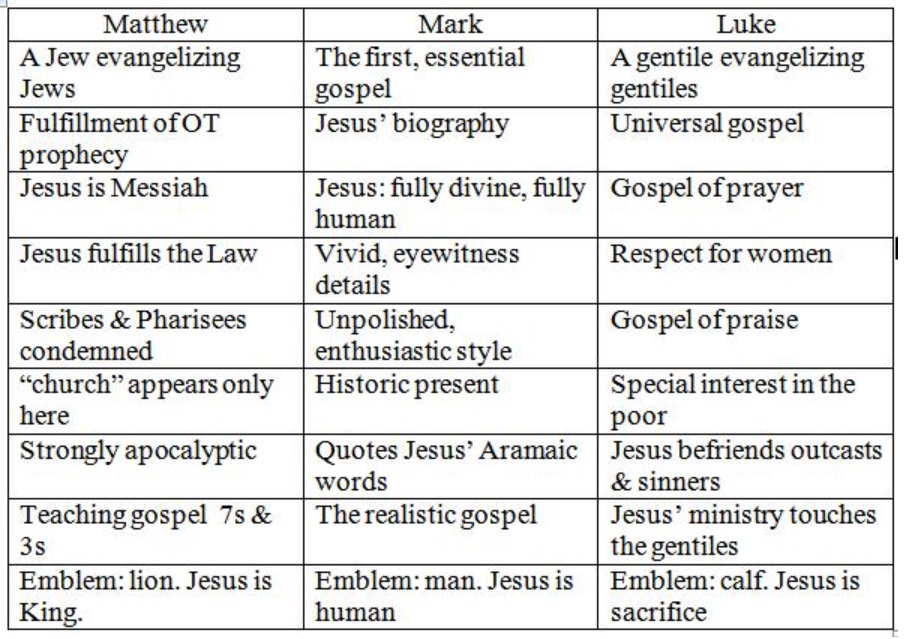
The following table shows how the Gospels tell the story of Jesus from different perspectives, each focusing on different perspectives of Jesus’ life, and each trying to give a different message about the life of Jesus.

Comparison of Gospels
 MatthewMarkLukeJohn
Portrait of JesusKingServantTeacherSon of God
Original readersJewsRomansGreekschurch
Key phrasesKingdom of heaven, fulfilledKingdom of God, Immediately, nowKingdom of God, Son of manBelieve, Word of God, only begotten Son, eternal life
FocusJesus is the Messianic King of the promised Davidic kingdom which fulfills the Old Testament prophecies and claimsJesus is the authoritative Son of God. He is God’s triumphant envoy come to suffer and die in order to claim victory over sin and deathJesus is the perfect Son of Man, the Messiah prophesied by the prophets who came to save and to minister of people of all nations through the power of God the Holy SpiritJesus Christ is the fully divine Son of God who existed before creation. He is the true Lamb of sacrifice through whom we receive the gift of eternal life
Prominent sectionssermonsmiraclesparablesteachings
Genealogytraced to Abrahamnonetraced to Adamnone
Geographic emphasisGalileeGalileeGalileeJudea
Comparison of the Gospels

Observe

Read the chart above. Which gospel is centered in Judea?

Clash of empires

Dancing in the Kingdom- Table of Contents

Dancing In the Kingdom – Part 1 – Shadows of the Kingdom – Chapter 1 – Prelude

Clash of empires

[Bible references:1, 2 and 3 Maccabees; Lamentations 3; Matthew 3:1-12]                                      

As the era of the Old Testament ends

  • the Assyrian Empire took the tribes of Northern Kingdom into exile where they were never to be heard from again in history,
  • the Babylonian Empire conquered the Assyrian empire and then took the best and brightest of the Southern Kingdom to Babylon,
  • the Persian empire overtook the Babylonian empire and allowed those Jews to not only return to their homeland but gave them the resources to begin the rebuilding of the city of Jerusalem and the temple.
  • the Greek Empire overtook much of the world, including the Persian Empire, then imposed its culture and language on all its territories. After the death of Alexander the Great, the Greek Empire split up.
  • Israel is first controlled by the Egyptian remnant of the Greek empire where some Jews were deported to Egypt where the Greek Septuagint version of scripture was written.
  • Then Israel came under control of the Syrian remnant of the Greek Empire whose general desecrated the temple, which invoked a successful rebellion led by the Hasmonean family and Israel become independent for a few years. The Maccabee books were written in this time.
  • the Roman Empire overtook the Greek Empire but kept Greek as the common language of the Empire, which in later years would become the language the church would use to write the New Testament texts as well as many of the texts that were written by the early church Fathers.

At the time the New Testament begins, the “king of Israel” installed by the Roman Empire was King Herod the Great. All the tumult of the times created an atmosphere where there was much speculation about the end of times and the coming of the Messiah. In fact, around the time of Jesus, there were many who claimed to be the Messiah.[1]

There are up to 400 prophecies concerning Jesus that were written in the Old Testament.[2] All the way back in the third chapter of Genesis, when Adam and Eve rejected God’s authority, God started to lay out His plan to have his image-bearing creatures restored to fellowship with Him. The New Testament introduces us to John the Baptist who could be said to be last of the Old Testament style prophets. He is the one who, as foretold by the Old Testament, was sent to prepare the way for Jesus’ ministry.

The New Testament Gospels, which are biographies of Jesus, emphasize the years of Jesus’ ministry leading up to his death and resurrection.


[1] Tabor, James. “Messiahs in the Time of Jesus” This page lists 12 Messiah-claimants between 47 BC to AD 66. Taborblog, jamestabor.com/messiahs-in-the-time-of-jesus/

[2] Appendix D – Prophecies about Jesus

Observe

Read Lamentations 3. In times of silence and grief, what is a cause for hope?

Messengers of a Greater Power

Dancing in the Kingdom – Table of contents

Part 1 – Shadows of the Kingdom, Chapter 9 – The Prophets and Writings

[Bible references: 1 Samuel 9-10; 13:8-14; 2 Samuel 12; Jeremiah 2:28]

During the entire time when Israel had kings, it also had prophets. Some prophets like and Elijah and Elisha did not leave any writings, although sixteen prophets did.[1] The prophets focused more on “forth-telling” (telling about changes that the kings and/or the people needed to make immediately) than “fore-telling” (telling about some future events) and were a constant reminder that God was acting in ways that transcended the earthly kingdom. Sometimes the prophets were there to encourage and sometimes to challenge the kings: The prophet Samuel was used to anoint Saul as king, then later had to let Saul know that God had rejected him. Samuel was also used to anoint David as king. Later, the prophet Nathan was used to let David know that God was aware of David’s sin with Bathsheba.

When we look at Jesus’ life and ministry, we see that he is uncompromisingly prophetic in a whole host of ways:

  • He is the revelation of the Father: he perfectly shows us what God is like.
  • He is the Word of God in flesh.
  • He is the mediator of the New Covenant between God and people.
  • He confronts evil and breaks the power of sin.
  • He calls people to return to God and live righteously.
  • He speaks truth to power (both religious and secular).
  • He only does what he sees the Father doing.
  • He is led by the Spirit and ministers in the power of the Spirit.
  • He prioritizes prayer and worship.
  • He speaks prophetically of the future.
  • He discerns the hearts and minds of people.
  • He challenges injustice and unrighteousness.

Jesus is the perfect expression of the prophet and so gives us the blueprint for a mature, holistic, multi-faceted way of being the prophetic church. We need to be prophetic in the way that Jesus was prophetic. Not just as individuals but as a Body with a collective prophetic consciousness.[2]

The Prophets of the Old Testament were precursors of the prophetic ministry of Jesus. And now the Church, as the Body of Christ, has the privilege of carrying on that ministry.

Challenging Unfaithfulness

[Bible references: Deuteronomy 16:18-20; 2 Chronicles 29:6; Isaiah 1; 56:1; Jeremiah 5:31; 28; Hosea 1:2; Amos 9:1-15; Zechariah 7]

Sometimes the prophet’s warnings would be not just for the kings but for everyone in the kingdom. The messages from the prophets often mixed the foretelling of the consequences for rejecting God with the hope that God will someday make things right. The most common offense cited by the prophets was the people’s lack of justice and the uselessness of their ritual sacrifices if justice was ignored. There were also diatribes against false prophets and against making idols. The most common metaphor used to describe Israel’s unfaithfulness to God and his commands was prostitution, even to the point where one prophet, Hosea, was told to marry an adulterous woman to be a visible reminder for Israel.

Lament and Anger

[Bible references: Lamentations; Genesis 15:12-15; Isaiah 10:5-11; 13:1-22; 15-1622:19; Micah 5:14]

God’s response through the prophets was to lament. There is even one entire book lamenting what happened to Israel. The lamenting would include calls for Israel to repent and turn back to God. The pleas for repentance would then be followed by God’s anger and God’s promise to root out, pull down and destroy Israel or any other nation around Israel that was involved in sin.[3] Sometimes God used other nations to discipline Israel but that was usually followed with threats to those same nations for their own behavior.

Future Hope

[Bible references: Jeremiah 29:11; Jonah]

But in the end was God’s promise to restore his kingdom and bless all those who repent. One prophet was even sent to a Gentile nation to call them to repent or be destroyed. When they did repent, God held back his punishment – although history tells us that they would go back to their old ways, and they would eventually be destroyed.


[1] Isaiah, Jeremiah, Ezekiel, Daniel, Hosea, Joel, Amos, Obadiah, Jonah, Micah, Nahum, Habakkuk, Zephaniah, Haggai, Zechariah, Malachi

[2] Accessible Prophecy, “Understanding the Prophetic Function” /

[3] Ex: Prophecy against Assyria (Isaiah 10:5-11), Babylon (Isaiah 13,), Moab (Isaiah 15-16) and others

Messengers of a greater power

Reflect

Based on what we know about the role of prophets, how should today’s churches carry out the prophetic function within our church or within our surrounding culture?

Observe

Read 1 Corinthians 2:6-16; 2 Corinthians 4:1-12. The Church is the visible representation of the Body of Christ, as such one of the Church’s prophetic functions is to reveal God to the world. How can we do that?

Challenging unfaithfulness

Reflect

Israel’s unfaithfulness to God was often referred to as prostitution. Does this help put your own unfaithfulness to God in perspective?

Observe

Read Zechariah 7. What words of warning are given to the people who were not faithful to God?

Lament and anger

Reflect

How does knowing God’s attitude towards sin affect our attitudes?

Observe

Read Isaiah 10:5-11. Here, God is chastising a “godless” nation, Assyria, which He used to discipline His own chosen nation, Israel, which had also behaving godlessly. Both nations will suffer the anger of God. Both nations are used to carry out His will. What is the warning and hope in that for us?

Future hope

Reflect

Despite Israel’s constant failure, God’s plan was to discipline, not destroy, them. Their discipline would eventually be followed by God’s plan to provide the Messiah, the Savior of the world. What might that mean about God’s plan for you?

Observe

Read Jonah 1-4. Assyria was a fierce nation that was severely violent in its conquering of other nations. Yet, God saw fit to use Jonah to call the city of Nineveh to repentance and then held back his threatened destruction when they responded in repentance.  How do you respond to this act of mercy?