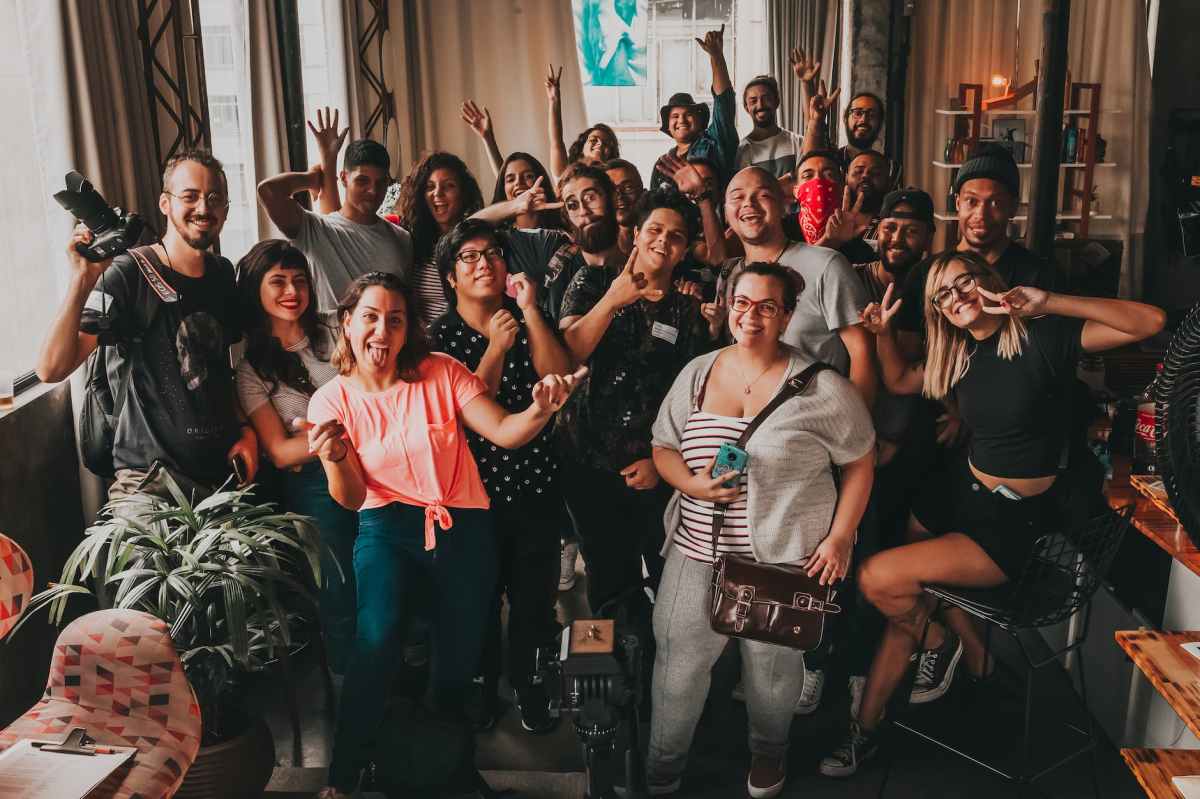
Community of persons, not groups

Dancing in the Kingdom- Table of Contents

Dancing In the Kingdom – Part 3 – Dancing in the Kingdom– Chapter 17 – Finding our place

Community of persons, not groups

[Bible references: 1 Corinthians 12]

It would be more typical to frame our relationships in a widening circle that centers on God and ourselves, then widens to family and then widens to the church. That would certainly fit the way we normally prioritize things. This is in the context of a culture with an increasingly self-centric consumer mentality that focuses on addressing our individual needs over the needs of the community. A typical response of organizations, including the church, is to identify which groups people are in and the provide a product or service to meet that needs of those groups such as children, youth, adults, married, single, etc.

While it is proper to identify common needs of various groups, care needs to be taken that we serve as individuals serving other individuals, not as one subcommunity in the church serving another subcommunity within the church. Both those who serve and those who are served are image-bearers who are individually valuable to the God who values each of us as individuals.

Observe

Read 1 Corinthians 12. What is it that we can do as an entire Body of Christ that we cannot do well as one part of the Body by itself?

Clash of sects

Dancing in the Kingdom- Table of Contents

Dancing In the Kingdom – Part 2 – The Kingdom Revealed– Chapter 10 – The Class of Apparitions

Clash of sects

[Bible references: John 2:18]

By the time Jesus entered history, several different types of groups had emerged among the Jews. When groups clash, the victors of those conflicts are the ones that write and preserve their own version of history and may also destroy any records of their enemies, there tends not to be much material about non-victor groups that survives for us to look at. Even so, there is some amount of evidence available for us to examine their views. Many of the views held by the Jewish sects will be seen again within Christian sects and even within groups today.

Observe

Read John 11:8-36. What kinds of things can we do to make people notice how much you love?

God working through broken individuals and communities

Dancing in the Kingdom- Table of Contents

Dancing In the Kingdom – Part 1 – Shadows of the Kingdom – Chapter 5– Patriarchs

God working through broken individuals and communities

[Bible references: Genesis 20; Psalm 51:17; Isaiah 40:8; 58:1-14; Jeremiah 5:19; Philippians 3:20-21]

Although the all-powerful Creator and Sustainer of the universe is capable of simply doing things by a show of great power and irresistible force,[1] he usually chooses to work through His image-bearers.[2] He can work through individuals or groups, although even when he works through groups it’s typically through individuals within those groups.[3] Most surprising is that even though all his image-bearers have flaws, God has still chosen to do His work within those flaws.[4] Despite our persistent failures, not only does God patiently empower us to fulfill the responsibility of stewardship of Creation that He gave us from the beginning, but He also empowers us to participate in His work of restoring the universe.


[1] Spurgeon, C.H. “The Power of Christ Illustrated by the Resurrection” Biblehub biblehub.com/library/spurgeon/spurgeons_sermons_volume_17_1871/the_power_of_christ_illustrated.htm

[2] Welchel, Hugh, “Three Key Passages Concerning Stewardship in the Bible” The Institute of Faith, Works & Economics 19 Oct 2016 tifwe.org/stewardship-in-the-bible

[3] Cole, Stephen J. “Lesson 51: How God Uses Ordinary People (Genesis 26:1-35)” Bible.org 29 Aug 2013 bible.org/seriespage/lesson-51-how-god-uses-ordinary-people-genesis-261-35

[4] Wilson, Jarrid, “God Uses Flawed People To Share Hope To a Flawed World” jarridwilson.com 16 Mar 2014 jarridwilson.com/god-uses-flawed-people-to-share-hope-to-a-flawed-world/

Reflect

What does it mean to you that the One who has all knowledge prefers to carry out his plans for us through us who not only have incomplete knowledge but have corrupted intentions?

Observe

Read Isaiah 58:1-14.This passage describes the difference between who we are now and what we should be. What can we be doing better?

Patterns of community

Dancing in the Kingdom- Table of Contents

Dancing In the Kingdom – Preface

Patterns of community

[Bible ref: Hebrews 10:23-25]

After decades of learning the Bible and church history, I could see the pattern of how the everything connected all the way from Genesis to Revelation and to all of church history, past and present. In preparing this project, all those patterns were reinforced in ways I never expected. One of the patterns that we see from the beginning is the use of stories. God is complicated and we are complicated, and we find that stories are sometimes the best way to explain everything from who God is to who we are.

To best understand the complications of who God is and who we are, this book is best processed in a small group setting so that we can work our own ideas with the ideas from other people. Furthermore, in our Western culture which prioritizes individuality, we sometimes find it hard to see the significance of the Biblical texts being addressed to the church rather to individuals within the church. We can better understand the texts if we can grasp that aspect.
Lastly, as we study the Bible, we need to remember that the goal of any Bible study is not to love the Bible but rather the One who gave it to us. That means, though, that we should love the church, which is Christ’s Body, Christ’s assembly of believers whom He loves.

And that love is not just an emotion or an idea, but a lifestyle of joy and self-sacrifice, receiving and giving, caring in word and deed, engaging with an interdependent community and with God in a dance, the Kingdom Dance, participating with God in restoring the Kingdom, turning the mourning of a broken world into the joy of a reunited heaven and earth.

Reflections – The Life Map exercise

The first step to see how our life’s story fits into God’s story, is to take the time to see how God may have already been working in your life. Plan on at least a half hour for this exercise.

Brainstorming:

Use only single words, short phrases or quick sketches to make these lists. Jot these items down as they come to you.

  • Make a list of significant things (events, people, places, etc.) in your life. People may include family members, influential people, teachers, authors, or influencers. Places may include where you’ve lived, places you’ve visited, places you want to go. Events may include family life and traditions, marriages, divorces, education, church, social organizations, jobs, or hobbies.
  • Make a list of successes or failures. These can include things that delighted you or disappointed you, relationships, things that you’ve done or things that have happened to you.

Rearrange the items in these lists in chronological order. Take some time to think of how God may have directed you in the midst of your story and talk to him about it. Think of how you would tell this story to other people.

There are other resources on the internet about make Life Maps:

Revisit in the future: As you work your way through Dancing in the Kingdom, you may want to further reflect on or revise your Life Map.