Reclaiming the institutional church

Dancing in the Kingdom- Table of Contents

Dancing In the Kingdom – Part 3 – Dancing in the Kingdom– Chapter 18 – Entering the Dance

Reclaiming the institutional church

[Bible references: Matthew 5:1-16, 38-48; Luke 6:1-49; John 13:1-17, 34-35]

There are many people who claim to love Jesus but not His church (which is his body). But we need to keep in mind that every accusation we may choose to hold against the church is against us personally. The church is comprised of sinful people, and that includes us. The church has done inappropriate things in the past and so have we. As part of our, and the church’s, sinful behavior is the ease with which we focus on the things that have gone wrong while forgetting to examine the “log” in our own eye. A quote from an old cartoon strip is appropriate here, “We have met the enemy and he is us.”[1]

The second thing we need to hold onto is that as Jesus loved the world enough to die for – and redeem – the very people who rejected him. That includes the church – which includes us. If we are commanded to love our enemies, what should our attitudes be towards the group that we are part of? It is normal for us to have higher expectations towards our own family than those who are outside the family. Because of that, it is normal for us to be disappointed by or hurt more easily by people within our family than by anyone else.

Those hurts and disappointments can lead to us overlooking all the ways in which the church has, in its broken way, still managed to fulfill at least some of the intentions God has had for the church. Within the very messiness of church history, the church had not totally neglected its ability to show love to one another and to reach in love to those outside the church. It is through the church that we have the Bible and faithful Christians through the years that created hospitals and orphanages, taken care of the widows and others who need care. It is the church that made it possible for us to hear about the gospel and respond to Christ’s invitation to follow him.

The church is the body of Christ. We serve as the hands and feet, etc. of Christ, doing together what is not possible to do by ourselves. In the apostle Paul’s articulation of the Body of Christ, he notes how we all serve as different parts of the body, helping each other grow by serving in the unique ways God has prepared for us. Furthermore, Christ has told us that we will be recognized as his disciples by how we serve one another in love. This is one of the grand themes of the Bible, God has reached out to us in love, and we can respond by loving him in return; also loving one another. It is through our reflection of his love that others will respond to God in love as well.

On this side of the second coming of Christ, we all remain broken and so our institutions will remain broken. But that does not mean that Christ is unable to use us (as individuals or as part of an institutional church) for his purposes and that does not mean that the goodness of Christ is unable to be reflected through us as individuals or groups or through the institutions we create as his co-heirs to bring mercy and justice to his image-bearers and the world he has prepared for us.

In formal or informal ways, we create the institutional church to help us more effectively serve one another within the Body of Christ and to serve others outside the Body of Christ. As we take an historical look at the expected mixed record of the Body of Christ’s broken church (and, we must remember, our personal records as well), we need to cling to Christ, His love, His sustenance, and forgiveness us for all the ways we have failed to love each other within the church and outside the church.


[1] Kelly, Walt, From a Pogo strip, 22 Apr 1970 www.thisdayinquotes.com/2011/04/we-have-met-enemy-and-he-is-us.html

Reflect

Sometimes our church organizations can be hard to love. Nevertheless, we cannot truly love Christ without loving his church. How could you better express love for your local congregation this year?

Observe

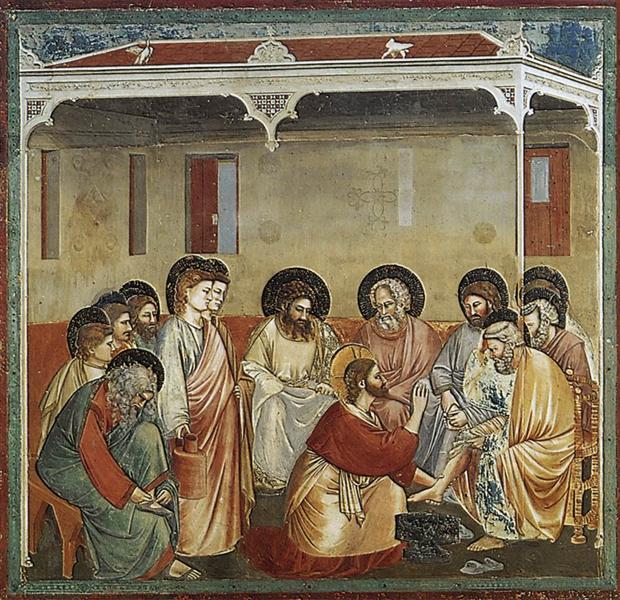
Read John 13:1-17. How can we love and serve the church as Jesus showed us?
Bottom-up strategy

Dancing in the Kingdom- Table of Contents

Dancing In the Kingdom – Part 3 – Dancing in the Kingdom– Chapter 18 – Entering the Dance

Bottom-up strategy

[Bible references: Romans 5:1-11; 10:11-15; 1 Corinthians 13; 2 Corinthians 8:1-14; 1 John 4:21]

There are two strands of strategy that can be seen in attempts of Christians to influence culture. In the bottom-up type of strategy, Christians reach out to individuals, with the thought that “transformed people transform cultures.”

“Discipled leaders transform cultures through their own transformed lives” [1]

But the evidence shows mixed results. For example, in America, as late as 2015, 89 percent of the people believed in God, but in government, academia, popular entertainment, were in process of becoming increasingly materialistic and secular. On the other hand, we see that Jews, who have never comprised more than 3.5 percent of the population, have had very strong contributions to many areas such as science, literature, music, and film.[2]

“The share of U.S. adults who say they believe in God, while still remarkably high by comparison with other advanced industrial countries, has declined modestly, from approximately 92% to 89%, since Pew Research Center conducted its first Landscape Study in 2007” [3]

We should keep in mind that historical records are not good at showing how the quiet contributions of individual Christians have made a difference in lives of other individuals who were not in positions of power, nor how such combined contributions may have impacted parts of society until such changes affect those in power. That does not mean that bottom-up transformation is without merit.

We certainly should not forget the importance of conventional methods of evangelism and missions which focus on outreach to individuals at all levels of society. After all, the change we most want to see are the hearts of individuals changed in direct response to the gospel message. In that regard, we are more concerned about heart transformations than the cultural transformation that should result from heart transformations.

Another bottom-up strategy in that regard is for a local church to “preach” to the culture around it by simply living as a Christian community, drawing individuals who respond to seeing how the Christian life can be lived out.


[1] Poore, Preston. “Transforming Culture through a Transformed Life” Preston Poore and Associates, 31 May 2020 prestonpoore.com/transforming-culture-through-a-transformed-life

[2] Hollinger, David. Science Jews, and Secular Culture Princeton University Press, 1996

[3] Pew Research Center. “U.S. Public Becoming Less Religious”3 Nov 2015 www.pewforum.org/2015/11/03/u-s-public-becoming-less-religious

Observe

Read Romans 5:1-11. How can the Christian life impact those who see it?

Listening to our culture

Dancing in the Kingdom- Table of Contents

Dancing In the Kingdom – Part 3 – Dancing in the Kingdom– Chapter 17 – Finding our place

Listening to our culture

[Bible references: Proverbs 12:15; Isaiah 5:20; Luke 10:25-37; Acts 17:16-34; Galatians 5:16-23; James 1:29; 1 John 4:1]

Outside of providing a healthy, flourishing place within the church community, how can we be more deliberate in engaging with those outside the church. Like the Apostle Paul engaging with the citizens of Athens, we must know what it is we believe then take the time to understand what the others believe and what their needs are so that we can begin the conversation. We can speak better after we have listened.

Listening to voices from outside the church can be challenging because their value systems and world views are so different. We saw in Chapter 13 how different experiences and viewpoints within the church have affected how they answer the various questions asked by the church. We do need to be aware of the different values and world views because, on the one hand, they may add useful understanding to our faith, then on the other hand, they can also distort the values and world views we have within the church.

“A newly released survey reveals that the ideologies of postmodernism and secular humanism have a noticeable influence on how Americans make decisions. The Cultural Research Center at Arizona Christian University released the eighth report of its 2021 American Worldview Inventory Tuesday. The report was based on responses collected from 2,000 American adults in February as part of a more extensive survey with a margin of error of +/- 2 percentage points. The survey found that although 2% of Americans have adopted secular humanism as their dominant worldview, a significantly higher share of the population (16%) actively embrace principles associated with the worldview. Similarly, while just 1% of Americans have adopted postmodernism as their dominant worldview, 16% frequently make decisions indicating that the philosophy plays an important role in shaping their day-to-day actions.” [1]

What is apparent from the study done by the Cultural Research Center at Arizona Christian University, is that there is a small percentage of Americans who are aligned with one particular ideology, but many of us, including many within the church, have adapted only various pieces of various ideologies. Before we figure on how to bring the gospel to or culture, we may first need to understand how our culture has affects our understanding of the gospel[2] so we can communicate clearly about what the gospel is.

According to Timothy Sheriden and Michael Goheen, there are four theological considerations:

“The first is an understanding of the gospel as the good news of the kingdom …God is restoring his gracious and loving rule over the whole of creation and every aspect of human life. … The second is an understanding of the comprehensive and restorative nature of salvation … the whole of human life … the restoration of this creation … The third is the lordship of Jesus Christ … He is more than a personal savior; he is Lord of all. Fourth, the church is the new humanity that shares in the future life of the kingdom now, as sign, foretaste, and instrument.” [3]

Once we are clear on what the gospel message is, then we are prepared to first express love by listening to our “neighbor,”[4] so that we then address our neighbor’s needs as we share the gospel. The very short following list highlights just a very few of the predominant cultural ideologies that have influenced our neighbors.

  • The church should not influence the government.
  • Religious ideas are to be kept as private ideas not to be discussed in public
  • Rejection of any knowledge other than what is available by science.
  • Humanity is always getting better.
  • All knowledge, hence, all truth, is relative.

When we talk with fellow image-bearers of God, we need to remember our common humanity,[5] that despite our differences there are many things that we share together. We were all intended to create good, and we are all broken in our attempts to do that good. Our society tends to put labels on ideas, such as those listed above, but those labels tend to be unhelpful because we then create divisiveness by using them to label people.

Whatever ideologies we may encounter in our conversations, we should remember that people are usually not as responsive to attacks on their ideas when they feel they are being listened to. When we are listened to, we may find each other more receptive as we each express our convictions sincerely in context of a polite conversation.

One way of loving our neighbor is suggested by Richard Mouw. Convicted Civility,[6] is a civility that begins with kindness, grace, patience, generosity, and caring for the other paired with a conviction that is not being relativistic, but truthful about what you don’t approve. Jesus showed most of his criticism to people within the religious establishment but was gracious to the “sinners.”


[1] Foley, Ryan. “Postmodernism, secularism have increasing influence over Americans’ decision-making: report” Christian Post, 10/22/2021 www.christianpost.com/news/peoples-choices-influenced-by-postmodernism-secularism-report.html

[2] Mattera, Joseph. “Why Your Faith is More Influenced by Culture than the Bible” JosephMattera.org 31 Aug 2017 josephmattera.org/faith-influenced-culture-bible

[3] Finn, Nathan A, Whitfield, Keith S. “Chapter 5 Missional Spirituality and Cultural Engagement” IVP Academic 2017IVP Academic 2017

[4] This parable helps us to understand that our “neighbor” includes anyone we encounter.

[5] Warren, Tish Harrison. “We Need to Talk How Americans Can Learn to Live Together Again” New York Times, 10/24/2021

[6] Mouw, Richard J. Uncommon Decency: Christian Civility in an Uncivil World. IVP Books 2010

Observe

Read Luke 10:25-37. Jesus told the story with characters his audience could identify with. What characters would you choose to tell the same kind of story today?

Preparing to engage with those outside the Church

Dancing in the Kingdom- Table of Contents

Dancing In the Kingdom – Part 3 – Dancing in the Kingdom– Chapter 17 – Finding our place

Preparing to engage with those outside the church

[Bible references: Matthew 9:35-38; 13:1-30; 22:34-40; John 3:16]

When talking with someone for the first time, we never know what experiences the person has gone through in which the Spirit of God was already at work. If we take the time to listen, then we can share the Gospel more effectively. Some will be immediately ready to receive the Gospel, and some will need more caring for. In either case, if we remember that our primary directive is to love God and love our neighbor, we must be ready to bear the cost of that love.

“For God so loved the world that he gave his only Son … (John 3:16, ESV)”

What costs are we prepared to bear for our neighbor? Are we prepared to bear the cost of loving those within the church so that we can provide a loving, united atmosphere to invite someone from the outside? Are we prepared to bear the cost of friendship with those outside the church so that they can witness what is means for us to have Jesus as our friend? Are we prepared to listen to the concerns of our neighbor so that we can model how God listens to us?

Reflect

What cost are you prepared to pay for the sake of loving your neighbor?

Observe

Read Matthew 13:1-30. How can we be “sowing seed” in all the different “fields” of our community?

The Discipline of Liturgy

Dancing in the Kingdom- Table of Contents

Dancing In the Kingdom – Part 3 – Dancing in the Kingdom– Chapter 15 – Reforming our Souls

Discipline of Liturgy

[Bible references: Exodus 12:1-28; Psalm 39:4-7; 90:9-12; Ecclesiastes 12:1]

I don’t know why so many Christian groups think they need to reinvent the wheel when it comes to “discipleship programs.” This time-tested annual pattern for the life of individual believers and the Church together that is focused on Christ, organized around the Gospel, and grounded in God’s grace, is sheer genius. It is simple enough for a child. It offers enough opportunities for creativity and flexibility that it need never grow old. Each year offers a wonderful template for learning to walk with Christ more deeply in the Gospel which brings us faith, hope, and love.[1]

Teaching and learning that are attuned to the spiritual power of habit recognize the power of little things, the formative power of micro practices. Little things repeated over time in community have a formative effect.[2]

In one sense, a liturgy is a ritual, or a script, used by a congregation to format its worship services. In that regard, all congregations are liturgical no matter how formal or informal. In another sense, a liturgy is a “work of the people” which emphasizes the participation of the congregation during the worship service. The goal of the liturgy is to place the whole of our lives, including our schedules, our possessions, and our efforts, in submission to Christ.

That means that we should consider not just what we do on Sundays in the corporate setting of the church, but as individuals, we have our own individual liturgies through the week as well. We should pay attention to the ‘work’ we do as individuals as we live our lives, the ways we worship as we go about our daily lives, the tasks we do and the habits we practice. How do we, in fact, place the whole of our lives, our schedules, our possessions and our efforts, in submission to Christ? That is the point of our liturgy and all the other disciplines we incorporate into our lives.

The liturgical year

The liturgical year is an ancient, time-tested method of discipleship. In addition to the weekly Lord’s Day reminder/celebration of the resurrection of Christ, the liturgical calendar provides a way of refocusing our attention on the spiritual aspects of life. The focus on the Christian story and celebrations provides an opportunity to be shaped by our counter-cultural message rather than the so-called secular message and celebrations. The liturgy of Word and Sacrament has varied through different times and places, but the ancient liturgical calendar provides one way for us to engage as in a concert in a practice that unites us to the one holy, catholic church, past, present, and future.

Sacred Time

Interestingly, the Jews have a liturgical calendar that is different than their “secular” calendar, in the same way that we keep a liturgical calendar that is different from the secular calendar. The calendar of the Canaanite culture of the Old Testament started at the beginning of the wet season which began in the fall. That was the time when seeds would be planted. The Biblical calendar starts in the spring at the beginning of the harvesting season. While the Canaanite culture begins the year with the work that they do to reap a harvest later, the Israelite culture begins their year harvesting the crops (that God provided) and from which they would have seeds to plant later. The difference highlights whose work has preeminence. The “Gentile” calendars are similar. The secular year begins in January as the date when the Roman consuls would begin their terms of office whereas, the Christian liturgical year builds our focus around the life and ministry of Jesus.

There is an intriguing way in which the Jewish culture uses its calendar compared to how we now use it. Whereas, in our present culture we, with a few exceptions, remember historical events according to the actual historical dates that event occurred set. There are exceptions, like Martin Luther King’s birthday which is set to be always celebrated on a Monday, regardless of his actual birthdate. The long weekend has preeminence over the actual birthdate.

This shift of preeminence helps explain what seems to be certain discrepancies in how things are recorded in the Bible. These apparent discrepancies include: the timing of travel to Sinai from Egypt, the construction of the tabernacle, the timing of events in Deuteronomy, even the timing of events in Holy Week. These apparent discrepancies can be explained when we look at them within the biblical framework.

The Bible’s liturgical calendar always celebrates historic events in the same way we handle our exceptions. In the Biblical framework, it is more important to remember events according to the liturgical calendar rather than the actual historic chronology, to frame events in a spiritual context rather than in an historical context.

This includes the events of creation. The modern debates concerning whether creation happened in six 24-hour earth days or six longer eras – or whatever – can be put aside as only scientific concern but not necessary as biblical concerns. The purpose of the liturgical calendar is to help us place everything, both in time and space, both physical and spiritual, in God’s domain. This includes us and the little piece of time and space that we occupy. Therefore, all things, including all our time, our possessions, and our efforts, are under the domain of God. The discipline of the liturgy then provides the larger context in which we can pursue all our spiritual disciplines


[1] Spencer, “Chaplain” Michael. Internet Monk Archives imonk.blog/2010/11/15/church-year-spirituality

[2] Smith, James K.A. “You Are What You Love: The Spiritual Power of Habit.” Brazos Press 2016. eBook

Reflect

The sacred calendar reminds us that all time is sacred. In which parts of your day are you most likely to need reminding of that sacredness?

Observe

Read Exodus 12:1-28. Yahweh is establishing a new calendar for the Israelite. What is the purpose of creating a new calendar?

Disciplines of our hearts

Dancing in the Kingdom- Table of Contents

Dancing In the Kingdom – Part 3 – Dancing in the Kingdom– Chapter 15 – Reforming our Souls

Disciplines of our hearts

[Bible references: Matthew 6:24; Romans 12:1-2; 1 Corinthians 3:16; 6:12-19; 9:25-27; 1 Timothy 4:7-8,12; 2 Timothy 3:16–17; Hebrews 4:1-11; 5:14; 2 Peter 1:3-25]

Anyone who remembers learning … remembers choosing to engage in repeated practice over and over and over precisely so that the rhythms become practices.[1]

Spiritual disciplines are personal and interpersonal practices (habits or activities – not attitudes or character qualities) that are taught or modelled in Scripture which promote spiritual growth among believers in the gospel of Jesus Christ. The spiritual disciplines derive from the gospel and take us deeper into an understanding of the gospel and they are the sufficient means by which we can know and experience God so that we can become more like Him.

“Spiritual discipline, then, is developing soul reflexes so that we know how to live. We discipline ourselves to develop soul memory in normal times so that we’ll be equipped for the times of high demand or deep crisis.”[2]

A few words of caution: Although spiritual disciplines are the means to godliness that does not mean that we are godly just because we practice them. The great error of the Pharisees was that they felt by merely doing these things they were godly. The disciplines are meant to provide opportunities for Christ to transform us – they are not meant to be a burden or an end in themselves. Although we engage in the disciplines to pursue God we should not rely on our effort or our strength, but by resting in power of the Spirit.

Although God will grant Christlikeness to us when Jesus returns, until then He intends for us to grow toward it. We aren’t merely to wait for holiness; we’re to pursue it.”[3]

“The Disciplines allow us to place ourselves before God so that he can transform us . . . The inner righteousness we seek is not something that is poured on our heads. God has ordained the Disciplines of the spiritual life as the means by which we place ourselves where he can bless us. In this regard it would be proper to speak of ‘the path of disciplined grace.’ It is ‘grace’ because it is free; it is ‘disciplined’ because there is something for us to do.” [4]

Maturity requires incremental growth, accumulation of experience

Before we begin to look at the specific disciplines available to us, we should consider their overall purpose. We are beings created in the image Christ, and although we are not Christ, we can become more like Him. Becoming like Christ is a process. We have examples all around us to show us that growth is a process. Plants start from a seed then, in time, grow and develop new parts until the plants become mature and can reproduce. The same with animals. These examples indicate to us that not only is growing a process but that there is an aspect to growth that is built in to automatically happen. Animals and plants, with proper nutrients and environment, will just naturally become mature.

Allowing intentional choices to become habits and the habits to shape our character

But image-bearers of Christ are not merely plants or animals. Our growth is dependent on the development of culture, which are aspects of our way of life that are not automatic but rather are chosen. We can make choices, moral choices, about what we think is important, to set priorities and values. Those choices started in a garden full of abundant food, but we had a choice to not eat the fruit from one particular tree, we had a choice to make based on love and obedience.

Allowing different disciplines to strengthen each other

The spiritual disciplines provide us with choices, to be intentional about how we want to grow. We will see that each discipline is dependent on the others, and each discipline can then weaken or strengthen the others. So, we may enter the disciplines at any point, but we should not neglect the others. We can choose to start from an area of strength or an area of weakness, but we should not neglect the other paths to growth.

The discipline of the soul is not disconnected from the discipline of the body

We are embodied creatures. As we engage in disciplines, we should consider the interplay of soul and body and how they affect each other. We see this effect when, on the one hand it is true that if we are feeling confident then our bodies tend to present a confident posture and on the other hand, it is also true that if we are not initially feeling confident then intentionally assuming a confident posture can produce the feeling of confidence. This leads us to the phrase, “fake it till you make it.” We should keep the interplay of spiritual and material, body, and soul, in mind as we engage in our spiritual disciplines.

Our bodies are the very temple of the Holy Spirit within us, and it is through our bodies that we exercise our faith – and through which we are capable of exercising immorality. To that end, the apostle Paul saw fit to discipline his body as part of his overall ministry.

Forming our virtues

Virtues are the qualities of Christ in our lives that are provided by Him: qualities such as compassion, kindness, humility, gentleness, patience, forgiveness. These qualities help us escape “the corruption that is in the world through lust. (KJV)” But although these qualities are given by Him, we are exhorted to strengthen those virtues with spiritual disciplines. For example, we should add virtue to our faith and virtue to our knowledge for knowledge without virtue only makes someone a walking textbook. Virtue helps add to our faith, to our knowledge, to our self-control, to our perseverance, to our godliness, to our brotherly kindness and to our brotherly love. It all hinges on godly virtues being added to our faith.

As Christians, we all want to grow in spiritual maturity and Christlikeness. Elders should be models of Christian maturity, qualified to the office primarily based on their character. While the Bible provides one quality related to skill (the ability to teach) and one related to the amount of time a man has been a Christian (not a recent convert), all the other qualifications are related to character. Yet while these traits are demanded of elders, they are not unique to elders. Elders are to be exemplars of the Christian graces which all Christians should aspire to. Every congregation is meant to be full of men and women who are above reproach, sober-minded, self-controlled, respectable, hospitable, sober, gentle, peacemaking, not lovers of money, mature, humble, and respected by outsiders.


[1] Smith, James K.A. “You Are What You Love: The Spiritual Power of Habit.” Brazos Press 2016. eBook

[2] Rumford, Douglas. SoulShaping. Tyndale House Publishers 1996

[3] Whitney, Donald S. Spiritual Disciplines for the Christian Life Navpress 2014

[4] Foster, Richard J. Celebration of Discipline Harper & Row Publishers ©1978

Observe

Read Romans 12:1-2; 1 Corinthians 9:25-27; 2 Timothy 3:16-17; Hebrews 4:9-11; 2 Peter 1:3-25. We are paradoxically called to both work and to rest. How do we do both at the same time?

Mystery of faith

Dancing in the Kingdom- Table of Contents

Dancing In the Kingdom – Part 2 – The Kingdom Revealed – Chapter 13 – Distinctives within the body of Christ

Mystery of faith

[Bible references: Exodus 31:1-11; Isaiah 1:18; Romans 1; 3:24; 4:16; 5:2-21; 6:15; 11:5-6; 2 Corinthians 6:1; Galatians 5; Ephesians 1; 2 Hebrews 12:1-39]

Faith and grace

If we try to systemize grace and faith, we find some saying that God will only give some people a special grace that allows them (and only them) to have faith to receive God’s forgiveness and some will say everyone is given that grace. Fortunately, receiving God’s grace is not dependent on our understanding. We only need to acknowledge it is only by God’s grace that we can be forgiven, and it is by God’s grace that we can be saved through faith.

After we “make a decision” to receive grace through faith, some will have the attitude that, “I’m saved, there is nothing more to do.” This attitude is sometime characterized as getting “fire insurance” or a “get out of hell free” card or as “easy believism.” This puts emphasis on “making a decision to accept Christ as our Savior” as if that was the main point.

While acknowledging Jesus as our Savior is a good thing, we should not put to the side that our decision should also acknowledge that Jesus is also our Lord and therefore our decision includes following Him as a disciple.

Faith and reason

Scripture is full of exhortations for us to use our reasoning. In Isaiah 1:18, Yahweh invites us to reason together with Him. In Romans 1, Paul tells us that we can even discern the truth of God’s invisible qualities, that they are clearly seen in the world around us. The scriptures are full of examples of God pleading with us, appealing with us to do the right things.

Scripture also encourages us to walk and live by faith, to trust God by faith, to obey God by faith, that we need to come to him by faith, that our righteousness comes by faith – and that faith is having confidence in what we hope for and assurance about what we do not see.

To hold these in tension, we cannot go to either extreme of abandoning our intellect or abandoning faith, rather we must go trust God to act in the future based on what we have seen him do in the past or present.

Faith and Creeds

It would seem nice if we could make a simple statement like, “The Bible says it and I believe it,” and not be misunderstood. But it’s not so simple. That’s because the Bible is not a straightforward text of moralizing or instructions. It’s a collection of stories, poetry, bits of wisdom, letters written from one person to another or to a group, prophecy, etc.  So biblical interpretation is not a task to be done lightly. Instead, it requires that we look at every verse in the context of the passage that it’s in, who wrote it and to whom and in the context of the entirety of scripture.[1] 

To address that problem, many congregations have found it expedient to clarify what they believe by using certain creeds or statements of faith. But then we run into the problem of the creeds or statement are not saying enough about the entirety of the faith of the congregation. So other congregations avoid creedal statements altogether and simply say that the Bible as a whole describes their faith.[2]

Faith and expressions of the Gospel

Living out the Gospel can encompass all parts of our lives, but for various reasons, different parts of the church at different times have chosen to focus on different aspects of the Gospel, often creating an imbalance in how the Gospel is lived out. Overfocusing on the intellectual aspects of faith led to a movement to focus instead on internalizing one’s faith and personal walk with God. Overfocusing on one’s personal walk with God led to a movement to put more of a focus on the public aspect of faith and the need for social justice. A desire to “return” to the faith of the New Testament church led to a desire to live out the “whole Gospel,” emphasizing the power of the Spirit as expressed by miracles, healings and speaking in tongues. Of course, the “whole gospel” actually encompasses all aspects and loving God with all our hearts, minds, soul and spirit.

Faith and Art

[Bible references: Exodus 28:3; 31:1-11; 35:10-33; 1 Kings 7:13-14; Proverbs 8:30; 22:29; Isaiah 54:16; Zechariah 1:20]

Expressing our faith through art had been common since God instructed people gifted in arts and crafts to build the Tabernacle. During New Testament times, poverty and persecution limited the amount of artwork, and that artwork was largely symbolic. But after the legalization of Christianity, expressions of the faith blossomed in both art and architecture. The eastern church started to express its faith through special artwork called icons which were highly revered. However, when a volcano erupted in AD 726, superstitions within the empire created a movement to rejected artwork[3] which did not finally end until AD 834[4]. To this day, different segments of the church either accept or reject the use of artwork.

Faith and perceptions of God in the Old and New Testament

At first glance, it could seem like God in the Old Testament is different than God in the New Testament. In the Old Testament the stress seems to be on the holiness of God and his distance from us while in the New Testament the stress seems to be on the love of God and his closeness to us. God in the Old Testament seems to act violently while in the New Testament He seems to act humbly and peaceably. This apparent dichotomy has created much consternation, causing some people to reject or ignore the Old Testament and only focus on the New Testament. But God is the same today, yesterday, and tomorrow. God never changes. More careful reading will show that the Old and New Testaments are not so different, and the characteristics we see of God in one testament can be found in the other testament.


[1] The discipline of “hermeneutics” or “bible interpretation” gives guidance on how to properly interpret the scriptures.

[2] These congregations are called noncreedal congregations.

[3] iconoclasm

[4] Art in Context, “Early Christian Art – Christian Artwork and Biblical Paintings” Artincontext artincontext.org/christian-art/ ; Joy of Museums “Christian Art and Biblical Paintings” Joy of Museums joyofmuseums.com/most-popular/popular-christian-art/

The challenge of the church

Dancing in the Kingdom- Table of Contents

Dancing In the Kingdom – Part 2 – The Kingdom Revealed – Chapter 13 – Distinctives within the body of Christ

The Challenge of the church

[Bible references: 2 Corinthians 11:1-15; Galatians 2:7; Colossians 2:8; 2 Thessalonians 2:4-15; 1 Timothy 2:14-26; 6:11-21; 2 Timothy 1:12-14; 2:16; 3:14-16]

Mysteries and distinctives

There is an impossible task set before the believers through the world who comprise what some call the invisible, universal church: Differences have arisen which have caused different local congregations to have some disagreements about what the correct theology is. We will call these differences, distinctives. It is from these distinctives that local congregations divide from one another with some finding themselves aligned into different groups that we call denominations or associations, and some not formally aligning themselves with any other congregation at all.

Although while trying to understand God, we may find that although some things are incomprehensible, other things are knowable. The knowable things make it possible to construct a limited theological framework, despite the tensions cited in Chapter 2 that require us to hold some things in tension.

When distinctives become heresies

Trying to understand a complex, incomprehensible and paradoxical God leads naturally to some diversity of thought. The problem is trying to detect when diversity leads to heresies, ideas that are identifiably contrary to the Biblical message and ought to be rejected by all the major bodies in the church. Heresies typically develop when biblical verses are taken out of context, or when attempts are made to mesh non-Christian ideas with biblical ideas.

The following is a list of some of the most prevalent heresies. For a more comprehensive list of some of the heresies and the terms used for them, read “Appendix F – Partial Listing of Heresies”.:

  • Matter is inherently evil and only the spiritual is good,
  • being saved by grace allows us to ignore any laws or norms,
  • rejection of the Old Testament,
  • rejection of the Trinity,
  • only the Father is God,
  • Gentiles need to be circumcised and follow the Jewish laws,
  • the validity of sacraments depends on the moral character of the person administering the sacraments,
  • those guilty of grave sin are permanently excluded from the church,
  • we can choose to be good apart from God’s grace,
  • Christ is not fully human and fully divine,
  • prophets who claim that they supersede the apostles,
  • all truth and knowledge of God is accessible by the human mind.,
  • all people will be saved.

Even within our limited framework, it is possible to find that sometimes someone’s theology seems so wrong that it must be corrected and dealt with more strongly. In those cases, the church must determine when some of our distinctives have crossed over from being a ‘distinctive’ to being a ‘heresy,’ teachings that are not just different but cause fundamental theological problems in the teachings of the church. The task of identifying and correcting heresies is a job that must be done but these days is complicated by the divisions within the church. This is one area where we need to recognize Dynamic Tension at work: balancing the need to deal with doctrine and practices that are deemed to be heretical with the need to, as much as possible, retain whatever unity is possible in the church.

There was a time that it was more possible to call together representatives from all parts of the church to discuss difficult issues and come to a common agreement, but that is no longer possible. Between AD325 and AD757 there were seven ecumenical councils[1], councils that were called by the Roman emperor which tried to resolve various questions, at least within the empire, which were dividing the church.

“all the doctrinal definitions of the Seven Ecumenical Councils (councils which have always, and still do, receive the unqualified acceptance of both East and West) … An Ecumenical Synod may be defined as a synod the decrees of which have found acceptance by the Church in the whole world”[2]

One of the most essential products of the councils were increasingly detailed creeds[3] for the church, statements written in response to perceived heresies that were being taught, clarifying what the orthodox teaching of the church ought to be.

Because of the complexities of the different viewpoints, the increasingly detailed creeds were never able to entirely resolve the differences between the Latin speaking and the Greek speaking parts of the church leaving the church with very intense divisions in the aftermath of each of the councils. After the seven Ecumenical Councils, the divisions in the church had become irreconcilable and it is no longer possible to call a council in which all sections of the church would be able to have an agreement on critical theological issues. There have been various ecumenical efforts through the years, including the creation of the World Council of Churches, but such efforts have not been able to overcome those disagreements on critical issues.

This division has complicated the issue of when theological differences become heresies. The inability of the visible church to resolve such issues forces us acknowledge our dependence on Christ; that the Gospel is the good news about our salvation to be found in the grace of Christ – and not in His still fractured church. In the meanwhile, despite the visible fracturing of the visible church, we need to humbly acknowledge the mystery of the unity of the church in Christ.


[1] Orthodox Church of America. “The Councils” Volume I – Doctrine and Scripture, Sources of Christian Doctrine, The Councils www.oca.org/orthodoxy/the-orthodox-faith/doctrine-scripture/sources-of-christian-doctrine/the-councils; Keating, Karl. “The 21 Ecumenical Councils” Catholic Answers www.catholic.com/magazine/print-edition/the-21-ecumenical-councils. Protestants and Eastern Orthodox regard only 7 ecumenical council, while the Roman Catholic regards 21 ecumenical councils because the Roman Catholic Church regards Eastern Orthodox and Protestant Churches as “separated brethren”.

[2] Schaff, Philip (1819-1893) (Editor) Publisher: Grand Rapids, MI: Christian Classics Ethereal Library, “A select library of the Nicene and Post-Nicene Fathers of the Christian Church. Second Series. Volume XIV. The Seven Ecumenical Councils. For a summary of the seven ecumenical Councils, See Appendix H

[3] See Appendix I – Creeds of the Church

Observe

Read 2 Corinthians 11:1-15; 1 Timothy 4:1-4; 6:1-10; 2 Timothy 2: 14-26. What are the warning signs of “false teachers?”

Guardians of the truth

Dancing in the Kingdom- Table of Contents

Dancing In the Kingdom – Part 2 – The Kingdom Revealed – Chapter 12 – Launching the church

Guardians of truth

[Bible references: Psalm 25:2; 45:4; 145:18; Proverbs 12:19; 22:21; Isaiah 45:19; 59:15; Jeremiah 5:1; Zechariah 8:16-19; John 1:14-17; 4:23-24; 8:44-45; 14:6; 16:13; Acts 20:30; Romans 1:18-25; 2:1-20; I Corinthians 11:18-19; 1 Timothy 4:6; 2 timothy 2:14-29; 1 John 2:20-21; 3 John 1:1-12]

God is always in part incomprehensible, mysterious, and paradoxical, which leads to an inevitable diversity of ideas about Him. And yet He has left us with a challenge, He has declared Himself to be the Truth and He has charged the church to be His instrument in making disciples, therefore making us the guardians of that truth. This means that when the church goes about its business of growing in the knowledge of God and developing doctrines about the One who always mysterious, there will be an inevitable tension of trying to discern when the developing diversity of ideas about the Truth will lead to ideas that oppose the gospel or lead to the revealed knowledge of God.

Observe

Read 2 Timothy 2:14-19. What lies are Timothy told to be concerned about?

Guarding the faith

Dancing in the Kingdom- Table of Contents

Dancing In the Kingdom – Part 2 – The Kingdom Revealed – Chapter 12 – Launching the church

Guarding the faith

[Bible references: Matthew 5:11-12; Romans 5:3-4; 1 Corinthians 11:29-31; 13:7; Ephesians 6:10-18; Philippians 1:10; 1 Timothy 4:16; 2 Timothy 2:10-12; 4:5; Hebrews 10: 36; James 1:2-12; 3:2-12; Revelation 2:3]

The church was launched in a world that was opposed to it. Jesus made it very clear that following him was in invitation to suffer. There would be enemies both within and outside the church, enemies that were sometimes not so apparent and therefore requiring discernment by the faithful. The opposition takes many forms but behind all the opposition are the spiritual forces in heavenly realms.

The real enemy is not so much the individual people we see but the spiritual forces of darkness acting around us manifesting as deceivers, scoffers, false apostles, divisions in the church, idolatry, or immorality – all either around us or within us. The challenge of fighting against those forces requires us to put on the full armor of God: truth, righteousness, the gospel, faith, salvation, the Spirit, and the Word. We are called to be alert, to always pray, to learn discernment, to endure and persevere.

By both his life and his death, Jesus offered reconciliation to all cultures. By his teaching Christ called Jew and Gentile together; both were offered a place in God’s kingdom, with the ethnicity of the Jews giving them no advantage whatsoever. While Jesus modeled this reconciliation in his own life and ministry, it took his followers some time to put this aspect of his message into effect. When they did, however, the results were revolutionary. The Jewish disciples of Jesus were taught to reach out with love and acceptance to the Gentiles, whom they had come to think of as beasts. The Gentiles were invited into fellowship with the Jewish disciples without having to become Jewish. … multiculturalism means fostering a genuine respect for diverse cultural expressions such as music, art, literature, and dance, and diverse cultural traditions in such matters as education, the family, and work. Such respect does not mean ignoring moral or spiritual failings reflected in these cultural expressions and traditions (since these can be found in any culture, including European). It does mean recognizing that certain constants of human life — love, growth, need, aspiration, suffering, hope — find expression in all cultures. [1]

As we engage with other cultures, we can celebrate God’s imprint on his image-bearers which has produced many creative, diverse, and multicultural ways to display God’s goodness. As we do, we should take care to recognize that all the world’s cultures are also subject to corruption. In our role as God’s ambassadors, we can recognize the good displayed in each culture and also reach out to offer God desire to reconcile all people to himself.

Since you died with Christ to the elemental spiritual forces of this world, why, as though you still belonged to the world, do you submit to its rules:  Do not handle! Do not taste! Do not touch!”? These rules, which have to do with things that are all destined to perish with use, are based on merely human commands and teachings. Such regulations indeed have an appearance of wisdom, with their self-imposed worship, their false humility, and their harsh treatment of the body, but they lack any value in restraining sensual indulgence. (Colossians 2:20-23, NIV)

In our discerning of the good and the bad in the cultures around us, we should be discerning of our own cultures and behaviors, not just the good and the bad, but the universal and cultural expressions of the gospel.


[1] Bible.org “Christ and Cultures: Multiculturalism and the Gospel of Christ” Bible.org bible.org/seriespage/12-christ-and-cultures-multiculturalism-and-gospel-christ.

Read Ephesians 6:10-18; James 3:2-12. What does it take to survive as a fruitful Christian?

Basics of the faith

Dancing in the Kingdom- Table of Contents

Dancing In the Kingdom – Part 2 – The Kingdom Revealed – Chapter 12 – Launching the church

Basics of the faith

[Bible references: Acts 1:12-26; 2:42-47; 4:32-37; 6:1-6; 8:14-17; 9:26-31; 11:1-18; 13:1-3; 15;1-29, 36-41; 1 Corinthians 1:10-17; 5:1-13; 6:1-11; 10:1-22; Galatians 2:1-14; 3:10-14. James 2:1-13; 3:1-12; 4:1-16; 2 Peter 2:1-22]

There are many aspects of the gospel, but it is nothing if it is not grounded in truth, about God and about us. But the truth is not the only thing, in fact, the whole truth of the gospel must be grounded in God’s character. The gospel is not just a set of facts that need an intellectual assent but good news that calls us to make an honest assessment of ourselves and to make a change of trust and allegiance.

The gospel is good news.

  • The gospel is the good news that God created us to pour his love into us.
  • The gospel is the good news that even though we are born in rebellion against God and are unable to keep doing things that separate us from him, that he has taken upon himself the punishment we deserve so that we don’t have to.
  • The gospel is the good news that when Jesus was resurrected and ascended into heaven, He went prepare a place for us there.
  • The gospel is the good news that if confess our sins then He is faithful and just and will forgive us our sins and cleanse us from all unrighteousness.
  • The gospel is the good news that once we begin our journey of trusting Jesus, then we begin the process of becoming more like Jesus.
  • The gospel is the good news that all of that and more is true.

There are various reasons that we sometimes don’t want to accept the good news. One of the biggest reasons is that we don’t want to acknowledge how bad we are and how deeply sin affects us. When we feel that way, we can start to imagine that we can balance out the good things we do with the bad things we do, and we’ll end up all right and God will be happy with that. But the gospel message is that,

  • the bad news is that our very nature is in rebellion against God and no amount of good works can make us unrebellious.
  • the bad news is that we can’t earn our way to a right relationship with God.
  • the bad news is that if we are not made right before God then we will suffer God’s judgement and wrath.
  • the good news is that Jesus paid the penalty for all our sins, past, present, and future.
  • the good news is that we can be made righteous through faith.
  • the good news is that it is by God’s grace that we are saved through faith. It is a gift – in fact, it can’t be something we earn.
  • the good news is that we only need to repent and confess our sins and receive His forgiveness.
  • the good news is that we can allow God to transform our lives and enable us to live lives that are pleasing to him.
  • the good news is that once God imparts his righteousness to us, we become his heirs.

Once we put our trust in Him, he does not automatically make us sinless. That won’t happen until he returns; and we all are resurrected with new, transformed bodies. It is through our untransformed bodies that we inherit the sin nature.

  • The good news is that the day of resurrection will happen.
  • The good news is that, between now and then, we can offer ourselves to God and He will, over time, begin the transformation process here in this life.
  • The bad news is that until then we will continue to rebel against God.
  • The good news is that in this in-between life that God can use our current struggles to strengthen us.
  • The bad news is that unbelievers will regard us as foolish.
  • The good news is that our apparent foolishness in committing our lives to Jesus is actually wisdom.

There is a lot of good news for us, and it’s based upon the truth of Jesus. Truth is important for Jesus, and in fact, he claims that He himself is the truth. The gospel is based on the truth, so it matters that we get the facts straight. That is why, one of the concerns expressed in the New Testament is the need to hold onto sound doctrine.

Read Galatians 3:1-12. What part of the gospel were the Galatians struggling with?

The Spirit and the servant-leaders

Dancing in the Kingdom- Table of Contents

Dancing In the Kingdom – Part 2 – The Kingdom Revealed – Chapter 12 – Launching the church

The Spirit and the Servant-Leaders

[Bible references: Matthew 23:8-11; Acts 1:12-26; 2:42-47; 4:32-37; 6:1-6; 8:14-17; 9:26-31; 11:1-18; 13:1-3; 15;1-29, 36-41; Galatians 2:1-14]

God had created the church as a community: a community to share life and resources, to support one another, to share the gospel and send out missionaries, and to pray together and make decisions together. It was as a community, a council of apostles, that they:

  • Chose Mattias to replace Judas Iscariot
  • Chose seven men to oversee the daily distribution of resources among the church
  • Accepted Saul into their ranks as an apostle.
  • Decided that the gospel was to be shared among the Samaritans and the Gentiles
  • Decided that Gentiles did not have to become circumcised to become believers.

It is normal that within the community decision-making, disagreements were a part of the discussion and those disagreements needed to be worked out. For example, there was at least one occasion where Paul had to correct Peter’s concession to the circumcision group within the community who were denying grace of the gospel. In the end though, the apostles’ decision-making included God, so their decisions always included prayer.

Outside the venue of the council, there were other disagreements as well, including one where Paul and Barnabas disagreed about whether to take Mark along on a mission trip. That result ended up with Barnabas and Paul splitting up and with Barnabas taking Mark with him.

Observe

Read Matthew 23:8-11; Acts 1:12-26; 2:42-47; 6:1-6; 13:1-3. What do these passages say about church leadership?

The Spirit and the scattering

Dancing in the Kingdom- Table of Contents

Dancing In the Kingdom – Part 2 – The Kingdom Revealed – Chapter 12 – Launching the church

The Spirit and the Scattering

[Bible references: Acts 5:12-16; 6:1-15; 7:1-60; 8:1-3, 14-24; 10; 9:1-19; 13:16-47; 17:16-31]

Since Jesus focused his effort almost exclusively on the Jewish population, it was natural that in the early years of the church, nearly all the believers were Jewish. It also happened that the apostles started off by focusing on the area around Jerusalem. So, while the believers were Jewish, the opposition to the believers was primarily Jewish as well; particularly, the Sanhedrin which was heavily controlled by the non-resurrection-believing Sadducees. It was difficult for the Sanhedrin to control the apostles because their miraculous healings made them exceedingly popular among the people. Even the deacon, Stephen, who was performing signs and wonders was creating a problem for the Sadducees. So some men created a conspiracy against Stephen, creating lies that resulted in Stephen becoming the first recorded martyr for the faith. Stephen was quite eloquent in defending the faith before the Sanhedrin, laying out the history of Israel and then accusing the Sanhedrin of continuing the persecution of God’s prophets. This enraged the Sanhedrin so much, that even after Stephen was put to death, the persecution of the church began in earnest, causing the first scattering of the church, although the apostles remained in Jerusalem.

With the scattering came new opportunities and challenges. When it was discovered that the Samaritans had received the gospel, the apostles gladly received the news. But when some of the Samaritans received the Holy Spirit, there were some kinds of signs (we aren’t told what they were) that excited a magician, who was one of the ones who received Christ. The magician then offered money to the apostles so that he could get the power to lay his hands on people and give them the Holy Spirit. The apostles had to strongly rebuke him. He repented – but this was a sign of how things could go astray.

After sending the gospel to the Samaritans, the next step was to reach out to the Gentiles. This step was initiated by God who first worked with the apostle Peter and a devout Gentile man named Cornelius. God had given visions to both Cornelius and Peter to create a reason for them to meet. When Cornelius visibly received the gift of the Holy Spirit, Peter was convinced that the gospel was meant for the Gentiles as well.

To further spread the gospel among the Gentiles, God called Saul, a well-educated man who was familiar not only with the Jews but also with the Gentiles. Saul was a zealous Pharisee, whose zeal originally caused him to participate in the persecution of the church, but God used that same zeal to make Saul (also called Paul) not only one of the primary missionaries to the Gentiles but also a writer of half of the documents that comprise the New Testament. Even though Saul became converted after the ascension of Jesus, it was Jesus himself who encountered Saul who was on his way to persecute the Christians, making Saul a direct witness to the ministry of Jesus.

Whether the gospel was shared with the Jews or with the Gentiles there was a story to tell. The Jews needed to understand how the story of Jesus fit into their history – their story – and the Gentiles needed to know how it fit into their story. We all have a worldview – a story of the world that we use to interpret the world around us – and the gospel is most effectively shared when there’s a way to reach inside the others’ worldview.

Observe

Read Acts 13:1647; 17:16-31. What was the difference between how Paul told the gospel to people in the synagogue vs. the people in the Athens marketplace?

The Spirit and the story

Dancing in the Kingdom- Table of Contents

Dancing In the Kingdom – Part 2 – The Kingdom Revealed – Chapter 12 – Launching the church

The Spirit and the Story

[Bible references: Exodus 18:13-26; Joel 2:28-32; Psalm 16; Luke 16:19-31; John 16:13; Acts 2:1-4; 6:1-7]

During Jesus’ three years of ministry, His teaching about the Kingdom of God coming to earth was accompanied by signs: miracles of healing, cleansing, and raising the dead, and by forgiveness of sins. The miracles affirmed the message. With the introduction of the church as the vehicle by which the gospel would be spread, more signs and miracles were called for.

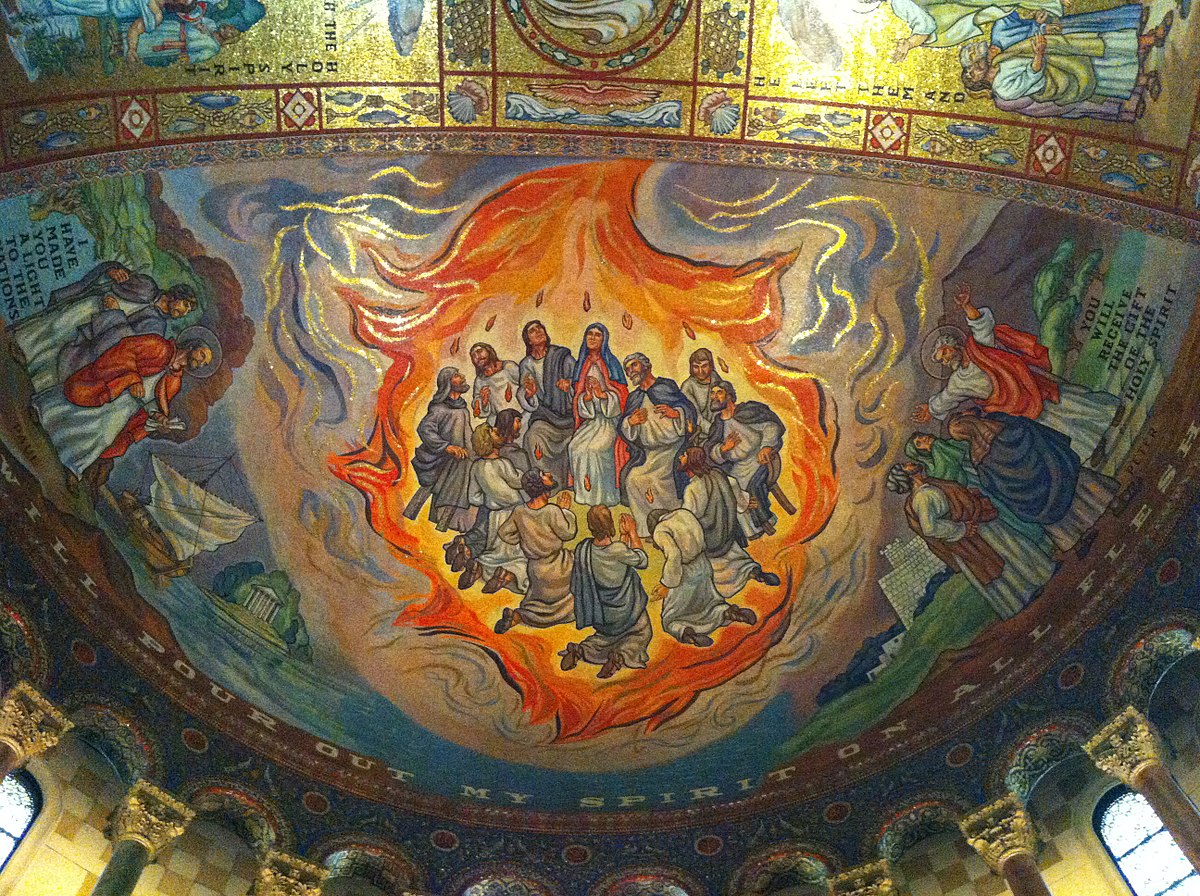
On Pentecost, Jews from all over the Roman Empire gathered in Jerusalem. Many were in the upper room with the apostles, when the Holy Spirit visibly empowered the apostles with tongues of fire, a violent wind, and the reversal of the tower of Babel as people of many different language groups were able to hear the apostles speak in their native tongues. These signs caused much excitement and wonder as the people responded to the work of God. As was true during the time of Jesus’ ministry, there were some who were ready to hear the gospel and others who were not. Those who were ready to hear the apostles’ message were able to understand the apostles’ message while those who were not ready did not understand the signs and resorted to mocking the apostles as if they were drunkards. This was no different than the time of Jesus’ ministry, the signs of the kingdom caused some to respond with increased faith while others responded with unbelief and hardened hearts.

As Jesus had promised, the Holy Spirit gave the apostles the words to explain what was happening. Peter quoted from the book of Joel about how the Spirit would be poured out causing all kinds of people to prophecy: sons and daughters, old men, and young men. Then Peter also quoted from David’s Psalms as he wove together the story of how all these things fit into the story of Jesus’ life, death, and resurrection. Those who were ready to hear the gospel asked what their response should be. Peter told them to repent, be baptized and then they too could receive the gift of the Holy Spirit. Since many of these people were from the Jewish diaspora, they, now filled with the Holy Spirit, would have been able to return to their homes to continue to spread the gospel, although it seems that some people from the diaspora stayed in Jerusalem.

We have sparse details of the life of the church, but there are a few things we know which are described quite succinctly in Acts 2:42-47:

And they devoted themselves to the apostles’ teaching and the fellowship, to the breaking of bread and the prayers. And awe came upon every soul, and many wonders and signs were being done through the apostles. And all who believed were together and had all things in common. And they were selling their possessions and belongings and distributing the proceeds to all, as any had need. And day by day, attending the temple together and breaking bread in their homes, they received their food with glad and generous hearts, praising God and having favor with all the people. And the Lord added to their number day by day those who were being saved.

With the rapid increase in disciples came some logistical problems as well. The miracles of the Spirit did not end the day-to-day problems of communicating between different cultural groups within the church. In the normal practice of sharing goods within the church and within that the need to take care of widows and orphans, there came a point where the Greek-speaking widows from outside Israel were not getting the same care as the Hebrew speaking widows. Because the apostles wanted to focus on teaching and prayer, they gathered the church to address the issue. The church resolved the issue by selecting seven men to oversee the distribution of goods. However, this would not be the last time that language and culture barriers would affect life of the church.

Observe

Read Exodus 18:13-26; Acts 6:1-7. What do these passages say about effective leadership?

The genealogies

Dancing in the Kingdom- Table of Contents

Dancing In the Kingdom – Part 1 – Shadows of the Kingdom – Chapter 1 – Prelude

The genealogies

[Bible references: Matthew 1; Luke 3]                              

There are not many passages in the New Testament that the average person tends to gloss over, but there are two places where that happens the most. Two of the Gospels have genealogies that look very different from one another, telling the story of Jesus from different perspectives. Neither genealogy is comprehensive, they are there to establish who Jesus is through particular relationships and to give different messages. It is typical for the average reader to skip over the genealogies when they read the Bible, but sometimes the stories attached to each name make a significant point, and sometimes the names themselves give a particular message. The genealogies are designed to give particular stories.

Matthew[1]

Matthew’s genealogy tells a three-part story that begins with Abraham, uses both Jews and Gentiles, includes women, and ends with Christ.

The list

  • Waiting for the Kingdom – Abraham, Isaac, Jacob, Judah and Tamar, Perez, Hezron, Ram, Amminadab, Nahshon, Salmon and Rahab, Boaz and Ruth, Obed, Jesse, David and Bathsheba
  • The Kingdom – Solomon, Rehoboam, Abijah, Asa, Jehoshaphat, Jehoram, Uzziah, Jotham, Ahaz, Hezekiah, Manasseh, Amon, Josiah, Jeconiah
  • Waiting for the re-established kingdom – Jeconiah, Shealtiel, Zerubbabel, Abiud, Eliakim, Azor, Zadok, Achim, Eliud, Eleazar, Matthan, Jacob, Joseph, Jesus

Items of note:

  • Matthew’s genealogy, starting from Abraham, traces a line to Judah to establish royal bloodline. Matthew shows Christ as the Messiah, by tracing the legal line from Judah and then to Joseph. This genealogy established Jesus’ legal rights to the throne through Judah.
  • The genealogy includes women with interesting stories:
    • Tamar was raped by Judah.
    • Salmon had children by Rahab a Gentile who was a prostitute in Jericho.
    • Boaz’s wife was Ruth who was a Gentile.
    • David had an affair with Bathsheba, who was married to Uriah.
  • Includes all the kings of Judah. Jeconiah appears twice (was last king before exile, then was part of exile) Zerubbabel (governor of Jerusalem after the return).
Luke[2]

Luke’s genealogy tells a story that starts with Adam, the son of God and ends with Jesus, the Son of God. Luke establishes Jesus as the Son of Man and goes back through Mary’s line to Noah and then to Adam. Ancient Greek genealogies traced the father’s lineage not the mother’s—but what do you do with the unique virgin-born Jesus? Certainly, Joseph was not his father, so the only logical male name available was that of Jesus’ maternal grandfather, Heli, for he was the last man involved in the genealogical process which led to Jesus. So Heli was the father of Mary, who was the mother of Jesus.

The list

  • God, Adam, Seth, Enosh, Kenan, Mahalalel, Jared, Enoch, Methuselah, Lamech, Noah, Shem, Arphaxad, Cainan, Shela, Eber, Peleg, Reu, Serug, Nahor, Terah
  • Abraham, Isaac, Jacob, Judah, Perez, Hezron, Aminadab, Nahshon, Salmon, Boaz, Obed, Jesse, David
  • Nathan, Mattatha, Menna, Melea, Eliakim, Jonam, Joseph , Judah, Simeon, Levi, Matthat, Jorim, Eliezer, Joshua, Er, Elmadam, Cosam, Addi, Melchi, Neri, Shealtiel
  • Zerubbabel, Rhesa, Joannan, Juda, Joseph, Semein, Mattathias, Maath, Naggai, Esli, Nahum, Amos, Mattathias, Joseph,  Jannai, Melchi, Levi, Matthat, Heli, Joseph, Jesus

Items of Note:

[Bible references: Genesis 5:25; 11:12-26; Jeremiah 22:30; Matthew 1; Luke 3]                             

  • Starts from Adam instead of Abraham, traces Mary’s line to establish Son of God, includes 4 generations born in captivity,
  • Methuselah (oldest recorded age), Shem (the Semitic race),
  • If we translate, instead of transliterating the first 10 generations from Adam to Noah we can read: Man (is), Appointed, Mortal, Sorrow (but), The Blessed God, Shall come down, Teaching, His death shall bring, The despairing, Comfort and rest
  • There is an interesting prophecy in Jeremiah, where it appears to refer to termination of David’s legal line to the throne from Jeconiah onwards. Jeremiah 22:30 implies a BLOOD LINE curse on Solomon’s line. This separation of the genealogies from David resolves the prophecy. With Mary being of David’s blood line through Nathan, the Messiah is from the House of David yet avoids the curse, whilst still claiming the legal claim through Solomon’s line, through Joseph his adopted and legal father
  • The values of the letters in David’s name (dalet=4, vav=6, dalet=4) add up to 14. Matthew’s genealogy is set up in groups of 14.
  • Jeconiah was the last operative King and the first waiting King, he ends the second group, and starts the third.
  • The name Zerah: Meaning: Rising, Dawn; Etymology From the verb זרח (zarah), to rise or break out.
  • The name Perez: Meaning: A Breach: Etymology: From the verb פרץ (paras), to break through.
Mark

[Bible references: Mark 9:35]                                        

Mark is portraying Christ as a servant and so does not use a genealogy.

John

[Bible references: John 1:1-2]                                         

John shows Jesus directly to be the Son of God.


[1] In Hebrew, the Hebrew word translated as genealogies, ‘toledoth’ always denotes father/son relationships, always works forward.

[2] In Hebrew, the word ‘yaghash,’ is used to establish legal rights or obligations; in contrast, it always works backwards tracing an individual’s legal right or duty back to its source.

Observe

Read John 21:15-25.  Which disciple do you identify more with and why, Peter or John.?

Overview of the Gospels

Dancing in the Kingdom- Table of Contents

Dancing In the Kingdom – Part 1 – Shadows of the Kingdom – Chapter 1 – Prelude

Overview of the Gospels

[Bible references: Matthew, Mark, Luke, John]

The New Testament begins with a set of four biographies about Jesus. They are referred to as the Gospels of Matthew, Mark, Luke and John. It is possible to think about the Old Testament as the inspired introduction to the New Testament, foretelling of the Person, work and kingdom of Christ. Old Testament quotes, allusions, and types are woven into the Gospels.

Christ is presented as king (who rules over all things), prophet (who represents God to the church) and priest (who intercedes for the church).  All the gospels record: the unique revelation of Christ, the ministry of John the Baptist, the feeding of the 5,000, Christ’s offer of Himself as King, the betrayal by Judas; the denial by Peter, the trial and crucifixion and bodily resurrection of Christ, events during the forty days of the post-resurrection ministry of Christ, the hope of His second coming.

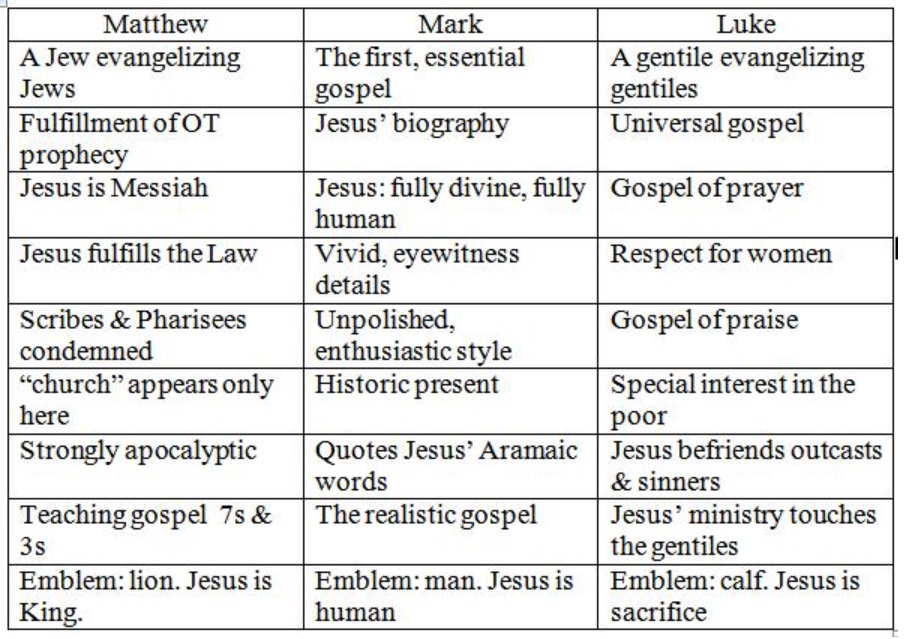
The following table shows how the Gospels tell the story of Jesus from different perspectives, each focusing on different perspectives of Jesus’ life, and each trying to give a different message about the life of Jesus.

Comparison of Gospels
 MatthewMarkLukeJohn
Portrait of JesusKingServantTeacherSon of God
Original readersJewsRomansGreekschurch
Key phrasesKingdom of heaven, fulfilledKingdom of God, Immediately, nowKingdom of God, Son of manBelieve, Word of God, only begotten Son, eternal life
FocusJesus is the Messianic King of the promised Davidic kingdom which fulfills the Old Testament prophecies and claimsJesus is the authoritative Son of God. He is God’s triumphant envoy come to suffer and die in order to claim victory over sin and deathJesus is the perfect Son of Man, the Messiah prophesied by the prophets who came to save and to minister of people of all nations through the power of God the Holy SpiritJesus Christ is the fully divine Son of God who existed before creation. He is the true Lamb of sacrifice through whom we receive the gift of eternal life
Prominent sectionssermonsmiraclesparablesteachings
Genealogytraced to Abrahamnonetraced to Adamnone
Geographic emphasisGalileeGalileeGalileeJudea
Comparison of the Gospels

Observe

Read the chart above. Which gospel is centered in Judea?