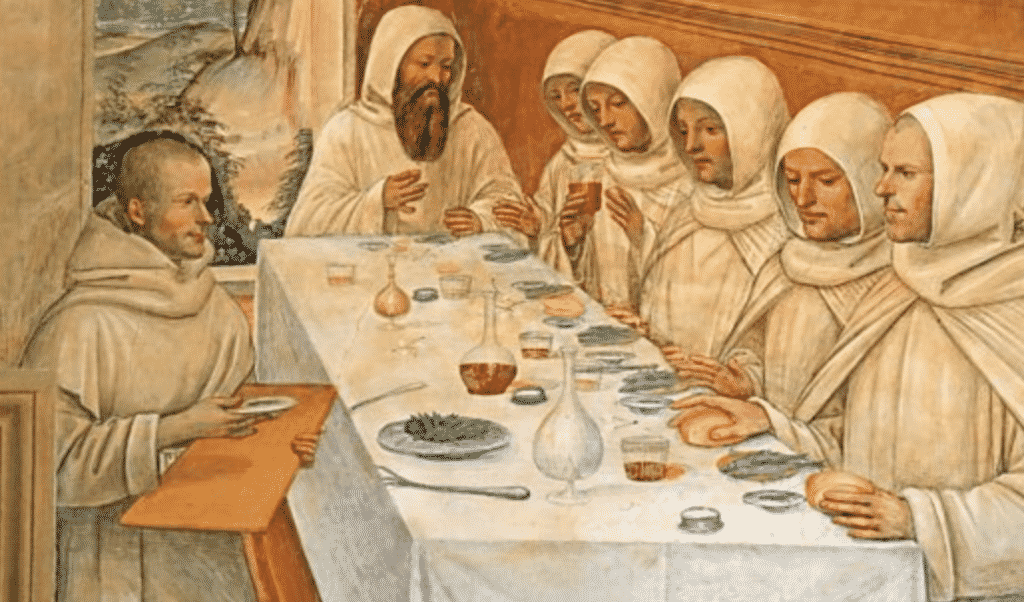
Discipline of Fasting

Dancing in the Kingdom- Table of Contents

Dancing In the Kingdom – Part 3 – Dancing in the Kingdom– Chapter 15 – Reforming our Souls

Discipline of Fasting

[Bible references: Isaiah 58:1-14; Ezra 8:21-23; Matthew 6:16-18]

By the help of the merciful Lord our God, the temptations of the world, the snares of the Devil, the suffering of the world, the enticement of the flesh, the surging waves of troubled times, and all corporal and spiritual adversities are to be overcome by almsgiving, fasting, and prayer.[1]

“More than any other Discipline fasting reveals the things that control us.” [2]

Fasting breaks up habits to let us see our lives in new ways or to enable us to pray at new times or in new ways. Because we are stopping something for a finite period of time, there’s an unfamiliarity and discomfort to it that can be very instructive, open up time for prayer, and draw us closer to God.”[3]

“In every culture and religion in history, fasting has been an instinctive and essential language in our communication with the Divine.”[4]

The pursuit of God can be described as in Psalm 37, to trust in, to delight in, to commit to, to wait on, and to be silent before the Lord; these are words of “giving up” of “going without” whatever the world offers and instead resting in God. The discipline of fasting then looks like learning to go without while learning to rest in, to fight through our appetites so that we can remain focused on the act of pursuing God and loving others, to push through our hunger pains so that we can discover we’re just fine on the other side of them, to look to God, to talk to him, to open ourselves to him in confession, to not so much as give up anything, but to commit to hearing the voice of God in our lives. The goal of fasting is to pursue God, to turn our hearts and our loves towards God and neighbor.

There are many reasons Christians are led by the Holy Spirit to the spiritual discipline of fasting, a few of them are: to strengthen one’s prayer life, to seek direction for one’s life, to express grief and loss, to seek deliverance and protection for life, to express repentance and reconciliation with God. to humble oneself, to express concern for the work of God, to minister to the needs of others, to overcome temptation and rededicate oneself to God, to express love, devotion, and worship of God, to establish rhythms between absence and abundance.

Simplicity and Gratitude can be precursors to fasting. Once we have determined how to order our lives then we are better equipped to identify those things that stand in our way and in the lives of those around us, not only the good vs. bad things, but the good things that detract us from the best things. The Gratitude for God and His provision can set our attitude in preparation for fasting.


[1] Sister Mary Sarah Muldowney The Fathers of the Church: A New Translation Writings of Saint Augustine Vol 17 Fathers of the Church 1959 Sermon 207 (p. 89)

[2] Foster, Richard J. Celebration of Discipline.  Harper & Row Publishers ©1978 (p. 48)

[3] Baab, Lynne M. “The Surprise of Fasting” Lynnebaab.com www.lynnebaab.com/blog/the-surprise-of-fasting

[4] Ryan, Thomas. The Sacred Art of Fasting: Preparing to Practice Skylight Paths 2005

Observe

Read Isaiah 58:1-14; Ezra 8:21-23; Matthew 6:16-18. The benefit of fasting does not come just from deprivation. What should accompany fasting?

Our limits

Dancing in the Kingdom- Table of Contents

Dancing In the Kingdom – Part 3 – Dancing in the Kingdom– Chapter 14 – Remembering our creation

Our Limits

[Bible References: Genesis 1-2; Deuteronomy 15:11; Psalm 40:17; 1 Corinthians 12]

As we seek to fulfill our cultural mandate, there are various constraints which control how we exercise our call.[1] First and foremost, as God’s image-bearers, we are to act in accordance with God’s character: holding to the balance and tension of acting with sovereignty and servitude, mercy and justice, playfulness, and orderliness, along with his attributes of overflowing goodness, generosity and peace, trustworthiness, faithfulness, self-sacrifice and forgiveness. Although we are not transcendent in the same way God is, as his image-bearers his character of transcendence can be reflected in the ways we manifest His other qualities: Our ability to creatively imagine the ways in which we establish dominion, live into our relationships, display fruitfulness, and fulfill our responsibilities as God’s image-bearers.

We also need to remember that there are limits with which we should exercise our responsibilities. God has given us finite resources of materials or time to work with along with the reminder of Sabbath to help us refocus, to remember that although we are designed to work that we are not designed solely for work. It is not work that gives us value, rather it is God who gives us value and our work only has value if it gives God the glory.

Part of our limits are tied to our embodiment. Our earthiness is a reminder of our dependance on the earth, each other, and God. Our earthiness should help us lean into the humility worthy of image-bearers of God. Our need to sleep is a constant reminder that we are not God who never sleeps.

The multi-faceted call God has given us, requires us as God’s stewards to weave together the call to glorify God, to bring to maturity God’s rule over the earth, to reflect God’s triunity within the community of his image-bearers. This call is not for us to fulfill individually, but rather together as the Body of Christ with whatever God provides.


[1] Theology of Work Commentary, “Genesis 1-11 and Work” Hendrickson Publishers Marketing 2015, 2016

Reflect

We have built-in limits to what we, in our bodies, can do. How do these limits remind us of our dependency on the earth where we live, on each other, and on God?

Observe

Read Deuteronomy 15:11; Ps 40:17; 1 Corinthians 12. Why do we need each other?

Timeless and in time

Dancing in the Kingdom- Table of Contents

Dancing In the Kingdom – Part 1 – Shadows of the Kingdom – Chapter 2 – The God who created

Timeless and in time

[Bible references: Psalm 102:25-29]

Closely related to the paradox of how God is both transcendent and immanent is how God is both timeless and in time. Many scholars in philosophy and science have trouble trying to resolve questions such as: How can God even have both attributes? Did God create time or is God himself confined by time? Is time static such that the past, present and future all exist simultaneously, and God sees them all at once, or is time dynamic such that the future does not yet exist – and therefore God does not yet know it?[1]  

It is not practical to try to summarize all the arguments with all their nuances here. For our purposes, we will not try to resolve the many difficult theological/philosophical issues[2] but, as Psalm 102 does, accept the finite mortality of our life on earth and the fact that God is both with us in the midst of our distress yet also exists outside of that.


[1] Closer to Truth “Is God Temporal or Timeless” This is a series of interviews showing different views on the subject of God’s timelessness. Closter to Truth www.closertotruth.com/series/god-temporal-or-timeless

[2] McKnight, Scott. “Is God Timeless” Patheos, Jesus Creed, 23 Feb 2013,  www.patheos.com/blogs/jesuscreed/2015/02/23/is-god-timeless/; Craig, William Lane. “God, Time and Eternity” Reasonable Faith, www.reasonablefaith.org/writings/scholarly-writings/divine-eternity/god-time-and-eternity/; Ganssle, Gregory E. Review of “The End of the Timeless God by RT Mullins The Gospel Coalition,  themelios.thegospelcoalition.org/review/the-end-of-the-timeless-god; All About God “God is Infinite Bible Verses” All About God www.allaboutgod.com/god-is-infinite-bible-verses-faq.htm

Observe

Read Psalm 102.  Reflect on how both anguish and hope are expressed. What speaks to you from that Psalm? How does God’s unchangeability provide hope in the midst of difficult circumstances?