Principles

Dancing in the Kingdom- Table of Contents

Dancing In the Kingdom – Part 3 – Dancing in the Kingdom– Chapter 18 – Entering the Dance

Principles

[Bible references: Genesis 1; Psalm 19:1-4; Isaiah 28:23-29; Romans 1:18-20; 2:14-15; 13:1-2; 1 Peter 2:13]

We cannot establish the kingdom of God nor overcome the powers of evil in our own power. While Jesus has overcome the powers of the world, we do not know when he will return to finish the deed to fully establish his kingdom and fully rid the world of the presence of evil. But we can continue to work on the mandates he gave us at the beginning and rephrased at the Great Commission to make disciples of all nations, teaching them to obey all that I have commanded you, which extends from our original directives to be fruitful and multiply and fill the earth, and to subdue it and rule over all the creatures.

From the beginning of the church, we can see that while some people were sent out with the express purpose of spreading the gospel, most people stayed within whatever vocation they had, living in their own communities, sharing their resources, and supporting one another. Those that stayed in their vocations, did not change their vocations although they may have changed the way they pursued their vocations.

Albert Wolters suggests several principles that can help guide the way in which we pursue our vocations:[1]

  • The universe that God created was good.
  • The structures/institutions created by people should reflect God’s character and his wisdom as revealed through creation and his word.
  • The structures/institutions created by people are vested with God’s authority.
  • The universe reveals God’s glory.
  • Wisdom is “ethical conformity to God’s creation.”
  • The will of God for our life can be known through his creation, our conscience, His word, spiritual discernment.
  • Since God’s initial creative activity in forming the universe, God has been creatively developing the universe either directly through his own work or indirectly through his people. Part of that development includes the development of societal and cultural institutions.
  • Even without the fall, people would still be expected to develop the garden and other aspects of civilization as part of our role in stewarding what God has given us
  • When Christ returns, He will restore the earth.[2]

Whether we are directly communicating the gospel in our vocation or not, we may hold the narrative of the gospel as public truth to be shared.[3] The first communicators of the gospel were eyewitnesses who could say, “That which we have seen and heard … we declare to you.” As the church, we are entrusted with the responsibility of sharing that same truth, not in a forceful way but in the way of Jesus and his apostles who affirmed what they knew and invited others to respond in dialog.


[1] Wolters, Albert M. Creation Regained: Biblical Basics for a Reformational Worldview, William B. Eerdmans Publishing 1985, 2005. eBook Chapter 2

[2] Wolters, Albert M. “Worldview and Textual Criticism in 2 Peter 3:10” Westminster Theological Journal 49 (1987) 405-413 allofliferedeemed.co.uk/Wolters/AMW2Peter3.pdf

[3] Newbigin, Leslie. . “An Introduction to the Theology of Religions: Biblical, Historical & Contemporary Perspectives” Gospel As Public Truth, Intervarsity Press 2003

Observe

Read Psalm 19:1-4. How can our work reflect the glory of God?

Discipline of Resting/Sabbath

Dancing in the Kingdom- Table of Contents

Dancing In the Kingdom – Part 3 – Dancing in the Kingdom– Chapter 15 – Reforming our Souls

Discipline of Resting/Sabbath

[Bible references: Exodus 20:8-11; Deuteronomy 5: 12-15; Mark 2:23-28; Hebrews 4:1-13]

We work to live

To understand the place of Sabbath we need to understand who we are and the place of our work (or play). The accumulation of archeological research in the last few decades has made it more possible to understand the Genesis creation account in the same way it was understood in the times of Moses. Creation was not primarily viewed as a physical event but rather the moment of being assigned a purpose. The creation account, understood this way, was a dedication of a temple, that is, a place where God would meet with his image-bearers. Those moments of dedication were done within the boundaries of days, “there was the evening and the morning.” After the temple was dedicated, it was now the time to live into the temple, to live into what it was designed for. The “rest” was not referring to a cessation of activity, but of doing the activity that the temple, in this case, the universe, was designed for.

The seventh day, as described in Genesis 2, was not assigned a beginning and an end. It was not designated with “and there was evening and there was morning.”  It continues now. Now is the time we live in the temple, doing that for which the temple was designed. Work has been designed for us, but we were not designed for work. Going back to Genesis 1 and 2, we see God was creating a place for him to reside and take control and for us to join him as co-regents. The seventh day, the sabbath, God had finished the dedication of the “temple,” but it was not a time where he ceased to do everything. Rather, it was the time where the “home” was now ready for God, and for us as co-regents, to begin the settling into our “home” and doing the things that our home was designed for. Jesus in John 5:1-7 clarified this idea where he explained, “My Father is always at his work to this very day, and I too am working.” Living into this sacred space would entail us taking part with God in his continual acts of creating and sustaining the universe. When Eve gave birth to Cain, she recognized that “I’ve created a man with Yahweh.”

The work that we were designed to do was more than just tending the garden. In Genesis 2:15, we were given a mandate to “work” and “take care of” the garden God had created. These tasks, again looked at in light of Ancient Near East culture, were more of a priestly nature, taking care of this temple where we reside with God. We were to take care of this place which was designed to be a “very good” place for us to flourish in, creating whatever structures we needed to “increase in number, fill the earth and subdue it.” This task, this mandate, meant that we would eventually go beyond the capacity of gardening and create not just a bigger garden but cities, a flourishing civilization as pictured in Revelation 21 and 22.

When examined closely, we can see the breadth of work committed to Adam and Eve. Subduing the earth would entail many physical, social, and intellectual activities. In the gardening we can see cultivation and farming; in taking care of the animals, we can see shepherding and domestication; in the naming of the animals, we can see a cultural and scientific activity which required understanding the nature and attributes of the animals and establishing authority over them. We can see that God had created things to be beautiful (Gen 3:6) and as his image-bearers we would be expected to also create beautiful things.

The introduction of sin has complicated this sense of work by corrupting the value of the good work that had been intended for us and by adding more types of work that are only necessary because we need to mitigate the effects of our sin (law enforcement, hospitals, military, etc.). But even to that work, we can join Christ in His work of redeeming creation.

We rest to remember

Having determined the nature and value of our work, we can now determine the place of sabbath rest. The discipline of Sabbath is a regular reminder that work may have a place for us, but we were created by God for God, we were not created by God for work. There is work designed by God for us to do, and even if we enjoy that work, we need the reminders that we were primarily made for our relationship with God. The Westminster Catechism states that we were designed to “enjoy God and glorify Him forever.” 

Our focus should be on God and not the work He has given us. In this world there is more than sufficient work to be done, but we are not created to be slaves to that work. The Sabbath is our opportunity to remember our dependence on God’s provision for us, leaning on His provision instead of our labors, trusting Him to provide for us instead of trusting in our work to provide for us. In that restful place we then have the opportunity to focus on our relationship with God. As Jesus pointed out, the Sabbath was made for us, for our benefit, for us to enjoy.

Observe

Read Exodus 20:8-11; Deuteronomy 5: 12-15; Mark 2:23-28; Hebrews 4:1-13. What is the reason for the Sabbath?

Our provision

Dancing in the Kingdom- Table of Contents

Dancing In the Kingdom – Part 3 – Dancing in the Kingdom– Chapter 14 – Remembering our creation

Our Provision

[Bible References: Genesis 1:29; Genesis 2:8-9; Psalm 3:5; 55:4-22; 1 Timothy 6:17-19; Hebrews 1:3; 1 Peter 4:7-11]

In all of this, as his image-bearers we are to remember that we need God’s provision to do our work. He is the creator of life and reproduction; sun, moon, earth, and stars; light and darkness; intelligence and wisdom; love, joy, and peace. He is the one who always goes before us and watches over us as a father watches his children.

Within all of these possibilities, we can work with God to fill the earth with his glory and influence people towards him. Our Cultural Mandate can be linked to the Great Commission and the task of evangelization, where we can use the full range of our abilities to point people to the God who is able to redeem us all.[1]

Unfortunately, just as we can engage in obedient culture making, we can also turn from God and engage in disobedient culture making,[2] turning ourselves and others away from God. Because of our rebellion against God, our cultural tasks can take on a different dimension.


[1] Manahan, Ronald E. “A Re-examination of the Cultural Mandate: An analysis and Evaluation of the Dominion Materials” Docsbay Grace Theological Seminary dissertation May 1982 docsbay.net/A-Re-Examination-Of-The-Cultural-Mandate

[2] Koyzis, David T. “What the Cultural Mandate is Not”  First Things www.firstthings.com/blogs/firstthoughts/2011/11/what-the-cultural-mandate-is-not

Reflect

If we base the possibilities of what we can do only our own strength and abilities, we will be limited. What stewardship project should you be considering based on what you can do with God’s help?

Observe

Read Psalm 3:5; 55:22. If we are confident that God will supply all our needs, how should we handle our possessions?

The Spirit and the power

Dancing in the Kingdom- Table of Contents

Dancing In the Kingdom – Part 2 – The Kingdom Revealed – Chapter 12 – Launching the church

The Spirit and the power

[Bible references: Genesis 25-19-21; 1 Samuel 1;1-20; 2 Samuel 7; Proverbs 2:1-5; Matthew 7:7-8; Mark 11:12-26; Luke 11:113; 12-26; John 20:21-23; 3:14-16; Acts 1:1-14; 2:1-41; 1 Peter 5:6-7]

There are remarkable parallels between Genesis 2:7 and John 20:22. We see from Chapter 2 that in Genesis 2, God breathed life into Adam who was then commissioned to take care of the sacred space that God had created. That sacred space was initially identified as the Garden of Eden, but we know from Genesis 1 that God had dedicated the entire universe as his temple. We also know that since God’s image-bearers were given the commission to “be fruitful and fill the earth” that the sacred space allotted to the care of the image-bearers was intended to be the entire earth.

After the resurrection, when Jesus met with the apostles in a locked room, He breathed on (or into) them.[1] This is the same word used in the Septuagint version of the Old Testament describing God breathing life into Adam and thereby giving him life. Immediately after this gesture, Jesus instructed the apostles to “Receive the Holy Spirit” who were then commissioned to continue the task that Jesus had begun.[2]

“The very same Greek verb (here only in N.T.) is used by the LXX. in Genesis 2:7 (Wis 15:11) of breathing life into Adam. This Gospel of the new Creation looks back at its close, as at its beginning (John 1:1), to the first Creation. We are probably to regard the breath here not merely as the emblem of the Spirit (John 3:8), but as the means by which the Spirit was imparted to them. ‘Receive ye,’ combined with the action of breathing, implies this. This is all the more clear in the Greek, because pneuma means both ‘breath’ and ‘spirit,’ a point which cannot be preserved in English; but at least ‘Spirit’ is better than ‘Ghost’ We have here, therefore, an anticipation and earnest of Pentecost; just as Christ’s bodily return from the grave and temporary manifestation to them was an anticipation of His spiritual return and abiding Presence with them ‘even unto the end of the world.’” [3]

Previously, in John’s gospel, we saw that “the Son of Man must be lifted up, that everyone who believes may have eternal life in him.” Now that Jesus was crucified and was soon ascend to heaven, the apostles were given the task of sharing the gospel so that people may believe unto eternal life. It is at this moment, in the locked room, that the apostles were given the commission to share the news of forgiveness.

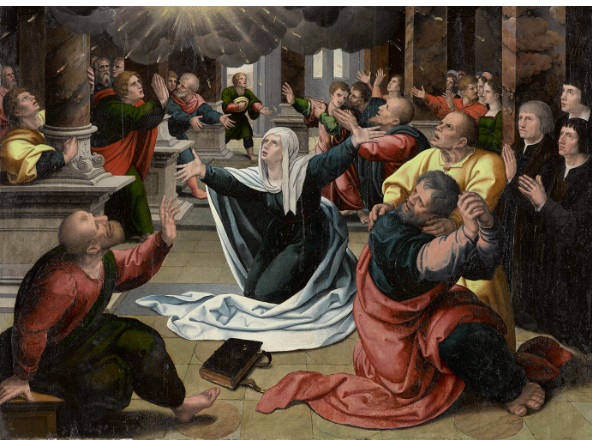
Ten days after Jesus ascended, fifty days after Passover, the disciples were gathered in Jerusalem, waiting for “what the Father had promised.” It was the time of Shavuot, which was known in Greek as the Pentecost. Shavuot is one of three pilgrimage festivals where Jews are supposed to travel to Jerusalem so Jews from all over the Roman Empire were in Jerusalem.

It was at this gathering that Spirit came upon the disciples in great power, revealing the fulfillment of Shavuot. While the disciples were gathered in a room, the Holy Spirit manifested himself with a great wind and tongues of fire that touched the apostles. The apostles then proceeded to prophecy and the people who were there from around the world were able to hear them speaking in their own languages. On that day 3000 people accepted Jesus as their Lord.

The full meaning of Passover and Shavuot was now revealed.

  • Jesus was executed on Passover, a holiday commemorating the celebration of freedom from slavery in Egypt which was observed by the slaying of the Passover lamb whose blood protected all the Israelites from the angel of death who had killed all the firstborn children in Egypt.
  • The miraculous outpouring of the Holy Spirit on the apostles which enabled them to speak in many different languages occurred on Shavuot, which had many different meanings for the Jews. Shavuot was associate with:

  • the giving of the commandments 50 days after the liberation from Egypt. Now the commandments were written on hearts instead of stone.
    • the first harvest of crops in the year, with those first portions being given to God, the provider of harvest. There were now 3000 souls harvested for God.
    • marriage, where Passover was considered the betrothal and Shavuot the marriage where the bride and groom commit themselves to each other. The period in-between the betrothal and marriage can be considered as a time of testing and waiting as the bride and groom prepare for life together. With His sacrifice, Jesus, the Bridegroom committed himself to the Church, His Bride.

Waiting. The virtue we want to bypass. Yet even though God has set seasons and times before us and insists on letting his ordained processes complete, from the beginning, we have wanted things immediately and we have been paying the price ever since. But there was a process God wanted to complete. After His resurrection, Jesus waited for the apostles to gather before He came to them, Jesus waited for many days to go by while He interacted with various groups of his disciples, then after His ascension, Jesus waited for his disciples to stay in Jerusalem, while they waited for the “gift His Father promised … to be baptized with the Holy Spirit.” And so, the apostles waited and prayed.


[1] Biblehub ἐνεφύσησεν Bible Hub biblehub.com/greek/enephyse_sen_1720.htm

[2] Scrivener, Glen. “What does John 20:21-23 mean” Christ the Truth christthetruth.net/2013/03/26/what-does-john-2021-23-mean; Skinner, Matt. “Commentary on John 20:19-23” Working Preacher www.workingpreacher.org/preaching.aspx?commentary_id=887; Lewis, Karoline. “Commentary on John 20:19-23” Working Preacher www.workingpreacher.org/preaching.aspx?commentary_id=76; Flattery, George. “John 20:19-23 Receive the Holy Spirit” Global Christian globalchristiancenter.com/sermons/dr-g-flattery-sermons-on-gospel-of-john/26192-john-2019-23-receive-the-holy-spirit

[3] Biblehub “John 20:22”Cambridge Bible for Schools and Colleges biblehub.com/commentaries/john/20-22.htm

Reflect

There are times when we need to take action and times when we need to wait for maturity or for “the fullness of time.” How can we discern the difference?

Observe

Read Mark 11:12-26; Luke 11:1-13. What should we expect when we pray?

Interlude

Dancing in the Kingdom- Table of Contents

Dancing In the Kingdom – Part 1 – Shadows of the Kingdom – Chapter 1 – Prelude

Interlude

[Bible references: Psalm 19]

As I was working one warm summer night at a convenience store with the door open, it was not unexpected to see a moth fly in through the door. Normally, moths are attracted to light sources, but this time the moth was attracted to the white top of a garbage container. The moth was distracted by the light reflected off the garbage container. That describes a lot of human behavior; we get distracted by the pretty garbage.

Since the time of Adam and Eve we’ve had the temptation to place ourselves at the center of the universe, dismissing the idea that we did not create the natural beauty of the world around us but that we can possess and control it ourselves, that we are the masters of all we see. We are tempted to dismiss the reality that we are part of a universe we did not create with the idea that we can define the universe which we think revolves around us.

In the meantime, there is a story that began long ago when God brought into being creatures made in his image, a story about his plans for those creatures, plans for them to fill the earth and making the whole earth a place of love and goodness, but a place where that love and goodness would be disrupted by our rebellion. Fortunately, that disruption did not deter God from continuing his plans for his image-bearing creatures and that story is still in the making. That story is now our story.

What can get confused is that this story is contained in the Bible which is often presented as a disconnected story. The Old and New Testaments of the Bible can seem disconnected because of the cultural barriers between us and the testaments. Some people even think the God described in the Old Testament is different from the God in the New Testament.

That disconnect is exasperated by the long and messy history of the church. The church seems very divided on how to interpret those writings and how to live into them, leaving us with a confusion of various interpretations and practices that seem to contradict one another. How is one supposed to make sense of it all?

However, it is possible to obtain a clearer understanding of how both Testaments make one cohesive story, a story into which we can fit. When we see how the unified story than runs from Creation to Revelation, we can then see how we, as part of God’s church, are intended to participate in that story. God did not need to create us or the universe, He did it out of a desire to share his love and delight. God’s creation was more an act of play than of work and He desires that we actively play with him, if you will, to dance with him in His Kingdom.

The Kingdom Dance is not meant to be a solo effort, we are to dance with God and with his people. To that end, while this book can simply be read as a solo exercise, there are additional ways to engage with the material.

  • Biblical references are provided extensively through the book. They are there to support the text. If you read them, particularly the shorter passages, take the time to slow down and let God the Spirit speak to you. The Bible has been described as ancient Jewish Meditation Literature.[1] It is best read when you give yourself time to absorb it.
  • There are extensive footnotes throughout the book. Whenever possible, I have provided hyperlinks to online materials to make the additional materials easily available to you. If you spend time investigating the footnotes, you will notice that I am not drawing from only one Christian tradition, but from a variety of them, allowing the richness of the different traditions to form a more complete story. To form a more complete story I also, particularly in the beginning, will use materials from the “Second Book of God” that is, book of Creation.[2]

“God has, in fact, written two books, not just one. Of course, we are all familiar with the first book he wrote, namely Scripture. But he has written a second book called creation.”[3]

  • For those who are not practiced in studying the Bible, Appendix A gives a summary of techniques that could be used to help understand scripture. This may prove useful for understanding when you study the Biblical references given throughout this book.
  • Reading the material with a group can make the most impact. There are questions at the end of each chapter that ask you to reflect on the material and then read related biblical passages to think more deeply about various issues. These exercises and questions will help you engage with the material by first asking you to think about how each section applies to your life and secondly to share your thoughts with others in the group so that together you can more thoughtfully “Enter the Dance” with God, with all the others that have come before, with those that are coming now and with that will continue to come until Heaven and Earth are reunited.
  • Finally, the best participation will be not to just read and reflect, but to dance the Kingdom dance with God. Part 3 of this book will suggest ways to take part in his activity in bringing healing to the world he loves, broken now but to be finally and fully restored when He rejoins heaven and earth.

The Bible is a complex collection of literature, using many literary styles and techniques and it can be difficult to understand some parts, particularly when one part seems to contradict another. I have found a useful principal in studying the Bible which I call “Conflicts are Clues” which says that any apparent conflict or confusion in Scripture should be handled as clues to look further instead of thinking that the conflicts create contradictions which reduce the integrity of the Bible.

In our age, many regard science and theology to be in conflict. In years past, however, the issue was not about conflict but about which discipline rules over or undergirds all the other disciplines. These ideas were expressed in ways such as “theology is the queen of all sciences,” “math is the queen of all sciences,” “philosophy is the queen of all sciences,” “philosophy is the handmaid of all sciences.”

The biblical perspective is that God speaks to us both through two books, the book of Creation and the Bible. Theology’s main goal is to understand spiritual reality and science’s main goal is to understand physical reality, but both fields can inform the other about the nature of God.

This principle of “Conflicts are Clues” applies not just to the “First Book of God” (that is, Scripture) but also to the “Second Book of God” (that is, Creation) which is practiced by the testing and revisions of theories, but also between the Two Books. During the course of history, the study of the Two Books got separated and some of those in science rejected Scripture and some of those who were Christian rejected science, leaving conflicts unresolved as contradictions. But moving forward, this does not prevent us from considering apparent conflicts between the books as clues to be investigated further.


[1] Bible Project “Ancient Jewish Meditation Literature” Bible Project bibleproject.com/explore/video/bible-jewish-meditation-literature-h2r/

[2] Rusbult, Craig. “How should we interpret the Two Books of God, in Scripture & Nature” American Scientific Affiliation www.asa3.org/ASA/education/origins/two-books.htm

[3] Bacon, Francis. “The Two Books of Francis Bacon of the Proficience and Advancement of Learning, Divine and Human.” The First Book. Section.VI.Paragraph.16 1605

Observe

Read Psalm 19. This Psalm captures a response to what Francis Bacon called the two books of God:  the Book of Creation and the Book of Scripture. How do you respond to the “two books”?