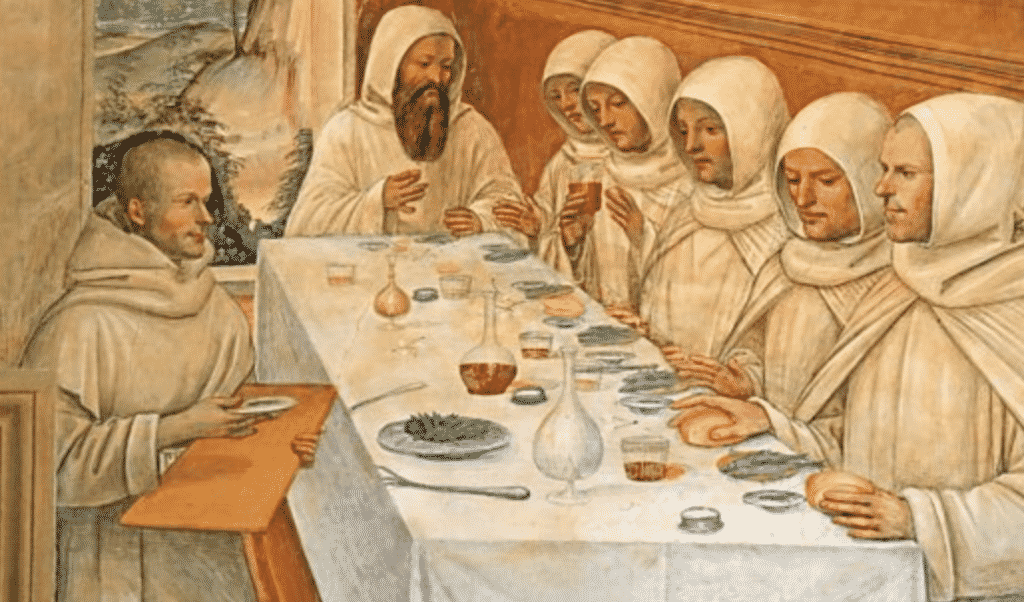
Discipline of Fasting

Dancing in the Kingdom- Table of Contents

Dancing In the Kingdom – Part 3 – Dancing in the Kingdom– Chapter 15 – Reforming our Souls

Discipline of Fasting

[Bible references: Isaiah 58:1-14; Ezra 8:21-23; Matthew 6:16-18]

By the help of the merciful Lord our God, the temptations of the world, the snares of the Devil, the suffering of the world, the enticement of the flesh, the surging waves of troubled times, and all corporal and spiritual adversities are to be overcome by almsgiving, fasting, and prayer.[1]

“More than any other Discipline fasting reveals the things that control us.” [2]

Fasting breaks up habits to let us see our lives in new ways or to enable us to pray at new times or in new ways. Because we are stopping something for a finite period of time, there’s an unfamiliarity and discomfort to it that can be very instructive, open up time for prayer, and draw us closer to God.”[3]

“In every culture and religion in history, fasting has been an instinctive and essential language in our communication with the Divine.”[4]

The pursuit of God can be described as in Psalm 37, to trust in, to delight in, to commit to, to wait on, and to be silent before the Lord; these are words of “giving up” of “going without” whatever the world offers and instead resting in God. The discipline of fasting then looks like learning to go without while learning to rest in, to fight through our appetites so that we can remain focused on the act of pursuing God and loving others, to push through our hunger pains so that we can discover we’re just fine on the other side of them, to look to God, to talk to him, to open ourselves to him in confession, to not so much as give up anything, but to commit to hearing the voice of God in our lives. The goal of fasting is to pursue God, to turn our hearts and our loves towards God and neighbor.

There are many reasons Christians are led by the Holy Spirit to the spiritual discipline of fasting, a few of them are: to strengthen one’s prayer life, to seek direction for one’s life, to express grief and loss, to seek deliverance and protection for life, to express repentance and reconciliation with God. to humble oneself, to express concern for the work of God, to minister to the needs of others, to overcome temptation and rededicate oneself to God, to express love, devotion, and worship of God, to establish rhythms between absence and abundance.

Simplicity and Gratitude can be precursors to fasting. Once we have determined how to order our lives then we are better equipped to identify those things that stand in our way and in the lives of those around us, not only the good vs. bad things, but the good things that detract us from the best things. The Gratitude for God and His provision can set our attitude in preparation for fasting.


[1] Sister Mary Sarah Muldowney The Fathers of the Church: A New Translation Writings of Saint Augustine Vol 17 Fathers of the Church 1959 Sermon 207 (p. 89)

[2] Foster, Richard J. Celebration of Discipline.  Harper & Row Publishers ©1978 (p. 48)

[3] Baab, Lynne M. “The Surprise of Fasting” Lynnebaab.com www.lynnebaab.com/blog/the-surprise-of-fasting

[4] Ryan, Thomas. The Sacred Art of Fasting: Preparing to Practice Skylight Paths 2005

Observe

Read Isaiah 58:1-14; Ezra 8:21-23; Matthew 6:16-18. The benefit of fasting does not come just from deprivation. What should accompany fasting?

Disciplines of the faith

Dancing in the Kingdom- Table of Contents

Dancing In the Kingdom – Part 2 – The Kingdom Revealed – Chapter 12 – Launching the church

Disciplines of the faith

[Bible references: Joshua 1:8; Psalm 1:1-2; 19:14; 37:7; 40:1; 133:1; Proverbs 1:1-9; Matthew 4:19; 5:8, 14-16; 6:1-18,30-33; 9:1311:29; 12:7,32; 23:12,23; Mark 12:30; Luke 16:13; John 4:22-24; 13:1-17; 17:23; Acts 1:8; 2:42; 10:43; 13:28; 14:23; 26:18; Romans 8:25; 9:15-18; 10:14-18; 12:9-12; 13:1-5; 1 Corinthians 1:9; 13:4; 2 Corinthians 1:12; 9:6-13; 11:2-3; Ephesians 1:10; 4:2-3, 11-14; 5:1-4,21; 6:18; Philippians 1:10; 2:15; 4:4-8; Colossians 4:2-6; 1 Timothy 2:1-2; 4:1-5; 6:6-8; 2 Timothy 2:15; Hebrews 4:1-11; 12:11; 13:4; James 3:17; 4:10; 5:16; 1 Peter 4:10; 1 John 1:3-7,9]

Fruits, whether of the Spirit or of a plant, do not develop without time and nurturing. God’s intentions are clear from His design of Creation, that everything in Creation is designed to operate by built-in processes. The normality and regularity of those processes inspired Christians investigating natural phenomena to develop what we now call the modern scientific method.[1]

In the same way that natural phenomena are subject to natural processes, spiritual phenomena are subject to spiritual processes, and those processes are the normal way God chooses to work through us and grow us into creatures who increasingly resemble Him. It is therefore recognized that the most effective way for Him to work with us is for us to engage in the practice of spiritual disciplines, which are habits that we try to build into our lives which invite God to transform us. When we practice spiritual disciplines, we voluntarily make ourselves available to yield to God and to give Him the opportunity to shape us. The resulting change, our transformation, is His work. The disciplines we practice are merely the means by which we cooperate with him. There are various ways we can categorize these disciplines (inward vs. outward, etc.) although various disciplines are not perfectly one category or another. One way to categorize the disciplines, which is shown below, is to describe disciplines in which we abstain from things (disciplines of abstinence) and those in which we engage with others (disciplines of engagement).

Disciplines of Abstinence:

  • meditation (silence, solitude, journaling)[2]
  • fasting[3]
  • submission (obedience)
  • patience
  • humility
  • Sabbath (rest)
  • purity of heart (chastity)
  • secrecy
  • simplicity

Disciplines of engagement:

  • service
  • confession (self-examination)
  • worship
  • celebration[4]
  • unity
  • forgiveness
  • mercy
  • stewardship (generosity, giving)
  • fellowship
  • evangelism
  • studying the Bible
  • thanksgiving
  • prayer

We should not think of disciplines as processes which deprive us of enjoyment, or which reduce the flourishing that God has intended for us. Rather, the disciplines can make our lives more enjoyable and enhance our flourishing. Because we, like all creatures, are made in a particular way, we will be better off if we stay in the environments for which we are designed. For instance, trains are built to best run when they are on railroad tracks, off the tracks they can hardly operate, but on the tracks, they can operate at their best. In the same way, spiritual disciplines put us in the best environment for us to thrive according to the way we are designed.


[1] Hannam, James. “How Christianity led to the rise of modern science” Christian Research Institute www.equip.org/articles/christianity-led-rise-modern-science

[2] Mathis, David. “Journaling as a path to joy” Desiring God”Desiring God www.desiringgod.org/articles/journal-as-a-pathway-to-joy; Chechowich, Dr. Faye. “Journaling as a Spiritual Discipline” BibleGateway www.biblegateway.com/resources/scripture-engagement/journaling-scripture/spiritual-discipline

[3] Mathis, David “Fasting for Beginners” Desiring God 26 Aug 2015 www.desiringgod.org/articles/fasting-for-beginners

[4] Heath, Elaine. “The Spiritual Discipline of Celebration” Ministry Matters 24 Dec 2019 www.ministrymatters.com/all/entry/9930/the-spiritual-discipline-of-celebration

Reflect

Some disciplines will come easier than others, but they all need to be practiced if we are to flourish in each area. Which area do you need to grow in?

Observe

Read Joshua 1:8; Psalm 1:1-2; 19:14; 37:7; 40:1; 133:1. What are some of the disciplines that mark a life of faith?