Discovering how we are formed

Dancing in the Kingdom- Table of Contents

Dancing In the Kingdom – Part 3 – Dancing in the Kingdom– Chapter 15 – Reforming our Souls

Discovering how we are formed – for each other

[Bible references: Romans 12, 1 Corinthians 12, 13:1-3; Ephesians 3:6-8; Ephesians 4, 1 Peter 4:7-10]

Once we have centered ourselves on Christ and have learned to submit to God and to one another, we are in a good place to evaluate the unique ways in which God has formed us.[1] One of the more holistic tools developed by Saddleback Church provides an evaluation of several aspects of how we are formed: the spiritual gifts, the desires, the abilities, the personality, and the experience God gives us.

The reality is that much is life is filled with, “I just gotta do what I gotta do.” Parenting is like that, housekeeping is like that, etc. Diapers need to be changed, the house needs to be cleaned, the bills must be paid, grocery shopping needs to be done, etc. Much of life is filled with responsibilities that need to be done regardless of what capacity we think we may have. There may be no luxury of just doing “what I think I am best at.”

But where it is possible, when we gather in a sharing community, there is the opportunity to allocate different tasks to those people who are best equipped for it. God has intended that we be in such communities, so described in scripture as “the body of Christ,” where different people serve in different functions. At such times, there are opportunities for us to discover in what unique ways God has designed us so that we may serve each other in the best way possible.

Scripture reveals that all who are in Christ are indwelt by the Holy Spirit, and that the Spirit has given us various gifts that we can use to help build up other members of the body of Christ. A few Bible passages give us an idea of the kinds of gifts of some of these gifts, but the lists are not exhaustive: exhortation, giving. leadership, mercy, prophecy, service, teaching, administration, apostle, discernment, faith, healing, helps, knowledge, miracles, prophecy, teaching, tongues, tongues, interpretation, wisdom, evangelism, pastor, teaching, celibacy, hospitality, missionary, voluntary poverty.

One way to discover what gifts we may have, is by serving in our community. As we serve in various ways, we may discover that God has particularly blessed our service in various ways. Sometimes others may point out those abilities or gifts to us. Another way to discover our gifts is to read about those gifts and certain gifts may become apparent to us that way. Another way is to take a questionnaire and the results of that questionnaire may reveal certain gifts to us. It may be helpful to take such a questionnaire with someone else because they may have different insights into the questions.

As we mature and encounter different life experiences, we may discover that different gifts emerge or that God has provided differently for us in our different circumstances. God knows us and our circumstances and may provide differently as we change, and our circumstances change.


[1] Links to various assessment tools: Spiritual gifts: Carver, Jeff. “Spiritual Gifts Test – Adult Version”Spiritual Gifts Test spiritualgiftstest.com/spiritual-gifts-test-adult-version ; Granger Community Church. “Spiritual Gifts Test” Granger Community Church spiritualgiftstest.com/spiritual-gifts-test-landing; Ministry Tools Resource Center. “Take Online Spiritual Gifts Test Inventory Assessment” Ministry Tools Resource Center mintools.com/spiritual-gifts-test.htm; Rock Church, “Gifts Test” Rock Church giftstest.com. Personality test sites: Hayes, Robert. “The Best Free Enneagram Tests You Can Take Online” Tech Junkie www.techjunkie.com/best-free-enneagram-tests; Truity Psychometrics. “The Enneagram Personality Test” Truity Psychometrics www.truity.com/test/enneagram-personality-test; Barkers, Ewald. “Eclectic Energies Enneagram Tests (Free) Eclectic Energies www.eclecticenergies.com/enneagram/test; Shape test: Hill, Kevin M. “S.H.A.P.E. Test” Free Shape Test www.freeshapetest.com; Saddleback Church “You Were SHAPED for Serving God” Saddleback Church www.ministryideas.com/doc/shape_discovery_tool.pdf

Discipline of Distress

Dancing in the Kingdom- Table of Contents

Dancing In the Kingdom – Part 3 – Dancing in the Kingdom– Chapter 15 – Reforming our Souls

Discipline of Distress[1]

[Bible references: Psalm 11:1-7; 24:1-10; Acts 4:23-31]

“Whenever you are in a time of stress, you should go to the Psalms. They have a medicine for everything, they depict every situation that a human being can be in, and they’ve addressed every emotion you could ever have. They also tell you how to process that emotion or about that situation before God.” [2]

Often in times of difficulty we are prone to turn our focus on whatever it is that is bothering us. This spiritual discipline, sometimes known as “don’t waste an illness,” helps us to confront what has caused us distress, and then to use our distress as an opportunity to lean more fully on God. Instead of being preoccupied by a difficulty we can learn to become occupied with the presence of God.

There are three ways distress can affect us.

  • Distress tends to cause us to focus on the problem in front of us. Like Peter, when He saw Jesus walk on the water, tried to also walk on the water but he became distracted by the winds and waves and lost his focus on Jesus.
  • At other times, distress can make us lean into whatever means of control we have, but again, we focus on the means of control that are right in front of us, forgetting that we are not the ones really in control.
  • Also, as part of needing to control our circumstances, we may avoid acknowledging our suffering or our fears instead of being honest about them to God, which will allow those things to control us later.

When we are confronted by things that cause us distress, we can train ourselves to focus more on God than the situation immediately in front of us, to remember that the Lord is on the throne, that He knows our situation, that He is in control, and that He knows our fears and concerns, that He has a plan. In the future, we may be able to look back like Peter and Joseph and see God’s hand at work in times of distress.[3]

In difficult times, worrying may indicate that we are thinking that we know more than God about how things should be working, and we are worrying that He is not going to get it right. In fact, God may also be testing us, to help us come to grips with what is in our heart, to better understand ourselves, to grow in the faith and to examine our priorities.


[1] Keller, Tim. “Disciplines of Distress” Redeemer City to City 26 Mar 2020 redeemercitytocity.com/articles-stories/tim-keller-disciplines-of-distress

[2] Keller, Tim. “Disciplines of Distress” Redeemer City to City 26 Mar 2020 redeemercitytocity.com/articles-stories/tim-keller-disciplines-of-distress

[3] Peter is remembering that Herod, Pontius Pilate, the Gentiles, and Israelites were anointed to do what God had already predestined them to do. Gen 5:20, Joseph is telling his brothers that the very things that they had intended to do evil, God was going to use it for the good.

Observe

Read Psalm 11:1-7; 24:1-10; Acts 4:23-31. In these passages, what did the people concentrate on in their distress?

Discipline of Gratitude

Dancing in the Kingdom- Table of Contents

Dancing In the Kingdom – Part 3 – Dancing in the Kingdom– Chapter 15 – Reforming our Souls

Discipline of Gratitude

[Bible references: Psalm 118:1-29; 136:1-26; Philippians 4:4-8; Colossians 3:1-17; 1 Thessalonians 5:16-18]

“One of the most important—and most neglected—elements in the beginnings of the interior life is the ability to respond to reality, to see the value and the beauty in ordinary things, to come alive to the splendor that is all around us.”[1]

But a true Christian experience would find, during some part of every day, the soul in a condition to love and praise God. To be in a praising state one must be in a most unselfish condition of mind; he must live relatively humble as before God; he must be sensitive to his obligations to God; he must have a faith that shall enable him to see God in the events which are transpiring about hi m. “a humble mind is the soil out of which thanks naturally grow.”[2]

 “Dr. Atkinson writes that scans show that when people share positive emotions there is a natural sync up process … research shows tremendous benefit to the one who is expressing gratitude, in the manner of it is better to give than to even receive.”[3]

“You cannot control what happens to you in life, but you can always control what you will feel and do about what happens to you.” [4]

“Men are disturbed, not by things, but by the views they take of them.”[5]

Gratitude is the affirmation of the good things we have received from someone else. That feeling of gratitude results in the desire to either repay the giver or to pay forward to someone else with good things. Basic gratitude is a simple response to what we have received, but the spiritual discipline of gratitude is pro-active; it calls us to not depend on external circumstances but to train ourselves to intentionally look for reasons to be thankful in all situations; it calls us to pursue gratitude not just because it makes us feel good but because it is good for one’s family, community, and society. It is a virtue that is practiced, not just a feeling. The discipline of gratitude calls us to seek greater mindfulness and awareness, to be more present in the moment, to sharpen our powers of observation, to notice what others miss, to develop humility in recognition that the good in one’s life comes from outside the self, and to actively seek to reciprocate these gifts, returning goodness for goodness. Therefore, the goal of Gratefulness is to develop our ability to recognize and appreciate God’s provision.

The discipline of gratitude will be on guard against the various obstacles to feeling gratitude: our busyness and distraction, our ingrained penchant for noticing the negative over the positive, our tendency to adapt to the feelings of gratitude and allowing ourselves to become numbed to the reasons for our gratitude, and the possibility of feeling envy as we tend to compare what we have to what others have.

Counteracting those obstacles will require us to focus on things that will enhance our ability to keep alert, to see familiar things in a new way, to recognize the abundance of what we have rather than what we lack, to not forget all the good we have in our lives and to remember where it came from and how it made us feel.


[1] Merton, Thomas. No Man is an Island Mariner Books 2002 (pp. 33-34)

[2] Beecher, Henry Ward. The Life of H. W Beecher. Chapter 4. Plymouth Church (p. 77)

[3] Green, Barbara J. “Open your heart and focus on gratitude: Feel connection, share connection” BJgreenphd.com 2 Feb 2016 www.bjgreenphd.com/open-heart-focus-gratitude-feel-connection-share-connection

[4] Frankl, Viktor E. Man’s Search for Meaning Beacon Press 2006

[5] Epictectus. Enchiridion. Thomas Wentworth Higginson, Ed. Chapter 5 www.perseus.tufts.edu/hopper/text?doc=Perseus%3Atext%3A1999.01.0237%3Atext%3Denc%3Achapter%3D5

Reflect

The marketing done in our consumer culture is designed to make us discontent, to make us desire things we don’t need. What desires are creating discontent in your life?

Observe

Read Psalm 136. This Psalm shows gratitude for what Yahweh had done for Israel in the past. Could you make a list of gratitude for what Yahweh has done in your life?

The Discipline of Liturgy

Dancing in the Kingdom- Table of Contents

Dancing In the Kingdom – Part 3 – Dancing in the Kingdom– Chapter 15 – Reforming our Souls

Discipline of Liturgy

[Bible references: Exodus 12:1-28; Psalm 39:4-7; 90:9-12; Ecclesiastes 12:1]

I don’t know why so many Christian groups think they need to reinvent the wheel when it comes to “discipleship programs.” This time-tested annual pattern for the life of individual believers and the Church together that is focused on Christ, organized around the Gospel, and grounded in God’s grace, is sheer genius. It is simple enough for a child. It offers enough opportunities for creativity and flexibility that it need never grow old. Each year offers a wonderful template for learning to walk with Christ more deeply in the Gospel which brings us faith, hope, and love.[1]

Teaching and learning that are attuned to the spiritual power of habit recognize the power of little things, the formative power of micro practices. Little things repeated over time in community have a formative effect.[2]

In one sense, a liturgy is a ritual, or a script, used by a congregation to format its worship services. In that regard, all congregations are liturgical no matter how formal or informal. In another sense, a liturgy is a “work of the people” which emphasizes the participation of the congregation during the worship service. The goal of the liturgy is to place the whole of our lives, including our schedules, our possessions, and our efforts, in submission to Christ.

That means that we should consider not just what we do on Sundays in the corporate setting of the church, but as individuals, we have our own individual liturgies through the week as well. We should pay attention to the ‘work’ we do as individuals as we live our lives, the ways we worship as we go about our daily lives, the tasks we do and the habits we practice. How do we, in fact, place the whole of our lives, our schedules, our possessions and our efforts, in submission to Christ? That is the point of our liturgy and all the other disciplines we incorporate into our lives.

The liturgical year

The liturgical year is an ancient, time-tested method of discipleship. In addition to the weekly Lord’s Day reminder/celebration of the resurrection of Christ, the liturgical calendar provides a way of refocusing our attention on the spiritual aspects of life. The focus on the Christian story and celebrations provides an opportunity to be shaped by our counter-cultural message rather than the so-called secular message and celebrations. The liturgy of Word and Sacrament has varied through different times and places, but the ancient liturgical calendar provides one way for us to engage as in a concert in a practice that unites us to the one holy, catholic church, past, present, and future.

Sacred Time

Interestingly, the Jews have a liturgical calendar that is different than their “secular” calendar, in the same way that we keep a liturgical calendar that is different from the secular calendar. The calendar of the Canaanite culture of the Old Testament started at the beginning of the wet season which began in the fall. That was the time when seeds would be planted. The Biblical calendar starts in the spring at the beginning of the harvesting season. While the Canaanite culture begins the year with the work that they do to reap a harvest later, the Israelite culture begins their year harvesting the crops (that God provided) and from which they would have seeds to plant later. The difference highlights whose work has preeminence. The “Gentile” calendars are similar. The secular year begins in January as the date when the Roman consuls would begin their terms of office whereas, the Christian liturgical year builds our focus around the life and ministry of Jesus.

There is an intriguing way in which the Jewish culture uses its calendar compared to how we now use it. Whereas, in our present culture we, with a few exceptions, remember historical events according to the actual historical dates that event occurred set. There are exceptions, like Martin Luther King’s birthday which is set to be always celebrated on a Monday, regardless of his actual birthdate. The long weekend has preeminence over the actual birthdate.

This shift of preeminence helps explain what seems to be certain discrepancies in how things are recorded in the Bible. These apparent discrepancies include: the timing of travel to Sinai from Egypt, the construction of the tabernacle, the timing of events in Deuteronomy, even the timing of events in Holy Week. These apparent discrepancies can be explained when we look at them within the biblical framework.

The Bible’s liturgical calendar always celebrates historic events in the same way we handle our exceptions. In the Biblical framework, it is more important to remember events according to the liturgical calendar rather than the actual historic chronology, to frame events in a spiritual context rather than in an historical context.

This includes the events of creation. The modern debates concerning whether creation happened in six 24-hour earth days or six longer eras – or whatever – can be put aside as only scientific concern but not necessary as biblical concerns. The purpose of the liturgical calendar is to help us place everything, both in time and space, both physical and spiritual, in God’s domain. This includes us and the little piece of time and space that we occupy. Therefore, all things, including all our time, our possessions, and our efforts, are under the domain of God. The discipline of the liturgy then provides the larger context in which we can pursue all our spiritual disciplines


[1] Spencer, “Chaplain” Michael. Internet Monk Archives imonk.blog/2010/11/15/church-year-spirituality

[2] Smith, James K.A. “You Are What You Love: The Spiritual Power of Habit.” Brazos Press 2016. eBook

Reflect

The sacred calendar reminds us that all time is sacred. In which parts of your day are you most likely to need reminding of that sacredness?

Observe

Read Exodus 12:1-28. Yahweh is establishing a new calendar for the Israelite. What is the purpose of creating a new calendar?

Mystery of faith

Dancing in the Kingdom- Table of Contents

Dancing In the Kingdom – Part 2 – The Kingdom Revealed – Chapter 13 – Distinctives within the body of Christ

Mystery of faith

[Bible references: Exodus 31:1-11; Isaiah 1:18; Romans 1; 3:24; 4:16; 5:2-21; 6:15; 11:5-6; 2 Corinthians 6:1; Galatians 5; Ephesians 1; 2 Hebrews 12:1-39]

Faith and grace

If we try to systemize grace and faith, we find some saying that God will only give some people a special grace that allows them (and only them) to have faith to receive God’s forgiveness and some will say everyone is given that grace. Fortunately, receiving God’s grace is not dependent on our understanding. We only need to acknowledge it is only by God’s grace that we can be forgiven, and it is by God’s grace that we can be saved through faith.

After we “make a decision” to receive grace through faith, some will have the attitude that, “I’m saved, there is nothing more to do.” This attitude is sometime characterized as getting “fire insurance” or a “get out of hell free” card or as “easy believism.” This puts emphasis on “making a decision to accept Christ as our Savior” as if that was the main point.

While acknowledging Jesus as our Savior is a good thing, we should not put to the side that our decision should also acknowledge that Jesus is also our Lord and therefore our decision includes following Him as a disciple.

Faith and reason

Scripture is full of exhortations for us to use our reasoning. In Isaiah 1:18, Yahweh invites us to reason together with Him. In Romans 1, Paul tells us that we can even discern the truth of God’s invisible qualities, that they are clearly seen in the world around us. The scriptures are full of examples of God pleading with us, appealing with us to do the right things.

Scripture also encourages us to walk and live by faith, to trust God by faith, to obey God by faith, that we need to come to him by faith, that our righteousness comes by faith – and that faith is having confidence in what we hope for and assurance about what we do not see.

To hold these in tension, we cannot go to either extreme of abandoning our intellect or abandoning faith, rather we must go trust God to act in the future based on what we have seen him do in the past or present.

Faith and Creeds

It would seem nice if we could make a simple statement like, “The Bible says it and I believe it,” and not be misunderstood. But it’s not so simple. That’s because the Bible is not a straightforward text of moralizing or instructions. It’s a collection of stories, poetry, bits of wisdom, letters written from one person to another or to a group, prophecy, etc.  So biblical interpretation is not a task to be done lightly. Instead, it requires that we look at every verse in the context of the passage that it’s in, who wrote it and to whom and in the context of the entirety of scripture.[1] 

To address that problem, many congregations have found it expedient to clarify what they believe by using certain creeds or statements of faith. But then we run into the problem of the creeds or statement are not saying enough about the entirety of the faith of the congregation. So other congregations avoid creedal statements altogether and simply say that the Bible as a whole describes their faith.[2]

Faith and expressions of the Gospel

Living out the Gospel can encompass all parts of our lives, but for various reasons, different parts of the church at different times have chosen to focus on different aspects of the Gospel, often creating an imbalance in how the Gospel is lived out. Overfocusing on the intellectual aspects of faith led to a movement to focus instead on internalizing one’s faith and personal walk with God. Overfocusing on one’s personal walk with God led to a movement to put more of a focus on the public aspect of faith and the need for social justice. A desire to “return” to the faith of the New Testament church led to a desire to live out the “whole Gospel,” emphasizing the power of the Spirit as expressed by miracles, healings and speaking in tongues. Of course, the “whole gospel” actually encompasses all aspects and loving God with all our hearts, minds, soul and spirit.

Faith and Art

[Bible references: Exodus 28:3; 31:1-11; 35:10-33; 1 Kings 7:13-14; Proverbs 8:30; 22:29; Isaiah 54:16; Zechariah 1:20]

Expressing our faith through art had been common since God instructed people gifted in arts and crafts to build the Tabernacle. During New Testament times, poverty and persecution limited the amount of artwork, and that artwork was largely symbolic. But after the legalization of Christianity, expressions of the faith blossomed in both art and architecture. The eastern church started to express its faith through special artwork called icons which were highly revered. However, when a volcano erupted in AD 726, superstitions within the empire created a movement to rejected artwork[3] which did not finally end until AD 834[4]. To this day, different segments of the church either accept or reject the use of artwork.

Faith and perceptions of God in the Old and New Testament

At first glance, it could seem like God in the Old Testament is different than God in the New Testament. In the Old Testament the stress seems to be on the holiness of God and his distance from us while in the New Testament the stress seems to be on the love of God and his closeness to us. God in the Old Testament seems to act violently while in the New Testament He seems to act humbly and peaceably. This apparent dichotomy has created much consternation, causing some people to reject or ignore the Old Testament and only focus on the New Testament. But God is the same today, yesterday, and tomorrow. God never changes. More careful reading will show that the Old and New Testaments are not so different, and the characteristics we see of God in one testament can be found in the other testament.


[1] The discipline of “hermeneutics” or “bible interpretation” gives guidance on how to properly interpret the scriptures.

[2] These congregations are called noncreedal congregations.

[3] iconoclasm

[4] Art in Context, “Early Christian Art – Christian Artwork and Biblical Paintings” Artincontext artincontext.org/christian-art/ ; Joy of Museums “Christian Art and Biblical Paintings” Joy of Museums joyofmuseums.com/most-popular/popular-christian-art/

The context of theology

Dancing in the Kingdom- Table of Contents

Dancing In the Kingdom – Part 2 – The Kingdom Revealed – Chapter 13 – Distinctives within the body of Christ

The Context of Theology

[Bible references: Matthew 22:37-39; John 13:34-35; 15:1-17; Romans 12:3-8; 1 Corinthians 12; 13; Ephesians 4:11-16]

More than doctrine

Everybody has an opinion of some sort when it comes to ideas about God. That is, everybody practices theology. According to one classical definition, theology is “faith seeking understanding.”[1] The only question is. whether our theology is good or bad. That said, there are some who may question whether or not to make a big deal of theology because it seems to create such divisiveness and others think that we should just keep everything as simple as possible.

We were created by God with mind, body, and soul – and it is through all those means that we can come to know God. The formal field of study that we call “theology” has often been restricted to academia, focusing on the intellectual – the mind; but as beings created in the image of God it would be a mistake to restrict our theology to just our mind. It is through our whole being that we can come to know and be transformed by God. Jesus once said that this transformed people would be recognized not by their knowledge, but by their love. Although it is beneficial if our love is informed by our knowledge, love is expressed in its action. In fact, Jesus identified the greatest commandments as loving God and loving our neighbors. Therefore, the practice of following Jesus (aka discipleship) is something we practice in community.

Once we understand all this, that our understanding of God requires the effort of our whole being, then we can see that while theology may have an academic component, it is more than an intellectual exercise. In fact, our soul, or spirit, is the first place in our being to examine our theology. Our theology is lacking if our God’s love is not overflowing through us into the rest of our lives.

To evaluate what our overflowing love might look like, we can consider the descriptions we find for the “fruit of the spirit” as shown in Galatians 5 and in 1 Corinthians 13: love, joy, peace, patience, kindness, goodness, faithfulness, gentleness, and self-control, does not envy or boast, is not proud, rude or self-seeking, is not easily angered, takes no account of wrongs, takes no pleasure in evil, rejoices in truth, bears all things, believes all things, hopes all things, endures all things. We can also consider how we express our love through the various gifts of God that He provides each one of us for the purpose of building each other up in the faith: wisdom, knowledge, faith, healing, miracles, prophets, discernments, tongues and their interpretation, leadership, serving, exhortation, giving, mercy, helps apostle, prophet, pastor, teacher.

It is interesting that many non-Christians, even those with limited knowledge of the Bible or of the church, are able to critique Christians by contrasting Christians with Christ. They may possibly misunderstand Christ, but because they have been designed as image-bearers of God, even they have some basis to compare the behavior of others to Christ.

The whole of faith

Meanwhile, in this in-between time, even disciples of Jesus are affected by sin and our theology is subject to corruption. We misuse theology in various ways: sometimes using it as a tool to achieve something else such as gaining power or justifying bad attitudes (e.g., arrogance or hatred), sometimes by focusing on just the academic side while neglecting the spiritual or practical aspects; or sometimes neglecting the academic side and try to avoid the truth or complexities of theology and simply stop asking questions, preferring instead to yield to fideism, which can be described as the “exclusive or basic reliance of faith alone” [2]

A robust faith is not a blind faith, but rather a thinking faith, a faith with eyes wide open to the realities of life’s circumstances and the reality of God’s providence,[3] a faith that seeks God with our whole self: body, mind, and spirit. So, we should not ignore the academic side of our faith or our theology. The process of taking all the knowledge we have gathered about God and then using that to “build up into an organic and consistent whole all our knowledge of God and of the relations between God and the universe” is called systematic theology.[4]

The all-encompassing nature of systematic theology requires care. Scientific models are helpful in understanding natural phenomena but are limited in predicting future behavior because the models are only approximations of the phenomena they describe. Similarly, our systematic theologies are helpful in understanding the infinite God and his works, but we need to be aware of its limitations. One of those limitations is how our perceptions are influenced by our particular personality, our particular environment/culture, our particular language, and our particular historical context.[5]

The problem of the other

Ever since the creation of humanity, we have continually chosen to idolize ourselves and to not love God, which also meant we have chosen to not love others. This mindset then causes us to blame whatever problems we have on others or even to blame God. It is this sort of mindset that would cause the New Testament church to disconnect itself from its Judaic heritage, setting the church up for continued divisiveness in the future. So it is worth exploring what led to the church to the severing its Judaic roots.

We know that Jesus spoke of how scriptures – and he could only be referring to what we call the Old Testament scriptures – pointed to him and his ministry, and how he was the fulfillment of those scriptures. That would mean that Jesus’ ministry was a continuation of God’s love and grace as set out in the Old Testament. Later on, as the ministry of the church strongly expanded to Gentiles, the apostle Paul spelled out that the Gentiles in the church were like the branch of a wild olive tree being grafted into nurtured tree; the tree being the Jews that were in the church and whose roots went back to the Old Testament people of faith. Paul then warned the Gentiles not to become arrogant about any of the other branches that were broken off because God is capable of grafting the original branches back onto the tree.

As the ministry to the Gentiles proceeded and expanded, Christian Jews still met in the temple and the synagogues with the non-Christian Jews, increasing their ministry there even as many of the non-Christian Jews strongly resisted. But there were two events that would change the trajectory of the church.

In AD 66 the zealots started to revolt against the Roman government. The Christians in Jerusalem want to avoid getting caught up in the rebellions and moved to Pella, causing tension between the zealots and the Christians. After the rebellion was defeated by the Romans in AD 70, the temple was destroyed and the Jews were scattered, but now there was increased tension between the Christian and non-Christian Jews.

Later on, in AD 132, a zealot nicknamed Bar Kokhba (meaning “son of the star”) arose to start another rebellion. He, with the support of a prominent rabbi, declared himself a messiah. Now, the Christian Jews not only did not want to participate in a rebellion, but they had to refuse to acknowledge a messiah other than Jesus. And the zealots, who supported Bar Kokhba, declared Bar Kokhba as messiah, thus rejecting Jesus as messiah, which quickly led to a hardening of those non-Christian Jews against the church, making them more resistant than before to the gospel. When the Romans defeated the zealots, Jews were now banned on penalty of death, from entering Jerusalem.

After this point, when leaders in the church tried to reach the Jews with the gospel, they encountered hardened hearts. However, instead of the recognizing that it had been foretold that Jews hearts would be hardened until the time of the Gentiles was over, the leaders in the church now arrogantly hardened their own hearts and became increasingly anti-Semitic. This resulted in the church increasingly turning away from their own roots and thus becoming susceptible to increasing influence of Greek philosophy. This would create dramatic effects in the development of theology in such areas as the rejection of the human body and sexuality as evil and sinful, and the conversion of asceticism from a form of spiritual discipline to a rejection of the pleasures God created as good things.[6]

The limits of language

Early on, in church history, there was an attempt to overcome the problem of the language barrier in the church. It was thought that the church could be united if theologians across the church world could use a common theological language. This attempt in the 5th century, when the languages included Aramaic, Greek, and Latin as well as all the local languages, did make it easier to find solutions to theological problems, but the negative consequence was that differences in theological views became heightened, leading to what may be the inevitable schisms in the church.

Theologians believed that one faith has to be expressed in one language … Distortion of language, they believed, inevitably leads to distortion of the common faith … ‘Byzantine scholasticism’ emerged in the post-Cyrillian era. This shift had both positive and negative consequences. The positive ones were that theologians started speaking one language. This helped them to easier find solutions to theological problems … The negative consequences of language-centrism were that when theologians disagreed on terms or categories, the regarded their disagreements about theological formulas as essential theological difference. This became one of the most important reasons of the church schism in the post-Cyrillian era.[7]

We cannot approach any field of study as a blank slate. All of our particular factors contribute to which particular theological method people may choose to use. Charles Hodge identified three general classes of methods used within the field of systematic theology: Speculative, Mystical, and Inductive.[8] Given all of that, we can see that there can be many approaches to even framing the questions we might ask about God, never mind the types of answers towards which we may lean. Engaging in the quest of trying to understand the current multi-faceted state of the current church can be overwhelming and most people don’t have the time to study a typical church history book of 800-1000 pages. To make this task more bearable, the approach here will not be to present a comprehensive study but to develop an overview of the church by focusing on 1) the internal and external issues that affected the development of the church, and 2) the main questions that the church has asked and briefly sharing the different answers formulated by different congregations.


[1] Migliore, Daniel L. “Faith Seeking Understanding”  William B. Eerdmans Publishing, third edition. 1991

[2] Amesbury, Richard. “Fideism” Stanford Encyclopedia of Philosophy ©2016 plato.stanford.edu/entries/fideism

[3] Migliore, Daniel L. “Faith Seeking Understanding” William B. Eerdmans Publishing, third edition. 1991 (pp. 3-5)

[4] Bible Study Tools “Chapter III – Method of Theology” Bible Study Tools www.biblestudytools.com/classics/strong-systematic-theology/part-i-prolegomena/chapter-iii-method-of-theology.html

[5] Migliore, Daniel L. “Faith Seeking Understanding” William B. Eerdmans Publishing, third edition. 1991 (p.205) Confession of Jesus Christ takes place in particular historical and cultural contexts … our response to questions of who we say Jesus Christ is and how he helps us will be s shaped in important ways by the particular contexts in which these questions arise … all theology is contextual

[6] Dualism rejects the physical world as evil or not desirable. “Mystery of Wisdom.” (p. 166)

[7] Hovorun, Cyril. Studia Patristica Vol. LVIII, Volume 6: Neoplatonism and Patristics, Peters 2013.  Importance of Neoplatonism on Formation of Theological Language” (p. 17-28)

[8] Hodge, Charles, “Systematic Theology” (Chapter I: On Method) Eerdmans Publishing Company, (Chapter I: On Method) 1940

Reflect

How can love affect your ability to know someone?

Observe

Read John 15:1-17; Ephesians 4:11-16. How do these passages relate to each other?

Future of the faith

Dancing in the Kingdom- Table of Contents

Dancing In the Kingdom – Part 2 – The Kingdom Revealed – Chapter 12 – Launching the church

Future of the faith

[Bible references: Isaiah 65:17-25; 66:22-24; Luke 20:34-362 Corinthians 5:1-10; 2 Peter 3:10-15; Revelation 21:1-8]

As mentioned in the previous section, the war against evil has been won. Christ has won the battle over sin and death. We need to keep our minds fixed on that when the battles rage around us. We need to remember that we are the side of the victor and not get defensive – our God is not small! We need to remember that the forces of evil have reigned since the fall and so, when Jesus came in the flesh, it was the forces of good that have intruded on the forces of evil, not the other way around.

With the life, death and resurrection of Jesus, the Kingdom of God has entered onto the earth and Jesus continues to bring the Kingdom of God on earth through his church. Unfortunately, we need to wait until Jesus returns before he completely restores the Kingdom of God. But He will restore it!

One of the in-between time confusions centers around what happens in the day that Christ returns. In this time, when Christians die, we are not automatically resurrected, instead we leave earth to go to heaven to be with the Lord. But that is not our last destination! When Christ returns, He will unite heaven with earth, and it is then that we will then receive our resurrected bodies so that we can live on that new earth.

One of the other confusions around what happens what is the relation between the old earth and the new earth. The language in 2 Peter 3:10 can make it seem that the old earth will simply be annihilated and replaced with the new earth. However, that would seem to conflict with Acts 3:21 where God is said to “restore all things.”

“The times of the restitution of all things – The noun rendered restitution … does not elsewhere occur in the New Testament. The verb from which it is derived occurs eight times. It means properly “to restore a thing to its former situation,” as restoring a “strained” or “dislocated” limb to its former soundness. Hence, it is used to restore, or to heal, in the New Testament …”[1]

It so happens that “all but one of the oldest and most reliable Greek manuscripts do not have the final words “will be burned up” but instead have “will be found, …”[2] and that would be more in line with Acts 3:21.[3] What has been the more common rendering of “burning up the earth” has caused some to not care about our current earth, but if the earth is to be transformed rather than destroyed then we might, as the stewards of the earth, pay more attention to taking care of the earth.


[1] Biblehub “Acts 3:21” Biblehub biblehub.com/acts/3-21.htm

[2] Wolters, Albert M. “Creation Regained: Biblical Bases for a Reformational Worldview” William B. Eerdmans Publishing 1985, 2005. (Location 568 of 1582)

[3] Bible.org “A Brief Note on a Textual Problem in 2 Peter 3:10” the meaning of the term is virtually the equivalent of “will be disclosed,” “will be manifested.” Thus, the force of the clause would be that “the earth and the works [done by men] in it will be stripped bare [before God].” BAGD suggests a slight modification of this: be found as a “result of judicial investigation” (s.v. εὑρίσκω, p. 325. 2), citing Acts 13:28; 23:9; John 18:38; 19:4, 6; and Barnabas 21:6 as approximate parallels. Danker2 suggested a parallel between 2 Pet 3:10 and Ps Sol 17:10 (“Faithful is the Lord in all his judgments which he executes on the earth”; the link here is conceptual, though in v. 8 εὑρίσκω is used of the exposure of men’s sins before God). We might add that the unusualness of the expression is certainly in keeping with Peter’s style throughout this little book. Hence, what looks to be suspect because of its abnormalities, upon closer inspection is actually in keeping with the author’s stylistic idiosyncrasies. The meaning of the text then, is apparently that all but the earth and men’s works will be destroyed. Everything will be removed so that humanity will stand naked before God.

Observe

Read 1 Peter 3:10-15. What should our attitude be because we know that the new heavens and earth will be happening?

Doctrine and the knowledge of God

Dancing in the Kingdom- Table of Contents

Dancing In the Kingdom – Part 2 – The Kingdom Revealed – Chapter 12 – Launching the church

Doctrine and the knowledge of God

[Bible references: 1 Corinthians 1:10; 8:1-13; Romans 12:1-8; 15:5-6; Philippians 1:27; 2:2-5; 1 Peter 3:8]

We can see the apostle Paul tackling the issue of doctrine and the knowledge of God in the book of Romans, written in the context of much hostility between Jew and Gentile, where he explains in many different ways how the doctrine of the faith actually binds Jew and Gentile together. Then towards the end of that lengthy exposition he says to be of one mind and accept one another in the same way as Christ who came to serve us and has accepted us.

Unfortunately, in our attempts to become more knowledgeable about doctrine, we get off-balance, forgetting that “love builds up” and instead get caught in the trap of “knowledge puffs up,” starting to think of ourselves “more highly than we ought.” In those same passages that remind us of that trap, we are also reminded of our responsibility to remember God’s grace to us and to remember that we all belong to the same Body of Christ.

Our knowledge gets distorted when we focus on the knowledge of the Biblical text and not the knowledge of the God who gave us the text. Our knowledge of doctrine should not become an end to itself. Our habitual forgetfulness to seek our unity in Christ has led to the claim that “doctrine divides.”  However, doctrine, as the properly taught knowledge of God, should lead to unity.

Observe

Read Romans 12:1-8. How can this passage help us handle issues of doctrine?

Guarding the faith

Dancing in the Kingdom- Table of Contents

Dancing In the Kingdom – Part 2 – The Kingdom Revealed – Chapter 12 – Launching the church

Guarding the faith

[Bible references: Matthew 5:11-12; Romans 5:3-4; 1 Corinthians 11:29-31; 13:7; Ephesians 6:10-18; Philippians 1:10; 1 Timothy 4:16; 2 Timothy 2:10-12; 4:5; Hebrews 10: 36; James 1:2-12; 3:2-12; Revelation 2:3]

The church was launched in a world that was opposed to it. Jesus made it very clear that following him was in invitation to suffer. There would be enemies both within and outside the church, enemies that were sometimes not so apparent and therefore requiring discernment by the faithful. The opposition takes many forms but behind all the opposition are the spiritual forces in heavenly realms.

The real enemy is not so much the individual people we see but the spiritual forces of darkness acting around us manifesting as deceivers, scoffers, false apostles, divisions in the church, idolatry, or immorality – all either around us or within us. The challenge of fighting against those forces requires us to put on the full armor of God: truth, righteousness, the gospel, faith, salvation, the Spirit, and the Word. We are called to be alert, to always pray, to learn discernment, to endure and persevere.

By both his life and his death, Jesus offered reconciliation to all cultures. By his teaching Christ called Jew and Gentile together; both were offered a place in God’s kingdom, with the ethnicity of the Jews giving them no advantage whatsoever. While Jesus modeled this reconciliation in his own life and ministry, it took his followers some time to put this aspect of his message into effect. When they did, however, the results were revolutionary. The Jewish disciples of Jesus were taught to reach out with love and acceptance to the Gentiles, whom they had come to think of as beasts. The Gentiles were invited into fellowship with the Jewish disciples without having to become Jewish. … multiculturalism means fostering a genuine respect for diverse cultural expressions such as music, art, literature, and dance, and diverse cultural traditions in such matters as education, the family, and work. Such respect does not mean ignoring moral or spiritual failings reflected in these cultural expressions and traditions (since these can be found in any culture, including European). It does mean recognizing that certain constants of human life — love, growth, need, aspiration, suffering, hope — find expression in all cultures. [1]

As we engage with other cultures, we can celebrate God’s imprint on his image-bearers which has produced many creative, diverse, and multicultural ways to display God’s goodness. As we do, we should take care to recognize that all the world’s cultures are also subject to corruption. In our role as God’s ambassadors, we can recognize the good displayed in each culture and also reach out to offer God desire to reconcile all people to himself.

Since you died with Christ to the elemental spiritual forces of this world, why, as though you still belonged to the world, do you submit to its rules:  Do not handle! Do not taste! Do not touch!”? These rules, which have to do with things that are all destined to perish with use, are based on merely human commands and teachings. Such regulations indeed have an appearance of wisdom, with their self-imposed worship, their false humility, and their harsh treatment of the body, but they lack any value in restraining sensual indulgence. (Colossians 2:20-23, NIV)

In our discerning of the good and the bad in the cultures around us, we should be discerning of our own cultures and behaviors, not just the good and the bad, but the universal and cultural expressions of the gospel.


[1] Bible.org “Christ and Cultures: Multiculturalism and the Gospel of Christ” Bible.org bible.org/seriespage/12-christ-and-cultures-multiculturalism-and-gospel-christ.

Read Ephesians 6:10-18; James 3:2-12. What does it take to survive as a fruitful Christian?

Growth in the faith

Dancing in the Kingdom- Table of Contents

Dancing In the Kingdom – Part 2 – The Kingdom Revealed – Chapter 12 – Launching the church

Growth in the faith

[Bible references: Genesis 2:9; 1 Samuel 2:6; Isaiah 61:1-11; 1 Corinthians 3:7; Ephesians 4:15-16; Colossians 1:10]

In the book of creation, God has shown us that it is a normal process for living things, plants and animals, to grow from seed to maturity and to the production of new seeds. That gives us a template for the process of spiritual growth as well, not only for us as individuals but for the church as a whole. When Christ planted His church, it took time for the church to study the mysteries of the faith and then to develop its doctrines and teachings about things such as the mysteries of who God is, who we are as individuals and how we can grow in our knowledge of Christ. This process would happen in the context of changing situations and emerging challenges such as growing numbers of new members in the church and the expansion of the church into new territories which add growing numbers of new languages to think and communicate in. Adding new languages and cultures makes things more complex, but at the same time provides the church new opportunities for learning and growing in the faith.[1]


[1] Richards, Olly. “9 Surprising Health Benefits of Learning a Foreign Language” Story Learning storylearning.com/blog/9-health-benefits-of-learning-a-foreign-language

Observe

Read Isaiah 61:1-11. What seeds are being referred to in Isaiah 61:11?

The gifts of the faith

Dancing in the Kingdom- Table of Contents

Dancing In the Kingdom – Part 2 – The Kingdom Revealed – Chapter 12 – Launching the church

The gifts of the faith

[Bible references: Romans 12:1-8, 1 Corinthians 7:7-8; 12; 13:1-3; Ephesians 3:6-8; 4; 1 Peter. 4:7-11]

One way to discover what gifts we may have is by serving in our community. As we serve in various ways, we may discover that God has particularly blessed our service in various ways. Sometimes others may point out those abilities or gifts to us. Another way to discover our gifts is to read about those gifts and certain gifts may become apparent to us that way. Another way is take a questionnaire and the results of that questionnaire may reveal certain gifts to us. It may be helpful to take such a questionnaire with someone else because they may have different insights into the questions.

As we mature and encounter different life experiences, we may discover that different gifts emerge or that God has provided differently for us in our different circumstances. God knows us and our circumstances and may provide differently as we change and our circumstances change.

To strengthen the spiritual gift questionnaires, Saddleback Church has created the SHAPE assessment tool. What this tool does, is combine the spiritual gifts assessment with other things that define us: these factors are Spiritual gifts, Heart (our desires), Abilities (talents we have), Personality (who we are) and Experience (the things we’ve lived through).[1]

Scripture reveals that all who are in Christ are indwelt by the Holy Spirit, and that the Spirit has given us various gifts that we can use to help build up other members of the body of Christ. A couple of Bible passages listed in the table below mention some of these gifts (the lists are not exhaustive):

Romans 12
exhortation
giving
leadership
mercy
prophecy
service
teaching  
1 Corinthians 12
administration
apostle
discernment
faith
healing
helps
knowledge
miracles
prophecy
teaching
tongues
interpretation
wisdom
Ephesians 4
Apostle
Evangelist
Pastor
Prophecy
teaching    
Misc. Passages                                                                                celibacy (1 Cor. 7:7-8)
hospitality (1 Pet. 4:9-10)
martyrdom (1 Cor. 13:1-3)
missionary (Eph. 3:6-8)
voluntary poverty (1 Cor. 13:1-3)  
Biblical lists of spiritual gifts

[1] Saddleback Church “Shape Guides” Saddleback Church www.ministryideas.com/doc/shape_discovery_tool.pdf; Hill, Kevin M. “S.H.A.P.E. Test” Free Shape Test www.freeshapetest.com;

Reflect

What abilities do you have that benefits other people?

Observe

Read 1 Peter 4:7-11. What is our motivation for exercising our spiritual gifts?

Disciplines of the faith

Dancing in the Kingdom- Table of Contents

Dancing In the Kingdom – Part 2 – The Kingdom Revealed – Chapter 12 – Launching the church

Disciplines of the faith

[Bible references: Joshua 1:8; Psalm 1:1-2; 19:14; 37:7; 40:1; 133:1; Proverbs 1:1-9; Matthew 4:19; 5:8, 14-16; 6:1-18,30-33; 9:1311:29; 12:7,32; 23:12,23; Mark 12:30; Luke 16:13; John 4:22-24; 13:1-17; 17:23; Acts 1:8; 2:42; 10:43; 13:28; 14:23; 26:18; Romans 8:25; 9:15-18; 10:14-18; 12:9-12; 13:1-5; 1 Corinthians 1:9; 13:4; 2 Corinthians 1:12; 9:6-13; 11:2-3; Ephesians 1:10; 4:2-3, 11-14; 5:1-4,21; 6:18; Philippians 1:10; 2:15; 4:4-8; Colossians 4:2-6; 1 Timothy 2:1-2; 4:1-5; 6:6-8; 2 Timothy 2:15; Hebrews 4:1-11; 12:11; 13:4; James 3:17; 4:10; 5:16; 1 Peter 4:10; 1 John 1:3-7,9]

Fruits, whether of the Spirit or of a plant, do not develop without time and nurturing. God’s intentions are clear from His design of Creation, that everything in Creation is designed to operate by built-in processes. The normality and regularity of those processes inspired Christians investigating natural phenomena to develop what we now call the modern scientific method.[1]

In the same way that natural phenomena are subject to natural processes, spiritual phenomena are subject to spiritual processes, and those processes are the normal way God chooses to work through us and grow us into creatures who increasingly resemble Him. It is therefore recognized that the most effective way for Him to work with us is for us to engage in the practice of spiritual disciplines, which are habits that we try to build into our lives which invite God to transform us. When we practice spiritual disciplines, we voluntarily make ourselves available to yield to God and to give Him the opportunity to shape us. The resulting change, our transformation, is His work. The disciplines we practice are merely the means by which we cooperate with him. There are various ways we can categorize these disciplines (inward vs. outward, etc.) although various disciplines are not perfectly one category or another. One way to categorize the disciplines, which is shown below, is to describe disciplines in which we abstain from things (disciplines of abstinence) and those in which we engage with others (disciplines of engagement).

Disciplines of Abstinence:

  • meditation (silence, solitude, journaling)[2]
  • fasting[3]
  • submission (obedience)
  • patience
  • humility
  • Sabbath (rest)
  • purity of heart (chastity)
  • secrecy
  • simplicity

Disciplines of engagement:

  • service
  • confession (self-examination)
  • worship
  • celebration[4]
  • unity
  • forgiveness
  • mercy
  • stewardship (generosity, giving)
  • fellowship
  • evangelism
  • studying the Bible
  • thanksgiving
  • prayer

We should not think of disciplines as processes which deprive us of enjoyment, or which reduce the flourishing that God has intended for us. Rather, the disciplines can make our lives more enjoyable and enhance our flourishing. Because we, like all creatures, are made in a particular way, we will be better off if we stay in the environments for which we are designed. For instance, trains are built to best run when they are on railroad tracks, off the tracks they can hardly operate, but on the tracks, they can operate at their best. In the same way, spiritual disciplines put us in the best environment for us to thrive according to the way we are designed.


[1] Hannam, James. “How Christianity led to the rise of modern science” Christian Research Institute www.equip.org/articles/christianity-led-rise-modern-science

[2] Mathis, David. “Journaling as a path to joy” Desiring God”Desiring God www.desiringgod.org/articles/journal-as-a-pathway-to-joy; Chechowich, Dr. Faye. “Journaling as a Spiritual Discipline” BibleGateway www.biblegateway.com/resources/scripture-engagement/journaling-scripture/spiritual-discipline

[3] Mathis, David “Fasting for Beginners” Desiring God 26 Aug 2015 www.desiringgod.org/articles/fasting-for-beginners

[4] Heath, Elaine. “The Spiritual Discipline of Celebration” Ministry Matters 24 Dec 2019 www.ministrymatters.com/all/entry/9930/the-spiritual-discipline-of-celebration

Reflect

Some disciplines will come easier than others, but they all need to be practiced if we are to flourish in each area. Which area do you need to grow in?

Observe

Read Joshua 1:8; Psalm 1:1-2; 19:14; 37:7; 40:1; 133:1. What are some of the disciplines that mark a life of faith?

Desires and truths of the faith

Dancing in the Kingdom- Table of Contents

Dancing In the Kingdom – Part 2 – The Kingdom Revealed – Chapter 12 – Launching the church

Desires and Fruits of Faith

[Bible references: Psalm 1:1-3; John 15:1-5; 1 Corinthians 13; Galatians 5:22-23; Ephesians 4:11-16; Colossians 1:10; James 2:14-26]

A part of faith is the mental assent to the truth of who Jesus is who we are, but that is just the beginning. If the assent is real, then faith should include a submission of the will which will then lead to a lifestyle that demonstrates trusting in Jesus and submitting to His Lordship. This faith should affect who we are and should show up in our behavior as Jesus starts the process of transforming our character. The fruits of the Spirit ought to be increasingly visible in our lives. Becoming a mature Christian ought to seen in the maturity of the fruits of the Spirit in our lives.

For us to grow and mature, and produce spiritual fruits, we need to think like a farmer; growing fruit requires feeding and nurturing. To this end, Jesus cautions us to remember that we are like branches on a vine, we need to stay connected to him to grow. Staying connected to God however is not an easy thing for us as we tend to be like sheep mindlessly wandering around. Thankfully, we have a God who has never stopped pursuing us.[1]

Our dance with God is a dance where He works on the process of transforming our lives to look more like Him. Our personalities will not all be the same, but there are certain characteristics that should become more evident in our lives. One concise list of those characteristics can be found in a short sentence within the letter to the Galatians, “But the fruit of the Spirit is love, joy, peace, forbearance, kindness, goodness, faithfulness, gentleness, and self-control. Against such things there is no law.” (Galatians 5:22-23). The first and most primary characteristic is that of love, a fuller expression of which can be found in 1 Corinthians 13. The epitome of love is described in John 15:13, “Greater love has no one than this, that someone lay down his life for his friends.” God created us out of the outpouring of His love, and He has created us to be in His image. Love is the characteristic that permeates all of God’s other characteristics and it should be the driving force in all we do.


[1] Compelling Truth “Does God Pursue Us?” Compelling Truth www.compellingtruth.org/does-God-pursue-us.html

Reflect

Our lives should be increasingly marked by a love that has responded to the love of God. We should not be driven by fear or hatred or legalism. In what ways do we seem to be motivated by something other than love?

Observe

Read Psalm 1; John 15:1-5; 1 Corinthians 13. What should mark a life of faith?

Looking for Messiah

Dancing in the Kingdom- Table of Contents

Dancing In the Kingdom – Part 2 – The Kingdom Revealed – Chapter 11 – The Kingdom Enters

Looking for Messiah

[Bible references: 1 Samuel 8:5; 2 Samuel 7:12-13; Isaiah 9:6-7; 52:13-53:12; Matthew 2:2; 3:16; Luke 1:23-33; 1 Peter 2:24; John 6:15; 1 John 5:1-13]

During all the messy history, Yahweh was working to bring his plan into fruition. His end goal was to create a new heaven and a new earth but there were things that needed to happen first, including the removal of the power of sin over his people. His solution was to lay aside some of his power and enter history as a human, not only so that he could identify with his image-bearers but so that we would be challenged to choose his authority as a matter of faith – not a blind faith, but a faith based upon recognizing God’s work.

In the writings of Hebrew scripture there were clues and prophecies about the Redeemer that Yahweh would provide: the Redeemer that would be anointed by God, the Redeemer would rescue people from sin and the Redeemer would restore their relationship with Yahweh. The charts in Appendix D show many of those prophecies. These prophecies created an air of expectation. While it’s easier for us who are looking back to see how Jesus fulfilled the Old Testament prophecies, at the time that Jesus was born there were differing expectations about how those prophecies would be fulfilled.

One thousand years previous to Jesus’ birth, the Israelites thought that their problem was that they didn’t have a king “like everybody else” Now once again, many still thought that their problem was still a political one and that what they needed was the kind of Messiah that would throw out the Roman government.[1] (There were also some other various controversies swirling around which we will discuss in more detail in the next chapter.) Nevertheless, people were looking for a Messiah.


[1] Bible Study Tools “John 6:15” Bible Study Tools www.biblestudytools.com/commentaries/gills-exposition-of-the-bible/john-6-15.html

Observe

Read 2 Samuel 7:12-13; Isaiah 9:6-7; 52:13-53:12; Matt 3:16; Luke 1:23-33; 1 Peter 2:24. What kind of Messiah was expected to come?

Apocalyptism

Dancing in the Kingdom- Table of Contents

Dancing In the Kingdom – Part 2 – The Kingdom Revealed– Chapter 10 – The Class of Apparitions

Apocalypticism

[Bible references: Matthew 24:1-51; John 14; 2 Peter 3]

In our current age, there have been many groups who have forecast the end of time, and that the end times will be quite dystopian. There are also many who have claimed to be the Messiah.[1] The Essenes[2] were waiting for the Messiah to come and wipe out secular governments. The Zealots, and some Pharisees, were trying to physically push out the Romans and put a new government in place. There were over a dozen apocalyptic texts produced in the Intertestament period[3] and texts continued to be produced in the early centuries. There is widespread disagreement about the various aspects of apocalyptic prophecies, but like all prophecy there are some widely accepted principles.

Predictive prophecies can serve a number of important functions. They can glorify God by testifying to His wisdom and sovereignty over the future. Then can also assure and comfort oppressed believers and motivate people to stronger faith and deeper holiness.[4]


[1] Wikipedia “List of Messiah claimants” Wikipedia en.wikipedia.org/wiki/List_of_messiah_claimants

[2] Johnson, Paul. “History of the Jews” Harper Perennial 1987 (p.123)

[3] NIV Cultural Background Study Bible “Apocalyptic Literature” Zondervan 2016

[4] Virkler, Henry A. “Hermeneutics: Principles and Process of Biblical Interpretation” Baker Books 1981 p. 191

Observe

Read Matthew 24. According to the end of the chapter, why are we to “keep watch” regarding the day our Lord will come?

Gentiles

Dancing in the Kingdom- Table of Contents

Dancing In the Kingdom – Part 2 – The Kingdom Revealed– Chapter 10 – The Class of Apparitions

Gentiles

[Bible references: Matthew 4:15; 8:5-13; 15:21-28; Luke 6:17-19]

The term, Gentile. refers to anyone who is not Jewish. When we think of Jesus’ interactions with the Gentiles, we primarily think of their role during Jesus’ trial and execution, but there were a couple of instances of Gentiles displaying great faith. Jesus had high praise for the faith of a Roman centurion when the centurion trusted the Jesus to heal his servant while Jesus was still a distance away from the servant. In another case, a Canaanite woman persisted in seeking Jesus’ healing for her demon oppressed daughter. Even though Jesus’ reminded her of his mission to ‘the lost sheep of Israel’ she still pressed the issue by insisting that even dogs eat the crumbs from the master’s table. Additionally, many Gentiles came with all the Jews to listen to Jesus and to be healed.

Observe

Read Matthew 15:24. Jesus proclaimed that he was only sent to the “lost sheep of Israel”. How does Jesus’ interaction with the Gentiles fit with that?

Sacrifice and death

Dancing in the Kingdom- Table of Contents

Dancing In the Kingdom – Part 1 – Shadows of the Kingdom – Chapter 6– A nation emerges

Sacrifice and death

[Bible references: Genesis 4:4; 8:20; 36-39; Leviticus 1-7; Psalm 51; Romans 12:1-2; Hebrews 7:27-28]

God also gave detailed instructions about how and when to conduct the rituals surrounding the tabernacle. Burnt offerings[1] had been offered before the tabernacle was built but now there were additional offerings to be made.[2] In the case of all the offerings, something had to die. The cost of sin was death, and it takes death to restore one’s relation with God. Moreover, the animals presented for sacrifice for the burnt offerings needed to be pure and without blemish or defect.

These “perfect” sacrifices were pointing to our ultimate need for a truly perfect sacrifice made on our behalf. The sacrifice would have to be more than an animal with no visible blemishes. The sacrifice would have to be made by a perfect human whose identity would gradually and prophetically be revealed … a new “Adam” who would succeed where the first Adam failed.

Sacrificial death, though, can take a different form than we expect. In Psalm 51, David declares,

“For you will not delight in sacrifice, or I would give it; you will not be pleased with a burnt offering. The sacrifices of God are a broken spirit; a broken and contrite heart, O God, you will not despise.” (Psalm 51:16-17 ESV)

and Micah declares.

“With what shall I come before the LORD, and bow myself before God on high? Shall I come before him with burnt offerings, with calves a year old? Will the LORD be pleased with thousands of rams, with ten thousands of rivers of oil? Shall I give my firstborn for my transgression, the fruit of my body for the sin of my soul?” He has told you, O man, what is good; and what does the LORD require of you but to do justice, and to love kindness, and to walk humbly with your God?” (Micah 6:6-8, ESV)

and later, the apostle Paul declares,

“I appeal to you therefore, brothers, by the mercies of God, to present your bodies as a living sacrifice, holy and acceptable to God, which is your spiritual worship. Do not be conformed to this world, but be transformed by the renewal of your mind, that by testing you may discern what is the will of God, what is good, acceptable, and perfect. (Romans 12:1-2, ESV)

I have been crucified with Christ. It is no longer I who live, but Christ who lives in me. And the life I now live in the flesh I live by faith in the Son of God, who loved me and gave himself for me. (Galatians 2:20, ESV)

These passages indicate a sacrifice of dying to oneself, of laying one’s own interests aside for the sake of another … for the sake of Christ. A sacrifice not made to “make things right” with God but rather a sacrifice made because things are right.


[1] Hal, Doulos. The Fire Sacrifices and Offerings of Israel – The Burnt Offering” Impact Bible.org blogs 4 Apr 2020 blogs.bible.org/the-five-fire-sacrifices-and-offerings-of-israel-the-burnt-offering. Burnt offerings are sometimes called whole offerings (because none of the offering is put aside for eating) or ascent offerings.

[2] Tam, Stephen, “The Five Offerings in the Old Testament” Moses Tabernacle 2003-2018 www3.telus.net/public/kstam/en/tabernacle/details/offerings.htm ; Bible.org “The Law of Burnt Offerings” Bible.org bible.org/seriespage/law-burnt-offerings-leviticus-11-17

Observe

Read Psalm 51; Romans 12:1-2. We do not have a temple to make animal sacrifices. What we do have is the opportunity to offer ourselves as a daily sacrifice. What is meant by a broken spirit?

Deceit instead of faith

Dancing in the Kingdom- Table of Contents

Dancing In the Kingdom – Part 1 – Shadows of the Kingdom – Chapter 5– Patriarchs

Deceit instead of faith

[Bible references: Genesis 25:29-34; 25:23; 27:1-40]

The biblical descriptions of Jacob and his twin brother Esau are not flattering. Esau is the older twin brother, but for a pot of porridge Esau was willing to give up his birthright. Later on, Jacob conspired with his mother, Rebekah, to deceive Isaac so that Jacob would receive the primary blessing from Isaac, instead of Esau.  Later on, Jacob would act deceitfully with his uncle, Laban. Then, like his father, Jacob would play favorites with his wives and his children.

Observe

Read Genesis 25:21-34; 27:1-40. The family dynamics in Isaac’s family were typically messy and complicated as many real families are and yet God will carry out his purposes. How can we use the example of Isaac and his family to give us confidence that God is able to carry out his purpose for us?

Walk of faith

Dancing in the Kingdom- Table of Contents

Dancing In the Kingdom – Part 1 – Shadows of the Kingdom – Chapter 5– Patriarchs

Walk of faith

[Bible references: Genesis 12:1-20; 15:1-6; 16:1-5; 17:1-14; 20:1-13; 22:1-18; 24:7; 28:16; 50:24; Romans 4:9; Hebrews 11:17]

Sometime after the scattering of nations, from the line of Shem and Noah, Yahweh called a man named Abram to leave his country in the Euphrates River Valley and go to a land “I will show you.” As Abram left his home country, at the age of seventy-five, God promised not only to bless Abram and his descendants but to bless the entire world though Abram. Despite his occasional failures, Abram (later named Abraham) is noted for his faith because he believed God and showed this by being obedient in following God’s instructions even when they didn’t make sense.

When Yahweh called Abram to journey to another land, we don’t know what particular experience Abram and brother and father had with Yahweh, but Genesis 24 and 31 indicates that they all knew of knew of Yahweh, even if they thought of Yahweh as one of many gods.[1] Even so, Abram must have had great faith when he took that journey to the Promised Land?[2] Then after Abram arrived in the Promised Land, what further questions may Abram have had when he experienced a deep drought in that same land, such that he needed to take a brief trip to Egypt?

After Yahweh told Abram, that he would make a great nation from him, Abram initially expressed his faith by his obedience when he took that journey to the Promised land. Again, when Yahweh showed him the stars and told him that his descendants would be as numerous as those stars, Abram believed, and Yahweh credited that to him as righteousness. Then Yahweh reiterated the promise again when Abram was 99 years old and changed Abram’s name (which meant exalted father) to Abraham (father of many nations).

God told Abraham that a great nation would come out of him and Sarah. Yet, this did not look promising when the only son born to Abraham and Sarah was Isaac who was not even born until Abraham was one hundred years old and Sarah was ninety. No wonder that Isaac was given a name that means “laughter.”


[1] Garris, Zachary. “Did Abraham Worship Yahweh Before His Call in Genesis 12?” Knowing Scripture knowingscripture.com/articles/did-abraham-worship-yahweh-before-his-call-in-genesis-12

[2] Although the term “Promised Land” is not used directly as the place of where Abram and his descendants were called to settle down in, there are several references to the “land that is promised you.”

Observe

Read Genesis 12:1-20. This renowned Patriarch of faith, Abram, believed Yahweh, and left his homeland to some destination that Yahweh would show to him. When Abram arrived at the place Yahweh led him to, he built an altar and set up his tent. Good start at a life of faith. Sometime afterwards, Abraham winds up in Egypt where he is now afraid for his life and asks his beautiful wife Sarah to say that she’s his sister instead of his wife, so that they people won’t kill him to get her. This does lead to complications we won’t discuss here but just to point out that we, never mind Abram, are subject to a wavering faith. Do you have incidents in your life where your faith wavered?

Overview of the Gospels

Dancing in the Kingdom- Table of Contents

Dancing In the Kingdom – Part 1 – Shadows of the Kingdom – Chapter 1 – Prelude

Overview of the Gospels

[Bible references: Matthew, Mark, Luke, John]

The New Testament begins with a set of four biographies about Jesus. They are referred to as the Gospels of Matthew, Mark, Luke and John. It is possible to think about the Old Testament as the inspired introduction to the New Testament, foretelling of the Person, work and kingdom of Christ. Old Testament quotes, allusions, and types are woven into the Gospels.

Christ is presented as king (who rules over all things), prophet (who represents God to the church) and priest (who intercedes for the church).  All the gospels record: the unique revelation of Christ, the ministry of John the Baptist, the feeding of the 5,000, Christ’s offer of Himself as King, the betrayal by Judas; the denial by Peter, the trial and crucifixion and bodily resurrection of Christ, events during the forty days of the post-resurrection ministry of Christ, the hope of His second coming.

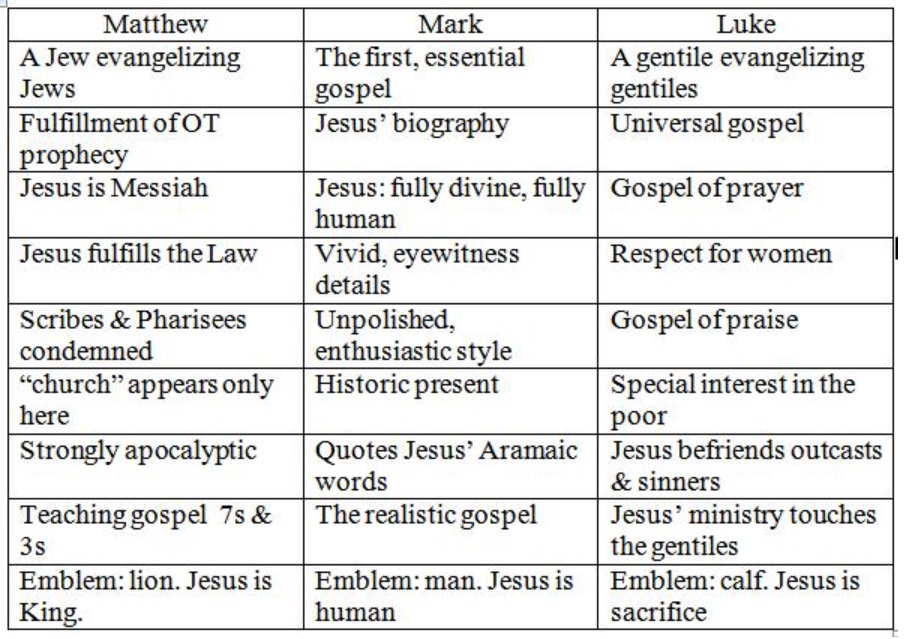
The following table shows how the Gospels tell the story of Jesus from different perspectives, each focusing on different perspectives of Jesus’ life, and each trying to give a different message about the life of Jesus.

Comparison of Gospels
 MatthewMarkLukeJohn
Portrait of JesusKingServantTeacherSon of God
Original readersJewsRomansGreekschurch
Key phrasesKingdom of heaven, fulfilledKingdom of God, Immediately, nowKingdom of God, Son of manBelieve, Word of God, only begotten Son, eternal life
FocusJesus is the Messianic King of the promised Davidic kingdom which fulfills the Old Testament prophecies and claimsJesus is the authoritative Son of God. He is God’s triumphant envoy come to suffer and die in order to claim victory over sin and deathJesus is the perfect Son of Man, the Messiah prophesied by the prophets who came to save and to minister of people of all nations through the power of God the Holy SpiritJesus Christ is the fully divine Son of God who existed before creation. He is the true Lamb of sacrifice through whom we receive the gift of eternal life
Prominent sectionssermonsmiraclesparablesteachings
Genealogytraced to Abrahamnonetraced to Adamnone
Geographic emphasisGalileeGalileeGalileeJudea
Comparison of the Gospels

Observe

Read the chart above. Which gospel is centered in Judea?