Re-envisioning our given environment

Dancing in the Kingdom- Table of Contents

Dancing In the Kingdom – Part 3 – Dancing in the Kingdom– Chapter 18 – Entering the Dance

Re-envisioning our given environment

[Bible references: Genesis 1-2]

“An important distinction exists between the concepts of nature and creation. There is no concept of nature in the Old Testament. Nature, derived from the Greek worldview, is by scientific definition a self-sustaining system replete with its own internal laws. Creation, a biblical-theological concept, recognizes that creation is not self-sustaining but is continually dependent on the presence of God.” [1]

In Genesis we explored how God had fashioned the cosmos to be a temple, a place where he would meet with his image-bearing creatures. This cosmos, and in particular, this world that we live in, ultimately belongs to him, for he built it with materials that he provided.

It was his intention, though, to not only share this temple with us, but to give us responsibilities within it. We know the story of how we rebelled against the responsibilities he gave us, and we know of the outpouring of patient love which he has endured and continues to endure as he works out his plan to restore our relationship with him. He still intends the cosmos to be his temple where he meets with us.

The theme of the temple began in the first chapters of the Bible with the temple dedication, the temple sanctuary in the Garden of Eden, and the charge he gave to his image-bearers to be the stewards of his temple and to fill the earth, expanding the sanctuary, the place he meets with us, to fill the entire earth.

The temple theme concludes in the last chapters of the Bible, revealing our intended destination, not just a primeval garden, but a garden with a city. It’s a city he built, for we, in and of ourselves, cannot build a city where there are no tears of sorrow, where there is no rebellion, where we can experience the entire fulness of shalom.

We don’t know when that time will come, but we do know the responsibility he gave us from the beginning, to be the stewards of what he has given us, to nurture, sustain, care for, and protect the world he provided.


[1] Bukus, Russell A. “The Stewardship of Creation” The Center for Christian Ethics at Baylor University, 2002 www.baylor.edu/ifl/christianreflection/CreationarticleButkus.pdf

Observe

Read Genesis 1:26-30; 2:1-15.  How do we best take care of the space Yahweh provided for us, with his intentions for its flourishing and with our role as stewards of this space?

New Jerusalem’s Urban Garden

Dancing in the Kingdom- Table of Contents

Dancing In the Kingdom – Part 3 – Dancing in the Kingdom– Chapter 16 – Fixing our eyes

New Jerusalem’s Urban Garden

[Bible references: Genesis 1-2; 1 Corinthians 12; 14;1 Peter 1, 4; Revelation 21-22]

In the now-broken earth, many people think of human civilization only as a corruption and pollution of the earth, that the earth was only meant to be pristine – as it supposedly was before humans started to mess it up. While we certainly have abused the earth in many ways, that does not mean all aspects of human civilization are inherently bad. When we use our God-given capabilities to join God in His kingdom building, that is good. Many of the things that we design, create and build are inherently good. The problem lies in our corruption and the world’s corruption that causes us to misuse every good thing.

When we were charged with filling and subduing the earth, it did not mean that we were to simply expand the Garden of Eden. God had given us many gifts to use, including tremendous creative abilities. We were given various spiritual gifts for the purpose of building one another up; we were given artistic gifts to make articles for the Tabernacle and Temple; we were given gifts of singing, making musical instruments and craftsmanship, hunting, trading, sailing – in general, making the things of civilization.

Those same gifts are available for current task of participating with God in the process of bringing His Kingdom to earth, a process that shall lead to ultimate uniting of heaven and earth, a process that leads not to the original Garden of Eden, but of an urban garden attached to the new Jerusalem.

It is undeniable that, despite the corruption we see, God has provided us an abundance of creative skills for displaying His transcendence and glory in our art, technology, engineering, and sciences. He has also given us social and political skills to create human public and private institutions that can organize our abilities to do good.

But it does not take much observation to also notice the corruption that has permeated our society. It can seem hard to determine if we have misused more than properly used the gifts and abilities God has given us. Nevertheless, as God’s co-regents we have been given a sacred obligation to nurture the place he gave us in anticipation of God’s final restoration of the earth.

Reflect

How can you use the gifts and skills that God has given you to help give people hope for the future?

Observe

Read 1 Peter 1. If our mind is set on seeing Christ soon, how shall we prepare?

Our Mandate

Dancing in the Kingdom- Table of Contents

Dancing In the Kingdom – Part 3 – Dancing in the Kingdom– Chapter 14 – Remembering our creation

Our Mandate

[Bible references: Genesis 1:26-28; 2:18-25; 3:6; 39:22-23; Matthew 17:10-13; Acts 3:19-42; 1 Peter 5:10]

We have seen how our journey, the journey of God’s people, creatures made in God’s own image, began with our ordination in the Garden of Eden and we have seen what God has intended for our future. We have seen how that intention has not changed despite our rebellion which continues to this day, and how God has not ceased to work with us, His people, despite our persistent rebellion. We have seen God’s patience and tenderness in not totally abandoning us despite our rebellion and how He has called us generation after generation – from the patriarchs and prophets to the apostles and all who are called Christian – to join Him in His ongoing restoration of His Kingdom on earth.

As image-bearers, we still are charged with the work of stewarding His creation, However, we must be restored ourselves before we can fully join Him in His work. That work of restoration begins when the Holy Spirit comes within us to unite us to God and His community. That is the work God must do within us.

In the previous chapters, we have followed how God called his image-bearers to join in the work that he began and then how, through the years, his image-bearers have joined that work, sometimes successfully and sometimes not. In this chapter, as we prepare to consider how to move forward, we will revisit that multi-faceted call to rule over the earth, to be fruitful and multiply, to fill the earth and subdue it” and to cultivate[1] and keep it, to create beauty. This call to act as God’s stewards of His creation is a call to use our gifts of intelligence and creativity, to cultivate the resources of the earth to establish a godly culture and civilization. This call is sometimes called the “cultural mandate,” where our culture includes all the things we discover and make and pass on from one generation to the next: our food, language, sports, arts, businesses and their products, civic organizations, and governments, etc.

The charge to “have dominion over” and “subdue” the earth and all its creatures includes physical, cultural, and intellectual activities such as farming, mining, manufacturing, government, arts, civic organizations, education, sciences, technology, and many other activities. But the primary place of God’s kingdom is to restore the souls of men. All would be well if all souls were in right relation to God, everything else would fall into place. Evangelization of the souls of all men is the ultimate goal. But if we think of the ways in which God, out of his overflowing abundance, finally managed to touch our hearts, there were many steps and many different ways in which we were individually touched by the hand of God.

As God’s image-bearers we are uniquely equipped to imagine and discover what kind of possibilities can be made of the overflowing abundance of  God, the physical resources He has provided for us: turning grain to bread, grapes to wine, oil to energy and plastics, iron ore to steel, limestone and shale and clay to cement, and many other things we have made from many types of resources. We are uniquely equipped to imagine and discover out of God’s overflowing abundance what kinds of ways we can organize ourselves to fulfill our responsibility to subdue and cultivate the earth by creating organizations such as businesses, civic and social organizations, political parties and non-profit organizations, governments and educational and religious institutions.[2] In all of these activities we can reflect God’s knowledge and wisdom by engaging in intellectual pursuits such as reading, writing, mathematics, sciences, philosophies, language arts, history, engineering, forensics, medicine, law, etc.  


[1] Huber, Dave. “Avodah Word Study” EFCA Today Summer 2012 www.efcatoday.org/story/avodah-word-study

[2] Manahan, Ronald E. “A Re-Examination of the Cultural Mandate: An Analysis and Evaluation of the Dominion Materials” Docsbay Grace Theological Seminary dissertation May 1982 docsbay.net/A-Re-Examination-Of-The-Cultural-Mandate

Reflect

We were assigned priestly duties in the Garden of Eden. As believers, we are to be kingdom of priests. As God’s care for His Creation continues, so does our mandate. What things can you do (and are equipped to do), with God, to fulfill His mandate?

Observe

Read Genesis 1:26-28; 2:15; 39:22-23. How would the world be different if we fulfilled our duties towards creation in the same way the Joseph fulfilled his duties?

The Spirit and the power

Dancing in the Kingdom- Table of Contents

Dancing In the Kingdom – Part 2 – The Kingdom Revealed – Chapter 12 – Launching the church

The Spirit and the power

[Bible references: Genesis 25-19-21; 1 Samuel 1;1-20; 2 Samuel 7; Proverbs 2:1-5; Matthew 7:7-8; Mark 11:12-26; Luke 11:113; 12-26; John 20:21-23; 3:14-16; Acts 1:1-14; 2:1-41; 1 Peter 5:6-7]

There are remarkable parallels between Genesis 2:7 and John 20:22. We see from Chapter 2 that in Genesis 2, God breathed life into Adam who was then commissioned to take care of the sacred space that God had created. That sacred space was initially identified as the Garden of Eden, but we know from Genesis 1 that God had dedicated the entire universe as his temple. We also know that since God’s image-bearers were given the commission to “be fruitful and fill the earth” that the sacred space allotted to the care of the image-bearers was intended to be the entire earth.

After the resurrection, when Jesus met with the apostles in a locked room, He breathed on (or into) them.[1] This is the same word used in the Septuagint version of the Old Testament describing God breathing life into Adam and thereby giving him life. Immediately after this gesture, Jesus instructed the apostles to “Receive the Holy Spirit” who were then commissioned to continue the task that Jesus had begun.[2]

“The very same Greek verb (here only in N.T.) is used by the LXX. in Genesis 2:7 (Wis 15:11) of breathing life into Adam. This Gospel of the new Creation looks back at its close, as at its beginning (John 1:1), to the first Creation. We are probably to regard the breath here not merely as the emblem of the Spirit (John 3:8), but as the means by which the Spirit was imparted to them. ‘Receive ye,’ combined with the action of breathing, implies this. This is all the more clear in the Greek, because pneuma means both ‘breath’ and ‘spirit,’ a point which cannot be preserved in English; but at least ‘Spirit’ is better than ‘Ghost’ We have here, therefore, an anticipation and earnest of Pentecost; just as Christ’s bodily return from the grave and temporary manifestation to them was an anticipation of His spiritual return and abiding Presence with them ‘even unto the end of the world.’” [3]

Previously, in John’s gospel, we saw that “the Son of Man must be lifted up, that everyone who believes may have eternal life in him.” Now that Jesus was crucified and was soon ascend to heaven, the apostles were given the task of sharing the gospel so that people may believe unto eternal life. It is at this moment, in the locked room, that the apostles were given the commission to share the news of forgiveness.

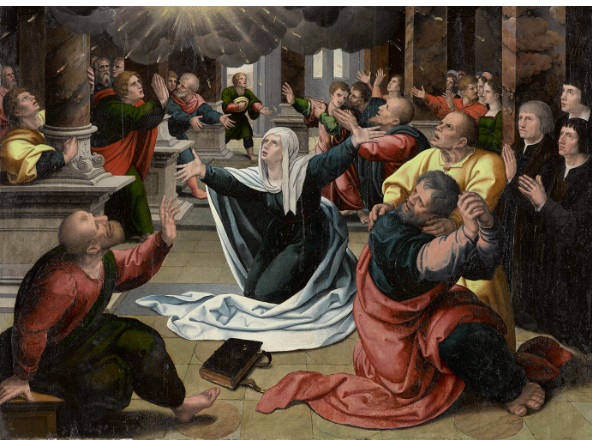
Ten days after Jesus ascended, fifty days after Passover, the disciples were gathered in Jerusalem, waiting for “what the Father had promised.” It was the time of Shavuot, which was known in Greek as the Pentecost. Shavuot is one of three pilgrimage festivals where Jews are supposed to travel to Jerusalem so Jews from all over the Roman Empire were in Jerusalem.

It was at this gathering that Spirit came upon the disciples in great power, revealing the fulfillment of Shavuot. While the disciples were gathered in a room, the Holy Spirit manifested himself with a great wind and tongues of fire that touched the apostles. The apostles then proceeded to prophecy and the people who were there from around the world were able to hear them speaking in their own languages. On that day 3000 people accepted Jesus as their Lord.

The full meaning of Passover and Shavuot was now revealed.

  • Jesus was executed on Passover, a holiday commemorating the celebration of freedom from slavery in Egypt which was observed by the slaying of the Passover lamb whose blood protected all the Israelites from the angel of death who had killed all the firstborn children in Egypt.
  • The miraculous outpouring of the Holy Spirit on the apostles which enabled them to speak in many different languages occurred on Shavuot, which had many different meanings for the Jews. Shavuot was associate with:

  • the giving of the commandments 50 days after the liberation from Egypt. Now the commandments were written on hearts instead of stone.
    • the first harvest of crops in the year, with those first portions being given to God, the provider of harvest. There were now 3000 souls harvested for God.
    • marriage, where Passover was considered the betrothal and Shavuot the marriage where the bride and groom commit themselves to each other. The period in-between the betrothal and marriage can be considered as a time of testing and waiting as the bride and groom prepare for life together. With His sacrifice, Jesus, the Bridegroom committed himself to the Church, His Bride.

Waiting. The virtue we want to bypass. Yet even though God has set seasons and times before us and insists on letting his ordained processes complete, from the beginning, we have wanted things immediately and we have been paying the price ever since. But there was a process God wanted to complete. After His resurrection, Jesus waited for the apostles to gather before He came to them, Jesus waited for many days to go by while He interacted with various groups of his disciples, then after His ascension, Jesus waited for his disciples to stay in Jerusalem, while they waited for the “gift His Father promised … to be baptized with the Holy Spirit.” And so, the apostles waited and prayed.


[1] Biblehub ἐνεφύσησεν Bible Hub biblehub.com/greek/enephyse_sen_1720.htm

[2] Scrivener, Glen. “What does John 20:21-23 mean” Christ the Truth christthetruth.net/2013/03/26/what-does-john-2021-23-mean; Skinner, Matt. “Commentary on John 20:19-23” Working Preacher www.workingpreacher.org/preaching.aspx?commentary_id=887; Lewis, Karoline. “Commentary on John 20:19-23” Working Preacher www.workingpreacher.org/preaching.aspx?commentary_id=76; Flattery, George. “John 20:19-23 Receive the Holy Spirit” Global Christian globalchristiancenter.com/sermons/dr-g-flattery-sermons-on-gospel-of-john/26192-john-2019-23-receive-the-holy-spirit

[3] Biblehub “John 20:22”Cambridge Bible for Schools and Colleges biblehub.com/commentaries/john/20-22.htm

Reflect

There are times when we need to take action and times when we need to wait for maturity or for “the fullness of time.” How can we discern the difference?

Observe

Read Mark 11:12-26; Luke 11:1-13. What should we expect when we pray?

Paradise and resurrection

Dancing in the Kingdom- Table of Contents

Dancing In the Kingdom – Part 2 – The Kingdom Revealed – Chapter 11 – The Kingdom Enters

Paradise and Resurrection

[Bible references: Matthew 27:45-53; Luke 23:42-44; John 20; 1 Corinthians 15; 2 Corinthians 12:3-5; Revelation 2:6-8; 21:1-27; 22:1-5]

His final words were, “It is finished.” Later that day, the other criminals also died, and the confessed criminal joined Jesus in paradise (heaven), the place where God resided.[1] But that is not the end of the journey.

We have to confess that we don’t understand how this happens, but in heaven, God’s creatures, the angels, etc. do not have physical bodies. This however is the place where God’s image-bearing creatures initially go when they die.

There is much we can’t understand about heaven, which is probably less a place “up there” but more like an alternate dimension where God dwells. It seems to overlap with the physical universe such as it did at the Garden Eden or the Tabernacle or the Temple or the body of Jesus or in all who are “in Christ.”  It seems also to the place where those who are “in Christ” initially go after death, to be separated from the physical world until the final resurrection when the earth is transformed into a new earth and when we receive transformed bodies. It is in heaven where God’s creatures can be in unbroken communion with God. For those who have chosen to stay in rebellion against God, there desire will be their destiny, permanently separated from the source of goodness. [2]

The final step will occur sometime later, when not only will Jesus return to earth but heaven itself will be rejoined to earth. At that time, the resurrection of the dead will occur and then, in their new resurrected bodies, all the elect of God will dwell with God in the new earth while the rest will suffer eternal separation from the God who created them. We will discuss what that will look like in the last chapter.


[1] Got Questions “Where was Jesus for the three days between His death and resurrection” Got Questions www.gotquestions.org/where-was-Jesus.html; Compelling Truth “Is Paradise the same thing as heaven? What is paradise” Compelling Truth www.compellingtruth.org/paradise.html; Welllman, Jack. “Is Paradise and Heaven the same thing?” What Christians want to know www.whatchristianswanttoknow.com/is-paradise-and-heaven-the-same-thing/

[2] Migliore, Daniel Le. “Faith Seeking Understanding” William B. Eerdmans Publishing, third edition. 1991 (p. 8)

Observe

Read Matthew 27:45-53; John 20; 1 Corinthians 15; Revelation 21-22. What will our resurrected bodies be like?

Looking back – Signs and shadows of the kingdom

Dancing in the Kingdom- Table of Contents

Dancing In the Kingdom – Part 2 – The Kingdom Revealed – Chapter 11 – The Kingdom Enters

Looking back – Signs and shadows of the kingdom

[Bible references: Genesis 6:5-7; Exodus 25:17-22; Leviticus 16; Joshua 24:19; 2 Kings 17:6; 2 Chronicles 36:17-24; Ezra 1-2; Psalm 14:2; 53:6; Isaiah 43; Jeremiah 29:10; 31:31-39; Matthew 4:12-17; Romans 7:7-24; 8:20-22; Colossians 2:16-17; Hebrews 8:5; 10:1, 5-10; Revelation 21-22]

In the beginning, God created a good earth. Within that good earth, Yahweh created a special place, the Garden of Eden, where he could meet and live with the creatures who bore his image. The Garden was a place where the heaven and earth overlapped, a place where the goodness of Yahweh overflowed, a place of shalom, a place where his image-bearers were intended to thrive and develop as co-creators with Yahweh and ultimately create a civilization that would cover all the earth to the glory of God.

“Perhaps the most fitting symbol of the development of creation from the primordial past to the eschatological future is the fact that the Bible begins with a garden and ends with a city – a city filled with “the glory and the honor of the nations.”[1]

However, the image-bearers put Yahweh’s authority to the side and rebelled against him. The rebellion disrupted the union of the Yahweh’s kingdom with his creatures and all of creation was put into disorder. Human space and Yahweh’s space were separated and all of creation was damaged, including not only the relations between Yahweh and his image-bearers but between the image-bearers themselves.

In the Bible, the themes of heaven and earth can be thought of as heaven being God’s space and the earth being the human space. It may be helpful to think of these spaces as different dimensions. In the Garden of Eden these spaces overlapped, allowing God and man could dwell together. In the garden the humans were to be partners with God taking care of this garden, however they decided to do things their own way rather than God’s. This resulted in the humans being ejected from the space where heaven and earth overlapped, and the remaining story of the Bible is about how God is once again going to bring heaven and earth back together.[2]

The image-bearers found themselves in an increasingly vicious cycle of violence and corruption causing God to restart his project by creating a great flood. Fortunately, out of his deep love for his rebellious image-bearers, Yahweh was resolved to overcome the violence and oppression and had a plan to reunite heaven and earth, extending his kingdom over all the earth.

Yahweh set processes in place that would begin with Abraham and Sarah, continue through to the other patriarchs, and then continue with the nation of Israel. Under Moses’ leadership and with the guidance of the Holy Spirit, the tabernacle was constructed to be the place where heaven and earth would overlap within the Holy of Holies. The temple was decorated and designed to make people feel like they were going back to the garden.

The difficulty was that God’s space is perfect, pure, just, and holy but the human space is full of sin and corruption. This problem was somewhat resolved through the sacrifice of animals, where the animal absorbed the sin of the people and died in their place, creating a limited clean space. Within the Holy of Holies, the mercy seat on the ark was where God’s presence would be but could only be accessed once a year by the high priest.

However, the tabernacle with all its rituals were designed to only be a shadow of things in heaven and a shadow of the things that were coming, a shadow of how Yahweh’s relationship with his image-bearers would be restored and all of earth would be joined with Yahweh’s kingdom in heaven as was intended from the beginning.

In the meanwhile, in those shadows of the coming kingdom, Yahweh worked within the nation of Israel, his chosen people, to gradually reveal signs of his intended restoration. Within those shadows, the people of Israel could see the futility of their own efforts to reconcile with Yahweh despite their denial of the reality of Joshua’s words, “You are not able to serve Yahweh.” Within those shadows, the nation of Israel would rebel against the kingship of Yahweh, rejecting his reign and insisting on creating their own kingdom, like “all the other nations.”

The nation was reminded time after time that the law was good, but they were not, that their continual animal sacrifices were never a permanent solution to reconciling with Yahweh, that they needed a redeemer, they needed a change of heart. Prophets were raised up to warn the people of the consequences of their continual rebellion, but they also delivered messages of hope that, despite their rebellion, God would restore his people to himself.

Then the promised judgment for their rebellion came: Most of the nation was lost to history as ten tribes of Israel were scattered through the Assyrian empire, which would be followed by the temple being destroyed and with a remnant of the remaining tribes being sent into exile in Babylon. If there was any hope that the ritual sacrifices at the temple could reconcile the people with Yahweh, now even that possibility was taken away. The restoration of their own kingdom seemed to be in doubt, never mind the kingdom of Yahweh.

However, the exile was promised to be temporary. After 70 years, the exiled nation had the opportunity to return to the Promised Land and rebuild the temple. Once the temple was rebuilt it was now possible for the temple worship to continue and even for their government to be restarted, although it would be under the auspices of a foreign nation. Yet in all that happened, one thing had not changed; the hearts of the image-bearers had not changed. There was still a need for a redeemer.


167 Wolters, Albert M. Creation Regained: Biblical Basics for a Reformational Worldview William B. Eerdmans Publishing 1985, 2005. eBook (Kindle Locations 581-583)

[2] Bible Project “Heaven and Earth” Bible Project thebibleproject.com/explore/heaven-earth

The Temple Maker

Dancing in the Kingdom- Table of Contents

Dancing In the Kingdom – Part 1 – Shadows of the Kingdom – Chapter 2 – The God who created

The Temple Maker

[Bible references: Genesis 1-2; Exodus 26; 1 Kings 6; Job; Psalm 8; 95; 100; 104 and others; Proverbs 8:22-31; Isaiah 44:21-28; 45:5-12; 51:4-12; 55:6-13; Matthew 26:61; I Corinthians 6:19-20; Revelation 21-22]

There has been much debate about how to interpret the creation account. There have been various attempts to understand creation as physical processes that had occurred (over shorter or longer periods, depending on your analysis) because in our current cultural context we default to thinking of creation in physical, scientific terms. But what if (surprise! surprise!) we consider the biblical text to be a theological text instead of a scientific one, about functional origins and not about material origins.[1]

The cosmos can only function as sacred space once God has inhabited it and people in his image are there. God is declaring purpose for the cosmos as an ordered space for people and as sacred space where he will dwell. This is what defines the divine activity …Adopting and promoting a vision and mission statement will not change how the institution operates. But it articulates a purpose and identity that may not have been realized or present before and proclaims that as its purpose. Genesis 1 is doing something similar. It is articulating a purpose through a mission statement (people living out their designated role as the image of God) and a vision statement (seeing the world around us as sacred space where God is living among his people and being in relationship with them). .[2]

In the last few decades, research has uncovered much more about the culture in the Ancient Near East than ever before. It has been discovered that in Ancient Near East cultures, the Genesis account would not have interpreted the creation account in terms of physical processes but rather in terms of assigning meaning and purpose. So, as we read the Creation account in Genesis 1, on the first three days the spaces of light and dark, waters above and below, and the land are being assigned a purpose. The next three days the populations of those spaces are assigned a purpose: the sun and the moon and stars, the birds and fish, the land animals.

In this perspective, the story of creation is seen more as a story about the dedication of a temple, where the universe and the world were dedicated as a sacred space, a space where God would dwell with his people. Therefore, the seventh day is when God rested from the act of dedicating the earth, which would now be the place where He would now live with his image-bearers. If you read Genesis 1-2, you will see that, unlike the other days, there is no “there was evening and there was morning.” That is because we are living in the seventh day.

The completion of God’s temple would be later remembered by the seventh day celebration of the Sabbath. Although God’s temple was completed by the seventh day, it was not a time where God ceased to do everything. The still continuing seventh day is the time when the “temple” which is our “home” is completed so that God and we, as his co-regents, can settle in and do the things that our home was designed for. Jesus in John 5:1-7 clarified this idea where he explained, “My Father is always at his work to this very day, and I too am working.” Living into this sacred space would entail us taking part with God in his continual acts of creating and sustaining the universe. That is the perspective of Eve, when she gave birth to Cain, she recognized that “I’ve created a man with Yahweh.”[3]

In Genesis 2, the focus moves to the humans God created and how they were to function in that sacred space where the Garden of Eden is the center. Genesis 2 is also where God’s name, “Yahweh,” begins to be used. Genesis 1 introduces the God as the Creator of the universe whereas Genesis 2 introduces the God who in establishing a personal relationship with the people he created uses a personal name.[4]

The cosmos that God created was intended to be a temple, the place where He would meet with his people. The temple/creation imagery permeates and unites all of scripture from the first book, Genesis, to the last book, Revelation. The temple/creation theme shows up in places like in the stories of Noah, Moses, and Abraham, in the construction of the Tabernacle and the Temple, in Job’s dialog with Yahweh, in the poetry of Psalms[5], in prophecies of Isaiah, in the body Jesus and in us as his Body and finally in the depiction of reuniting of heaven and earth. Each instance shows its own unique aspect of the temple, so that when combined with each other, they show a more complete picture of how God meets with us and provides for us and what he has intended for us. We see a complex picture of the temple as a physical place in Creation and at the same time the temple is within us, inside the bodies of all of those who call on his name. In both those cases we can see the provision of God who 1) abundantly fills all of Creation in ways that exceed our imagination and exceed the capacity of any book to tell and, 2) abundantly fills us with His strength and His Spirit so that we can fulfill the desire He has for us to “cultivate and keep” the abundant place He has provided for us.

One of the benefits of considering only the theological aspects of the Creation accounts, or the why of creation, is that we don’t have to be as highly concerned about the how of creation, or the scientific/physical accounts of creation. When scientific creation accounts are proposed and are not perceived to be correct because they don’t seem to theologically fit, we don’t need to despair. It may be that the various proposed scientific explanations simply don’t theologically fit because they just don’t or because we just don’t understand just how they could theologically fit. We know that the sciences are limited and that theories will change as more discoveries are made. Sometimes those theories may seem to move closer or further from our limited theological understandings, but our theology is not constrained by whatever the current science may indicate. In the meanwhile, we are free to explore the science and wonder in awe and marvel at just how God managed to do it all while humbly admitting that we don’t have the mind of God and how much higher his ways are than our ways.


[1] Walton, John. “The Lost World of Adam and Eve,” Proposition 3, InterVarsity Press. 2015 Kindle Edition. pp. 35-45; Driver, Cory. “Commentary on Genesis 1:1-5” Working Preacher 10 Jan 2021 www.workingpreacher.org/commentaries/revised-common-lectionary/baptism-of-our-lord-2/commentary-on-genesis-11-5-5; Carlson, Reed. “Commentary on Genesis 1:1-2:4a 12” Working Preacher Sept 2011 www.workingpreacher.org/commentaries/narrative-lectionary/creation-by-the-word/commentary-on-genesis-11-24a-5; Throntveit, Mark. “Commentary on Genesis 1:1-2:4a; or 1:1-5,26-2:4a 1 Working Preacher 1 Sept 2011 www.workingpreacher.org/commentaries/narrative-lectionary/creation/commentary-on-genesis-11-31-21-4

[2] Walton, John. “Material or Function in Genesis 1? John Walton Responds” Biologos 3 Apr 2015 biologos.org/series/reflections-on-the-lost-world-of-genesis-1-by-john-walton/articles/material-or-function-in-genesis-1-john-walton-responds

[3] Friedman, Richard Elliot, Commentary on the Torah, Harper Collins, 2003 Location 6942 of 37412

[4] There will be more discussion on that name in “Hope in the Brokenness,” Chapter 4

[5] Muran, Alexej. “The Creation Theme in Selected Psalms” Geoscience Research Institute 1 May 2015 www.grisda.org/the-creation-theme-in-selected-psalms

Reflect

Does viewing the universe as a temple affect the way we look at it?

Observe

Read Proverbs 8. This proverb personifies God’s wisdom. Read how God is describing how His wisdom is built into the very framework and fabric of this temple we call Creation. How can we sense God’s presence with us because of how His wisdom should be speaking to us?

A Brief Account

Dancing in the Kingdom – Table of Contents

Dancing In the Kingdom – Part 1 – Shadows of the Kingdom Chapter 1 – Prelude

A Brief Account

The following is an Extremely Brief Account of the Very Long Story, a summary of the Bible’s story.

There was, and is, and will be, a complex person we call God, who exists as three people that we have come to know as the Father, Son and Holy Spirit. God decided that he wanted to expand the love that was shared between the Father, Son and Holy Spirit. To that end, he created an entire universe so that on one of its planets he could create an abundance of living creatures.

On that planet, he created special creatures, humans, who were made in his image such that they could love him in the way that he loved them. This universe then, would be a form of temple, a place where God can meet with his people. The garden he placed them in was where the dimensions of heaven and earth overlapped. The garden was a place where God’s good and beautiful kingdom of heaven was fully present.

Of course, these humans were not duplicate spiritual beings who were gods themselves, but physical creatures who had enough of God’s characteristics so that they could love in the way God loved. But because love is a voluntary thing that we must choose to do, we cannot love unless we have the option to not love.

God placed his first people in a garden and gave them an assignment. They were to be his representatives, priests if you will, in this garden. They were to take care of it as His representatives, His stewards in the garden. Their long-term task was to multiply and fill the earth so that the whole earth would become the place where God could meet with all his people. The entire earth was intended to be filled with God’s abundant provision for his people who would then take care of what God provided, and all the while giving and receiving and sharing the love which God would freely bestow. In this way, the kingdom of heaven would overlap with the entire kingdom of earth and God would freely mingle with his people.

The option to love or not love was provided by a test of trust. There was in the garden a tree whose fruit not only looked appealing but promised to provide the gift of all knowledge if one ate it. The humans were told to trust God and not eat the fruit of that tree. Eating that fruit would not only provide certain knowledge but would also provide death.

The results of that test are now apparent all around us. Death comes to us not only in the form of physical death, the separation of our souls from physical life, but also in the form of spiritual death, the lack of love which separates us from each other and from God. Fortunately, our current situation is not our destiny – and that is what the rest of the story is about.

God intended that death would not merely be a penalty for not trusting (or loving) but would also be the very mechanism by which he would restore us to himself. From the descendants of the first people, God separated out a family through which he would bring blessing to the entire world. Through that family that a nation would be raised and through that nation the eternal God would choose a family to accomplish the inconceivable. In that chosen family, the eternal God would cause himself to be conceived within the womb of a woman who would then give birth to a being who was both fully God and fully human. He would then be raised as a human and eventually would suffer death by execution as a human and then be resurrected as a human.

In that resurrected human body, the eternal God would return to heaven, but before doing so, he invited us to, in essence, to represent Him on earth by becoming part of his body on earth. By trusting him and accepting his Spirit, we could join with him in His death and resurrection by dying to our own self-interests and uniting with his loving interests.

He then promised to return to us again in bodily form, at which time the kingdoms of heaven and earth will again overlap. Heaven will be rejoined to earth to fulfill the intention God had from the beginning. But meanwhile, in this time between His incarnation and His eventual return, we are still called to be stewards of our currently broken world, bringing slivers of the light and hope of heaven into a world now very dark with evil and suffering and pain.

Reflections

How do you feel in comparison to the immense size of the universe? What does it mean to you, that the universe was designed with you in mind?

Observe

Read Acts 2:22-36; 7:2-50; 10:34-43; 13:16-39; 17:22-31. These passages show the various ways the gospel was presented to various audiences. As you read through the different accounts of the gospel, what stands out to you?