Occupy Till I Come

Dancing in the Kingdom- Table of Contents

Dancing In the Kingdom – Part 3 – Dancing in the Kingdom– Chapter 18 – Entering the Dance

Occupy Till I Come

[Bible references: Jeremiah 29; Luke 19:11-27]

On His way to Jerusalem the last time before His triumphal entry, Jesus knew the kind of expectations the people had about how the Kingdom of God would appear. To prepare them for the long wait between His resurrection and His return to fully restore the Kingdom of God, He told them a parable about a nobleman who would, before going into a far country, give his servants some money with instructions to engage in business while he was gone. The parable ended with rewards given to those who made profits and penalties for those who did not.

This then is our instruction, to make use of what God has given each of us to ‘engage in business,’ (KJV “Occupy Till I Come”) that is, we are called to help advance the kingdom until He returns.

When Jesus came two thousand years ago, he announced the beginning of a new age, “The Kingdom is here … The Kingdom of heaven is near … The Kingdom of God has come.” As disciples of Jesus we can say, “The Kingdom of God is within us.” Then, with our hearts changed by Jesus, we are charged to go and make disciples, to do justly, love mercy and to walk humbly with our God.

As we then join Jesus in bringing His kingdom into the world, we need to remember our humble estate …We cannot even change our own hearts, never mind the hearts of others. Certainly, we cannot change our culture. It is up to our Savior to change our hearts, and even more so to change the culture around us.

Jesus and his disciples lived more as servants or slaves within the Roman Empire. They had no political influence. But as the disciples lived transformed lives, living as well as preaching the Gospel, and showed the power of sacrificial love, their Spirit empowered lives opened the way for the Spirit of God to change the hearts of many throughout the Roman Empire, eventually moving the heart of a Roman Emperor, Constantine.

History has shown the mixed results of combining the power of state and church, but the teachings of Jesus have penetrated even our secular postmodern culture in ways that are not widely recognized as such. Despite the church’s own history of abusing and misusing power, Jesus’ concepts of using power to serve others, even one’s enemies still managed to occasionally penetrate the halls of power – in imperfect form to be sure, just as the ideas expressed in the Enlightenment imperfectly expressed ideas from Christianity.

“Reparations let’s say for slavery or in New Zealand reparations to the Māori or in Australia reparations to the Aboriginal even for native indigenous American Indians. And this language is actually not a historic language. This is a language since Jesus. See, because Genghis Khan never worried about reparations. He never felt he had any moral responsibility to somehow make it right for all the women he raped and all the men he killed and all the families destroyed and all the villages he burned down. We have Caesar or Alexander, they never really had remorse for anything they conquered or anything they destroyed or any people whose lives they overthrew. This concept of justice of using power well is a concept that only emerges because Jesus lived 2,000 years ago. He revolutionized the entire understanding of power. The idea that a government should actually care about its citizens is really, it’s not a historic human concept. This concept is infused by the ethics that Jesus brought to the understanding of power that it says when Jesus had all power and all authority, he ties a towel around his waist and he washes his disciples’ feet. This is a reinvention of power. … if you go back to World War II … when you look at the American response to conquering Germany and conquering Japan, and how within a decade or two, both of them became two of the greatest economies in the world … You get to see what happens when you’re conquered from a Christian mindset world with West Germany. You realize that Japan becomes one of our greatest allies. That doesn’t happen historically. You do not conquer a nation and then rebuild it to feel a moral obligation to re-establish that country better than it was before. Even what we’ve done historically has been informed by a Christian worldview. I’m not saying that England or United States or any Western nation is a Christian nation. What I’m saying is the conversations we’re having are informed by Jesus’s revolutionary, brilliant genius thoughts about power.” [1]

There are debates on the ideas expressed above, often fraught with ideas of self-interest[2] and ideology, about how to provide for populations that have experienced oppression or how to manage the after-effects of war. But these ideas and other expressions of compassion and justice – like hospitals, orphanages, the concept of “war crimes,” or the many ways to carry out “social justice” (that is, God’s expression of compassion and justice) – are ideas not found in history until God introduced them first to his chosen people, Israel, and then through the person of Jesus to His Body. As God’s image-bearers

Unfortunately. the church often abused its privilege, often succumbing to the worldly temptations of power and ignoring its mandate to steward God’s world with compassion and justice. But even though the church has stumbled, it has still managed to live out, admittedly imperfectly, its mandate of compassion and justice. And the world has noticed. Bu interestingly, many have adopted those same values even though they choose to ignore the source of our mandate.


[1] Mcmanus, Erwin. Interview with Carey Nieuwhof, CNLP 452: Erwin McManus on the Future of the Church, How to do Evangelism More Effectively, Authenticity and Reflections on Being Labeled a Heretic Carey Nieuwhof careynieuwhof.com/episode452

[2] Niebuhr, Reinhold.  “Editorial Notes” republished as Christianity and Crisis Magazine providencemag.com/2022/06/christian-realism-enlightened-self-interest-marshall-plan-emerges-reinhold-niebuhr/ 17 Jun 2022

Reflect

In what ways have you lived out a sacrificial love?

Observe

Read Jeremiah 29; Luke 19:11-27. What do we need to do to live transformed lives, living and preaching the Gospel, and show the power of sacrificial love with Spirit empowered lives?

Guardians of the truth

Dancing in the Kingdom- Table of Contents

Dancing In the Kingdom – Part 2 – The Kingdom Revealed – Chapter 12 – Launching the church

Guardians of truth

[Bible references: Psalm 25:2; 45:4; 145:18; Proverbs 12:19; 22:21; Isaiah 45:19; 59:15; Jeremiah 5:1; Zechariah 8:16-19; John 1:14-17; 4:23-24; 8:44-45; 14:6; 16:13; Acts 20:30; Romans 1:18-25; 2:1-20; I Corinthians 11:18-19; 1 Timothy 4:6; 2 timothy 2:14-29; 1 John 2:20-21; 3 John 1:1-12]

God is always in part incomprehensible, mysterious, and paradoxical, which leads to an inevitable diversity of ideas about Him. And yet He has left us with a challenge, He has declared Himself to be the Truth and He has charged the church to be His instrument in making disciples, therefore making us the guardians of that truth. This means that when the church goes about its business of growing in the knowledge of God and developing doctrines about the One who always mysterious, there will be an inevitable tension of trying to discern when the developing diversity of ideas about the Truth will lead to ideas that oppose the gospel or lead to the revealed knowledge of God.

Observe

Read 2 Timothy 2:14-19. What lies are Timothy told to be concerned about?

Assembly of God’s people

Dancing in the Kingdom- Table of Contents

Dancing In the Kingdom – Part 2 – The Kingdom Revealed – Chapter 12 – Launching the church

Assembly of God’s people

[Bible references: Isaiah 54; Matthew 5:44-48; 16:18; 18:17; 28:16-20; Luke 17:3; Acts 2:42-47; 11:22; Romans 16:5; 1 Corinthians 12; 14:19, 26, 35; Ephesians 5:32; James 5:13-20]

God did not create us to be isolated individuals. In fact, He created us in His image, a mysterious Triune God who is at once a person, God, and is also a community: God the Father, God the Son, God the Holy Spirit. To help us understand this complexity, the Bible uses a couple of metaphors that are used to describe the church. Sometimes scripture describes the church as a building of which Christ is the cornerstone, sometimes as a body with many parts that are all necessary for each other, and sometimes as a bride with Christ as the Bridegroom. All these metaphors give us different ways to think of how we connect to each other.

In the Old Testament the Hebrew word for assembly is “qahal,” and in the New Testament it’s the Greek word, “ecclesia.” In both the Old and New Testaments there were people who believed in God. These days we call the assembly of God’s people the “church,” but where did that word come from.

The word “church” is derived from the Scottish work “kirk” which is derived from the Greek word “kuriakon” which means belonging to the Lord (Greek “kyrios”). In the Bible, this word was used a couple of time to refer to “the Lord’s” supper and “the Lord’s” day.  In this same expression, sometimes the building where those “who belong to the Lord” meet is also called the church, where it’s the building that belongs to the Lord.

The word “church” is used in a variety of ways: the whole body of Christians in one city; a particular local congregation; or the whole body of believers on earth (past, present and future). Throughout this book, the word ‘church,’ using the lower case ‘c,’ refers to this whole body of believers. It might be clearer if, perhaps, we used the term am Yahweh (“people of Yahweh”) (Numbers 11:29) to refer to all believers through time, through Old and New Testaments.

There are also other words in the Bible that are used to describe Christians in general:

  • Brethren – those who belong to a spiritual brotherhood or fellowship.
  • Believers – those whose doctrine is faith in the Lord Jesus Christ.
  • Saints – Those who are consecrated to God, holy ones who are separated from the world and dedicated to God
  • The Elect – those who are chosen by God
  • Disciples – those who follow Jesus to learn from him.
  • Christians – those who belong to Christ
  • Those of the Way – those who follow Christ, live like Him

There are also metaphors used to refer to the church:

  • The Body of Christ – which refers to the many inter-related functions of the people in the church. Related to this is the way we sometimes say the church ought to be regarded more as an organism rather than an organization.
  • The Temple of God – which sometimes refers to the entire church being built on the cornerstone, “Jesus,” and sometimes to the individual believers in whom the Holy Spirit resides.
  • The Bride of Christ – which refers to the intimate relationship we all have with Jesus.
  • Pillar and buttress of the truth – which refers to the need to behave correctly and defend the truth.

All of this is to say that there are many ways to refer to “the church,” depending on what one wants to emphasize. But it is clear that the mission of “the church” is to

“Go therefore and make disciples of all nations, baptizing them in the name of the Father and of the Son and of the Holy Spirit, teaching them to observe all that I have commanded you. And behold, I am with you always, to the end of the age.” (Matt 28:19-20).

Making disciples, being a disciple, is a life-long process. It includes many things, the commands given to Adam to steward the earth and create a culture that glorifies God, all the ways in which we can love God with all our heart, mind, soul and strength, all the ways in which we can love our neighbor – and even our enemy, all the ways in which we can be a part of our church community that builds one another up, and all the ways in we can worship God in all we do.

Toward that end, God has given spiritual gifts to each one of us, so that in context of the community we can build each other up and help each other grow into the unity of the faith.

 “Local congregations … must resume the practice of making the spiritual formation of their members into Christlikeness their primary goal, the aim which every one of its activities serve” [1]

God has not supplied one person with all the gifts but has divided them among the disciples in a community so that together we might build one another up. The church is a community designed to worship together, to share the sacraments, to build one another up and hold each other accountable.

It is in the context of living in community that we can grow in love towards others as we learn to sacrifice ourselves for the sake of others, even those with whom we disagree and with those who are unable to respond equally. Our attitude should be the same as the attitude of our “good and overflowing God” to generously reach out to others with the good news of the gospel.


[1] Willhoit, James C. “Spiritual formation as if the church mattered” Willhoit, James C. “Spiritual formation as if the church mattered” Baker Academic 2008

Reflect

What groups of people do you identify with?

Observe

Read James 5:13-20. What power is there when people pray together?

The darkness

Dancing in the Kingdom- Table of Contents

Dancing In the Kingdom – Part 2 – The Kingdom Revealed – Chapter 11 – The Kingdom Enters

The Darkness

[Bible references: Matthew 17:11; 27:45-46; Luke 23:43; John 16; 19:25-27; 23:44-46; Romans 1-3]

Jesus’ trials were performed in the dark of night, physically and spiritually. He was condemned by the Jewish rulers who were spiritually blind and then allowed to be crucified by the equally blind Roman rulers and even deserted by the disciples he spent three years training. He was condemned by a world who did not deserve him; the whole world was guilty of turning away from him. The world he loved, and for which he would suffer and die, was not deserving of his mercy and grace. The world itself and all the creatures who bore the image of God were corrupted by sin and truly separated from the one who never stopped loving them all. The Creator literally put his life on the line to break the hold of sin in the world so that the world and image-bearing creatures could be restored to what he had intended from the beginning.

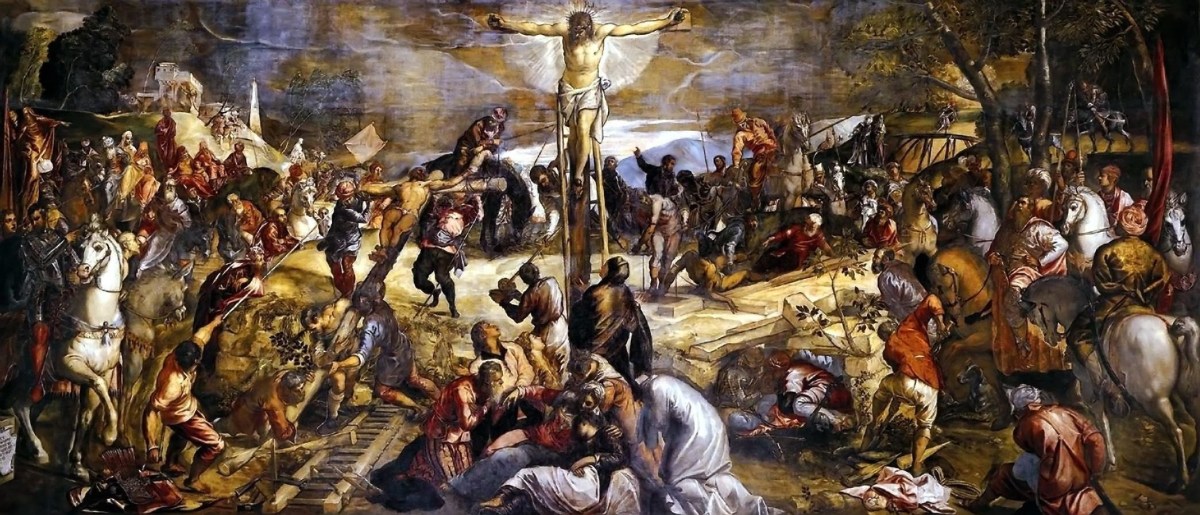
The darkness that hung over the world at that moment was a darkness that Jesus had come to defeat. The darkness would only last for a while more. So, with that in mind, even as he was hanging on the cross, Jesus was fixed on the future. He assigned one of his disciples to take care of his mother, Mary. When one of the criminals who were crucified with him, recognized Jesus as God and confessed his guilt, Jesus assured that man, “Today you shall be with me in paradise.” Jesus had chosen to be born the same way as his image-bearing creatures so that he might come to this moment of suffering and dying on our behalf; for this was the way to defeat the hold of sin and death, not only over our lives but over all of creation as well.

Observe

Read John 16. As John is writing about these events, he is careful to detail how the events correspond to the prophecies in Scripture. What is important about making that kind of connection?

Passion unto death

Dancing in the Kingdom- Table of Contents

Dancing In the Kingdom – Part 2 – The Kingdom Revealed – Chapter 11 – The Kingdom Enters

Passion unto death

[Bible references: Genesis 3:12; Matthew 16:21-23; 21:4-5; 26-27; Mark 9:30-37; Luke 22:54-62; John 1:14; 12:12-19; Romans 1:18-32; 5:20; 6:23; Ephesians 2:1-10]

There is a sense in which each moment of history is equally important to the next. Each moment is a moment which God pursues us as he guides us to our ultimate flourishing. There is no reason to suppose that our continuing flourishing will cease once heaven and earth are reunited, but we should expect that our flourishing will continue as a manifestation of his glory.

However, in our current state of affairs in which earth is broken from heaven, there are moments, epiphanies, in which heaven more noticeably breaks through. There are moments in which angels are more visible or in which Yahweh reveals himself through his prophets. Even more remarkable is the moment in which Yahweh submitted himself to taking on human form, even to the point of being conceived as an embryo inside the body of a human woman and then enduring the normal process of physically growing to become a human adult. Yet even that was not sufficient. Yahweh may have taken the form of a human, but it wasn’t a glorified human,[1] not yet the human as he intends for us to be.

To do that would require him to suffer the shame and justice that we ourselves have earned. The sin that brought us death would have to overcome by a sacrifice that would bring us life. In becoming human, Jesus identified himself with us, but in order for us to become like him he would have to make us ready to receive his spirit. We were helpless to make ourselves acceptable to God, to make ourselves free from sin and its consequences. Bonhoeffer once related his prison experience to Advent. He could not free himself – he needed someone to come from the outside to rescue him.[2] And that is our dilemma, we need someone to come from the outside to rescue us. The covenant revealed to Moses was given to increase our sin, to make it more evident than before about our inability to rescue ourselves. We were condemned by our sin to remain separated from God.

We saw in the previous chapter, that the world was very much like it is now, full of factions and frictions, the powerful and the poor, and everyone waiting and wanting the world to be a better place. The world into which Jesus was born was as broken as it is now. Jesus came into this world with a message of love and hope and with acts of healing and casting out of demons, but that would not be enough. Sin and death had a power over the world that needed to be broken. To rescue the world, to restore it to what it was intended to be, sin and death would need to be defeated. And there was no one who could carry out the rescue except God.

It was as true then as it is now, ever since Adam and Eve, people look at the problems around them and think that the problem lies somewhere else besides inside them. In particular, the more factions and frictions there are, the easier it is to find someone else to point to. So, when Jesus came, teaching, healing, and identifying with the common people more than the elite, it seemed that the more Jesus revealed himself the more the people seemed to think that Jesus would be the one – to rescue them from the Roman government.

Even Jesus’ chosen twelve disciples, the ones who would spend three years with him day and night … even they couldn’t understand the type of rescue they would need. Jesus would explain many times about what he needed to do, but the disciples couldn’t understand. The truth is, though, that even as we look back and see what Jesus had to do, we also have a hard time fully understanding just how desperately that we need rescuing. We don’t understand the depths of our own depravity.

When Jesus approached Jerusalem with his disciples for the last time, some of the disciples argued about which of them was the greatest, or who would sit next to Jesus on his throne. When Jesus showed his power with his resurrection of Lazarus, the crowds got more excited about the possibility of Jesus throwing out the Roman government and then they gave him a grand entry into Jerusalem. However, Jesus refused to act as they wanted, and the crowds eventually turned against Jesus. Even one of the disciples, Judas Iscariot, gave up on Jesus and agreed to betray him to the Sanhedrin. Then, when Jesus was arrested, the rest of the disciples went into hiding. Even Peter, who tried to follow the lynching party at a distance, refused to be identified with Jesus.


[1] Got Questions “How does the Bible describe glorified bodies we will possess in heaven?” Got Questions www.gotquestions.org/glorified-bodies.html

[2] Kincaid, Elisabeth Rain, “Bonhoeffer: Advent is Like a Prison Cell” Christianity Today www.christianitytoday.com/women/2018/december/bonhoeffer-advent-is-like-prison-cell.html

Observe

Read John 12:12-19. In this scene, the crowd is expecting a rescue from the Romans,  the Pharisees are worried about their competition becoming too popular, and the disciples are not comprehending what is happening. How did the disciples eventually understand what was happening?