Relation to Self

Dancing in the Kingdom- Table of Contents

Dancing In the Kingdom – Part 3 – Dancing in the Kingdom– Chapter 17 – Finding our place

Relation to Self

[Bible references: Psalm 8:5; 104:27-30; Micah 6:8; Matthew 6:26; 10:29-31; Luke 12:24; 18:29-30; John 13:35; Ephesians 1:7; 5: 21-33; Philippinas 2:1-11]

The second greatest commandment, “Love your neighbor as yourself” implies that we love ourselves. God loves us. He cares about us, even to the number of hairs on our head. We are His creatures. That makes us worth something. While the focus in the Greatest Commandments seems to be of us loving God and us loving our neighbor, we need to remember that the love we give flows out of the love we are given. We are neither loved more nor less than anyone else. This complementarity is woven together in Ephesians 5 where husbands are instructed to love their wives as much as they love their own bodies. In fact, we are best able to take care of others if we are healthy ourselves.

Our health includes all dimensions of our being: physical, emotional, intellectual, spiritual – If you will, our body, soul, and spirit. To be fully healthy, we need to pay attention to all these aspects of our lives. One problem area in the church as a whole is that it has commonly addressed all these aspects in an unbalanced way. It was due to that imbalance that a pastor, Peter Scazzero wrote, “Emotionally, Healthy Spirituality”[1] in response to the results of an unhealthily imbalance in his own life. Even within the field of medicine, there is a recognition of the connection of physical and spiritual health.[2]

Yahweh has created us with particular bodies in particular times and places, but our post-modern culture has added one more type of imbalance. When some of us experience a dysmorphic disorder, our culture encourages us to deny our embodied identity in Christ. Instead of grounding our being in the surety of our identity in Christ, we are encouraged to ground our being in an identity based on a broken self-perception.

This action replaces Yahweh’s authority with our own, centering our lives in our limited knowledge which is subject to fleeting emotions. This post-modern diminished focus on Yahweh’s authority strips the determination of truth from an all-knowing God and places the determination of truth on our incomplete (and sinfully corrupted) knowledge.[3] However, our primary identity should be based on our identity in Christ with all sub-identities being subject to that.

When we engage in other relationships both within and without the church, we need to be honest about who we are. None of us has it all figured out. We all fall short of what Yahweh intends for us to be. We all lack wisdom and knowledge and all of us are in rebellion. All of us, whether we claim we are children of Yahweh or not, are daily working our way to or from Yahweh. We all imperfectly “do justly, love mercy and walk humbly with our God.” We all need forgiveness.

In the end, Yahweh will be the dispenser of wrath to those who remain in rebellion against him, but it is his love that draws us to Him, and it is by His love that people will know we belong to him. The love and mercy we receive from Yahweh may be unearned, but we are loved, and therefore, we need to learn to love ourselves as well. From the security of that love, the love which Christ had towards us when were unlovable, we can then reach out in love with those with whom we disagree or find offensive. As we learn to fully receive the love of God, we will strengthen our ability to love others.


[1] Scazzero, Peter. “Emotionally, Healthy Spirituality”  Zondervan, 2017

[2] Cook, Alison. “The Most Important Gift” Alisoncookphd.com www.alisoncookphd.com/the-most-important-gift and “Saying Yes To Yourself” 2 Dec 2020 www.alisoncookphd.com/saying-yes-to-yourself/

[3] Groothuis, Douglas. “Postmodernism on Race and Gender: An Evangelical Response” Asbury Seminary, place.asburyseminary.edu/cgi/viewcontent.cgi?article=1317&context=asburyjournal

Reflect

Various businesses use our various media to try to make us dissatisfied with our bodies to create desires to buy services or products to make our bodies “more acceptable.” Our social media enhances that effort. While It is good to be

Observe

Read Psalm 8:5; 104:27-30; Matthew 6:26; 10:29-31; 12:11-12; Luke 12:24. If God cares about your needs, how should you care for yourself?

Discipline of Service

Dancing in the Kingdom- Table of Contents

Dancing In the Kingdom – Part 3 – Dancing in the Kingdom– Chapter 15 – Reforming our Souls

Discipline of Service

[Bible references: Deuteronomy 10:12; Psalm 126:5-6; Matthew 5:16; 10:42; 20:28; 25:22-23; Mark 10:43-44; Luke 22:27; John 4:34; 13:14; 27:4; Acts 20:9, 24; I Corinthians 3:9; 12:7; Ephesians 4:4-8; 6:7; Philippians 2:7; 1 Timothy 6:18; Titus 2:7; Hebrews 10:24; James 2:17-18; 1 Peter 2:12; 4:11]

To belong to Christ is to belong to His Body, all those who belong him. All who believe in Christ are sealed with the Holy Spirit, and the Spirit gives spiritual gifts to all who belong to him, gifts that are designed for the building up of His body. This automatically calls us then to be serving others within the Body of Christ.

Change the diapers

Once we are in Christ, by virtue of the gifts He has given to us, we become responsible to Him and therefore to His Body, to use the gifts we are given. This does not mean, however, that we are not obligated to serve outside the scope of the particular spiritual gifts he has given us. For example, if we have a baby, we are obligated to change the diapers even if “it’s not our gift.” It’s merely what we’re called to do. The point is that belonging to Jesus is to belong to His Body and to be a part of an enterprise that began long before we were born and will continue after we die. To be part of that Body is to have a function in that Body.

Different services

To each of us, whatever possessions or gifts we have, all belong to God, and we are stewards of whatever He has given. Jesus declared, “The Son of Man came not to be served but to serve, and to give his life as a ransom for many” (Matt. 20:28). Since to be in Him is to become like Him, we should also have that same attitude of service. A part of developing this attitude is to develop a sense of humility, beginning with the realization that God is holy and that we all deserve His wrath for rebelling against Him, but by His love and grace He has rescued us from the full consequence of our rebellion, and has instead chosen to give us great blessings. It is out of gratitude that we can respond and give back by serving Him, and therefore His Body. The difficulty is, that in this time of “Already and Not Yet” we need to be intentional about dealing with the sin in and around us by developing the habits, which is the discipline, of service. There are different aspects of our service.

  • The service of hiddenness – hiddenness is a rebuke to the flesh and can deal a fatal blow to pride.
  • The service of small things – those frequent opportunities to help in small ways.
  • The service of guarding the reputation of others – actively avoiding gossip which causes division, and instead promoting unity through your words.
  • The service of being served – true servants should graciously receive service, not feeling they must repay it.
  • The service of common courtesy – acknowledging others and affirming their worth
  • The service of hospitality – “practice hospitality ungrudgingly to one another” (1 Peter 4:9); making a space where people are welcome as they are to be together and share life.
  • The service of listening – we don’t need to have all the answers, we simply need to be present and listen well in love.
  • The service of bearing the burdens of each other – weeping with those who weep and bearing the hurts and sufferings of others.
  • The service of sharing the word of Life with one another – nobody hears God perfectly; thus we are dependent on one another to receive the full counsel of God

Reflect

Think about the needs of those around you and how you might serve them.

Observe

Read Ephesians 6:7. How does this verse affect how we serve others?

The Discipline of Liturgy

Dancing in the Kingdom- Table of Contents

Dancing In the Kingdom – Part 3 – Dancing in the Kingdom– Chapter 15 – Reforming our Souls

Discipline of Liturgy

[Bible references: Exodus 12:1-28; Psalm 39:4-7; 90:9-12; Ecclesiastes 12:1]

I don’t know why so many Christian groups think they need to reinvent the wheel when it comes to “discipleship programs.” This time-tested annual pattern for the life of individual believers and the Church together that is focused on Christ, organized around the Gospel, and grounded in God’s grace, is sheer genius. It is simple enough for a child. It offers enough opportunities for creativity and flexibility that it need never grow old. Each year offers a wonderful template for learning to walk with Christ more deeply in the Gospel which brings us faith, hope, and love.[1]

Teaching and learning that are attuned to the spiritual power of habit recognize the power of little things, the formative power of micro practices. Little things repeated over time in community have a formative effect.[2]

In one sense, a liturgy is a ritual, or a script, used by a congregation to format its worship services. In that regard, all congregations are liturgical no matter how formal or informal. In another sense, a liturgy is a “work of the people” which emphasizes the participation of the congregation during the worship service. The goal of the liturgy is to place the whole of our lives, including our schedules, our possessions, and our efforts, in submission to Christ.

That means that we should consider not just what we do on Sundays in the corporate setting of the church, but as individuals, we have our own individual liturgies through the week as well. We should pay attention to the ‘work’ we do as individuals as we live our lives, the ways we worship as we go about our daily lives, the tasks we do and the habits we practice. How do we, in fact, place the whole of our lives, our schedules, our possessions and our efforts, in submission to Christ? That is the point of our liturgy and all the other disciplines we incorporate into our lives.

The liturgical year

The liturgical year is an ancient, time-tested method of discipleship. In addition to the weekly Lord’s Day reminder/celebration of the resurrection of Christ, the liturgical calendar provides a way of refocusing our attention on the spiritual aspects of life. The focus on the Christian story and celebrations provides an opportunity to be shaped by our counter-cultural message rather than the so-called secular message and celebrations. The liturgy of Word and Sacrament has varied through different times and places, but the ancient liturgical calendar provides one way for us to engage as in a concert in a practice that unites us to the one holy, catholic church, past, present, and future.

Sacred Time

Interestingly, the Jews have a liturgical calendar that is different than their “secular” calendar, in the same way that we keep a liturgical calendar that is different from the secular calendar. The calendar of the Canaanite culture of the Old Testament started at the beginning of the wet season which began in the fall. That was the time when seeds would be planted. The Biblical calendar starts in the spring at the beginning of the harvesting season. While the Canaanite culture begins the year with the work that they do to reap a harvest later, the Israelite culture begins their year harvesting the crops (that God provided) and from which they would have seeds to plant later. The difference highlights whose work has preeminence. The “Gentile” calendars are similar. The secular year begins in January as the date when the Roman consuls would begin their terms of office whereas, the Christian liturgical year builds our focus around the life and ministry of Jesus.

There is an intriguing way in which the Jewish culture uses its calendar compared to how we now use it. Whereas, in our present culture we, with a few exceptions, remember historical events according to the actual historical dates that event occurred set. There are exceptions, like Martin Luther King’s birthday which is set to be always celebrated on a Monday, regardless of his actual birthdate. The long weekend has preeminence over the actual birthdate.

This shift of preeminence helps explain what seems to be certain discrepancies in how things are recorded in the Bible. These apparent discrepancies include: the timing of travel to Sinai from Egypt, the construction of the tabernacle, the timing of events in Deuteronomy, even the timing of events in Holy Week. These apparent discrepancies can be explained when we look at them within the biblical framework.

The Bible’s liturgical calendar always celebrates historic events in the same way we handle our exceptions. In the Biblical framework, it is more important to remember events according to the liturgical calendar rather than the actual historic chronology, to frame events in a spiritual context rather than in an historical context.

This includes the events of creation. The modern debates concerning whether creation happened in six 24-hour earth days or six longer eras – or whatever – can be put aside as only scientific concern but not necessary as biblical concerns. The purpose of the liturgical calendar is to help us place everything, both in time and space, both physical and spiritual, in God’s domain. This includes us and the little piece of time and space that we occupy. Therefore, all things, including all our time, our possessions, and our efforts, are under the domain of God. The discipline of the liturgy then provides the larger context in which we can pursue all our spiritual disciplines


[1] Spencer, “Chaplain” Michael. Internet Monk Archives imonk.blog/2010/11/15/church-year-spirituality

[2] Smith, James K.A. “You Are What You Love: The Spiritual Power of Habit.” Brazos Press 2016. eBook

Reflect

The sacred calendar reminds us that all time is sacred. In which parts of your day are you most likely to need reminding of that sacredness?

Observe

Read Exodus 12:1-28. Yahweh is establishing a new calendar for the Israelite. What is the purpose of creating a new calendar?

Rejoicing in the hope of God

Dancing in the Kingdom- Table of Contents

Dancing In the Kingdom – Part 3 – Dancing in the Kingdom– Chapter 14 – Remembering our creation

Rejoicing in the hope of God

[Bible references: Psalm 42; Isaiah 40; Romans 5:1-11; 2 Corinthians 5:11-21]

The relationship between lament and hope is crucial. Reconciliation without lament cheapens hope. To be deeply bothered about the way things are is itself a sign of hope.[1] It is because of our great hope that we can face the brokenness around us and within us, knowing that God still rules over all things and above all things, knowing that He has not and will not cease working to bring his mercy and justice, and knowing that God will eventually restore all of creation to what He has intended from the beginning.

That is the hope we can remember each time we share communion. In the broken bread we remember: Christ broken for us; our sharing in His brokenness; the Body of Christ, that the church now broken will be made whole when our joy will be consummated at the Wedding Feast of the Lamb. In the wine we remember: Christ’s blood shed for us; our sharing in His suffering; the Blood of Christ which cleanses and redeems us so that with pure hearts and with one heart, we may enjoy the glorious presence of our Lord. And so it is, after facing the reality of our brokenness, acknowledging it with our lament, looking forward to the reality of the hope we have in God and seeking His desire to restore all things to Himself, that we can face the reality of what we need to do, so that we can join Christ in his redemptive work. If we have truly faced the reality of our brokenness then we will not be deceived by the illusion of progress in our culture, which ultimately is unable to overcome evil.[2] Our hope is fixed solely in Christ who has defeated evil.


[1] Katongole, Emmanuel. Reconciling All Things: A Christian Vision for Justice, Peace, and Healing  Intervarsity Press, 2009; Wright N.T. “Five Things to know about lament” NT Wright Online www.ntwrightonline.org/five-things-to-know-about-lament

[2] Wright, N.T. Surprised by Hope: Rethinking, Heaven, the Resurrection, and the Mission of the Church  Harper Collins 2008. Kindle Edition (p.84-86)

Reflect

How can communion provide us hope within the brokenness that we live in?

Observe

Read 2 Corinthians 5:11-21. What do we need to experience before we can act a ambassadors of Christ?

Mystery of the traditions and the Bible

Dancing in the Kingdom- Table of Contents

Dancing In the Kingdom – Part 2 – The Kingdom Revealed – Chapter 13 – Distinctives within the body of Christ

Mystery of the Traditions and the Bible

[Bible reference: Matthew 15:1-14; Mark 7:1-23; 2 Timothy 3:10-17]

What is the relation between the Bible and church traditions?

Christ came to establish the church, not the Bible. The Bible is the product of the church recognizing which of its writings should be considered to be inspired by God. Within the Orthodox and Roman Catholic traditions, there are unwritten as well as written traditions (including the Bible and other writings by the church Fathers) and both have equal weight. The Protestant denomination, reacting against the corrupted traditions of the Roman Catholic denomination, gave the Bible the authority over tradition.       

How were writings selected to get included in the Bible?

Throughout history, there were various “lists” denoting which books should be accepted as scripture.[1] Eventually, most congregations agreed on the New Testament writings, but there has been significant disagreement about which books to include in the Old Testament.

The Masoretic text is a set of writings that were preserved in oral form by the Jews until they were set in writing by Masoretes during the 6th through 10th centuries. This “Hebrew Bible” contains all the writings included in the current Protestant Bible and are arranged in three groups: the Torah, the Prophets and Writings.

The Roman Catholics and Orthodox use the Greek translations of the Hebrew scripture that were created around 200 BC.[2] The writings that are in the Septuagint that are not in the Masoretic canon but are accepted by the Orthodox as scripture are: I Esdras, Tobit, Judith, Wisdom of Solomon, Ecclesiastical by Sirach, Baruch, the Epistle of Jeremy, the First, Second and Third Books of Maccabees, and parts of Esther and Daniel. The Roman Catholic canon includes all those books except 3 Maccabees, Psalm 151, the Prayer of Manasseh in Chronicles, 1 Esdras.

The Protestants use the Masoretic texts but put the texts in the same order as the Septuagint[3].

How do we interpret the Bible?

The Bible was not constructed as a book of doctrines, but rather a collection of different types of poetry and prose: songs, wisdom literature, letters, civil and religious law and narratives, stories of God interacting with people and people trying to respond to God. More than that, each of those genres use a variety of literary techniques: hyperbole, poetry, allegories, anthropomorphisms, metaphors, etc.

That complexity, combined with the complexity of the historical context and language barriers, means that it is not straightforward as we try to use the Bible to construct theologies, statements of faith, and rules for behavior. The result is that many disagreements have arisen in how to interpret the Bible.[4] One of the current controversies has to do with that when we say that the Bible is true, how literal do we need to be in Bible interpretation.[5] That discussion is very serious as various heretical teachings have arisen when some individuals or groups put the community to the side and developed their own interpretations. For example, an individual, Marcion, rejected the Old Testament entirely and most of the New Testament except for what Paul had written.

The main types of interpretative principles used by various church communities are:

  • Interpreting the Bible according to its historical, socio-political, geographical, cultural, and linguistic / grammatical context.[6]
  • Analyzing the Bible by applying various literary genres that it uses,[7] including the differing levels of symbology, allegory, figurative language, metaphors, similes, and literal language. Also, each verse should be analyzed in context of surrounding chapter and book.
  • Presuming that the original texts of the Bible are without error or contradiction.[8]
  • Presuming that the basic message of the Bible can be easily understood by the average person.[9]
  • While some basic content can be understood by the average person, those understandings need to subject the expert knowledge of those who are trained in Bible interpretation.
  • While there are many academic disciplines used in interpreting scripture, proper interpretation can only be done by those who are spiritually discerning. The main goal of Bible study is not to gain knowledge but to gain sanctification.

How do you apply Biblical views to todays’ issues when the Bible is silent on those issues?

Particularly in regards in how to do worship, there are two main schools of thought on how to apply scripture: that we are allowed to do whatever is not specifically restricted by Scripture, or we cannot do anything that is not specifically permitted by Scripture.[10]


[1] Canonical books are the writings that are accepted as scripture from God

[2] Septuagint, a translation form Hebrew into Greek which was created by seventy-two scholars in the 2nd and 3rd century BC.

[3] Oakes, John. “When was the Old Testament Canon Decided?” Evidence for Christianity 3 Dec 2013 evidenceforchristianity.org/when-was-the-old-testament-canon-decided-was-it-at-the-council-of-jamnia

[4] The technique of interpreting the Bible is called hermeneutics, with the first step of hermeneutics being exegesis which means to interpret a text by way of a thorough analysis of its content.

[5] Christian Bible Reference Site. “Should the Bible Be Interpreted Literally?” christianbiblereference.org www.christianbiblereference.org/faq_BibleTrue.htm#:~:text=Literal%20Bible%20Interpretation%20Many%20fundamentalists%20believed%20the%20Holy,true.%20Anything%20less%20would%20be%20unworthy%20of%20God Different Church communities have different ideas on how to use a high level of literal interpretation or whether to use allegorical interpretation in various sections of Scripture; Bible Project “How To Read the Bible” Podcast Series bibleproject.com/podcast/series/how-to-read-the-bible-series

[6] Historical-grammatical Interpretation considers the historical, socio-political, geographical, cultural, and linguistic / grammatical context.

[7] Literary analysis – Each genre of Scripture (narratives, histories, prophecies, apocalyptic writings, poetry, psalms, and letters) has a different set of rules that applies to it.

[8] The principle of Inerrancy – The original autographs were without error or self-contradiction or contrary to scientific or historical truth (when the original authors intended historical or scientific truth to be portrayed).

[9] Principle of perspicuity

[10] Jackson, Wayne. “The Silence of the Scriptures: Permissive or Prohibitive”; also known as permissive view of scripture vs the restrictive view Christian Courier christiancourier.com/articles/the-silence-of-the-scriptures-permissive-or-prohibitive

Historical issues affecting the church

Dancing in the Kingdom- Table of Contents

Dancing In the Kingdom – Part 2 – The Kingdom Revealed – Chapter 13 – Distinctives within the body of Christ

Historical issues affecting the church

[Bible references: Matthew 5:14-16; 13; 24; 26:6-13; John 15; 17; Romans 12;  1 Corinthians 1:26-31; 3-7; Ephesians 6:10-20; Colossians 2; 1 John 4]

Overcurrents – Historical issues outside the church that impact the development of the church.

The development of the church doesn’t happen in a vacuum, it happens in the midst of governments rising and falling, conflicts within and between nations, in the culture of the people around the church influencing the culture within the church, in the plagues and catastrophes and other events that happen to society. Within those events, sometimes it’s the world that impacts the church and sometimes it is the church that impacts the culture around it.

The church initially developed during the time of Pax Romana in which a stable empire and its infrastructure enabled the missionary efforts of the apostles and others. That same empire was also responsible for various persecutions of the church. However, the response of the church to those persecutions sometimes profoundly impacted not only by those who became witnesses of God’s glory displayed by the courage of the martyrs, but also the courage of those who risked their own health and well-being to give aid to the helpless and sick.

Those persecutions unfortunately created tension within the church as it had to deal with those who succumbed to the pressure of the persecution and denied Christ (a problem that would occur in future persecutions in other places and times). Some persecutions almost totally eradicated Christian populations. This happened with the Church of the East which almost entirely disappeared in the 14th century. This happened even though the church, which was established in Persia in AD 410, grew to be the largest denomination in the world and whose influence extended to the east coast of China.

In the age of our hyper-individualism, it seems strange for us to imagine that it has been common throughout history for communities to identify themselves with a single religious identity. In the time of the early church, Christianity did not conform to the Roman religion which was cause for the persecution of the church. However, when Constantine became emperor of Rome (AD 306-337) and identified himself with Christianity, the church now found itself tied to the secular power of the government which changed dynamics within the church, with people now seeking identity with the church as a way of seeking power. Later on, as kings broke away from the empire and nation-states began to form (beginning in AD 1848), the religious ties to the state were often hijacked in order to accomplish the goals of the individual secular governments.

As the church spread, the different cultural environments and different languages spoken within the church created problems. Prominently, the Latin language and culture caused different developments than within the Greek language and culture. Emperor Constantine’s decision to create a separate capitol in Constantinople (AD 324) laid the groundwork for the creation of a bifurcated (Eastern and Western) Roman Empire. The Latin/Greek language problem worsened when the Western Roman Empire was overtaken by invaders from the north (AD 410), creating further isolation between East and West, and would eventually result in the formal East/West Schism in AD 1054.

Larger cultural events impacted the church as well. The contributions of Greek philosophers Plato and Aristotle impacted the development of science and philosophy for many years. The contributions of Greece and Rome would be redeveloped during the Middle Ages in the development of sciences, although the church’s attachment to Aristotle’s geocentrism would hinder the development of astronomy for a while.

The invention of the printing press in 1439 supported the spread of ideas in science and humanism and would also be central to the Protestant revolution in the 1500s. During the same period, developments in shipbuilding and technology enabled the development of European empire and contributed to the age of Enlightenment (1714-1789) with the emphasis on reason having priority over theology, liberty, and progress[1].

Undercurrents – Issues within the church that have had a wide impact throughout the church

Christianity introduced new ways of thinking of the world, but those ideas did not change all patterns of thinking all at once. They needed a chance to develop and mature and then over time would challenge the older ways of thinking as the new patterns were gradually absorbed. In our current post-Christian era, new ways of thinking are developing, but the pattern continues. The now older Christian ideas are providing some of the framework for the current post-Christian ideas to build on, although the Christian contributions may not be recognized.

In that regard, as we examine the patterns of thought in Christian history, we find that there are various classic Greek ideas which have influenced the church. One of the classic Greek contributions, Platonism, developed into what has been termed Gnosticism. Within Gnosticism, one idea was that salvation is obtained through secret knowledge; this has led to the development of “secret” societies like the Freemason’s where only those within the society have that knowledge. Another gnostic idea is known as dualism, where spiritual things are considered to be good and material things are considered to be bad. The consequences of that thinking have led to heretical teachings about the nature of Jesus, severe asceticism, unhealthy thinking about sexuality, neglecting our stewardship of creation, rejection of the arts, etc.

Many disagreements have occurred through the years about the role of faith in respect to reason and revelation. When trying to balance these ideas with one another, some espoused fideism (in which faith is independent of and hostile to reason), some espoused special revelation (i.e., prophecies) over rationalism, and some espoused rationalism over faith or prophecies. These imbalances eventually fed into the conflict of faith vs. science in the 1800s highlighted by Darwin’s contribution to the evolution of species.[2]

There have been various moments in church life where there seems to have been a loss of focus on how Christianity is supposed to be lived out in our daily lives. When religious practices were perceived to be over-intellectualized, various pietistic movements were started where attention was paid to the spiritual aspects of the faith and on the transformation of our daily lives.

As the church grew it was natural that different personalities combined with different languages and cultures would result in differing ideas the nature of God and practice of Christianity. After all the apostles had died, the church had to learn how to determine which differences were acceptable and which differences were not. When someone’s practices seemed inappropriate the council would generate rules to address those practices. When ideas were taught that seemed to conflict with core beliefs of the church, the council created creedal statements, such as the Apostle’s Creed or Nicene Creed. The Creeds[3] were not designed to be all-inclusive statements of belief but were rather designed to address the emerging heresies of the moment.

Church developments outside the bounds of the Roman Empire, and eventually the fracturing of the Roman Empire itself, led to the fracturing of the church as well. The difficulty and sometimes outright inability of the church to hold a single large ecumenical council representing the whole church has contributed to the many branches of the church that can be seen today.

During the era of Enlightenment, reasoning and rationality were emphasized while the supernatural was rejected. In regard to the Bible, this meant that any miraculous events described in the Bible including miracles, healings, divine revelation, or God being active in any way in the world were rejected.

There was a view which postulated that God had created the world but then let it run according to natural laws without any further interference. This same viewpoint along with the acceptance of evolution, led to an evolutionary perception of historical and social development that led to the rejection of the traditional viewpoint of biblical development. One idea that became very popular in the 1800s (and is still popular today) was the idea that the Bible was created by piecing together various texts during Israel’s time of exile.[4]

Steering Currents

We should not assume that the church is dragged helplessly by overcurrents and undercurrents. Through all those influences, the Spirit of God is at work in the church. If the church sometimes behaves badly, it is a reminder that it is not the church that is the Savior of the world, that distinction belongs to God alone. Occasionally, even the church forgets that she is in daily need of a Savior as she brings the gospel to the world. Christ is the faithful one, not the church.

Those of us who are members of the visible church don’t even know with certainty which members of the visible church truly belong to Christ and who does not. Only God knows that. Only God knows whether we have the right balance of beliefs and practices,[5] and we most likely don’t. God’s ways are higher than the ways of those who are in the church as well as outside the church. This should call us to humility. But it should also call us to assurance that God is working His plan and His church even if we are broken and sometimes failing. The hope that we bring to the world is that God still works within us despite our weakness and failures.

In our unfaithfulness, we need to remember the words of Jeremiah. After many chapters of God accusing his chosen people, Israel, of prostituting herself to the love of other gods, at the end, God said, “Return, O virgin Israel …” Again, it is our faithful Yahweh who persists in seeking and holding onto us, despite our unfaithfulness – and yet He will cleanse us and put our unfaithful ways behind us. This is the good news that the church can receive and pass on to those not yet in the church. Our faithful Yahweh has not left us or abandoned us but leads us, able to redeem us even in our rebellion.

God loves His church, and He will restore us. We are therefore in no position to not love the church that God loves. He has not abandoned us but calls us by His Spirit. I have often said, “It is a miracle that the gospel has survived the church.” It is a miracle, and the miracle continues as it already has through the centuries. God will use the church and guide the church, despite herself. And there is the promise from Jesus to His followers, “Very truly I tell you, whoever believes in me will do the works I have been doing, and they will do even greater things than these, because I am going to the Father.


[1] Martin, Bruce. “Science and Faith: The Enlightenment;” Encyclopedia.com “Enlightenment and Empire” Explorations in Life, Theology, and Creation rossway.net/science-and-faith-the-enlightenment

[2] Darwin, Charles. “On the Origin of Species” John Murray 1859

[3] See Appendix I – Creeds of the Church

[4] Graf-Wellhausen Documentary Hypothesis University of Maryland Department of Computer Science www.cs.umd.edu/~mvz/bible/doc-hyp.pdf

[5] orthodoxy and orthopraxy Learn Religion www.learnreligions.com/orthopraxy-vs-orthodoxy-95857

Observe

Read John 17:13-25. In His love towards us, God has created many things in the world for us to enjoy. However, the world’s hatred of the things of God is sometimes masked by the sweet enticements that lure us away the love of God towards the love of those things. How do we discern when we are being lured away from God?


Kingdom of God

Dancing in the Kingdom- Table of Contents

Dancing In the Kingdom – Part 2 – The Kingdom Revealed – Chapter 12 – Launching the church

Kingdom of God

[Bible references: Matthew 4:12-23; 5:43-48; 6:31-34; 13:1-9; Mark 1:15; 4:1-33; Luke 4:17-22; 17:20-21; 18:16-18; 1 John 5:3-5; Romans 14:17]

“The primary idea of the Kingdom of God in Scripture is that of the rule of God established and acknowledged in the hearts of sinners by the powerful regenerating influence of the Holy Spirit, insuring them of the inestimable blessings of salvation, — a rule that is realized in principle on earth, but will not reach its culmination until the visible and glorious return of Jesus Christ.”[1]

The Kingdom of God (Kingdom of Heaven) is broadly wherever the rule of God is in the universe[2] or spiritually in the hearts of those who do His will. Although the Kingdom of God has arrived already, it has not yet arrived in its fulness. That won’t happen until Christ returns. There are some who make the Kingdom of God synonymous with the institutional church, however, the church itself belongs to the Kingdom. When Christians do anything under the authority of God, then they are making manifest the Kingdom of God[3]. Believers belong to the Kingdom when they receive God as their ruler, and they belong to the church in the separateness from the world in devotion to God and in their union with one another. As a church they are called to be God’s instrument in bringing in the Kingdom.

The Kingdom then is not defined by any physical location, nor does it have physical boundaries, rather it exists wherever God’s rule is in heaven or in earth. At the beginning of his ministry Jesus declared that the Kingdom has come near and then he described it in terms of healing the sick, loving enemies as well as neighbors, righteousness, freedom for prisoners, giving sight to the blind, and setting the oppressed free, that it must be received as a child, that it requires repentance to receive it, that it’s like a seed on the ground that falls on various kinds of soil.


[1] Louis Berkoff. Systematic Theology William B. Eerdmans 1974 (Kindle Locations 14321-14324)

[2] Bible Study Tools “Kingdom of God” Biblestudytools www.biblestudytools.com/bible-study/explore-the-bible/what-is-meant-by-the-kingdom-of-god-10-things-to-know.html

[3] Christianity.com “What is the Kingdom of God? Understanding its Meaning” Christianity.com www.christianity.com/wiki/god/what-is-the-kingdom-of-god-understanding-it-s-meaning.html

Observe

Read Luke 17:20-21. Where do you see the Kingdom of God?

Sacrifice and death

Dancing in the Kingdom- Table of Contents

Dancing In the Kingdom – Part 1 – Shadows of the Kingdom – Chapter 6– A nation emerges

Sacrifice and death

[Bible references: Genesis 4:4; 8:20; 36-39; Leviticus 1-7; Psalm 51; Romans 12:1-2; Hebrews 7:27-28]

God also gave detailed instructions about how and when to conduct the rituals surrounding the tabernacle. Burnt offerings[1] had been offered before the tabernacle was built but now there were additional offerings to be made.[2] In the case of all the offerings, something had to die. The cost of sin was death, and it takes death to restore one’s relation with God. Moreover, the animals presented for sacrifice for the burnt offerings needed to be pure and without blemish or defect.

These “perfect” sacrifices were pointing to our ultimate need for a truly perfect sacrifice made on our behalf. The sacrifice would have to be more than an animal with no visible blemishes. The sacrifice would have to be made by a perfect human whose identity would gradually and prophetically be revealed … a new “Adam” who would succeed where the first Adam failed.

Sacrificial death, though, can take a different form than we expect. In Psalm 51, David declares,

“For you will not delight in sacrifice, or I would give it; you will not be pleased with a burnt offering. The sacrifices of God are a broken spirit; a broken and contrite heart, O God, you will not despise.” (Psalm 51:16-17 ESV)

and Micah declares.

“With what shall I come before the LORD, and bow myself before God on high? Shall I come before him with burnt offerings, with calves a year old? Will the LORD be pleased with thousands of rams, with ten thousands of rivers of oil? Shall I give my firstborn for my transgression, the fruit of my body for the sin of my soul?” He has told you, O man, what is good; and what does the LORD require of you but to do justice, and to love kindness, and to walk humbly with your God?” (Micah 6:6-8, ESV)

and later, the apostle Paul declares,

“I appeal to you therefore, brothers, by the mercies of God, to present your bodies as a living sacrifice, holy and acceptable to God, which is your spiritual worship. Do not be conformed to this world, but be transformed by the renewal of your mind, that by testing you may discern what is the will of God, what is good, acceptable, and perfect. (Romans 12:1-2, ESV)

I have been crucified with Christ. It is no longer I who live, but Christ who lives in me. And the life I now live in the flesh I live by faith in the Son of God, who loved me and gave himself for me. (Galatians 2:20, ESV)

These passages indicate a sacrifice of dying to oneself, of laying one’s own interests aside for the sake of another … for the sake of Christ. A sacrifice not made to “make things right” with God but rather a sacrifice made because things are right.


[1] Hal, Doulos. The Fire Sacrifices and Offerings of Israel – The Burnt Offering” Impact Bible.org blogs 4 Apr 2020 blogs.bible.org/the-five-fire-sacrifices-and-offerings-of-israel-the-burnt-offering. Burnt offerings are sometimes called whole offerings (because none of the offering is put aside for eating) or ascent offerings.

[2] Tam, Stephen, “The Five Offerings in the Old Testament” Moses Tabernacle 2003-2018 www3.telus.net/public/kstam/en/tabernacle/details/offerings.htm ; Bible.org “The Law of Burnt Offerings” Bible.org bible.org/seriespage/law-burnt-offerings-leviticus-11-17

Observe

Read Psalm 51; Romans 12:1-2. We do not have a temple to make animal sacrifices. What we do have is the opportunity to offer ourselves as a daily sacrifice. What is meant by a broken spirit?

Body, soul and spirit

Dancing in the Kingdom- Table of Contents

Dancing In the Kingdom – Part 1 – Shadows of the Kingdom – Chapter 3 – The image-bearers

Body, soul and spirit

[Bible references: Genesis 2; Matthew 3:16-17; 19:6; Acts 2:42-47; Romans 5:5; 1 Corinthians 3:16-17; 6:19-20; 12:4-30; 2 Corinthians 9:6-8; Colossians 1:18; Revelation 21-22]

The mystery of perichoresis which tries to describe the one person God consisting of the relation of the Father, Son and Holy Spirit may very well be the best approach to understanding the mystery of God’s image-bearers. There are conflicting views on whether a person consists of a body and soul or body and spirit or body, soul, and spirit. Are we two parts or three parts then which parts? A similar issue arises in the attempts to figure out the relation between the brain and consciousness.[1] Some researchers think that consciousness is only due to biology and that we will be able to eventually build a computer with a conscious, but it is likely that the mystery of perichoresis will prevail.

As image-bearers, being created as community of male and female points one way to the community of God as Father, Son, and Holy Spirit, but also points in another way to their unity as represented by becoming “one flesh.” The term, “one flesh,” refers to the way in which the sexual union of husband and wife signifies the reconnection of Adam and Eve. Genesis 4:1 says that “Adam knew [Hebrew yada]Eve, his wife and she conceived …” The term yada is rich in meaning; it does not refer to knowing information about, but to know intimately on an emotional level. Also significantly, in the Ancient Near East, yada was used to indicate a covenant relationship.[2] All this together heightens the sexual intimacy to much more than a simple physical relationship.

In Genesis 2:22, most English translations translate the Hebrew word צלע (tsela) as “rib” but it more properly means “side.” Adam’s own words clarify that Eve came from one of his sides when he declared of his wife, “Finally, this is bone of my bone and flesh of my flesh!” (Gen 2:23). Had Eve been created from the man’s rib alone, Adam would only have been able to say that she was “bone of his bone.” As Adam’s bone and flesh, the woman is the man’s “other half.”

So, Adam’s “deep sleep” (תרדמה, tardemah) was probably like a hospital patient’s sleep via anesthesia, more like a vision in which God removed half of Adams’ body to create Eve, she is metaphorically then, Adam’s other (better?) “half”. This vision then would present the woman as an equal to Adam.[3]

So the sexual union husband and wife reunites the two halve as husband and wife become “one flesh.”[4] Our male and femaleness show us our human incompleteness without each other. The joining of the male and female bodies brings completeness.

This completeness does not just happen at a physical level. Humans are unlike all other creatures in that we are made in God’s image with body, soul and spirit, and our spirit is joined to God’s Spirit. So as husband and wife become “one flesh,” they create a living metaphor of the union of Christ with the church. The love, intensity, and passion of two different but complementary bodies united both in spirit and in “one flesh” is an extension of the perichoresis of the Trinity as the bodies of the image-bearers united in spirit with Christ become the body of Christ on earth, joined in love, intensity, and passion, enjoying the overflowing goodness and shalom that God has intended for us.

We are created body, soul, and spirit with the intention that when heaven and earth are rejoined, we will be restored body, soul, and spirit (although it will be in resurrected bodies) in the new heaven and earth. It is also through our bodies that we are restored to Christ. When he took on flesh.

God created the flesh of man, which the Son assumes in the Incarnation, all so that he might save the flesh of man.

Tertullian states this idea straightforwardly: caro salutis cardo, the flesh is the hinge of salvation …Thus, our bodies are not meat-suits to be discarded or clusters of atoms that will disintegrate and disappear. They are made to last, because God’s kingdom will last, taking up from this world all that is good and preserving it. All that is made in and through Christ – including the body – will find its ultimate meaning in him. “My soul longs, yea, faints for the courts of the Lord; my heart and flesh sing for joy to the living God” (Ps. 84:2 RSV).[5]

When fellow Christ-bearers assemble together, they are together the Body of Christ, with each person bringing different gifts to support and strengthen the others in the Body. By wedding himself to humanity, Christ truly becomes “one flesh” with them (Ephesians 5:30–32), making them his members, “the body of Christ” (1 Corinthians 12:27), with Christ as their Head (Colossians 1:18). Head and body are joined through the “bond of charity,” the love that has been “shed abroad in our hearts” by the Holy Spirit (Romans 5:5). The union of love between Head and body is so close that “Head and body speak as one,” because they are “no longer two, but one flesh” (Matthew 19:6).[6]


[1] Tolson, Jay. “Is There Room for the Soul?” CBS News 15 Oct 2006 www.cbsnews.com/news/is-there-room-for-the-soul/

[2] Hegg, Tim. “As a Covenant Term in the Bible and the Ancient Near East” Torah Resource torahresource.com/hebrew-word-yada/

[3] Schaser, Nicholas J. “Splitting the Adam” Israel Bible Weekly 23 July 2021 weekly.israelbiblecenter.com/splitting-the-adam/

[4] Schaser, Nicholas J. “Did Eve Come From Adam’s “Rib?” Israel Bible Weekly 8 May 2021 weekly.israelbiblecenter.com/eve-come-adams-rib/

[5] Franks, Angela. “What’s a Body For?” Plough Quarterly 6 Aug 2018

[6] Colbrook, Niamh. “Inhabiting Our Feeling Bodies” Comment Essay 26 Aug 2021 comment.org/inhabiting-our-feeling-bodies

Reflect

If God’s love is expressed through our current bodies which were used to shape our character, do you think that it is possible that our resurrected bodies will retain aspects of our current bodies which have shaped us in the same way that Jesus’ resurrection body still bore his scars?

Observe

Read 1 Corinthians 3:16-17; 12:4-30. Together we are God’s temple and together we share the Spirit and His gifts. What do we miss if we try to be a Christian apart from other Christians?

Overview of the Gospels

Dancing in the Kingdom- Table of Contents

Dancing In the Kingdom – Part 1 – Shadows of the Kingdom – Chapter 1 – Prelude

Overview of the Gospels

[Bible references: Matthew, Mark, Luke, John]

The New Testament begins with a set of four biographies about Jesus. They are referred to as the Gospels of Matthew, Mark, Luke and John. It is possible to think about the Old Testament as the inspired introduction to the New Testament, foretelling of the Person, work and kingdom of Christ. Old Testament quotes, allusions, and types are woven into the Gospels.

Christ is presented as king (who rules over all things), prophet (who represents God to the church) and priest (who intercedes for the church).  All the gospels record: the unique revelation of Christ, the ministry of John the Baptist, the feeding of the 5,000, Christ’s offer of Himself as King, the betrayal by Judas; the denial by Peter, the trial and crucifixion and bodily resurrection of Christ, events during the forty days of the post-resurrection ministry of Christ, the hope of His second coming.

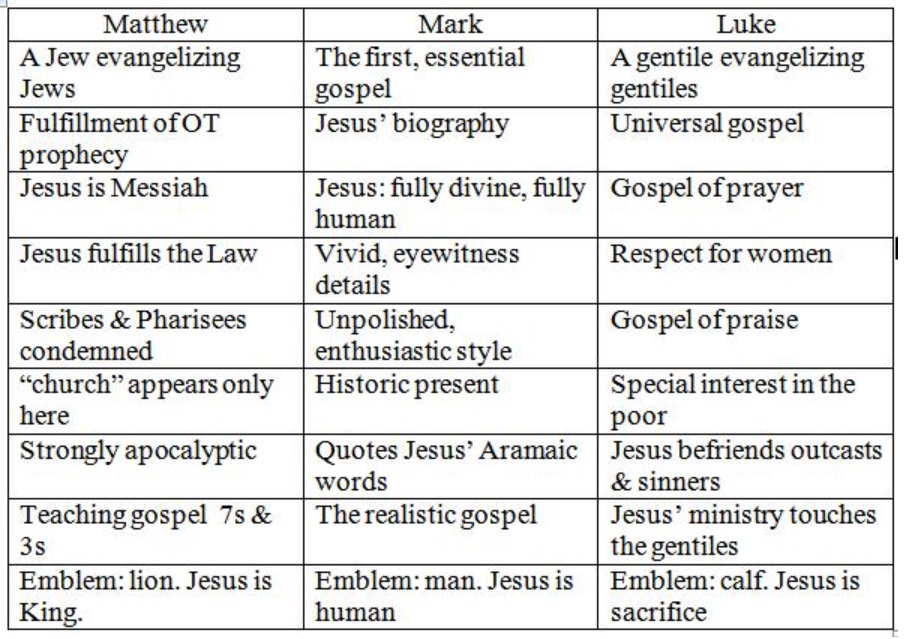
The following table shows how the Gospels tell the story of Jesus from different perspectives, each focusing on different perspectives of Jesus’ life, and each trying to give a different message about the life of Jesus.

Comparison of Gospels
 MatthewMarkLukeJohn
Portrait of JesusKingServantTeacherSon of God
Original readersJewsRomansGreekschurch
Key phrasesKingdom of heaven, fulfilledKingdom of God, Immediately, nowKingdom of God, Son of manBelieve, Word of God, only begotten Son, eternal life
FocusJesus is the Messianic King of the promised Davidic kingdom which fulfills the Old Testament prophecies and claimsJesus is the authoritative Son of God. He is God’s triumphant envoy come to suffer and die in order to claim victory over sin and deathJesus is the perfect Son of Man, the Messiah prophesied by the prophets who came to save and to minister of people of all nations through the power of God the Holy SpiritJesus Christ is the fully divine Son of God who existed before creation. He is the true Lamb of sacrifice through whom we receive the gift of eternal life
Prominent sectionssermonsmiraclesparablesteachings
Genealogytraced to Abrahamnonetraced to Adamnone
Geographic emphasisGalileeGalileeGalileeJudea
Comparison of the Gospels

Observe

Read the chart above. Which gospel is centered in Judea?