The genealogies

Dancing in the Kingdom- Table of Contents

Dancing In the Kingdom – Part 1 – Shadows of the Kingdom – Chapter 1 – Prelude

The genealogies

[Bible references: Matthew 1; Luke 3]                              

There are not many passages in the New Testament that the average person tends to gloss over, but there are two places where that happens the most. Two of the Gospels have genealogies that look very different from one another, telling the story of Jesus from different perspectives. Neither genealogy is comprehensive, they are there to establish who Jesus is through particular relationships and to give different messages. It is typical for the average reader to skip over the genealogies when they read the Bible, but sometimes the stories attached to each name make a significant point, and sometimes the names themselves give a particular message. The genealogies are designed to give particular stories.

Matthew[1]

Matthew’s genealogy tells a three-part story that begins with Abraham, uses both Jews and Gentiles, includes women, and ends with Christ.

The list

  • Waiting for the Kingdom – Abraham, Isaac, Jacob, Judah and Tamar, Perez, Hezron, Ram, Amminadab, Nahshon, Salmon and Rahab, Boaz and Ruth, Obed, Jesse, David and Bathsheba
  • The Kingdom – Solomon, Rehoboam, Abijah, Asa, Jehoshaphat, Jehoram, Uzziah, Jotham, Ahaz, Hezekiah, Manasseh, Amon, Josiah, Jeconiah
  • Waiting for the re-established kingdom – Jeconiah, Shealtiel, Zerubbabel, Abiud, Eliakim, Azor, Zadok, Achim, Eliud, Eleazar, Matthan, Jacob, Joseph, Jesus

Items of note:

  • Matthew’s genealogy, starting from Abraham, traces a line to Judah to establish royal bloodline. Matthew shows Christ as the Messiah, by tracing the legal line from Judah and then to Joseph. This genealogy established Jesus’ legal rights to the throne through Judah.
  • The genealogy includes women with interesting stories:
    • Tamar was raped by Judah.
    • Salmon had children by Rahab a Gentile who was a prostitute in Jericho.
    • Boaz’s wife was Ruth who was a Gentile.
    • David had an affair with Bathsheba, who was married to Uriah.
  • Includes all the kings of Judah. Jeconiah appears twice (was last king before exile, then was part of exile) Zerubbabel (governor of Jerusalem after the return).
Luke[2]

Luke’s genealogy tells a story that starts with Adam, the son of God and ends with Jesus, the Son of God. Luke establishes Jesus as the Son of Man and goes back through Mary’s line to Noah and then to Adam. Ancient Greek genealogies traced the father’s lineage not the mother’s—but what do you do with the unique virgin-born Jesus? Certainly, Joseph was not his father, so the only logical male name available was that of Jesus’ maternal grandfather, Heli, for he was the last man involved in the genealogical process which led to Jesus. So Heli was the father of Mary, who was the mother of Jesus.

The list

  • God, Adam, Seth, Enosh, Kenan, Mahalalel, Jared, Enoch, Methuselah, Lamech, Noah, Shem, Arphaxad, Cainan, Shela, Eber, Peleg, Reu, Serug, Nahor, Terah
  • Abraham, Isaac, Jacob, Judah, Perez, Hezron, Aminadab, Nahshon, Salmon, Boaz, Obed, Jesse, David
  • Nathan, Mattatha, Menna, Melea, Eliakim, Jonam, Joseph , Judah, Simeon, Levi, Matthat, Jorim, Eliezer, Joshua, Er, Elmadam, Cosam, Addi, Melchi, Neri, Shealtiel
  • Zerubbabel, Rhesa, Joannan, Juda, Joseph, Semein, Mattathias, Maath, Naggai, Esli, Nahum, Amos, Mattathias, Joseph,  Jannai, Melchi, Levi, Matthat, Heli, Joseph, Jesus

Items of Note:

[Bible references: Genesis 5:25; 11:12-26; Jeremiah 22:30; Matthew 1; Luke 3]                             

  • Starts from Adam instead of Abraham, traces Mary’s line to establish Son of God, includes 4 generations born in captivity,
  • Methuselah (oldest recorded age), Shem (the Semitic race),
  • If we translate, instead of transliterating the first 10 generations from Adam to Noah we can read: Man (is), Appointed, Mortal, Sorrow (but), The Blessed God, Shall come down, Teaching, His death shall bring, The despairing, Comfort and rest
  • There is an interesting prophecy in Jeremiah, where it appears to refer to termination of David’s legal line to the throne from Jeconiah onwards. Jeremiah 22:30 implies a BLOOD LINE curse on Solomon’s line. This separation of the genealogies from David resolves the prophecy. With Mary being of David’s blood line through Nathan, the Messiah is from the House of David yet avoids the curse, whilst still claiming the legal claim through Solomon’s line, through Joseph his adopted and legal father
  • The values of the letters in David’s name (dalet=4, vav=6, dalet=4) add up to 14. Matthew’s genealogy is set up in groups of 14.
  • Jeconiah was the last operative King and the first waiting King, he ends the second group, and starts the third.
  • The name Zerah: Meaning: Rising, Dawn; Etymology From the verb זרח (zarah), to rise or break out.
  • The name Perez: Meaning: A Breach: Etymology: From the verb פרץ (paras), to break through.
Mark

[Bible references: Mark 9:35]                                        

Mark is portraying Christ as a servant and so does not use a genealogy.

John

[Bible references: John 1:1-2]                                         

John shows Jesus directly to be the Son of God.


[1] In Hebrew, the Hebrew word translated as genealogies, ‘toledoth’ always denotes father/son relationships, always works forward.

[2] In Hebrew, the word ‘yaghash,’ is used to establish legal rights or obligations; in contrast, it always works backwards tracing an individual’s legal right or duty back to its source.

Observe

Read John 21:15-25.  Which disciple do you identify more with and why, Peter or John.?
Overview of the Gospels

Dancing in the Kingdom- Table of Contents

Dancing In the Kingdom – Part 1 – Shadows of the Kingdom – Chapter 1 – Prelude

Overview of the Gospels

[Bible references: Matthew, Mark, Luke, John]

The New Testament begins with a set of four biographies about Jesus. They are referred to as the Gospels of Matthew, Mark, Luke and John. It is possible to think about the Old Testament as the inspired introduction to the New Testament, foretelling of the Person, work and kingdom of Christ. Old Testament quotes, allusions, and types are woven into the Gospels.

Christ is presented as king (who rules over all things), prophet (who represents God to the church) and priest (who intercedes for the church).  All the gospels record: the unique revelation of Christ, the ministry of John the Baptist, the feeding of the 5,000, Christ’s offer of Himself as King, the betrayal by Judas; the denial by Peter, the trial and crucifixion and bodily resurrection of Christ, events during the forty days of the post-resurrection ministry of Christ, the hope of His second coming.

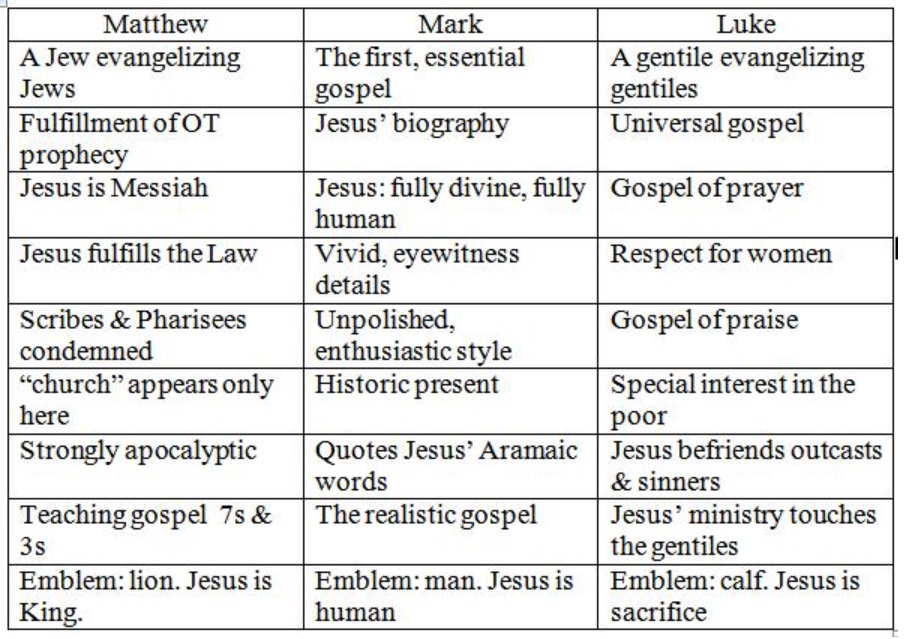
The following table shows how the Gospels tell the story of Jesus from different perspectives, each focusing on different perspectives of Jesus’ life, and each trying to give a different message about the life of Jesus.

Comparison of Gospels
 MatthewMarkLukeJohn
Portrait of JesusKingServantTeacherSon of God
Original readersJewsRomansGreekschurch
Key phrasesKingdom of heaven, fulfilledKingdom of God, Immediately, nowKingdom of God, Son of manBelieve, Word of God, only begotten Son, eternal life
FocusJesus is the Messianic King of the promised Davidic kingdom which fulfills the Old Testament prophecies and claimsJesus is the authoritative Son of God. He is God’s triumphant envoy come to suffer and die in order to claim victory over sin and deathJesus is the perfect Son of Man, the Messiah prophesied by the prophets who came to save and to minister of people of all nations through the power of God the Holy SpiritJesus Christ is the fully divine Son of God who existed before creation. He is the true Lamb of sacrifice through whom we receive the gift of eternal life
Prominent sectionssermonsmiraclesparablesteachings
Genealogytraced to Abrahamnonetraced to Adamnone
Geographic emphasisGalileeGalileeGalileeJudea
Comparison of the Gospels

Observe

Read the chart above. Which gospel is centered in Judea?

Clash of empires

Dancing in the Kingdom- Table of Contents

Dancing In the Kingdom – Part 1 – Shadows of the Kingdom – Chapter 1 – Prelude

Clash of empires

[Bible references:1, 2 and 3 Maccabees; Lamentations 3; Matthew 3:1-12]                                      

As the era of the Old Testament ends

  • the Assyrian Empire took the tribes of Northern Kingdom into exile where they were never to be heard from again in history,
  • the Babylonian Empire conquered the Assyrian empire and then took the best and brightest of the Southern Kingdom to Babylon,
  • the Persian empire overtook the Babylonian empire and allowed those Jews to not only return to their homeland but gave them the resources to begin the rebuilding of the city of Jerusalem and the temple.
  • the Greek Empire overtook much of the world, including the Persian Empire, then imposed its culture and language on all its territories. After the death of Alexander the Great, the Greek Empire split up.
  • Israel is first controlled by the Egyptian remnant of the Greek empire where some Jews were deported to Egypt where the Greek Septuagint version of scripture was written.
  • Then Israel came under control of the Syrian remnant of the Greek Empire whose general desecrated the temple, which invoked a successful rebellion led by the Hasmonean family and Israel become independent for a few years. The Maccabee books were written in this time.
  • the Roman Empire overtook the Greek Empire but kept Greek as the common language of the Empire, which in later years would become the language the church would use to write the New Testament texts as well as many of the texts that were written by the early church Fathers.

At the time the New Testament begins, the “king of Israel” installed by the Roman Empire was King Herod the Great. All the tumult of the times created an atmosphere where there was much speculation about the end of times and the coming of the Messiah. In fact, around the time of Jesus, there were many who claimed to be the Messiah.[1]

There are up to 400 prophecies concerning Jesus that were written in the Old Testament.[2] All the way back in the third chapter of Genesis, when Adam and Eve rejected God’s authority, God started to lay out His plan to have his image-bearing creatures restored to fellowship with Him. The New Testament introduces us to John the Baptist who could be said to be last of the Old Testament style prophets. He is the one who, as foretold by the Old Testament, was sent to prepare the way for Jesus’ ministry.

The New Testament Gospels, which are biographies of Jesus, emphasize the years of Jesus’ ministry leading up to his death and resurrection.


[1] Tabor, James. “Messiahs in the Time of Jesus” This page lists 12 Messiah-claimants between 47 BC to AD 66. Taborblog, jamestabor.com/messiahs-in-the-time-of-jesus/

[2] Appendix D – Prophecies about Jesus

Observe

Read Lamentations 3. In times of silence and grief, what is a cause for hope?

Exile and return

Dancing in the Kingdom- Table of Contents

Dancing In the Kingdom – Part 1 – Shadows of the Kingdom – Chapter 1 – Prelude

Exile and return

[Bible references: Jeremiah, Lamentations, Ezekiel, Daniel, Esther, Ezra, Nehemiah]                                     

When Assyria captured the Northern kingdom, they took most of the inhabitants and scattered them throughout the empire and replaced them with people from elsewhere in the empire. The result was that the 10 northern tribes were integrated into the Assyrian empire and were never heard from again as a people group.

Babylon overran the Assyrians and also captured the Southern kingdom. The practice of the Babylonians was to take the best and brightest, bring them to their capital and train them to work for the Babylonian empire. A couple of the prominent people taken were Daniel and Ezekiel. 

Since it was primarily the people of Judah that were captured and the other kingdoms had essentially disappeared, the people of Israel now became known as Jews. It was while in captivity, that the Jews got serious about preserving their culture. It was while in captivity that they worked on 1) identifying which writings they had would be considered as scripture and 2) developing cultural patterns that would allow them to preserve their identity. It was in captivity that synagogues developed as a way of continuing to worship without the availability of the temple. Interestingly, it also showed how they knew that they could function under the Law of Moses without a temple and therefore without the system of animal sacrifices.

The Babylonian kingdom was then overrun by the Persian empire. The policy of the Persian empire was to allow the captured peoples that were exiled to Babylonia, to return to their homeland. The first returnees rebuilt the temple that was destroyed by the Babylonians, although the new temple was not as grand as it had been before. Later, Ezra would return to re-establish the Law and then Nehemiah would return to rebuild the wall around Jerusalem.

Observe

Read Jeremiah 18:1-10. How does God interact with our decisions?

Earthly kings and the rejection of God as king

Dancing in the Kingdom- Table of Contents

Dancing In the Kingdom – Part 1 – Shadows of the Kingdom – Chapter 1 – Prelude

Earthly kings and the rejection of God as king

[Bible references:1 and 2 Samuel, 1 and 2 Kings; 1 and 2 Chronicles]               

The last of judges was Samuel, who also functioned as a priest. By this point in time, Israel was convinced that their continuing problems were, of course, not themselves. They thought that their problem was that they didn’t have a king like everyone else. Actually, God was their king and Samuel was His representative. But the Israelites were not satisfied with God choosing prophets who would speak for Him. So, God gave them a king, like everyone else, Saul. While it did not take Saul a long time to turn from God so completely that God rejected him, Saul was able to reign for 40 years. David, who was described as someone after God’s own heart, replaced Saul. David expanded the kingdom from the Orontes River in the north to the Sinai peninsula in the south.[1] Solomon, building off of David’s legacy, did not focus on expanding the kingdom as much as building its wealth. Solomon’s wealth increased not only in riches of gold and silver, but also in wives and concubines. His love towards his wives and concubines overrode his love for God, so at Solomon’s death, the kingdom split in two parts.

Ten tribes who rebelled against Solomon’s son, aligned with the northern kingdom, which became named Israel.  Of the other 2 tribes, the tribe of Judah was most prominent. Both kingdoms were eventually conquered by neighboring empires: the northern kingdom by Assyria and the southern kingdom by Babylon.


[1] Archaeologists have had difficulty locating evidence of the kingdoms of David and Solomon. That is due, in part, to the Israelites tendency to adopt the customs of the Palestinian nations, making their artifacts indistinguishable from the nations they displaced.

Reflect

From what we see in the world around us, how often do people take responsibility for their own problems?

Observe

Read 1 Samuel 15:15. What’s the clue that Saul was no longer following God?

Settling into the Promised Land

Dancing in the Kingdom- Table of Contents

Dancing In the Kingdom – Part 1 – Shadows of the Kingdom – Chapter 1 – Prelude

Settling into the Promised Land

[Bible references: Joshua, Judges]                                     

Moses died on the east of the Jordan River. Joshua, one of the 12 spies, led Israel into the Promised Land. After the conquest was complete, the land was divided among the 12 tribes and the tabernacle was moved to Shechem, the place where God promised his descendants would dwell, where Abraham, Sarah, Isaac, Jacob and Joseph were buried.

After Joshua’s death, no one was appointed to be the leader of the people. The people did have the Books of the Law as written by Moses to guide them. God was supposed to be their king. But particularly when things were going well, Israel was inclined to forget about God and not be obedient to the Law. To encourage Israel to return to Him, God would allow some of the neighboring tribes harass them. When things got too bad, the people would complain to God, who would raise up leaders (called judges) to help them overcome their enemies, after which Israel would remember to their old ways. The process would repeat several times.

Observe

Read Judges 2:10-19. What habits did the Israelites find hard to break? What habits are hard for you to break?

Moses and the Exodus

Dancing in the Kingdom- Table of Contents

Dancing In the Kingdom – Part 1 – Shadows of the Kingdom – Chapter 1 – Prelude

Moses and the Exodus

[Bible references: Exodus 8-11; 14-15; Numbers 13-14; Deuteronomy 1]                                      

430 years would pass after the promise was given to Abraham, that his people, now named after his grandson, Israel, would walk out of Egypt. God told Abraham that his descendants would be enslaved in Egypt for four generations[1] before they return to the Promised Land at which time the “sin of the Amorites would be complete.”

At the scheduled time, God called Moses to lead the Israelites out of Egypt, and it would take 10 plagues, including the death of the firstborn, to convince the Pharaoh to let Israel go. Moses led the people out of Egypt by way of the “Red Sea.” The Commandments were given, and the building of the Tabernacle occurred, at Mt Sinai, location uncertain, before Israel would leave for the “Promised Land.”  When 12 spies were sent into the land, 10 of them focused on the difficulty of taking the land, inspiring fear among the people and causing God to consign Israel to wander in the wilderness for 40 years where all the adults 20 and over would die before Israel would finally go into the Promised Land.


[1] LeBrun, Ken. “The 400-Year Prophecy and the Fourth Generation”” Thoughtlines www.thoughtlines.org/2013/09/the-400-year-prophecy-and-fourth.html; BibleAsk “Did the Israelites spend 400 years in Egypt?” BibleAsk bibleask.org/did-the-israelites-spend-400-years-in-egypt/; Glatt-Gilad, David. “How Many Years Were the Israelites in Egypt?” TheTorah.com www.thetorah.com/article/how-many-years-were-the-israelites-in-egypt; Got Questions. “How many Israelites left Egypt in the exodus?” Got Questions www.gotquestions.org/Israelites-exodus.html; It would be 430 years from the time Abraham’s son Isaac was born but the time spent in Egypt would only be for four generations. Linked to that is the apparent size of the Israelite people leaving Egypt. Allowing for only 4 generations in slavery and, starting with a population of 70 people, something less than 10,000 people would have left Egypt with Moses. This helps to make sense of the Biblical events in the Promised Land and also of the archaeological evidence now available.

Reflect

Think of situations where you had to overcome fears in order to spiritually grow.

Observe

Read Genesis 15. Abram was living in the land of Canaanites which the Lord had promised to give to Abram’s descendants, but in a dream the Lord about how Abram’s descendants would first be enslaved and then return to the Promised Land, but only after “the sin of the Amorites reached its full measure. What does that say about how God works in the present day?

The Patriarchs

Dancing in the Kingdom- Table of Contents

Dancing In the Kingdom – Part 1 – Shadows of the Kingdom – Chapter 1 – Prelude

The Patriarchs

[Bible references: Genesis 12-50]                                    

Approximately 2000 B.C., a man named Abram[1] lived in the city of Ur (at that time a coastal city on what is now the Persian Gulf). Abram’s father took his family up the Euphrates River to the city that would be named after Abram’s brother, Haran and settled there. When Abram was 75, God called him to go to another country. When he arrived in Shechem, God told him that this would be the land given to his offspring. Abram did go down to Egypt briefly, but then returned to Shechem. By that point in time, the herds were so large that it was necessary for Abram and his nephew Lot to split up. Abram’s nephew Lot chose to move down to the valley of Sodom and Gomorrah.

When Abram was 90 years old, God told Abram that he would be the father of many nations, renaming him Abraham. But Abram would be 100 years old before his son, Isaac, was born. Abram did have a son, Ishmael, through his wife’s servant, but Ishmael would be sent away, becoming the father of the Arabs.

Isaac didn’t get married until he was 40. He was 60 by the time his only sons, the twins, Esau and Jacob were born.

Jacob had 12 sons and a daughter by 2 wives and 2 concubines. At one point, Jacob wrestled with an angel, who gave him the name, Israel (“struggles with God”).

Jacob’s son, Joseph, was sold as a slave by his brothers to a trader passing through to Egypt, where, through interesting circumstances he became 2nd in charge to the Pharaoh. Years of droughts led to Israel and his other sons moving to Egypt.


[1] To see how Biblical events fit into the history of the Middle East empires see Appendix B, “Timeline for Middle East Empires.”

Observe

Read Genesis 17. Abram was 99 years old and still had no son with his wife Sarah when God renamed him Abraham (“father of many nations.”) and then repeated his promise to Abram 24 years earlier. What does this tell you about patience and faith?

Nations form from descendants of Noah’s sons

Dancing in the Kingdom- Table of Contents

Dancing In the Kingdom – Part 1 – Shadows of the Kingdom – Chapter 1 – Prelude

[Bible references: Genesis 6-11]                                       

Following the introduction of sin into the world, the rebellion of God increased to the point where God saw fit to destroy all of mankind apart from Noah and his family with a great flood.[1] After the flood, the rebellion continued in the form of the tower of Babel where people saw fit to make a name for themselves instead of lifting up God. God responded by confusing their languages which caused them to spread out, and ultimately form different nations.

In general, the descendants of Japheth include the Europeans; the descendants of Shem include the Middle Easterners (including the nation of Israel), and the descendants of Ham includes the Africans, the Amorites and the Canaanites.


[1] Ball, Steven. “A Christian Physicist Examines Noah’s Flood and Plate Tectonics” LeTourneau University http://www.letu.edu/academics/arts-and-sciences/files/plate-tectonics.pdf; McDonald, David.  “The Flood: Mesopotamian Archaeological Evidence” National Center for Science Education ncse.ngo/flood-mesopotamian-archaeological-evidence; Trefil, James. “Evidence for a Flood” Smithsonian Magazine http://www.smithsonianmag.com/science-nature/evidence-for-a-flood-102813115; Isaak, Mark. “Flood stories from around the World” Talk Origins http://www.talkorigins.org/pdf/flood-myths.pdf “There is still some uncertainty about how to correlate the current understanding of the Biblical text with modern archaeology. There is some evidence of a local flood in the Mesopotamian area or in the Black Sea area. There is also abundant evidence of flood stories from around the world.”

Observe

Read Genesis 10 then find a map that show how the nations spread out. (e.g. www.columbiabible.com/2016/06/22/genesis). From which of Noah’s sons might you have descended from?

Scope and direction of sin’s consequence

Dancing in the Kingdom- Table of Contents

Dancing In the Kingdom – Part 1 – Shadows of the Kingdom – Chapter 1 – Prelude

Scope and direction of sin’s consequence

[Bible references: Genesis 2:16-17; 3:14-15, 23; 6:5; Romans 8:19-28]

And so, it happened. The one thing that could create the ultimate catastrophe did happen. The good Creator, who only intended good things, allowed his image-bearers to give into their temptation, to put their own authority above His and violate the one restriction placed before them. This violation by the stewards of His creation broke everything: the relationship between themselves, the relationship between them and Him, the relationship between them and creation. All of creation was affected and is even now waiting for things to be made right again.

Everything in creation had been designed to be good, to reflect the good character of the good God. Creation was designed to be a place where God and his image-bearers could keep on creating good things and bring increasing glory to God. But now, although the ultimate structure of creation was still good, it was headed in the wrong direction. The broken universe would now cause things to move away from God’s glory.

“Anything in creation can be directed either toward ward or away from God – that is, directed either in obedience or disobedience to his law. This double direction applies not only to individual human beings but also to such cultural phenomena as technology, art, and scholarship, to such societal institutions as labor unions, schools, and corporations. and to such human functions as emotionality, sexuality, and rationality. To the degree that these realities fail to live up to God’s creational design for them, they are misdirected, abnormal, distorted. To the degree that they still conform to God’s design, they are in the grip of a countervailing force that curbs or counteracts the distortion. Direction therefore fore always involves two tendencies moving either for or against God.” [1]

In our current times, we can get things so quickly and easily compared to times in the past. We want what we want, and we want it now. Our desire to get what we want now overwhelms our capacity to think of others, as we put ourselves at the center of our part of the universe, replacing God with ourselves. In the case of the first humans, they wanted to grab knowledge and wisdom for themselves instead of waiting to receive it from God.

Everything was broken and separated from God. Spiritual death, the impaired relation between God and His image-bearers was immediate and would be mirrored by the physical death caused by separation of the people who would no longer have access to the Tree of Life. This was a great tragedy that could not be undone, not by the image bearers. But as we look around us, we can see that, despite the tragedy around us, things aren’t totally bad. Even though evil is very evident around us, there is still some goodness that is evident. It is in that observation that we can glimpse the possibility of hope.

God had ordained the penalty of death to be the consequence of turning away from him. Sin resulted in spiritual death, the immediate separation God’s image-bearers from God, nevertheless, the people did not die physically right away. Instead, what God did, was to apply discipline to his image-bearers. He also gave a hint of the solution to the problem created by sin, the first of many other hints that were to come.


[1] Wolters, Albert M. “Creation Regained: Biblical Basics for a Reformational Worldview (Kindle Locations 685-689). Kindle Edition.

Observe

Read Romans 8:19-28. How has sin affected you and the one’s you love?

Confronting our freedom

Dancing in the Kingdom- Table of Contents

Dancing In the Kingdom – Part 1 – Shadows of the Kingdom – Chapter 1 – Prelude

Confronting our freedom

[Bible references: Genesis 3:1-24; Deuteronomy 7:6-14; 30:18-20; Joshua 24:14-16; John 7:17; 15:16]

To be creatures designed in the image of the transcendent creative, loving God, we needed a kind of independence so that we could choose to love – or not love – and to be free to imagine and create wildly new and different things as proper for God’s image-bearing creatures. We were free to do this in a place where everything was very good and designed so that we could flourish. However, that very freedom which gave image bearers the possibilities of independent thoughts, also gave those image-bearers the opportunity to also confront temptation.

While the image-bearers were given the opportunity to meet with God and to walk with him in a specially designed garden, they were also allowed the opportunity for questions. They could even question the motives of the God who made them: 

  • Was something good being withheld from them?
  • Were they being deprived of some power?
  • What would be available to them if they violated the restriction?
  • Would they actually die?
  • What special knowledge were they being deprived of – particularly this knowledge of good and evil?
  • Everything they had encountered had been good, why would their thinking about violating this one restriction not be good?
  • Was the Creator so good anyway?”

Observe

Read Deuteronomy 7:7; 30:18-20; Joshua 24:14-16. The ability to love is not possible without the ability to choose. What did the Israelites choose to love (or not love)?

Creation

Dancing in the Kingdom- Table of Contents

Dancing In the Kingdom – Part 1 – Shadows of the Kingdom – Chapter 1 – Prelude

Creation

[Bible references: Genesis 1:26:28; 2:15; 3:6; Jeremiah 29:11; Revelation 21; 22]

Studies of Ancient Near East cultures have found that the creation account could be looked at as the dedication of a temple, where God was creating a place for him to reside with us and we would join him as co-regents[1]. On the seventh day, God had finished the dedication of the “temple,” but it was not a time where He ceased to do everything. Rather, it was the time where the “temple” was now ready, both for God and for us as co-regents, to begin settling in and doing the things that the temple was designed for. Jesus in John 5:1-7 clarified this idea where he explained, “My Father is always at his work to this very day, and I too am working.” Living into this sacred space would entail us taking part with God in his continual acts of creating and sustaining the universe. When Eve gave birth to Cain, she recognized that “I’ve created a man with Yahweh.”[2]

Although these image-bearers had close, unhindered, intimate contact with their Creator, there was enough space given them to think freely, as if they were not being watched all the time. It was in this space that they – and we – were given the responsibility of being stewards over all the earth and over all other creatures. We were given the assignment to fill all the earth, discover its possibilities and care for the world in the same way that God would care for the world[3]. Just as God continues to create more living things and sustaining all that he has created, we can join him in creating  and in sustaining those things entrusted to our care.

There are two ways in which God imposes his law on the cosmos, two ways in which his will is done on earth as in heaven. He does it either directly, without mediation, or indirectly, through the involvement of human responsibility. Just as a human sovereign does certain things himself, but gives orders to his subordinates for other things, so with God himself. He put the planets in their orbits, makes the seasons come and go at the proper time, makes seeds grow and animals reproduce, but entrusts to mankind the tasks of making tools, doing justice, producing art, and pursuing scholarship. In other words, God’s rule of law is immediate in the nonhuman realm but mediate in culture and society. In the human realm men and women become coworkers with God; as creatures made in God’s image they too have a kind of lordship over the earth, are God’s viceroys in creation. [4]

The work that we were designed to do was more than just tending the garden. In Genesis 2:15, we were given a mandate to “work” and “take care of” the garden God created[5]. These tasks, looked at in light of Ancient Near East culture, were more of a priestly nature[6], taking care of this temple where we reside with God. We were to take care of this place which was designed to be a “very good” place for us to flourish in, and for us to create whatever structures we needed to as we would “increase in number, fill the earth and subdue it.” This task, this mandate, meant that we would eventually go beyond the capacity of gardening and create not just a bigger garden but cities, a flourishing civilization as pictured in Revelation 21 and 22[7].

When examined closely, we can see the breadth of work committed to Adam and Eve. Subduing the earth would entail many physical, social and intellectual activities. In the gardening, we can see cultivation and farming; in the taking care of the animals, we can see shepherding and domestication; in the naming of the animals, we can see a cultural and scientific activity which required understanding the nature and attributes of the animals and establishing authority over them. We can see that God had created things to be beautiful and as his image-bearers we would be expected to also create beautiful things. Later on, in scripture we will see even more extended uses of the work God has intended for us.


[1] Walton, John H. “In Genesis 1, God Orders the Cosmos as Sacred Space” The Lost World of Adam and Eve: Genesis 2-3 and the Human Origins Debate InterVarsity Press. Kindle Edition.

[2] Friedman, Richard Elliot, Commentary on the Torah, Location 6942 of 37412, Harper Collins, 2003

[3] Crouch, Andy. “What is the Cultural Mandate,”,” The Village Church, 6 Jan 2017 www.thevillagechurch.net/resources/videos/what-is-the-cultural-mandate

[4] Wolters, Albert M. Creation Regained: Biblical Basics for a Reformational Worldview” William B. Eerdmans Publishing 1985, 2005. eBook (Kindle Locations 203-208).

[5] Walton, John H. The Lost World of Adam and Eve: Genesis 2-3 and the Human Origins Debate (p. 105-106). InterVarsity Press. Kindle Edition. The verbs ʿbd and šmr (NIV: “work” and “take care of”) are terms most frequently encountered in discussions of human service to God rather than descriptions of agricultural tasks… ‘bd can refer to … work connected with one’s vocation.. to religious service deemed worship … šmf is used in the contexts of the Levitical responsibility of guarding sacred space, as well as in the sense of observing religious commands and responsibilities.

[6] Walton, John H. The Lost World of Adam and Eve: Genesis 2-3 and the Human Origins Debate (p. 106). InterVarsity Press. Kindle Edition. “it is likely that the tasks given to Adam are of a priestly nature: caring for sacred space. In ancient thinking, caring for sacred space was a way of upholding creation.”

[7] Buzenitz, Nathan. “The New Jerusalem”, Cripplegate, 8 April 2017 thecripplegate.com/the-new-jerusalem-2/

Observe

Read Genesis 1:26-28. How do we fulfill the instructions to rule over the other creatures?

Biblical eras

Dancing in the Kingdom- Table of Contents

Dancing In the Kingdom – Part 1 – Shadows of the Kingdom – Chapter 1 – Prelude

Biblical eras

The following table provides a quick outline of the different periods of history covered in the Bible and can serve as a guide as you read different sections of the Bible. The table is followed by a brief outline just a bit to help see the larger story whose details are filled out in the rest of the book.[1]

Biblical eventSummary
CreationGod dedicates the universe as His temple, a place for him to be with his people.
SinGod created us in his image, which included the ability to freely love. But we freely to not love God with devastating consequences
NationsGod floods the world and restarts the human project. The beginning of nation forming.
PatriarchsOut of all the nations, God chooses one nation through whom his people can be redeemed. The new nation, which is promised a land of their own, starts with the family line of Abraham, Isaac, Jacob
ExodusGod’s new nation begins its formation in Egyptian slavery and then leads them out to the land he promised them.
JudgesOnce settled in the Promised Land, God raises up people to lead and administer justice
KingsThe people reject God’s kingship and demand human kings like the nations around them. Sin initially causes the kingdom to be split into two and further sin causes the two kingdoms to be sent into exile
ExileThe Northern kingdom is captured by and exiled into Assyria then disappears from history, leaders from the Southern kingdom are brought into Babylon. which is eventually overtaken by the Persians who allow the exiles to return home
Return from exileOnly some of the exilees return. Against opposition they attempt rebuild the temple and the wall around Jerusalem, but not to its previous splendor
IntertestamentThere is a gap between the last inspired text written in the Old Testament and first inspired texts written for the New Testament
GospelsGod takes on human form in Jesus, grows up in Galilee, begins his ministry and then is executed and resurrected
ChurchUpon receiving the Spirit, the apostles begin building the church
MissionsThe church is scattered and begins spreading around the Roman Empire
End timesJesus’ return and His restoration of the Kingdom

[1] For a more detailed timeline see Appendix E – Bible Timeline

Breath to breath

Dancing in the Kingdom- Table of Contents

Dancing In the Kingdom – Part 1 – Shadows of the Kingdom – Chapter 1 – Prelude

Breath to breath

[Bible ref: 2 Timothy 3:16; Romans 15:4; Hebrews 4:12; Psalm 19:7-11]

We say that the Bible is inspired, God-breathed. That is, God breathed His words to the human writers of the Bible, who then wrote down what “God breathed” into them. But how is that revelation, that communication, of God which was written by human authors, breathed into us so that we can respond to the hearing of God’s inspired word and live it out, breath it out if you will, out into the world around us as we participate with God in bringing His Kingdom into the world?

Old Testament authors used scrolls made of papyrus reeds to record his inspirations from God. But making copies of manuscripts was labor intensive and would take a long time, so most people did not have written copies of what Moses wrote. Most people only heard as others read it out loud. Reading out loud in community was the normal way to read until the invention of the printing press.

The people hearing the inspired word then learned to memorize and meditate on what they heard. The Hebrew word for “hear” is “shema.” Shema implies not just passively hearing or listening but also implies obedience. So, to “shema” the inspired Word is not just to hear it but to obey it.

When the New Testament manuscripts began to be produced, the copies could now be put into a codex, which is similar to modern-day books. The codex manuscripts were then more easily stored and carried. But again, few people had written copies and most people still relied on hearing the word and memorizing and meditating on it. The codex technology did allow for the integration of such things as parallel columns and reference notes for the few people who had access to the written Bibles.

The invention of the printing press in the 1400s now allowed copies to be easily and cheaply mass produced so that more people could now have access to the written Bible. It was at this time that the Biblical writings were now divided into chapters and verses. This allowed the average person to more easily refer to specific passages. Before the chapter and verse notations were added to the Bible, people could only refer to particular passages by quoting them – which was manageable if people were in the habit of memorizing those writings. Printed Bibles with chapters and verses now allowed people to use the Bible without as much need for memorizing Bible passages.

The Protestant Reformation’s rebellion against the authority of the (Roman Catholic) church was enabled by the availability of the Bible to the common person. In addition to Bibles, Bible reference books such as concordances and Bible dictionaries were produced, allowing the average person to study the Bible on their own.

When home computers became available in the 1980’s, electronic version of the Bible and Bible references were produced, making those resources more available to the average user. Access to the World Wide Web began in the 1990’s which made even more resources easily available. Mobile devices even added more convenient access beginning in the 2000’s. All these new technologies make it possible to learn and use the Bible in different ways.

In this digital era, I would encourage you to mix old and new, memorize not just search, meditate not just share, listen not just read, do not just hear. As you use different forms of media to encounter Scripture, reflect on them with others in your faith community and work together to make choices out of conviction rather than convenience alone.[1]

We now have many options available for connecting with the Biblical text. But knowing the Bible is not the same as engaging is spiritual disciplines to open oneself to being transformed and to better  know God and it’s not the same as participating with a community of believers building up one another.


[1] Dyer, John. “Bible Apps are the new Printing Press” Christianity Today www.christianitytoday.com/ct/2022/december/dyer-bible-apps-software-screen-printing-press.html

Observe

Read 2 Timothy 3:16. How does the definition of the Hebrew word, “shema,” fit with the statement in 2 Timothy 3:16?

The library

Dancing in the Kingdom- Table of Contents

Dancing In the Kingdom – Part 1 – Shadows of the Kingdom – Chapter 1 – Prelude

The library

[Bible references: Daniel 9:2; Jeremiah 31:31, Matthew 21:42; 26:28; Mark 12:24; Luke 4:21; 24:13-35; John 2:22; 5:39]

The Bible we have now is in one binder, but it was not written that way. It was not written as one book by one person at one time with a series of chapters. The Bible actually contains a library of different texts written by different people in different time periods. Originally, those texts were written on individual scrolls and over time people collected those scrolls to make a little library of scrolls, or what we now call “books.”

The term, “Bible,” comes from ” the Phoenician word for “reed,” byblos.” Later on, that word was transliterated into Greek as “ta Biblia,” which means “the books” or “the library”. After that when the word was translated in Latin as “Biblia” and in English as “Bible.” The Bible then is a collection of “books” which were first written on scrolls.[1] In New Testament times, Christians started to make copies of the Bible texts in a “codex” form, sort of like today’s books. This format allowed multiple texts to be put in a single codex.[2]

The “books” within the first part of the Bible, before Jesus was born, were written mostly in Hebrew over a period of 1500 years and we call that set of books the “Old Testament.” The books written after that were written mostly in Greek over a period of 50 years and we call that set of books, the “New Testament.”  In all the major Christian traditions, the New Testament has 27 books while the number of books in the Old Testament have at least 39 books.[3]

The word testament means either 1) a disposition or will or 2) a covenant or an agreement. We get the term “New Testament” from the book of Jeremiah 31:31(NIV) “The days are coming,” declares the Lord, “when I will make a new covenant with the people of Israel and with the people of Judah.”

The books in our biblical library contain many kinds of literature, there is historical narrative, biography, prophecy, poetry, letters written to and from various people, various kinds of wisdom literature, rules of conduct, instructions for how to build things, interpretations of things previously written. All that complexity makes it difficult for people to figure out how to use the Bible. But at the same time, despite all its complexity, the essence of what we need to know can be known by the average person.[4]

The Old Testament writings centered around God’s covenant of Israel as mediated by Moses. The Hebrew Bible contains 5 books in the Torah, 8 Books in the Prophets, 11 books in the Writings.  In the Protestant version of the Bible, the Old Testament contains 5 books of the Law; 12 historical books, 5 poetical books and 17 prophetic books. The Roman Catholic and Eastern Orthodox version also contain other books which were accepted by the Jews in Egypt but not by the Jews in Palestine[5].

The “New Testament” writings written after the death of Jesus centered around God’s covenant to the world as mediated by Jesus. It contains 4 Gospels (“Good News” about Jesus), 1 history book, 21 letters (some written by Paul to various churches, some written by Paul to individuals, and some written by other apostles to the churches), and 1 prophecy book (which is also written as a letter).


[1] Soroski, Jason. “What does ‘Bible’ mean and how did I get that name?” Bible Study Tools www.biblestudytools.com/bible-study/explore-the-bible/what-does-bible-mean.html

[2] Encyclopedia Britannica “codex manuscript” Encyclopedia Britannia Britannica.com/topic/codex-manuscript

[3] See Appendix C – Books of the Bible

[4] Got Questions “What is the doctrine of the perspicuity of Scripture?” Got Questions www.gotquestions.org/perspicuity-of-Scripture.html

[5] These were known as the Deuterocanonical (second canon) Books, although the Protestants call them the Apocrypha. (See Appendix C – Books of the Bible)

Observe

Read Luke 24:13-35. We don’t know all the scriptures that Jesus was explaining to the two disciples, although Appendix D may provide some of those passages. What scripture passages “burn” in your heart?

The paradox of authority

Dancing in the Kingdom- Table of Contents

Dancing In the Kingdom – Part 1 – Shadows of the Kingdom – Chapter 1 – Prelude

The paradox of authority

[Bible references: Jeremiah 29:7; Matthew 18:16-20, 21:22-24; 28:16-20; Romans 13:1-3; 1 Corinthians 2:6-13; 13:9-11; 1 Timothy 3:1-12; 1 Peter 2:12-14]

On the one hand, we consider scripture to be inspired by God and therefore to be authoritative and a means by which God can speak to each of us. On the other hand, scripture was determined by the operation and traditions of the church because the church, as the Body of Christ was given the authority to preserve, teach and preach God’s Word.[1] This process creates a tension concerning authority when there is an apparent conflict between the authority of scripture and the traditions of the church. One of those conflicts resulted in the Protestant Reformation when the Reformers, seeing the corruption inside the Roman Catholic Church, wanted to place the Bible’s authority over the traditions of the Church.[2]


[1] Terry, Tom. “The Power and the Authority of the Church” Preachitteachit, preachitteachit.org/archives/12186; Uttinger, Greg “The Power and Authority of the Church” Chalcedon Foundation, chalcedon.edu/resources/articles/the-power-and-authority-of-the-church

[2] History.com “The Reformation” History.com, www.history.com/topics/religion/reformation

Reflect

When you assemble a gathering of imperfect Christians, they will make an imperfect congregation. And yet, as a part of the Body of Christ, they have the authority to preserve, teach and preach God’s Word. In our current day, many people are dissatisfied with the organized church. Why do you think this is?

Observe

Read Matthew 28:16-20; Romans 13:1-3. What do we do if there is a conflict between the authority of the government with our authority as Jesus’ disciples to make disciples?

Breathed by God, Written by Human Hands

Dancing in the Kingdom- Table of Contents

Dancing In the Kingdom – Part 1 – Shadows of the Kingdom – Chapter 1 – Prelude

Breathed by God, Written by Human Hands

[Bible references: Genesis 2:7; Acts 15:1-35; 2 Corinthians 4:1-4; 2 Timothy 3:14-17]

It is God who gives life, breathes life. The Hebrew word for Spirit, ruach, is the same word for wind. God breathed life into the creatures of the earth and then into the first people, creating them as images of himself who could serve as priests and stewards of His Creation.

God’s Spirit guided Abraham to leave for the Promised Land, guided Moses to lead his people out of Egypt, guided Joshua to lead his people back into the Promised land, guided leaders who were identified as judges to guide his people, guided kings to rule over his people, guided prophets to exhort His people and inspired them to record the words he spoke, guided disciples to become apostles to further the project of bringing his kingdom into the world. God inspired disciples to write biographies of his life and letters to the churches. After the apostles had died, that same Spirit raised other leaders to disciple the church and guide the church in how to live and practice its faith, to become mature disciples of Christ, guiding church councils to discern truth from error and to discern what writings should become the scripture for the church.

God had inspired (“God-breathed”) those who had written scripture, but Spirit-led guidance is just that, guidance. How we respond to God’s guidance is up to us. So even if we receive Spirit-led guidance, we need to grapple with a couple of problems. The first problem is that everyone only incompletely understands who God is and different people come to different and incomplete understandings. The second problem is our sin and rebellion against God causes us to deceive ourselves and others, and to fall further from God.

To help overcome these problems, the church has learned to come together in councils. By gathering in councils, church leaders guided by the God’s Spirit have helped each other discern the truth, grow in the faith and bond together in unity. Over time though, as the church expanded into different parts of the world, different languages and cultures added to mix of differences that were already mentioned, which led to apparently irresolvable differences that has resulted in the fracturing of the church, a fracturing that has continued to this day. Despite that fracturing, different parts of the church have still found benefit in gathering in their separate councils to determine what doctrines and practices are correct. While there are forces at work to further fracture the church and disrupt its unity, the Holy Spirit is at work throughout the Church, preserving the Biblical message and creating a unity that is hidden behind the fractured and broken church. The obvious message is that the Church is not the Savior but needs the Savior as much as those who are not yet in the Church. This allows the Church to invite others to come alongside as together we all learn how to Dance.

Observe

Read Acts 15:1-35. What is the power of having a council making a decision together? In what situations do you seek a decision from a group?

Old and relevant

Dancing in the Kingdom- Table of Contents

Dancing In the Kingdom – Part 1 – Shadows of the Kingdom – Chapter 1 – Prelude

Old and relevant

[Bible references: Hebrews 13:1-8]

How can the Bible, written so long ago be relevant to our lives today? It’s not written like a normal textbook, and it seems that many different people think it says many different things,[1] so then how are we supposed to make sense of it? Those are all good questions and hopefully by the time you finish reading Dancing in the Kingdom you will have some understanding. The goal of Dancing in the Kingdom is move between the extreme of under-reading the Bible and making it too simple and the extreme of diving in so deeply that one needs a seminary education. To do that we’ll lay out the big picture of the Bible and the church while spending time of some details that help to flesh out the deeper meanings within the Biblical story. One avenue to explore is the Bible’s stories about people, people who have temptations, weaknesses, struggles and emotions that we call can relate to. And as we see God interact with those people, we can see ways in which God can interact with us.


[1] Storms, Sam. “Why are there so many different interpretations of the Bible?” samstorms.comwww.samstorms.org/enjoying-god-blog/post/why-are-there-so-many-different-interpretations-of-the-bible-the-problem-of–pervasive-interpretive-pluralism-

Observe

Read Hebrews 13:1-8. Paul gives a lot of different kinds of advice on how to behave in different areas; then he says, “Jesus Christ is the same yesterday, and today and forever.” Why does he say that? Which advise might you need to heed?

A meaning in the patterns

Dancing in the Kingdom- Table of Contents

Dancing In the Kingdom – Preface

A meaning in the patterns

One of the patterns of history is that humans have been a mess since the beginning of humanity. The mess shows up throughout biblical history, church history, and even today. Another pattern is how God has been working his plan throughout that messy history – and his plan uses those messy humans to carry out his plan. The charge He gave to the first humans to be stewards of His creation was never revoked. Neither was His love and faithfulness that has persisted despite the persistent rebellion of generations of His image-bearers. And biblical history and church history and the history we make today reveals the pattern of His continued faithfulness.

Patterns of community

Dancing in the Kingdom- Table of Contents

Dancing In the Kingdom – Preface

Patterns of community

[Bible ref: Hebrews 10:23-25]

After decades of learning the Bible and church history, I could see the pattern of how the everything connected all the way from Genesis to Revelation and to all of church history, past and present. In preparing this project, all those patterns were reinforced in ways I never expected. One of the patterns that we see from the beginning is the use of stories. God is complicated and we are complicated, and we find that stories are sometimes the best way to explain everything from who God is to who we are.

To best understand the complications of who God is and who we are, this book is best processed in a small group setting so that we can work our own ideas with the ideas from other people. Furthermore, in our Western culture which prioritizes individuality, we sometimes find it hard to see the significance of the Biblical texts being addressed to the church rather to individuals within the church. We can better understand the texts if we can grasp that aspect.
Lastly, as we study the Bible, we need to remember that the goal of any Bible study is not to love the Bible but rather the One who gave it to us. That means, though, that we should love the church, which is Christ’s Body, Christ’s assembly of believers whom He loves.

And that love is not just an emotion or an idea, but a lifestyle of joy and self-sacrifice, receiving and giving, caring in word and deed, engaging with an interdependent community and with God in a dance, the Kingdom Dance, participating with God in restoring the Kingdom, turning the mourning of a broken world into the joy of a reunited heaven and earth.

Reflections – The Life Map exercise

The first step to see how our life’s story fits into God’s story, is to take the time to see how God may have already been working in your life. Plan on at least a half hour for this exercise.

Brainstorming:

Use only single words, short phrases or quick sketches to make these lists. Jot these items down as they come to you.

  • Make a list of significant things (events, people, places, etc.) in your life. People may include family members, influential people, teachers, authors, or influencers. Places may include where you’ve lived, places you’ve visited, places you want to go. Events may include family life and traditions, marriages, divorces, education, church, social organizations, jobs, or hobbies.
  • Make a list of successes or failures. These can include things that delighted you or disappointed you, relationships, things that you’ve done or things that have happened to you.

Rearrange the items in these lists in chronological order. Take some time to think of how God may have directed you in the midst of your story and talk to him about it. Think of how you would tell this story to other people.

There are other resources on the internet about make Life Maps:

Revisit in the future: As you work your way through Dancing in the Kingdom, you may want to further reflect on or revise your Life Map.