
Dancing in the Kingdom- Table of Contents
Dancing In the Kingdom – Part 1 – Shadows of the Kingdom – Chapter 2 – The God who created
The Name Elohim
[Bible references: Genesis 1:1; Deuteronomy 6:4; Isaiah 48:14-16; Matthew 3:16-17]
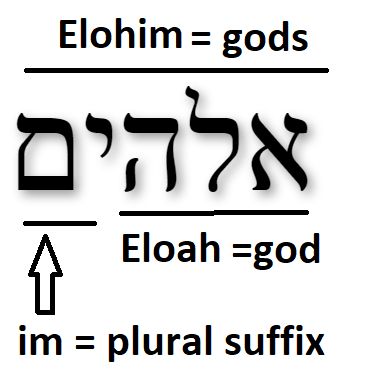
Elohim is a plural noun having the masculine plural ending “im,” but when referring to God, is often used with a singular verb, whereas in other instances, “elohim” is used to refer to other (multiple) gods. Although the Hebrew language could be said to be using ‘Elohim’ as an intensive plural [1](i.e., it could be translated as ‘Great God’), it could be said to hint at the later revelations of the God as Father, Son and Holy Spirit.
- Genesis 1:1, “In the beginning God (Elohim) created the heavens and the earth,”
- Exodus 20:3, “You shall have no other gods (elohim) before Me,”
- Deuteronomy 13:2, “…Let us go after other gods (elohim)…”
Plural Pronouns
[Bible references: Genesis 1:26; 3:22; 11:7; Isaiah 6:8]
Often when God speaks of himself, he clearly uses the plural pronoun:
- Genesis 1:26: Then God (Elohim) said, “Let Us make man in Our image, according to Our likeness.…”
- Genesis 3:22: Then the LORD God (Yahweh Elohim) said, “Behold, the man has become like one of Us…”
- Genesis 11:7: “Come, let Us go down, and there confuse their language…”
- Isaiah 6:8: “Also I heard the voice of the LORD, saying, “Whom shall I send, and who will go for Us?”
The Name Eloah
The use of Elohim with a singular verb is a deliberate act, otherwise the Bible could just have used the singular form of Elohim, Eloah. This singular form could have easily been used consistently. Yet it is only used 250 times, while the plural form is used 2,500 times. The far greater use of the plural form again turns the argument in favor of plurality in the Godhead rather than against it.
The Shema
[Bible references: Genesis 1:5; 2:4; Deuteronomy 6:4; Ezra 2:64; Ezekiel 37:17]
Deuteronomy 6:4, known as the Shema, has always been Israel’s great confession which says “Hear (Shema), O Israel (yisrael): The LORD (Yahweh) our God (Eleheinu) , the LORD (Yahweh) is one (echad)!”
Yahweh is the Hebrew personal name of God. Whenever you see LORD in the Old Testament, it is referring to this name.
Eloheinu is theHebrew way of saying “our Elohim”.
Echad does not mean an absolute “one” but a compound “one.” For instance, in Genesis 1:5, the combination of evening and morning comprise one (echad) day. In Genesis 2:24, a man and a woman come together in marriage and the two “shall become one (echad) flesh.” In Ezra 2:64, we are told that the whole assembly was as one (echad), though of course, it was composed of numerous people. Ezekiel 37:17 provides a rather striking example where two sticks are combined to become one (echad). The use of the word echad in Scripture shows it to be a compound and not an absolute unity. There is a Hebrew word that does mean an absolute unity and that is yachid, which is found in many Scripture passages, the emphasis being on the meaning of “only.” If Moses intended to teach God’s absolute oneness as over against a compound unity, this would have been a far more appropriate word.
God Is One and Three
[Bible references: Genesis 2; 6:3; 16:7; 16:13; 22:11-12; Exodus 23:20-23; Job 33:4; Psalm 51:11; 139:7; Isaiah 11:2]
If the Hebrew Scriptures truly do point to plurality, the question arises, how many personalities in the Godhead exist? It is possible to find three distinct personalities that may be considered divine, although in the Jewish conception of monotheism, the following examples are just different expressions of the presence of God and do not necessarily indicate the different persons of the Trinity.
- First, there are the numerous times when there is a reference Yahweh often translated as “the LORD”. This usage is so frequent that there is no need to devote space to it.
- A second personality is referred to as the Angel of Yahweh. This individual is always considered distinct from all other angels and is unique. In almost every passage where He is found He is referred to as both the Angel of Yahweh and Yahweh Himself. For instance, in Genesis 16:7 He is referred to as the Angel of Yahweh, but then in 16:13 as Yahweh Himself. In Genesis 22:11 He is the Angel of Yahweh, but God Himself in 22:12. Other examples could be given. A very interesting passage is Exodus 23:20-23 where this angel has the power to pardon sin because God’s own name Yahweh is in him, and, therefore, he is to be obeyed without question. This can hardly be said of any ordinary angel. But the very fact that God’s own name is in this angel shows His divine status.
- A third major personality that comes through is the Spirit of God, often referred to as simply the Ruach Ha-kodesh. There are a good number of references to the Spirit of God among which are Genesis 1:2, 6:3; Job 33:4; Psalm 51:11; Psalm 139:7; Isaiah 11:2, etc. The Holy Spirit cannot be a mere emanation because He contains all the characteristics of personality (intellect, emotion and will) and is considered divine.
The Three Personalities in the Same Passage
[Bible references: Isaiah 48:2-16; 63:7-14]
The Hebrew Scriptures have not neglected to put all three personalities of the Godhead together in one passage. It should be noted that the speaker refers to himself as the one who is responsible for the creation of the heavens and the earth. It is clear that he cannot be speaking of anyone other than God.
In Isaiah 48:2-16, the speaker refers to himself using the pronouns of I and me and then distinguishes himself from two other personalities. He distinguishes himself from the Lord Yahweh and then from the Spirit of God. The Tri-unity as clearly defined as the Hebrew Scriptures make it.
In Isaiah 63:7-14, there is a reflection back to the time of the Exodus where all three personalities were present and active. The LORD Yahweh is referred to in verse 7, the Angel of Yahweh in verse 9 and the Spirit of God in verses 10, 11 and 14. While often throughout the Hebrew Scriptures God refers to Himself as being the one solely responsible for Israel’s redemption from Egypt, in this passage three personalities are given credit for it. Yet, no contradiction is seen since all three comprise the unity of the one Godhead.
[1] Josh. “Hebrew plural: Used with an intensive meaning as well?” WordReference.com Language Forums 8 Nov 2010 forum.wordreference.com/threads/hebrew-plural-used-with-an-intensive-meaning-as-well.1971563/
Reflect
In modern English, the word, “you” can be either a singular or plural word. How do we distinguish which meaning it has in a sentence?
Observe
Read Genesis 1:26-27. In Hebrew, the verb comes before the subject of a sentence. In Genesis 1 and elsewhere, the verb for create, bara, is 3rd person singular. The Hebrew word, elohim, is a plural word, it is translated as God because in Genesis 1 it says bara elohim, or “he created God …” And then Gen 1:26-27 says “let us make mankind … male and female he created them.” What does that suggest about the relationship between male and female?

 Dancing In The Kingdom
The problem is their’s only one God and that’s the father! Jesus genesis Matt.1:18 begins in Mary’s womb ! This is my (the father says) only begotten son. Jesus has a God and that in itself negates him being God. He sits at the right hand of his God and Father.
Christians don’t believe Jesus is the son of God and Jews don’t believe that Jesus was his son either ! The opening of the mind is the greatest miracle one can receive, it’s to bad that Christianity ended in 325 AD and original Christianity went under ground for the next 1900 years ! The Trinity is nonsensical as is evolution ! The Bible is clear in Rev.21 that not until sin and judgement are eradicated does God dwell with his creation! Jesus has just spent the last 1100 years as high priest to his and our God and father !
LikeLike